
Most people view the legal aftermath of a loss as an impenetrable maze, but the truth is that a successful probate application process is actually a logical equation: proper preparation plus precise documentation equals an efficient estate resolution. It’s a formula that turns administrative chaos into a manageable path forward. We understand that when you’re facing grief-induced decision fatigue, the last thing you want is the looming shadow of the Supreme Court of NSW and the fear of personal liability if a single form is lodged incorrectly.
You’ve likely already felt the weight of these responsibilities, and it’s perfectly natural to worry about court timelines or the potential for costly requisitions. This guide provides the clarity you need to navigate these complexities with professional precision and empathy. We’ll strip away the archaic jargon and show you exactly how to secure a valid Grant of Probate while protecting the legacy of the person you’ve lost. From understanding the mandatory 14-day notice period to mastering the mandatory Online Registry system, we’ll preview every milestone you need to reach for a smooth and respectful asset distribution.
Key Takeaways
- Recognise why a Grant of Probate is the essential first step in securing the legal authority to manage and protect a loved one’s assets.
- Discover how to navigate the four critical stages of the probate application process, starting with the mandatory NSW Online Registry requirements.
- Learn why the “pragmatic equation” of estate law means that even a single staple mark or paperclip can lead to a frustrating court requisition.
- Identify the common name discrepancies and documentation errors that frequently cause DIY applications to be rejected by the Supreme Court of NSW.
- Find out how to shield yourself from personal liability while ensuring a transparent and efficient distribution of the estate to beneficiaries.
What is Probate and Why is the Application Process Necessary?
Probate is the legal “green light” to distribute a loved one’s estate. In technical terms, a Grant of Probate is the Supreme Court of NSW’s official recognition that a Will is valid and the named Executor has the proper authority to manage the deceased’s affairs. While you can explore a general overview of what is probate to understand its global roots, the NSW context is specific and strictly regulated by state law.
The Executor acts as the estate’s primary facilitator. Your role involves more than just reading a document; it’s a strategic mission to organise assets, pay off creditors, and protect the interests of beneficiaries. Without the court’s seal of approval, your hands are effectively tied. Banks, share registries, and the Land Registry are risk-averse institutions. They require the Grant of Probate to ensure they’re dealing with the legally authorised representative. This protection prevents them, and you, from being held liable for incorrect asset distribution. It’s a pragmatic safeguard for everyone involved.
When is Probate Required in New South Wales?
Determining if you need to start the probate application process usually comes down to the nature and value of the assets involved. If the deceased owned real estate in their own name, the NSW Land Registry will not allow a title transfer without a Grant. For cash and shares, requirements vary by institution. Most Australian banks have a threshold between $20,000 and $50,000. If the account balance sits above this limit, the bank will freeze the funds until they see the court’s paperwork. You’ll also need this grant to recover significant nursing home bonds, which are often the largest single asset in an estate after the family home.
Probate vs. Letters of Administration
The legal pathway you choose depends on whether a valid Will exists. When there is a clear, valid Will naming an Executor, you proceed with the standard probate application process. However, if the deceased died without a Will, the situation is called “intestacy.” In these cases, you must apply for Letters of Administration instead. The Supreme Court of NSW follows strict rules under the Succession Act 2006 to determine who can apply and how the assets are shared. Identifying the correct application type early is vital. Applying for the wrong grant is a common mistake that leads to expensive court requisitions and months of avoidable delays. It’s about getting the foundation right from day one.
The 4 Key Stages of the Probate Application Process in NSW
Unlike other Australian jurisdictions where newspaper notices still linger, the probate application process in NSW is a modern, digital sequence. It requires a methodical approach to satisfy the Supreme Court of NSW that the Will is valid and the assets are correctly identified. This pathway consists of four distinct stages: advertising your intention, gathering an inventory of property, drafting formal court documents, and filing the final application. Missing a detail in any of these stages is the fastest way to trigger a “requisition,” which is a formal request for clarification that can stall your progress for weeks.
Step 1: The Online Advertisement
The first mandatory step is to publish a Notice of Intention to Apply for Probate. This must be done through the NSW Online Registry probate service at least 14 days before you file your application. This waiting period is a statutory requirement to give creditors or anyone wishing to contest the Will a chance to come forward. Precision at this stage is vital. The deceased’s name must match the Will and the Death Certificate exactly. If the Will refers to “Margaret Smith” but the Death Certificate says “Margaret Ann Smith,” you must address this discrepancy in your advertisement to avoid court rejection. Digital notices have replaced the old newspaper format because they are centralised and easily searchable, ensuring transparency for all interested parties.
Step 2: Document Preparation and Filing
Once the 14-day notice period expires, you move to the heavy lifting of documentation. You must compile an “Inventory of Property,” which is a comprehensive list of all assets and liabilities located within NSW. Accuracy here is non-negotiable; if you discover a hidden bank account later, you may need to apply for an “Amended Grant,” which involves more fees and paperwork. You’ll also prepare the Affidavit of Executor, a formal document where you swear or affirm the truth of the application. This is also the stage where you must physically lodge the original Will with the court. Because these documents carry significant legal weight, many families seek professional estate law advice to ensure their filing is airtight. After submission, the court reviews the file. If everything is in order, they issue the Grant; if not, you’ll receive a requisition that requires a formal, written response to correct any errors.
DIY Probate vs. Professional Legal Assistance
Choosing between a DIY approach and professional legal assistance comes down to a simple, pragmatic equation: Time + Risk vs. Professional Cost. While the Supreme Court of NSW allows individuals to manage their own filings, the “hidden costs” of a DIY probate application process often outweigh the initial savings. It’s a calculation that involves more than just a filing fee; it’s about the opportunity cost of your time and the heavy weight of legal responsibility. When an application is lodged by a non-professional, the court’s scrutiny is intense. Even a minor clerical error or a misunderstood procedural rule can trigger a requisition, sending you back to the start and adding weeks of delay to the estate’s resolution.
The Risks of Going It Alone
Personal liability is perhaps the most overlooked risk. As an Executor, you’re legally responsible for the accurate distribution of the estate. If you distribute assets prematurely or fail to settle a debt because you didn’t follow the statutory waiting periods, you can be held personally liable. This means creditors or overlooked beneficiaries could pursue your personal assets to settle the estate’s shortcomings. It’s a high-stakes role that demands absolute precision. For those managing complex family structures that cross international borders, you can discover Israel Cross Border Law Firm for expert guidance on navigating jurisdictional legal challenges.
Engaging a specialist solicitor transforms the process from a source of anxiety into a structured, predictable project. We use tech-integrated document management to ensure every form is airtight and filed through the correct digital channels. This methodology ensures the application is “done right the first time,” bypassing the common errors that lead to court requisitions. We also act as a vital neutral third party. In families where tensions are high, having a professional “steady hand” to manage communications can prevent minor disagreements from escalating into full-blown litigation.
Transparency is the cornerstone of our approach at Aquarius Lawyers. We offer fixed-fee arrangements for uncontested probate, so you know exactly what the legal costs will be before we even begin. This “no-nonsense” perspective removes the fear of bill shock and allows you to focus on your family. By blending traditional legal expertise with modern efficiency, we provide a pathway that protects both the deceased’s legacy and your own peace of mind.
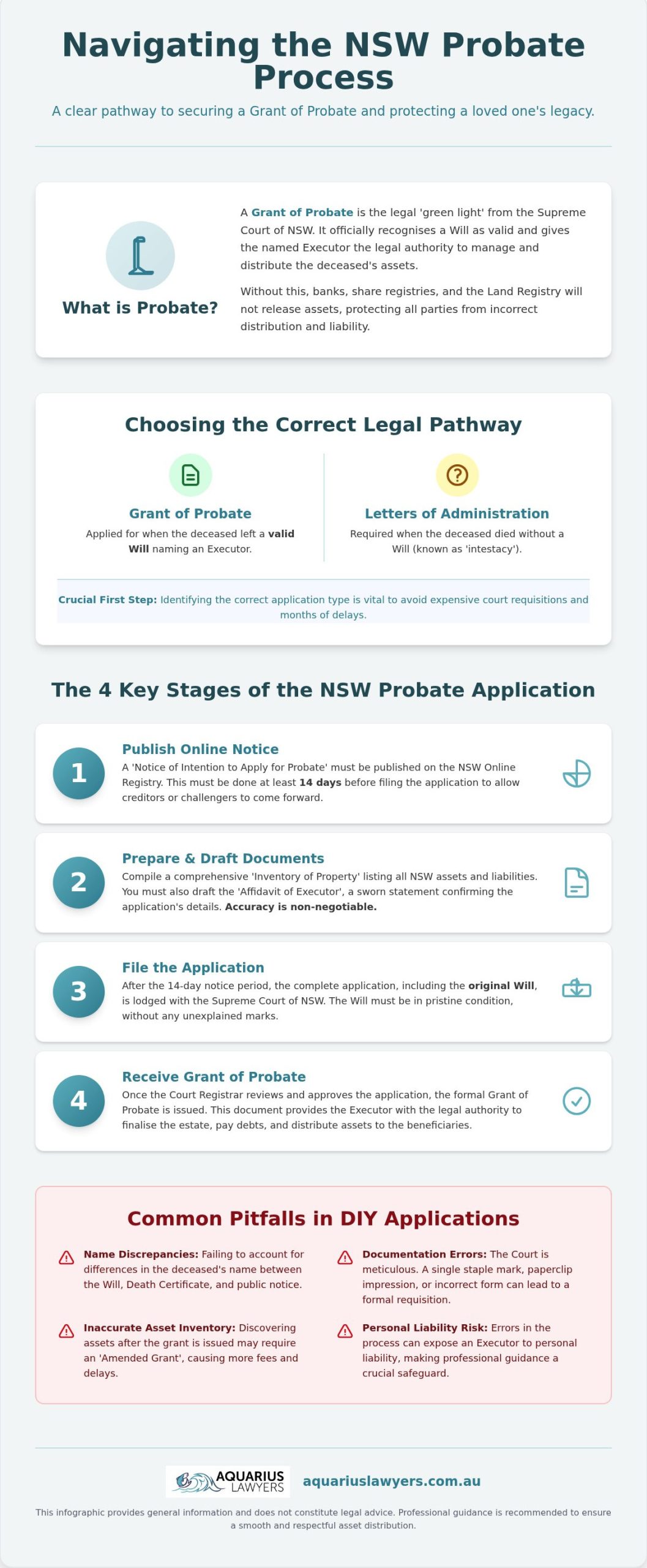
Common Pitfalls in the NSW Probate Application
The Supreme Court of NSW is notoriously pedantic. While the probate application process follows a logical sequence, it’s a path littered with technical traps that can catch even the most diligent Executor. A single slip-up doesn’t just cause a minor headache; it can derail your timeline and lead to personal liability. One of the most frequent issues involves name discrepancies. If the Will refers to “Bob Smith” but the Death Certificate lists him as “Robert John Smith,” the court won’t simply take your word for it. You’ll need to provide an Affidavit of Alias to bridge the gap. Precision isn’t just a preference in estate law; it’s a mandatory requirement.
The physical condition of the Will is another common sticking point. If you’ve removed a staple to make a photocopy or used a paperclip that left a visible mark, the court may issue a “Condition of Will” requisition. To the Registrar, a stray staple hole suggests a missing codicil or an unauthorised amendment. You must also be mindful of the “six-month rule.” In NSW, you’re expected to lodge your application within six months of the date of death. If you miss this window, you’ll have to file a formal explanation for the delay. Filing sooner rather than later also prevents interest from accruing on certain estate debts or legacies, protecting the final pool of assets for beneficiaries.
Dealing with “Requisitions”
A requisition is essentially a formal “please explain” letter from the Court Registrar. It stops the clock on your application immediately. Common clerical errors, such as incorrect filing fees or missing information in the Inventory of Property, are the primary triggers. Every time a requisition is issued, it can add four to twelve weeks to the processing time. This delay is more than just an administrative annoyance; it keeps beneficiaries waiting and increases the risk of estate funds being eroded by ongoing costs. Responding to these requires a formal, written legal document, which often necessitates professional help to resolve correctly.
Managing Family Expectations
Transparency is your best defence against family conflict. Many beneficiaries don’t realise that a straightforward estate can take between 6 and 14 months to finalise. This period is often referred to as the “Executor’s Year,” allowing enough time to identify all debts and meet statutory notice periods. If you don’t communicate these timelines clearly, you may face pressure from eager beneficiaries, which can lead to estate litigation. Providing regular updates on the progress of the court filing helps manage these expectations and proves you’re acting in the estate’s best interests. To ensure your application is airtight and avoid these common traps, it’s wise to consult an estate law expert who can guide you through the technical requirements of the Supreme Court.
How Aquarius Lawyers Organises Your Probate Pathway
Navigating the legal aftermath of a loss requires a blend of deep traditional knowledge and modern administrative speed. At Aquarius Lawyers, we operate as “innovative veterans,” combining decades of legal experience with a forward-thinking methodology that simplifies the probate application process for NSW families. We don’t believe in hiding behind archaic jargon or cold formality. Instead, we offer a down-to-earth, no-nonsense approach that prioritises results over ceremony. This ensures you feel like a partner in the process rather than just another file on a desk.
Our Tech-Driven Process
Efficiency is the cornerstone of our estate administration. We recognise that the Supreme Court of NSW’s shift toward digital filing is an opportunity to reduce the stress on grieving families. By using sophisticated digital tools, we gather estate information and compile the Inventory of Property faster and with greater precision than traditional manual methods. Our secure online portals allow for the seamless signing and verification of documents, which significantly reduces the physical paper trail. This tech-integrated strategy doesn’t just save time; it minimises the risk of clerical errors that often lead to court requisitions, ensuring your application moves through the system with professional precision.
Whether you’re located in the heart of Sydney or in regional NSW, our accessibility remains a top priority. We provide strategic estate law advice across the state, ensuring that distance is never a barrier to high-quality legal support. We speak plain English to ensure you understand every obligation and protection available to you as an Executor. This clarity is designed to move you from a state of confusion to a settled estate with absolute confidence. It is a methodical flow that builds trust by layering expertise with practical, everyday wisdom.
Start Your Application Today
Taking the first step toward resolving an estate shouldn’t be a source of anxiety. We recommend booking an initial consultation to review the Will and assess the complexity of the assets involved. This early assessment allows us to map out a clear, strategic pathway forward. Our commitment to transparency means we offer cost-effective, fixed-fee probate services for uncontested applications, providing you with financial certainty from the outset. You can organise a consultation with our Sydney Wills and Estates team to begin the process of protecting your loved one’s legacy and fulfilling your duties with ease.
Secure Your Family’s Legacy with Confidence
Managing the legal affairs of a loved one is a significant responsibility, but it doesn’t have to be an overwhelming burden. By understanding that the probate application process is a methodical sequence of preparation and precision, you can navigate the Supreme Court of NSW requirements with clarity. We have explored the critical importance of exact documentation and the digital shift toward the Online Registry, both of which are designed to ensure the valid and efficient distribution of assets. Avoiding common pitfalls like name discrepancies or damaged documents is the key to bypassing court delays and protecting yourself from personal liability.
Led by Katherine Hawes, affectionately known as “The Fish Lawyer,” our team at Aquarius Lawyers specialises in NSW Wills and Estates with a focus on tech-driven, cost-effective solutions. We provide the steady, down-to-earth guidance you need during this transition, offering transparent fixed-fee options so you can plan with certainty. You don’t have to face the bureaucracy alone. Contact Aquarius Lawyers to start your Probate Application today and move forward with the peace of mind that your family’s legacy is in expert hands. We are here to help you turn a complex legal requirement into a respectful, resolved outcome.
Frequently Asked Questions
How long does the probate application process take in NSW?
Routine, uncontested applications are generally processed by the Supreme Court of NSW within 2 to 8 weeks after filing. However, the total time to finalise a straightforward estate typically takes 6 to 14 months from the date of death. This timeline includes the mandatory 14-day notice period and the statutory six-month waiting period before assets can be distributed. If the court issues a requisition for further information, expect an additional 4 to 12 weeks of delay.
What documents do I need to start a probate application?
You must have the original Will and any codicils, the official Death Certificate, and a comprehensive list of all assets and liabilities. You’ll also need the Summons for Probate and the Affidavit of Executor. These documents form the core of your submission to the Supreme Court of NSW. Accuracy is vital because any discrepancy between the name on the Will and the Death Certificate must be explained through a separate affidavit to avoid rejection.
Can I apply for probate if there is no Will?
If there is no valid Will, you cannot apply for probate. Instead, you must apply for Letters of Administration. This is a similar probate application process but it follows the rules of intestacy set out in the Succession Act 2006 (NSW). The court usually appoints the next of kin as the administrator to manage the estate. It’s a distinct legal pathway that ensures the deceased’s assets are distributed according to specific statutory formulas.
How much does it cost to apply for probate in Sydney?
The total cost includes a $59 fee for the Notice of Intention to Apply and a Supreme Court filing fee. These filing fees are calculated on a sliding scale based on the gross value of the NSW assets. For example, estates under $100,000 currently have no filing fee, while larger estates can incur fees ranging from roughly $960 to over $7,000. Professional legal fees for uncontested matters are often handled through transparent fixed-fee arrangements.
Do I have to go to court to get a Grant of Probate?
No, you rarely need to physically attend the Supreme Court of NSW. Most uncontested applications are managed through the mandatory Online Registry system or by post. The Registrar reviews your documents in chambers and, if the application is airtight, issues the Grant of Probate electronically. Physical court appearances are typically reserved for complex estate litigation or when the validity of a Will is being seriously contested by a family member or creditor.
What happens if someone challenges the probate application?
If a caveat is lodged against the estate, the probate application process stops immediately. The matter then moves into the realm of contested litigation. This often occurs if a beneficiary disputes the deceased’s testamentary capacity or claims the Will was made under undue influence. In these cases, the court will require evidence from witnesses and medical professionals. We often recommend mediation as a pragmatic way to resolve these disputes and protect the estate’s remaining assets.
Can an executor live outside of Australia?
Yes, an executor can live overseas, but it often complicates the administration of the estate. The Supreme Court of NSW may require an executor living outside Australia to provide security for administration to protect local beneficiaries and creditors. Practically, managing an Australian estate from abroad involves logistical hurdles with document witnessing and asset transfers. Many international executors choose to appoint a local solicitor via a Power of Attorney to handle the administrative tasks on the ground; similarly, for those managing cross-border interests in the United States, Massingill Attorneys & Counselors at Law offers specialised guidance on Texas-based probate and estate planning.
The Inventory of Property is a formal document listing all the deceased’s assets and liabilities located within New South Wales. This includes real estate, bank accounts, shares, and personal items like jewellery or vehicles. You must also disclose any outstanding debts, such as mortgages or funeral expenses. This list is a critical part of your application because it determines the filing fee and defines the scope of your authority to manage and distribute the estate.
Disclaimer
Please note that legal rules change and this is not a substitute nor construed as legal advice. It is general information only.