Could a single oversight in your shipping manifest or a minor breach of NSW DPI regulations derail your entire commercial operation? You already know that the sea is an unforgiving environment, but the legal currents beneath the surface are often just as treacherous. Between onerous compliance requirements and the escalating costs of international shipping disputes, engaging an expert international maritime lawyer australia ensures you have a strategic partner to manage these risks. Staying afloat requires more than just a sturdy vessel; it demands a legal framework that protects your assets and your reputation.
We understand that you need clear, cost-effective legal solutions rather than dense jargon and mounting billable hours. This guide provides a strategic roadmap to mastering Australian and international maritime law, helping you select the right legal counsel in Sydney’s competitive market. We will examine practical pathways for aquaculture compliance and the nuances of expert representation in the Federal Court of Australia, ensuring your business remains both compliant and profitable. By blending traditional experience with modern methodology, you can turn legal obligations into a competitive advantage.
Key Takeaways
- Gain clarity on how Federal laws like the Admiralty Act 1988 intersect with local NSW State regulations to affect your maritime activities.
- Identify the essential criteria for selecting an international maritime lawyer australia who possesses the specific vessel and cargo expertise your operation demands.
- Master the complexities of fisheries and aquaculture law to effectively manage commercial fishing quotas and navigate NSW DPI compliance.
- Explore tactical legal strategies, including vessel arrest and debt recovery, to resolve international shipping disputes and secure your maritime claims.
- Shift from complex legal hurdles to clear pathways by adopting a pragmatic, tech-integrated approach to maritime and commercial law.
Understanding the Australian Maritime Legal Landscape in 2026
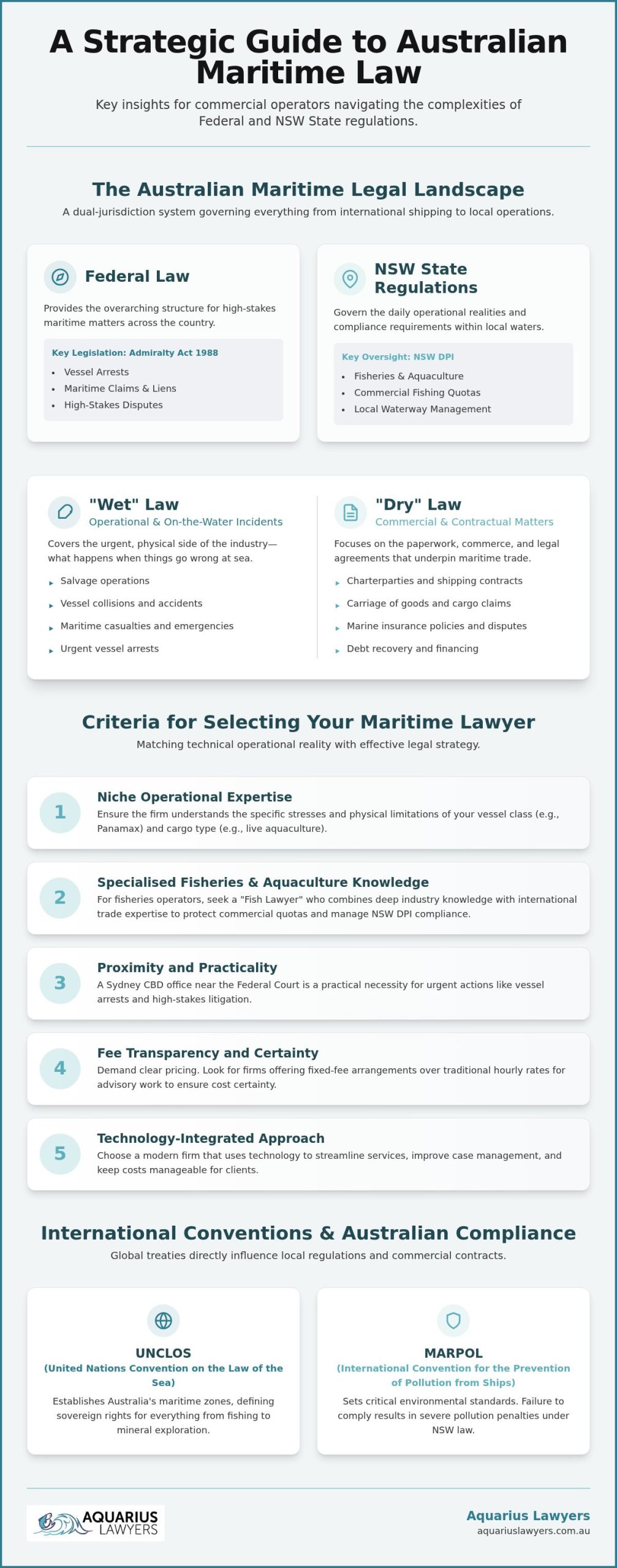
Maritime law is the specialised legal framework governing commerce, navigation, and virtually every activity occurring on the open sea. It’s the foundation of global trade. In Australia, this landscape is defined by a dual-jurisdiction system. While the Federal Admiralty Act 1988 provides the overarching structure for high-stakes matters like vessel arrests, NSW State regulations govern the daily operations within our local waters. Understanding this overlap is the first step toward effective risk management.
Sydney operators move through high-traffic zones like Port Botany and Sydney Harbour. These hubs are vital to our economy, but they are also high-pressure legal environments. An international maritime lawyer australia must understand how to interact with the Australian Maritime Safety Authority (AMSA). AMSA maintains strict vessel safety standards across the country. If your vessel fails an inspection or faces a detention order, the financial fallout happens quickly. You need a legal partner who knows how to resolve these regulatory hurdles before they anchor your profits.
The Distinction Between “Wet” and “Dry” Maritime Law
We categorise maritime legal issues into two distinct areas. “Wet Law” covers the operational and often urgent side of the industry. This includes handling salvage operations, collisions, vessel arrests, and maritime casualties. It’s about what happens on the water when things go wrong, and for those requiring specialised legal support for severe accidents or traumatic brain injuries, you can click here. Conversely, “Dry Law” focuses on the paperwork and commerce. It involves managing charterparties, carriage of goods, and marine insurance. Sydney operators need a firm capable of navigating both operational emergencies and complex contractual issues. You can’t separate the physical vessel from the legal agreements that keep it moving.
International conventions dictate local outcomes. The United Nations Convention on the Law of the Sea (UNCLOS) establishes Australia’s maritime zones, defining where our sovereign rights begin and end. This treaty influences everything from fishing rights to mineral exploration. International conventions directly dictate the liability limits and dispute resolution clauses found in modern Sydney-based shipping contracts. Staying compliant with MARPOL is equally critical for any commercial entity. Failing to meet these international environmental standards results in severe pollution penalties under NSW law. A proactive international maritime lawyer australia helps you build a compliance pathway that respects both global treaties and local enforcement priorities.
Criteria for Selecting an International Maritime Lawyer in Australia
Selecting an international maritime lawyer australia isn’t just about finding a name in a directory. It’s about matching technical operational reality with legal strategy. You need to know if a firm understands the specific stresses of your vessel class or cargo type. A generic commercial firm might understand a contract, but they likely won’t understand the physical limitations of a Panamax vessel or the biological sensitivities of live aquaculture transport. Experience in the specific niche of your operation is the difference between a theoretical win and a practical resolution.
For those in the fisheries sector, general maritime knowledge often falls short. This is where the specialised expertise of “The Fish Lawyer” becomes a force multiplier. It’s a specific legal equation: niche fisheries knowledge plus international trade expertise equals protected commercial quotas. When your livelihood depends on NSW DPI compliance or complex licensing, you need an advisor who speaks the language of the industry as fluently as the language of the law.
Proximity and pricing are equally vital. A Sydney CBD office near the Federal Court isn’t just a prestige point; it’s a practical necessity for urgent vessel arrests or high-stakes litigation. You should also demand fee transparency. The traditional hourly rate model is being challenged by fixed-fee arrangements for advisory work, providing the cost certainty modern businesses demand. Before committing, ask how a firm utilises technology to streamline their services and keep costs manageable.
Evaluating Technical vs. Legal Proficiency
A great lawyer must be a pragmatist first. They should understand maritime technology and how it integrates into modern case management. You aren’t just paying for research; you’re paying for a result. Check for a track record that balances mediation with aggressive Federal Court litigation. If you’re facing a complex dispute, you might want to consult a specialist who values results over ceremony and understands the “no-nonsense” needs of a commercial fleet.
The Value of Local Sydney Knowledge
Sydney’s legal waters have their own unique ripples. Success often depends on your lawyer’s ability to work within the Australian maritime legal framework while managing local relationships. This includes navigating the specific requirements of the Port Authority of New South Wales and understanding local Sydney Harbour berthing and commercial charter regulations. Having access to a local network of marine surveyors and technical experts ensures that your legal strategy is grounded in physical evidence, not just legal theory.
Specialised Expertise: Fisheries, Aquaculture, and Marine Law
Fisheries law operates at a unique intersection where biological science meets administrative regulation. While most maritime firms focus on the steel of a ship or the terms of a charterparty, fisheries law focuses on the living resource. It’s a distinct specialty because it requires a deep understanding of quota management, gear restrictions, and the administrative complexities of the NSW Department of Primary Industries (DPI). Managing commercial fishing quotas or licensing disputes in NSW isn’t just a legal task; it’s a fight for your commercial survival.
Sydney-based investors are increasingly looking toward the sea for sustainable returns, yet the legal barriers to entry are high. Aquaculture compliance involves a maze of environmental standards and marine pollution risks. This is where an international maritime lawyer australia with niche expertise becomes indispensable. At Aquarius Lawyers, we integrate the “The Fish Lawyer” methodology into our broader maritime practice. Engaging an international maritime lawyer australia ensures your global shipping interests align with these local fisheries mandates, providing a strategic pathway for those whose livelihoods depend on the water.
Navigating Fisheries Compliance and Prosecutions
Prosecutions in Sydney and regional NSW waters often trigger from technical breaches that commercial fishers might overlook. Whether it’s a dispute over gear placement or an alleged catch limit violation, the consequences are severe. Strategies for defending commercial fishing licence appeals must be grounded in a “no-nonsense” assessment of the DPI’s evidence. The 2026 regulatory updates introduce more stringent reporting requirements for quota holders, making real-time compliance non-negotiable for commercial operators. If you’re facing a prosecution, you need a defender who understands the water as well as the courtroom.
Legal Support for the Growing Aquaculture Sector
Securing aquaculture licences and development approvals from the NSW DPI requires more than just filling out forms. It demands a sophisticated understanding of environmental compliance and the ability to manage marine pollution risks proactively. Investors need to ensure their fish farms are legally robust from day one to avoid costly detentions or fines later. For those looking to scale their operations, seeking expert aquaculture legal compliance advice ensures your project moves from a proposal to a productive reality without getting caught in regulatory red tape.
Managing Maritime Disputes and Regulatory Compliance
Commercial friction is an inevitable part of global trade. In Sydney, these frictions frequently manifest as cargo claims, charterparty breaches, or unpaid invoices. When a counterparty fails to meet their obligations, you need a pragmatic strategy to recover what you’re owed. Debt recovery for maritime service providers isn’t just about sending letters; it’s about understanding the unique leverage points within the shipping industry. An international maritime lawyer australia uses these points to ensure your business remains liquid and your operations continue without interruption.
Environmental law is another high-stakes area. The Protection of the Sea Acts impose strict liability and heavy fines for marine pollution. Even a minor spill can lead to catastrophic financial and reputational damage. Avoiding these penalties requires more than just good intentions; it requires a robust operational framework. We view legal protection as a proactive shield. By integrating strict compliance with international standards, you transform a potential liability into a manageable operational risk.
Vessel Arrest and Federal Court Proceedings
Vessel arrest is one of the most powerful tactical tools available in Australian law. It allows a claimant to secure a maritime claim by physically detaining a ship within an Australian port. This process is handled through the Federal Court of Australia, which offers a sophisticated and efficient forum for Sydney maritime cases. Engaging an international maritime lawyer australia to manage these proceedings ensures you navigate the Admiralty Rules with precision. If you’re a creditor, arresting a vessel might be your only chance to secure payment from a foreign owner. Conversely, if your vessel is threatened with arrest, you must act immediately to provide security and prevent costly delays. Speed is the essential currency in these proceedings.
Proactive Compliance to Minimise Legal Risk
The most cost-effective dispute is the one that never happens. Developing a maritime compliance checklist tailored to both NSW and international standards is a critical first step. For commercial shipowners, retainer-based corporate legal support ensures you have an “innovative veteran” on standby to review contracts before they become liabilities. The formula is simple: Strategic compliance + regular contract reviews = reduced litigation risk. Regular reviews prevent the ambiguities that fuel commercial litigation. If you want to secure your commercial interests before a dispute arises, contact our Sydney maritime team for a strategic review of your current agreements.
Aquarius Lawyers: Your Strategic Partner in Sydney Maritime Law
Aquarius Lawyers represents a new standard for those seeking an international maritime lawyer australia who prioritises results over ceremony. We blend high-level professional expertise with a “down-to-earth” pragmatism that resonates with commercial operators. This “innovative veteran” persona defines our firm. We possess deep, traditional credentials but remain actively engaged with contemporary legal technology to streamline your case. Principal Katherine Hawes, recognised across the industry as “The Fish Lawyer,” offers a level of niche expertise that generalist firms simply cannot match. Whether you’re managing international shipping lanes or local fisheries quotas, our team provides the intellectual versatility required to protect your commercial interests.
Our physical presence reflects our commitment to the industry. Based at Level 13, 135 King Street, our Sydney CBD office is strategically positioned for international shipping clients and those appearing before the Federal Court. Engaging an international maritime lawyer australia ensures you have a strategic partner located in the heart of Sydney’s legal district, supported by a strong regional NSW presence. We don’t just practice law; we facilitate outcomes that keep the Australian maritime sector moving forward. This includes supporting the high standards of the local yachting sector, where Casa Catering Sydney provides the specialised corporate catering essential for professional harbour operations. We value efficiency and the proactive resolution of issues, ensuring your business stays on course.
A Personalised Approach to Maritime Legal Solutions
We believe that legal protection should be a facilitator of growth, not a drain on resources. Our team prioritises cost-effective outcomes by identifying the most direct pathway to resolution. We move beyond archaic legal jargon, delivering clear, plain-English advice that vessel owners and fleet managers understand. This commitment to clarity helps reduce the stress of complex litigation or regulatory disputes. Our dedication to the Sydney maritime community and the broader Australian blue economy is rooted in a desire to see sustainable, legally robust commercial growth. We provide the steady, common-sense guidance needed to turn legal hurdles into strategic advantages.
Organise a Consultation with Aquarius Lawyers
Taking the first step toward a resolution shouldn’t be daunting. During your initial maritime or fisheries legal strategy session, we focus on establishing a foundation of trust and identifying your specific goals. To ensure the most efficient use of your time, please prepare all relevant documentation in advance. If you’re dealing with a cargo claim, have your bills of lading, manifests, and condition reports ready. For those facing fisheries licence appeals or NSW DPI prosecutions, bring all formal correspondence and logbook records. This preparation allows us to move quickly from analysis to action. Organise a consultation with Aquarius Lawyers today to secure your maritime future.
Charting a Compliant Course for Your Maritime Future
Successfully navigating Sydney’s legal waters requires more than just a passing knowledge of shipping contracts. It demands a sophisticated understanding of how Federal Admiralty law intersects with local NSW DPI regulations. We’ve explored the necessity of technical proficiency and the unique value of niche expertise in fisheries and aquaculture management. By prioritising proactive compliance and clear, plain-English advice, you transform legal obligations into a strategic commercial advantage.
Selecting the right international maritime lawyer australia is a critical decision for any operator moving through Port Botany or Sydney Harbour. Principal Katherine Hawes, known as “The Fish Lawyer,” brings a specialised perspective to marine and aquaculture law that traditional firms often overlook. With our Sydney CBD presence on King Street and regional NSW locations, we provide accessible, authoritative counsel tailored to your specific vessel or quota needs.
Don’t let regulatory complexity anchor your growth. Secure your maritime interests with Aquarius Lawyers and gain the confidence to trade on a global scale. Your business deserves a partner who values results over ceremony and understands the practicalities of the sea. We look forward to helping you navigate a clear pathway to success.
Frequently Asked Questions
What is the difference between maritime law and admiralty law in Australia?
Maritime law is the broad umbrella covering all things sea-related, including commercial contracts and environmental rules. Admiralty law specifically deals with the legal jurisdiction of the courts over ships and shipping activities. In Australia, the Admiralty Act 1988 gives the Federal Court power to hear specific claims, such as vessel arrests. It’s the difference between the industry’s general rules and the court’s specific powers to resolve ship-based disputes.
How much does it cost to hire an international maritime lawyer in Sydney?
Costs vary based on the complexity of your matter and the fee structure used. Many Sydney firms traditionally use hourly rates, but there’s a shift toward fixed-fee arrangements for advisory work to provide cost certainty. You should expect to pay for specialised expertise, particularly in high-stakes litigation or vessel arrests. We recommend requesting a clear costs agreement at the start to understand the financial commitment for your specific case.
Can a maritime lawyer help with fisheries licence appeals in NSW?
Yes, provided they have specific expertise in fisheries law. While many firms focus on general shipping, an international maritime lawyer australia with niche fisheries knowledge is essential for navigating NSW DPI appeals. We handle disputes regarding quota allocations and licence conditions by representing clients before administrative tribunals. Protecting your commercial fishing rights requires a lawyer who understands the biological and regulatory nuances of the local industry.
What should I do if my vessel is involved in a collision in Sydney Harbour?
Your first priority is safety and reporting the incident to the Port Authority of New South Wales and AMSA. You must document the scene, exchange details with the other party, and preserve all electronic data from your bridge systems. Contacting a lawyer immediately is critical to manage liability and prepare for potential litigation. Early legal intervention helps secure evidence before it’s lost and ensures your insurance interests are protected from the outset.
Does Aquarius Lawyers handle international maritime disputes for overseas clients?
We regularly represent overseas shipowners, charterers, and P&I clubs in Australian-based disputes. Our Sydney CBD location allows us to act quickly in the Federal Court of Australia, which is a preferred forum for many international maritime matters. Whether you need to arrest a vessel in an Australian port or defend a cargo claim, we provide the local expertise required to navigate our specific jurisdictional rules while understanding the global nature of your business.
How long do I have to file a maritime claim in the Australian courts?
Time limits vary significantly depending on the type of claim. For instance, cargo claims under the Hague-Visby Rules generally have a one-year limit, while collision claims often have a two-year limit. Missing these deadlines can permanently bar your right to recover losses. It’s vital to consult an international maritime lawyer australia as soon as a dispute arises to ensure your claim is filed within the strict statutory timeframes required by law.
What is a vessel arrest and when is it used in Australia?
A vessel arrest is a legal procedure that physically detains a ship to secure a maritime claim. It’s used when a creditor needs to ensure a foreign-owned vessel doesn’t leave Australian waters before a debt is paid or security is provided. This powerful tool is available for claims involving unpaid bunkers, crew wages, or collision damage. The process is handled through the Federal Court, providing a fast and effective way to gain leverage.
Do I need a specialised lawyer for aquaculture compliance in NSW?
Specialisation is highly recommended because aquaculture involves complex environmental and administrative layers. General commercial lawyers may not understand the specific requirements for NSW DPI development approvals or the nuances of marine pollution compliance. A lawyer with niche expertise in the blue economy provides the strategic foresight needed to avoid costly detentions or fines. We offer pathways for investors to ensure their operations meet all local and international environmental standards from the start.
Disclaimer
Please note that legal rules change and this is not a substitute nor construed as legal advice. It is general information only.