
Your commercial fishing quota isn’t just a permit to work; it’s a high-value asset that requires the same strategic protection as any multimillion-dollar property portfolio. With the introduction of the Fisheries Management Amendment (Enforcement) Bill 2026, the stakes for your business have never been higher. Partnering with a specialised commercial fishing lawyer nsw is no longer just about basic compliance. It’s about safeguarding your future against a system that’s becoming increasingly punitive and complex.
You’ve likely spent years navigating the tides, only to find the regulatory landscape shifting faster than the currents. It’s frustrating when new “fit and proper person” tests and complex statutory fishing rights (SFRs) threaten the business you’ve worked so hard to build. We believe that professional expertise plus proactive strategy equals a protected livelihood. This guide provides the legal roadmap you need to protect your assets and stay compliant. We’ll break down the latest 2026 enforcement changes, explain how to manage seamless quota transfers, and outline the clear pathway to a successful defence against prosecution.
Key Takeaways
- Understand how the 2026 Fisheries Management Amendment Bill increases enforcement powers and what these stricter penalties mean for your business operations.
- Learn to treat your Statutory Fishing Rights (SFRs) as high-value commercial property to ensure your assets are legally secured during sales or transfers.
- Discover how a commercial fishing lawyer nsw can help you navigate the “strict liability” trap to defend your licence against prosecutions and heavy fines.
- Identify why generic commercial contracts often fail in the marine industry and how to use specialised ASBA standard agreements to protect your vessel investments.
- Gain a clear pathway to compliance by integrating modern legal strategy with traditional maritime expertise to safeguard your long-term livelihood.
Navigating the NSW Commercial Fisheries Regulatory Landscape
The Fisheries Management Act 1994 (NSW) is the heavy-duty framework that dictates every move you make on the water. It’s not just a set of guidelines; it’s the legislative engine that manages your access to resources and the value of your business. In NSW, the Department of Primary Industries and Regional Development (DPIRD) oversees state-managed waters. However, once you venture further offshore, the Australian Fisheries Management Authority (AFMA) takes the lead in Commonwealth jurisdiction. Knowing exactly where these lines are drawn is vital. A jurisdictional error can lead to a prosecution before you’ve even realised you crossed a boundary.
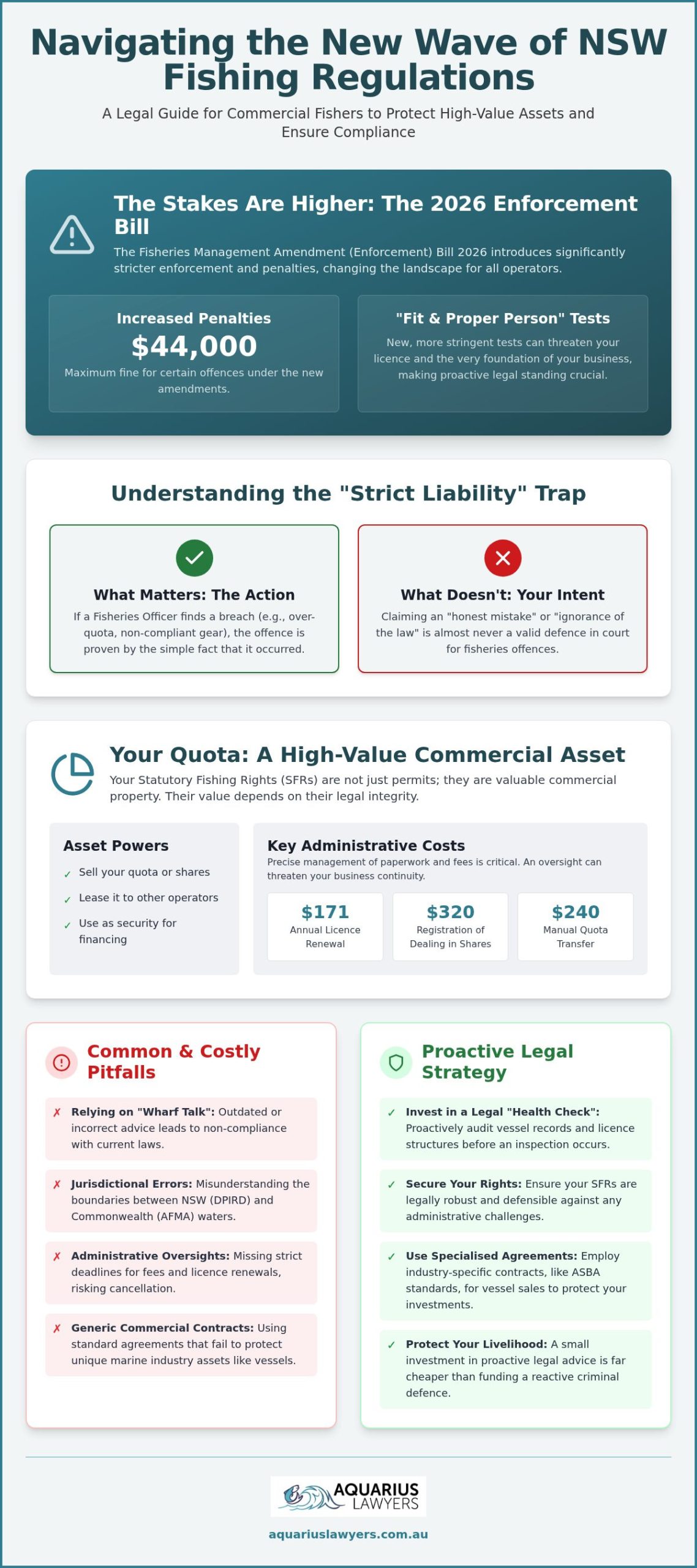
Fisheries law in NSW operates on a principle of strict liability. This means that your intention or “honest mistake” usually won’t save you in court. If a Fisheries Officer finds you over-quota or using non-compliant gear, the offence is often proven by the fact it happened. Ignorance of the law is never a valid defence. With the 2026 enforcement amendments increasing penalties up to $44,000 for certain offences, the margin for error has disappeared. A commercial fishing lawyer nsw provides the strategic oversight needed to interpret these shifting rules before they impact your bottom line.
The Complexity of NSW Fisheries Management
NSW manages its waters through a mix of share-managed and restricted fisheries. Share-managed fisheries offer a higher degree of long-term security, but they come with dense management plans that are notoriously difficult to navigate. While the Commercial Fishing NSW Advisory Council works to represent the industry, the final word always rests with the written law. Many fishers fall into the trap of relying on “wharf talk” or outdated advice. This leads to common pitfalls, such as miscalculating seasonal closures or failing to account for specific zoning restrictions in Marine Parks. Efficiency on the deck is wasted if your paperwork doesn’t match the current regulation.
Compliance as a Business Strategy
Smart operators view compliance as a proactive business strategy rather than a bureaucratic hurdle. It’s a simple equation: proactive legal strategy plus meticulous record-keeping equals a protected livelihood. It is always cheaper to invest in a “legal health check” than to fund a reactive criminal defence. A commercial fishing lawyer nsw can audit your vessel records and licence structures to ensure they’re robust enough to withstand a surprise inspection. This no-nonsense approach identifies weak points in your operation, such as outdated endorsements or misaligned quota holdings, allowing you to fix them on your terms rather than under the pressure of an audit.
Securing and Managing Statutory Fishing Rights (SFRs) and Licences
In the eyes of the law, your fishing shares and Statutory Fishing Rights (SFRs) are more than just permissions to harvest; they are sophisticated forms of commercial property. This classification is vital because it allows you to treat your quota as a tangible business asset. You can lease it, sell it, or use it as security to secure financing for a new vessel or equipment. However, the value of these rights is entirely dependent on their legal integrity. If your documentation is flawed, your asset value evaporates. Engaging a commercial fishing lawyer nsw ensures that your property rights are robust and legally defensible against administrative challenges.
Managing renewals is another area where many operators stumble. An administrative oversight can lead to the cancellation of a licence that took decades to build. The NSW Department of Primary Industries maintains strict schedules for fees and renewals, such as the $171 annual renewal fee for commercial licences. Missing these deadlines isn’t just a headache; it’s a threat to your business continuity. Proactive management of your licensing portfolio is the only way to avoid the administrative trap that can sideline your boat during peak season.
Transferring Quota and Shares
Buying or selling fishing shares requires a higher level of due diligence than most commercial transactions. You must verify that the shares are not subject to any undisclosed liens, debts, or pending legal actions. A water-tight transfer agreement should account for specific costs, such as the $320 fee for the registration of dealing in shares or the $240 manual transfer of quota. Beyond the purchase price, you must consider the tax implications and potential stamp duty. Getting the paperwork right the first time prevents costly disputes down the line. If you’re looking to expand your holdings, seeking a strategic asset review can help you identify risks before you sign a contract.
Licensing Disputes and Appeals
If your licence application is refused or your current licence is suspended, the impact on your cash flow is immediate. The NSW Civil and Administrative Tribunal (NCAT) serves as the primary venue for appealing these decisions. Success at NCAT requires more than just a good story; it requires a precise legal argument that addresses the specific criteria of the “fit and proper person” test. A commercial fishing lawyer nsw can help you navigate this process, aiming to keep you on the water while the dispute is resolved. Protecting your livelihood during a suspension period is about speed and accuracy in your legal response.
Defending Fisheries Prosecutions and Compliance Audits in NSW
The moment a Fisheries Officer steps onto your deck, the clock starts ticking on your legal rights. Common offences like over-quota fishing, using non-compliant gear, or misreporting catch data can trigger a full-scale investigation. Most of these charges fall under the Fisheries Management Act 1994, which carries the “strict liability” trap. This means the prosecution doesn’t have to prove you intended to break the law; they only need to prove the act occurred. However, a conviction isn’t a foregone conclusion. A commercial fishing lawyer nsw knows how to dissect a Brief of Evidence to find procedural errors or technical flaws that can see charges dropped or significantly reduced.
If you receive a caution or an infringement notice, treat it with the same urgency as a court summons. These smaller penalties often serve as the foundation for future licence suspensions or the “fit and proper person” reviews. Strategic defence starts with a no-nonsense evaluation of the facts. We look at whether the equipment used for weighing or measuring was properly calibrated and whether the officers followed correct protocols during the inspection. Challenging the evidence early is often the most cost-effective way to stay on the water.
Step-by-Step: Responding to a Fisheries Prosecution
Facing a prosecution requires a methodical approach to protect your licence and your reputation. Following these steps can change the outcome of your case:
- 1. Seek immediate legal advice: Don’t make formal statements or participate in recorded interviews until you’ve spoken with a specialist. Anything you say can and will be used against you.
- 2. Review the Brief of Evidence: Your lawyer will scrutinise the prosecution’s evidence for technical errors, such as incorrect GPS coordinates or faulty gear measurements.
- 3. Negotiate with the prosecutor: It’s often possible to negotiate “plea representations” to have charges withdrawn or downgraded in exchange for a guilty plea to a lesser offence.
- 4. Court representation: Whether in the Local Court or the Supreme Court, having a commercial fishing lawyer nsw who understands the industry ensures your side of the story is heard with authority.
Managing Vessel and Gear Seizures
When DPIRD seizes your vessel or gear, your ability to earn an income stops instantly. There are legal pathways to apply for the early release of seized property, especially if the seizure is causing undue financial hardship. We also examine the legality of the search and seizure operation itself. If the officers exceeded their authority, the evidence they gathered might be inadmissible. If a seizure is found to be unlawful, you may be entitled to claim compensation for your loss of income during the period your boat was tied up. This proactive approach ensures that a single inspection doesn’t sink your entire business.
Commercial Law for Fishers: Contracts, Vessel Sales, and Partnerships
Generic commercial contracts often sink when they hit the unique realities of the fishing industry. A standard sales agreement might work for a truck, but it won’t account for the intricacies of quota entitlements, maritime liens, or specific gear requirements. In this industry, niche knowledge plus robust contract drafting equals long-term asset security. Whether you’re entering a joint venture for shared quota operations or hiring a new crew, the paperwork must be as tough as the hull of your boat. A commercial fishing lawyer nsw ensures your agreements are built to withstand both legal scrutiny and industry-specific challenges.
For vessel transactions, we recommend using Australian Shipbrokers Association (ASBA) standards. These contracts are designed to handle the specific warranties and conditions unique to maritime assets. We also manage the complexities of employment law, ensuring your crew agreements comply with seafarer rights while protecting your business from unfair dismissal claims or safety disputes. Getting these contracts right from the start prevents the “he-said, she-said” disputes that can tie up your operations in court for months.
Vessel Sales and Maritime Liens
Buying a vessel without a thorough search of the Australian Register of Ships is a gamble you can’t afford to take. Maritime liens can follow a boat regardless of who owns it, meaning you could inherit the previous owner’s debts. We conduct rigorous due diligence to ensure every vessel is free of encumbrances before you sign. If disputes arise over vessel condition or survey reports, we provide the pragmatic mediation or litigation support needed to resolve the issue quickly. This protective step ensures your investment is a source of profit, not a legal liability.
Structuring Your Fishing Business
How you structure your business determines how well your quota is protected. While many start as sole traders, moving to a company or trust structure often offers superior asset protection for high-value fishing shares. This is especially important for succession planning. Passing a fishing business to the next generation isn’t just about handing over the keys; it’s about a seamless legal transfer of property rights and licences. If you’re ready to secure your legacy, contact our commercial team to discuss a tailored business structure that safeguards your family’s future.
Why Aquarius Lawyers is the Strategic Choice for NSW Commercial Fishers
Most law firms are generalists. They might handle a suburban conveyancing job one hour and a retail lease the next. Commercial fishing is far too specialised for that kind of broad-brush approach. You need a commercial fishing lawyer nsw who speaks your language and understands the deck of a trawler as well as the floor of a courtroom. Katherine Hawes, widely known across the industry as “The Fish Lawyer,” brings a rare combination of high-level legal strategy and down-to-earth pragmatism. We don’t just read the regulations; we understand how they impact your daily haul and the long-term value of your quota. Our team provides the clarity and confidence you need when the regulatory tide starts to turn against you.
Whether you’re operating out of Sydney Harbour or working from regional ports, our offices in Sydney and Shellharbour ensure we’re accessible to the people who need us. We value results over ceremony. This is why we offer transparent pricing and fixed-fee options for many commercial transactions. It’s about giving you financial certainty in an industry that’s often unpredictable. Partnering with a specialist means you aren’t paying a lawyer to learn the basics of fisheries law on your time. We hit the ground running with a no-nonsense attitude and a focus on your bottom line.
A Modern Approach to Maritime Law
We combine traditional maritime credentials with a forward-thinking methodology. By integrating modern technology into our practice, we provide cost-effective legal solutions that don’t compromise on quality. Our strategy looks beyond the immediate legal hurdle to focus on the long-term sustainability and profitability of your fishing operation. We believe that a healthy industry requires fishers who are legally secure and commercially robust. It’s a simple formula: expert niche knowledge plus efficient technology equals better outcomes for our clients. We act as a steady guide through the complexities of DPIRD requirements and AFMA jurisdictions.
Get Started with a Fisheries Legal Audit
Don’t wait for a Fisheries Officer to find a gap in your paperwork during a surprise inspection. A proactive fisheries legal audit identifies potential risks in your licences, crew contracts, and quota holdings before they become expensive legal problems. We help you tighten your operations, ensuring you’re fully prepared for the 2026 enforcement changes and the new “fit and proper person” tests. You can book a consultation at our Sydney or Shellharbour offices to get a clear, honest assessment of your legal standing. Protect your fishing future—contact Aquarius Lawyers today to ensure your livelihood remains on a steady course.
Secure Your Legacy on the Water
The landscape of NSW commercial fishing is undergoing its most significant shift in years. Between the 2026 enforcement amendments and the tightening of “fit and proper person” tests, the margin for administrative error has vanished. Protecting your livelihood requires a shift in mindset. You must see your quota not just as a permit, but as a high-value commercial asset that demands professional legal oversight. Expert strategy plus proactive compliance equals a business that can withstand any regulatory storm.
Success in this industry now relies on these logical foundations. Whether you’re transferring shares, drafting vessel sale agreements, or defending a complex prosecution, having a specialist on your side is the only way to navigate these waters with confidence. As a dedicated commercial fishing lawyer nsw, Katherine Hawes and the Aquarius Lawyers team provide the niche expertise needed to keep your business afloat and compliant across Sydney and regional NSW. Our “The Fish Lawyer” advantage ensures you receive practical, no-nonsense advice tailored to the unique demands of the maritime world.
Secure your commercial fishing future—speak to The Fish Lawyer today. Your hard work deserves the best protection, and we’re here to ensure your business is ready for whatever the next season brings.
Frequently Asked Questions
Do I really need a lawyer for a fisheries infringement notice?
You should treat an infringement notice as a serious threat to your long-term licence security. While paying the fine might seem like the easiest path, it creates a permanent record that DPIRD can use during future “fit and proper person” assessments. A commercial fishing lawyer nsw can review the evidence to see if the notice can be challenged or withdrawn. This proactive approach prevents a minor fine from becoming a major barrier to your career later on.
Can the NSW government take away my fishing shares without compensation?
Fishing shares are a form of commercial property, but the government can alter management plans in ways that diminish their practical value. While the Fisheries Management Act 1994 provides some protections, “re-zoning” or “quota adjustments” often occur without direct financial compensation. Navigating these administrative shifts requires a strategic legal response to ensure your property rights are respected and that any “taking” of rights is challenged through the appropriate legal channels.
What is the difference between a state and a Commonwealth fishing licence?
The primary difference lies in the jurisdiction where you operate. State licences, managed by DPIRD, cover waters from the low-water mark out to three nautical miles. Beyond that three-mile limit, you enter Commonwealth waters managed by the Australian Fisheries Management Authority (AFMA). Operating across these boundaries without the correct endorsements is a common source of prosecution. It’s vital to ensure your vessel’s paperwork matches the specific GPS coordinates of your primary fishing grounds.
How do I transfer my statutory fishing rights to another person in NSW?
Transferring statutory fishing rights involves a formal application process through the FishOnline portal or via manual forms submitted to DPIRD. You must pay specific transaction fees, such as $320 for registering a dealing in shares or $240 for a manual quota transfer. We recommend having a commercial fishing lawyer nsw draft a separate, private sale agreement. This document protects you against payment defaults or disputes over the condition of the assets being transferred.
What should I do if fisheries officers board my vessel for an inspection?
You are legally required to assist fisheries officers and provide access to your vessel, gear, and records. Be professional and polite, but avoid making speculative statements about your catch or operations. If the officers begin a formal interview under caution, you have the right to remain silent until you’ve spoken with a lawyer. Take your own photos of the gear or catch being inspected; these can be vital if you need to challenge their evidence later.
Can a fisheries conviction lead to a permanent ban from the industry?
Yes, a serious conviction or a history of repeated offences can lead to the cancellation of your licence. Under the “fit and proper person” test introduced in 2026, the regulator can refuse, suspend, or cancel licences based on criminal history or serious fisheries offences. This isn’t just about fishing laws; convictions for other serious crimes can also trigger a review. Protecting your record is just as important as protecting your boat and your livelihood.
How much does it cost to defend a fisheries prosecution in NSW?
The cost of a defence depends on the complexity of the charges and whether the matter proceeds to a full hearing in the Local or Supreme Court. While we don’t provide fixed prices without reviewing your Brief of Evidence, we focus on transparent pricing and strategic efficiency. Investing in a specialist defence is often significantly cheaper than the long-term cost of losing your quota, facing a $44,000 fine, or having your vessel seized for months.
What are the legal requirements for an aquaculture lease in NSW?
Aquaculture leases in NSW are typically granted for 15-year terms and require a formal application to DPIRD. You must comply with a specific Aquaculture Strategy and maintain a bond to cover potential environmental remediation. These leases are transferable commercial assets, but they come with strict compliance obligations regarding infrastructure maintenance and stock reporting. We help operators manage these lease agreements to ensure their investment remains secure and compliant with current environmental standards.
Disclaimer
Please note that legal rules change and this is not a substitute nor construed as legal advice. It is general information only.