Does the Fair Work Act still protect your crew when your vessel crosses into international waters, or does the law simply vanish at the twelve-mile limit? It’s a question that keeps many Australian shipowners awake at night, especially as maritime employment law becomes increasingly layered with international conventions. With the national minimum wage now sitting at $26.44 per hour and ‘PayDay Super’ legislation in full effect as of July 2026, the margin for administrative error has never been thinner.
You’re likely feeling the weight of these shifting regulations while trying to keep your fleet operational and your staff satisfied. We know that balancing AMSA safety requirements against Fair Work Commission standards often feels like a constant tug-of-war. This guide provides a pragmatic pathway to total compliance and operational confidence. We’ll examine the latest Seagoing Industry Award salary updates, explore the nuances of unfair dismissal protection, and provide a clear framework for drafting Seafarer Employment Agreements that protect your business from costly industrial disputes.
Key Takeaways
- Define the geographical limits where the Fair Work Act 2009 intersects with international conventions to avoid jurisdictional confusion.
- Master the 2026 updates to the Seagoing Industry Award to ensure your maritime employment law compliance is airtight and up to date.
- Learn how to draft robust Seafarer Employment Agreements (SEAs) that go beyond generic templates to include mandatory AMSA clauses.
- Identify the specific employer liabilities under the Navigation Act 2012 to better manage injury claims and workplace safety at sea.
- Discover how a blend of traditional maritime expertise and modern legal strategy can help you avoid costly Fair Work Commission disputes.
Understanding the Jurisdictional Reach of Australian Maritime Employment Law
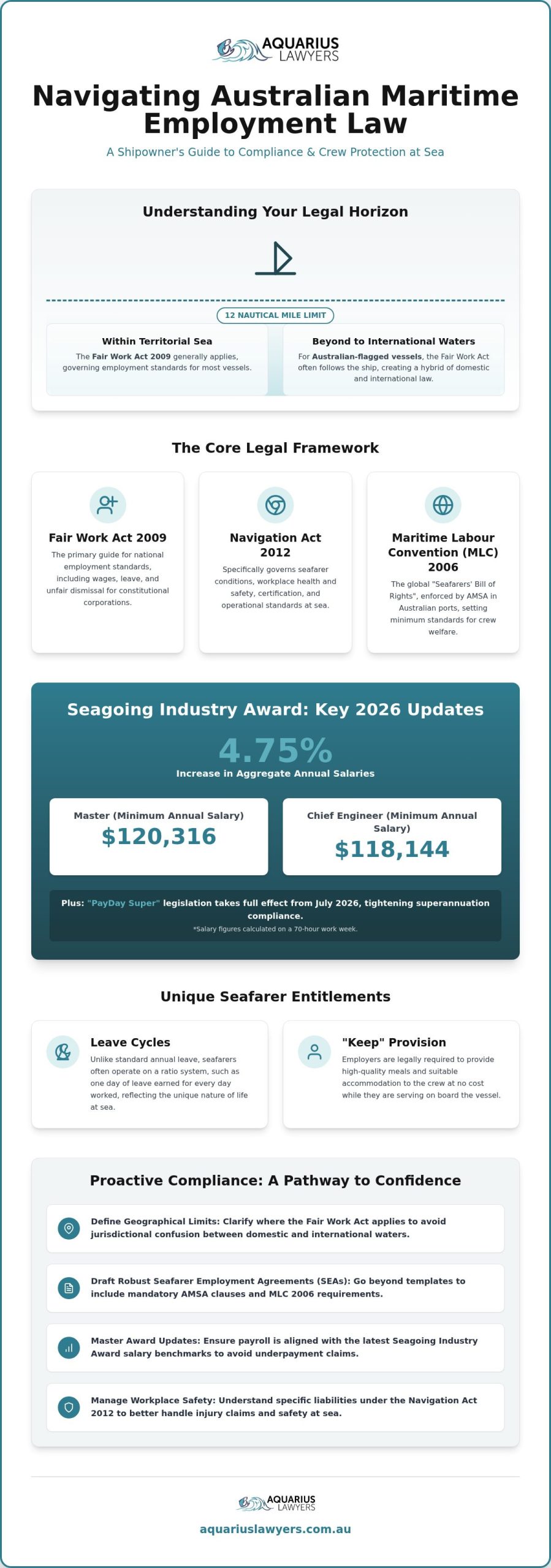
Maritime employment law is the synthesis of industrial relations and admiralty law. It’s the essential framework that keeps our shipping lanes moving and our crews protected. Understanding where one set of rules ends and another begins is the first step toward avoiding costly legal pitfalls. The reach of the Fair Work Act 2009 generally stops at the twelve-nautical-mile limit of Australia’s territorial sea. However, for many Australian-flagged vessels, the legislation follows the ship wherever it sails, creating a legal hybrid where domestic protections meet international standards. Foundational concepts of Maritime law provide the base for these local regulations, ensuring that commerce and crew welfare remain balanced.
The flag of a vessel is more than just a piece of fabric; it dictates which nation’s laws apply on board. If you operate an Australian-registered vessel, you’re bound by Australian workplace standards, including the 2026 minimum wage increases and superannuation requirements. Foreign-flagged vessels operating under a coastal trading licence face a different set of rules. These often require a complex blend of local and international pay scales that can confuse even the most seasoned operators. Getting this distinction right is vital for compliance.
The Fair Work Act vs. The Navigation Act
Vessels shift between state and federal industrial jurisdictions depending on their trade routes and the nature of the employer. If your business is a constitutional corporation, the Fair Work Act is your primary guide for employment standards. The Navigation Act 2012 steps in to handle specific seafarer conditions, safety, and certification. Disputes for onshore staff usually go straight to the Fair Work Commission. For those at sea, the process often involves a mix of maritime-specific arbitration and standard industrial claims. It’s a dual-layered system that requires a steady, common-sense approach to manage effectively.
MLC 2006: The International Seafarers Bill of Rights
The Maritime Labour Convention (MLC) 2006 acts as a global safety net for everyone working on the water. AMSA (the Australian Maritime Safety Authority) rigorously enforces these standards in Australian ports. This means even foreign-flagged vessels must meet minimum requirements for crew welfare, medical care, and food quality while in our waters. For Australian shipowners, these international standards aren’t just suggestions. They’re core components that must be integrated into every Seafarer Employment Agreement to ensure compliance and avoid vessel detention. This proactive alignment with global norms protects your reputation and your bottom line.
Seafarer Rights and the Seagoing Industry Award
Working at sea isn’t your typical desk job. While a land-based maritime worker might finish their shift at the wharf and head home, a seafarer’s workplace is also their home for weeks or months at a time. This physical reality creates a distinct branch of maritime employment law that separates those on the water from those on the shore. Understanding Australian workplace laws for the maritime industry is essential for anyone navigating the Seagoing Industry Award 2020 [MA000122]. This award sets the pace for the industry, ensuring that the unique pressures of life at sea are balanced with fair compensation.
Central to this framework are the 2026 salary updates. As of July 1, 2026, the aggregate annual salaries for those under the Seagoing Industry Award have seen a 4.75% increase. A Master now commands a minimum of $120,316, while a Chief Engineer’s rate sits at $118,144. These figures are calculated based on a 70-hour work week, reflecting the intense nature of the role. If you’re unsure whether your current payroll aligns with these new benchmarks, getting a quick audit from employment law specialists can save you from a Fair Work Commission headache later.
Minimum Entitlements for Australian Crew
The National Employment Standards (NES) provide the baseline, but the maritime industry adds its own specific layers. “Leave Cycles” are a perfect example. Instead of a standard four-week annual leave block, seafarers often operate on a ratio system, such as one day of leave for every day worked. There’s also the mandatory provision of “Keep,” which dictates that employers must provide high-quality meals and accommodation at no cost to the crew. Public holidays also work differently; when a vessel is in transit, entitlements are often rolled into the aggregate salary or compensated with additional time off, depending on the specific agreement in place.
The Role of AMSA in Employment Standards
AMSA does more than just check lifejackets and hull integrity. They have the authority to board vessels and inspect Seafarer Employment Agreements (SEAs) to ensure they meet the Maritime Labour Convention standards. If a crew member’s Certificate of Competency is expired or invalid, it doesn’t just affect safety; it can void their employment status and leave the shipowner liable for massive fines. Beyond technical checks, AMSA and the Fair Work Ombudsman provide pathways for reporting workplace bullying or harassment. In the confined space of a vessel, these protections are vital for maintaining both mental health and operational safety.
Drafting Compliant Seafarer Employment Agreements (SEAs)
For operators in the commercial fishing and aquaculture sectors, the choice between fixed-term and permanent contracts is particularly high-stakes. Seasonal work requires flexibility, but recent Fair Work amendments have placed strict limits on how long a series of fixed-term contracts can last. For those whose operations extend into land-based primary production, you can learn more about Fair Farms and their specialised HR support for the Australian horticulture sector. If you’re managing a fleet for a specific harvest or fishing season, your SEAs must be drafted with precise “outer limit” dates to avoid accidentally granting permanent status to seasonal crew. This balance is where strategic legal drafting becomes a protective shield for your bottom line.
Every SEA must clearly define the “Point of Engagement.” This isn’t just administrative trivia; it dictates your financial responsibility for repatriation if a crew member is left at a distant port. Beyond the basics, your agreements should include:
- Repatriation Rights: Specific triggers and destinations for returning crew home at the employer’s expense.
- Medical Fitness: Clear provisions making a valid AMSA medical certificate a condition of ongoing employment.
- Intellectual Property: Essential for aquaculture, protecting proprietary breeding techniques or “secret” fishing spots and data.
- Confidentiality: Robust clauses to ensure commercial catch data stays within your organisation.
Avoiding Unfair Dismissal Claims
Performance management on a vessel is notoriously difficult. You can’t simply send a deckhand to a quiet HR office for a formal warning when you’re three days out from the nearest port. However, the Fair Work Commission still requires procedural fairness, regardless of your GPS coordinates. To avoid unfair dismissal claims, your SEA must outline clear protocols for termination at sea. If serious misconduct occurs, safety is the priority, but the process of removing a crew member must be documented meticulously. We suggest using digital logbooks to record incidents in real-time, providing a contemporary evidence trail that stands up in court. Clear protocols for immediate removal ensure that a volatile situation doesn’t turn into a legal disaster.
Workplace Health, Safety, and Injury Claims at Sea
Safety on the water is governed by a dual layer of protection that doesn’t stop at the shoreline. For Australian operators, this means balancing the Occupational Health and Safety (Maritime Industry) Act 1993 with the specific safety requirements of the Navigation Act 2012. It’s a high-stakes environment where the “Duty of Care” for shipowners is amplified by the inherent risks of commercial fishing and aquaculture. If a crew member sustains an injury in international waters, maritime employment law ensures that the employer’s liability remains active under the vessel’s flag state obligations. With the OSH(MI) Act currently undergoing a significant reform process as of April 2026, staying ahead of these changes is essential for operational continuity.
The Seacare Authority and Compensation
For seafarers operating on vessels that transit through international waters or for those requiring assistance with complex injury matters in other jurisdictions, Scotland Claims Injury Lawyers provide specialist expertise in handling personal injury claims on a no-win-no-fee basis.
Determining who is covered by the Seacare scheme versus state-based WorkCover is a common point of confusion. The Seafarers Rehabilitation and Compensation Act 1992 governs the federal Seacare scheme, which applies to “prescribed ships” involved in interstate or international trade. If your vessel falls outside this definition, such as many smaller coastal fishing boats, you’ll likely navigate the state-based WorkCover systems instead. This distinction is vital because the benefits, premiums, and reporting obligations vary significantly between jurisdictions.
When a serious accident occurs, your immediate response dictates your legal exposure. You must secure the site, provide medical care, and record every detail in the official logbook. Beyond physical trauma, modern maritime safety must account for psychological injury. The isolation of long-haul voyages can take a toll on mental health. Implementing a proactive welfare strategy isn’t just a “nice to have”; it’s a strategic move to reduce long-term compensation claims and maintain a stable, productive crew.
Drug and Alcohol Testing Policies
Safety and sobriety are non-negotiable on a vessel. Random drug and alcohol testing is a legal tool available to Australian shipowners, but it must be handled with precision. A zero-tolerance policy is only enforceable if it’s explicitly written into the Seafarer Employment Agreement and communicated clearly to all crew members. The Fair Work Commission often looks for procedural fairness even in clear-cut safety breaches.
If a crew member tests positive or refuses a test, it’s considered a fundamental breach of the safety contract. This usually provides grounds for immediate removal from the vessel and termination of employment. To ensure your safety manuals and testing protocols are legally airtight, consult with Aquarius Lawyers for an expert compliance audit of your workplace policies.
Strategy for Success: Why Specialist Maritime Counsel Matters
In the volatile world of commercial shipping and aquaculture, general legal advice often falls short. You need a partner who understands that a crew dispute isn’t just an HR issue; it’s a direct risk to your operational licence and your commercial fishing quota. Aquarius Lawyers operates as an “innovative veteran” in this space. We blend deep, traditional credentials with modern, tech-savvy methodologies to provide clarity in a complex landscape. Our approach to maritime employment law isn’t about rigid formality. It’s about pragmatic, common-sense solutions that keep your fleet moving and your business protected.
Your commercial fishing quota is likely your most valuable asset. Poor staff management or non-compliant contracts can lead to safety breaches that put that quota at risk. By integrating fisheries expertise with a robust employment strategy, we ensure your team is an asset to your compliance record rather than a liability. We offer fixed-fee contract reviews and proactive compliance audits. This gives fleet owners the financial certainty they need to focus on the harvest rather than the paperwork. It’s a strategic equation: expert oversight plus proactive management equals reduced industrial risk.
The “Fish Lawyer” Advantage
Katherine Hawes, widely known as “The Fish Lawyer,” brings a unique perspective to every maritime dispute. Her niche expertise in aquaculture and fisheries compliance means she speaks your language and understands the nuances of the industry. Whether you’re managing a large-scale prawn farm or a boutique commercial fleet, she understands the seasonal pressures and regulatory hurdles you face. We’ve successfully resolved numerous crew disputes before they ever reached the Federal Court, saving our clients significant time and litigation costs. With offices in both Sydney and Shellharbour, we provide accessible, high-level strategic advice to regional NSW fishing businesses from the city to the coast.
Next Steps for Employers and Seafarers
Don’t wait for a Fair Work Commission claim to arrive before checking your paperwork. A proactive “health check” on your current Seafarer Employment Agreements can identify gaps in repatriation clauses or leave cycle calculations before they become active disputes. We’re here to provide a steady, grounded guide through the most complex maritime employment law challenges. If you’re facing an urgent dispute or simply want to shore up your compliance for the 2026 season, reach out to our team. You can Organise a strategy session with Aquarius Lawyers today to secure your business’s future on the water.
Chart a Compliant Course for Your Maritime Business
Managing a vessel or a commercial fleet in 2026 requires more than just nautical skill; it demands a precise understanding of the legal currents that govern our industry. We’ve explored how the intersection of the Fair Work Act and the Navigation Act creates a unique regulatory environment. From ensuring your maritime employment law compliance with the latest Seagoing Industry Award rates to drafting SEAs that actually protect your commercial fishing quota, the path to success is built on proactive strategy. Clear protocols for safety and termination aren’t just administrative hurdles. They’re essential tools for avoiding the Fair Work Commission.
Principal Katherine Hawes, widely known as “The Fish Lawyer,” provides the niche expertise you need to navigate NSW fisheries and aquaculture compliance with confidence. Whether you’re based in Sydney, Shellharbour, or operating across regional Australia, our team offers pragmatic, no-nonsense legal solutions tailored to the marine industry. Don’t leave your compliance to chance while you’re out at sea. Contact the experts in maritime employment law at Aquarius Lawyers to shore up your agreements today. Your operational peace of mind is just a strategy session away.
Frequently Asked Questions
Does the Fair Work Act apply to seafarers on international voyages?
The Fair Work Act 2009 applies to seafarers on international voyages if they’re employed by an Australian constitutional corporation or working on an Australian-flagged vessel. While the geographical limit of the Act is usually twelve nautical miles, the flag state principle extends Australian workplace protections across the globe. This ensures crew members maintain their National Employment Standards entitlements regardless of their vessel’s GPS coordinates. Understanding this jurisdictional reach is a core part of modern maritime employment law.
What is the Seagoing Industry Award 2020 and who does it cover?
The Seagoing Industry Award 2020 [MA000122] covers employees on vessels used for the transport of cargo or passengers and research vessels. As of July 2026, minimum salaries have increased by 4.75 per cent, with a Master’s aggregate annual salary now set at $120,316. This award specifically excludes the commercial fishing and offshore oil and gas industries, which are governed by their own distinct industrial instruments and safety regulations.
Can a seafarer be fired while the ship is still at sea?
You can terminate a seafarer’s employment while at sea, but you must follow strict procedural fairness to avoid unfair dismissal claims. If serious misconduct or a major safety breach occurs, the Master has the authority to remove the individual from duty immediately. However, you must meticulously document the incident in the vessel’s logbook and ensure the dismissed crew member is safely repatriated according to their Seafarer Employment Agreement.
What are the minimum rest hours for crew members under Australian law?
Crew members must receive a minimum of 10 hours of rest in any 24-hour period and 77 hours in any seven-day period. These standards are strictly enforced by AMSA to prevent fatigue-related accidents. The 10 hours of rest can be divided into no more than two periods, one of which must be at least six hours long. Maintaining accurate records of these hours is a mandatory compliance requirement for all Australian vessel operators.
How do I know if my vessel is under State or Federal jurisdiction?
Your vessel falls under federal jurisdiction if the employer is a constitutional corporation or if the ship is engaged in interstate or international trade. Most commercial shipping operations are governed by the federal Fair Work Act and the Navigation Act 2012. Smaller, locally owned fishing operations that don’t cross state lines might still operate under state-based industrial relations systems. Determining your specific jurisdiction is the first step in any compliance audit.
What should be included in an Australian Seafarer Employment Agreement (SEA)?
An Australian Seafarer Employment Agreement must include the employer’s name, the seafarer’s date of birth, and the capacity in which they’ll serve. It’s also mandatory to outline wages, leave entitlements, and clear repatriation rights. Every SEA must be signed by both parties and meet the minimum standards set by the Maritime Labour Convention. Including specific clauses for medical fitness and confidentiality is also recommended for commercial fishing and aquaculture operators.
Are commercial fishers considered employees or independent contractors?
Commercial fishers can be either employees or independent contractors, depending on the nature of their engagement and the level of control the shipowner exerts. If the fisher receives a fixed wage and follows specific shift patterns, they’re likely an employee. However, many in the industry still operate under share arrangements as contractors. Getting this classification wrong can lead to significant back-pay claims for superannuation and leave entitlements.
What happens if a seafarer is injured while working in international waters?
If a seafarer is injured in international waters, the employer’s liability is typically governed by the Seacare scheme or state-based workers’ compensation. For vessels covered by the Seafarers Rehabilitation and Compensation Act 1992, the employer must provide medical care and facilitate rehabilitation regardless of where the accident happened. Proper maritime employment law strategy involves having robust insurance and clear incident reporting protocols to manage these high-risk situations effectively.
Disclaimer
Please note that legal rules change and this is not a substitute nor construed as legal advice. It is general information only.