
If you went into business with your best mate on a handshake, what happens to your hard-earned investment when they suddenly decide to move to the coast or, worse, you find yourselves at a total stalemate over a major decision? It’s a question many Australian founders avoid until the pressure is on. You might wonder why we need a shareholder agreement when the company constitution already exists, but relying on a generic document is like sailing into a storm without a life jacket. This is especially true for sectors like aquaculture, where industry revenue is projected to reach A$2.8 billion by 2026.
We understand that you’ve poured your capital into building something significant. It’s natural to feel anxious about potential fallouts or the uncertainty of a future exit. This article will show you how a tailored shareholder agreement secures your investment, prevents costly disputes, and provides a clear roadmap. We will examine the risks of operating without one, provide a framework for resolving conflicts, and outline a legally sound exit strategy. By combining traditional legal expertise with a pragmatic approach, you can transform potential volatility into long-term stability. Clarity + Legal Strategy = Business Longevity.
Key Takeaways
- Learn why a private shareholder agreement is the essential partner to your public company constitution, acting as the specific “rule book” for your business owners.
- Identify the five core pillars of a secure agreement, including clear protocols for future funding rounds and decision-making on high-value assets.
- Understand why we need a shareholder agreement to prevent costly disputes and provide a certain exit strategy when a partner decides to move on.
- Recognise the specialised requirements for aquaculture and fishing ventures, particularly regarding the ownership and transfer of marine-based licences.
- Explore the Aquarius pathway to drafting your agreement, ensuring all parties are aligned through a methodical consultation and “Heads of Agreement” process.
What is a Shareholder Agreement and why is it vital?
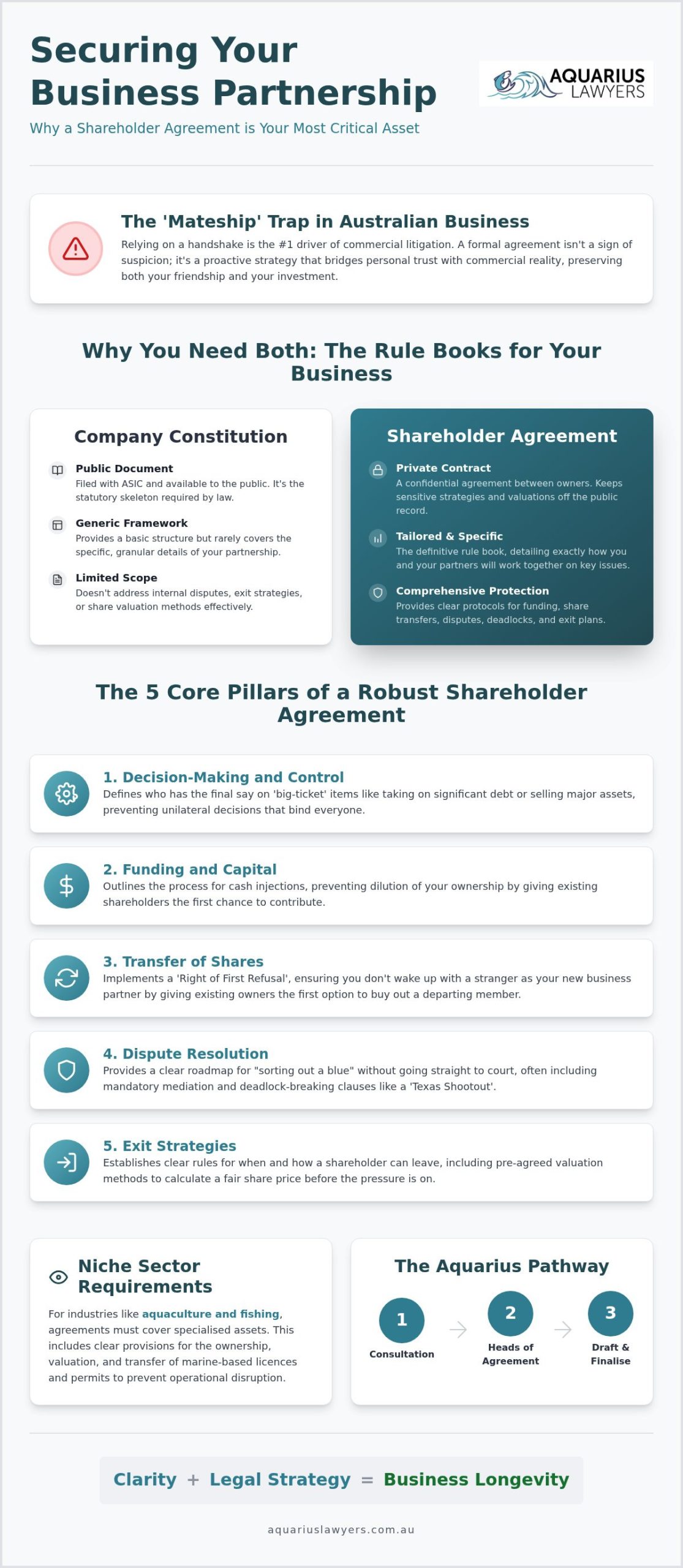
A company constitution acts as the statutory skeleton required by the Corporations Act 2001. While it’s a public document filed with ASIC, it rarely covers the granular detail of how you and your partners actually intend to work together. What is a Shareholder Agreement? It’s a private contract that serves as the definitive rule book for the owners. By keeping this document private, you ensure that sensitive commercial strategies and internal valuation formulas remain off the public record. This confidentiality is a fundamental reason why we need a shareholder agreement to secure the inner workings of an Australian proprietary company and ensure the founders maintain control over their narrative.
The “Mateship” Trap in Australian Business
In our local business culture, we often rely on a handshake or the assumption that everyone is a “good bloke.” This informal approach is the number one driver of commercial litigation in Australia. When expectations remain unstated, they eventually clash as the business evolves or faces external pressure. Formalising your business relationship isn’t a sign of suspicion; it’s a proactive step that removes future grey areas. A well-drafted agreement is the bridge between personal trust and commercial reality. It allows partners to focus on growth rather than second-guessing each other’s intentions. Clarity + Formalisation = Preserved Mateship.
When is the best time to organise an agreement?
Timing is everything. Drafting your agreement during the “honeymoon phase” ensures that terms are decided while everyone is aligned and focused on success. Negotiating during a “crisis phase” is usually a recipe for high legal fees and broken relationships. Beyond conflict resolution, having this document is a prerequisite for growth. Most Australian banks and investors require a formal framework before committing capital. They view it as a sign of professional maturity and risk management. The logic is simple: Strategic Planning + Clear Boundaries = Investor Confidence. This foresight is exactly why we need a shareholder agreement to build a scalable pathway for your business and protect your personal investment from the start.
The 5 Core Pillars of a Robust Shareholder Agreement
A robust agreement isn’t just about legal jargon; it’s about operational efficiency. To understand why we need a shareholder agreement, you must look at the five pillars that support every successful Australian proprietary company. These pillars define shareholder rights and responsibilities, ensuring that the business doesn’t grind to a halt when the founders disagree.
- Decision-Making and Control: This defines who has the final say on “big-ticket” items. This might include taking on significant debt or selling major assets. Without it, you risk a single director making a choice that binds everyone.
- Funding and Capital: If the business needs an injection of cash, this pillar outlines the process. It prevents dilution by allowing existing shareholders the chance to contribute first, ensuring you maintain your percentage of ownership.
- Transfer of Shares: Pre-emptive rights and the “Right of First Refusal” ensure you don’t wake up with a stranger as your new business partner. It gives existing owners the first opportunity to buy out a departing member.
- Dispute Resolution: This provides a roadmap for “sorting out a blue” without heading straight to court. It sets out a clear pathway for mediation and internal resolution.
- Exit Strategies: Clear rules for how and when a shareholder can leave. This includes valuation methods to ensure everyone knows how the share price is calculated before the pressure is on.
Managing Deadlocks and Disagreements
What happens in a 50/50 split when you cannot agree on a pathway forward? A deadlock can paralyse a business. We often use mediation as a first step, but more decisive tools like “Texas Shootout” or “Shotgun” clauses can force a resolution. These mechanisms ensure that one party buys the other out at a fair price, allowing the business to survive even if the partnership doesn’t. A clear process prevents the business from being paralysed by a stalemate.
Protecting Minority and Majority Interests
Balance is essential. Tag-along rights ensure that if a majority shareholder sells their stake, minority owners have the right to join the deal on the same terms. Conversely, drag-along rights prevent a small shareholder from blocking a lucrative buyout that the majority wants to accept. These clauses are vital for “future-proofing” your eventual exit. If you are unsure how these apply to your specific industry, speaking with a specialist in commercial law can help clarify your position. This balance is precisely why we need a shareholder agreement to maintain fairness as the company grows.
Constitution vs. Shareholder Agreement: Why you need both
Every Australian proprietary company needs a constitution to satisfy the Corporations Act 2001. Think of the constitution as the statutory skeleton. It provides the basic framework for things like calling meetings and issuing shares. However, it is almost always a generic document that lacks the “muscle” needed to govern the specific, day-to-day relationship between owners. This is why we need a shareholder agreement; it provides the private, detailed terms that define your unique commercial deal.
In the event of a conflict between these two documents, a well-drafted agreement usually contains a “supremacy clause.” This ensures the private contract between shareholders prevails over the company’s public constitution. Generic constitutions often fail in critical moments, such as the sudden death or permanent incapacity of a partner. Without an agreement, there is no automatic mechanism for a forced share buy-back. You could find yourself in business with a partner’s executor or a family member who has no interest or expertise in your trade. This creates a paralysis that can sink a profitable venture. Clarity + Legal Certainty = Business Continuity.
To ensure these buy-back mechanisms are financially viable, many small businesses consult with Cairns Quality Accounting to establish clear valuation formulas and understand the tax implications of such transitions. Accurate Valuation + Tax Planning = Financial Security.
Privacy and Confidentiality
A major distinction between the two lies in accessibility. Your constitution is a public document filed with ASIC. Anyone can pay a fee to download it and read your basic rules. Conversely, a shareholder agreement is strictly confidential. You certainly don’t want competitors, suppliers, or staff viewing your internal dividend policies, trade secrets, or valuation formulas. By using robust confidentiality clauses within the agreement, you protect the “secret sauce” of your business. This layer of protection is a compelling reason why we need a shareholder agreement to safeguard your sensitive commercial interests.
Customising for Your Specific Industry
Off-the-shelf constitutions are designed for general use. They simply cannot account for the nuances of specialised sectors like aquaculture or commercial fishing. A tailored agreement allows you to link shareholding to specific performance KPIs for working directors. If a director fails to meet their agreed targets, the agreement can trigger a share transfer or a reduction in voting power. If you are looking to secure your business future, consulting a Commercial Lawyer Sydney ensures your document reflects the practical reality of your trade. Specificity + Accountability = Operational Success.
Niche Scenarios: Aquaculture, Fishing, and Regional Businesses
Marine-based businesses operate within a complex web of statutory requirements that a standard off-the-shelf contract cannot address. This is precisely why we need a shareholder agreement that reflects the “Fish Lawyer” perspective. In the aquaculture and commercial fishing sectors, the value of the company often rests in intangible assets like statutory licences, quotas, and leases. If these assets are not managed correctly within your internal documentation, a single shareholder’s exit could trigger a regulatory nightmare or an administrative freeze on your operations.
Compliance is not just about following the law; it is about ensuring your business structure remains resilient under pressure. Your agreement should include specific triggers for regulatory changes. For instance, if a director loses their “fit and proper person” status under fisheries legislation, the agreement must provide an immediate pathway for their removal or share divestment. Proactive Governance + Sector Expertise = Regulatory Resilience. This level of foresight ensures that the business continues to thrive even when individual circumstances change.
Licences and Leases as Business Capital
Specialised equipment and fishing quotas require a unique valuation framework. You cannot value a commercial trawler or an oyster lease using the same formulas you would use for a suburban retail shop. Your agreement must clearly define how these assets are treated when a shareholder exits or when the business seeks new capital. It is vital to ensure that your internal rules align with NSW Fisheries regulations to prevent the accidental forfeiture of valuable permits. When the “rule book” matches the reality of the water, the risk of a total operational shutdown is significantly reduced.
Regional NSW Business Succession
In regional NSW, many primary production businesses are family-run enterprises transitioning from a “Founding Father” to the next generation. These transitions are often fraught with emotional tension. Using a shareholder agreement as a strategic asset allows you to set clear boundaries between family dynamics and commercial obligations. It provides a framework for the next generation to earn their stake through performance-based KPIs rather than just lineage. To ensure your business survives the transition, it is helpful to integrate your agreement with your broader Wills and Estates planning. This holistic approach prevents family disputes from sinking the business. If you are ready to secure your regional legacy, you can contact our commercial law team to start the process. Strategic Planning + Succession Clarity = Generational Wealth.
Organising Your Agreement: The Aquarius Pathway
Moving from the theory of legal protection to the practical reality of a signed document requires a methodical approach. At Aquarius Lawyers, we follow a clear pathway designed to get you from uncertainty to total clarity. It begins with an initial consultation where we identify your specific goals and the unique risks inherent to your industry. We don’t believe in a one-size-fits-all approach. Instead, we start by drafting a “Heads of Agreement” to ensure all partners are aligned on the big issues before we dive into the fine print. This initial alignment is exactly why we need a shareholder agreement that is built on consensus rather than compromise.
Our “No-Nonsense” review process ensures that the legal language matches your practical day-to-day operations. We translate complex statutes into clear, actionable rules. Once executed, your agreement shouldn’t sit in a bottom drawer gathering dust. It needs to grow with your business. Regular reviews ensure that as your company scales or your market conditions change, your protection remains robust. Clarity + Consistency = Long-term Security.
Cost-Effective Legal Support
We prioritise efficiency by using modern technology to streamline the drafting process. This tech-integrated methodology allows us to offer fixed-fee options alongside traditional hourly rates, giving you total transparency over your legal spend from day one. We view a well-drafted contract as a strategic asset rather than a sunk cost. The logic is simple: Small investment now + Strategic drafting = Massive savings in future litigation. By addressing potential “blues” before they happen, you protect your capital and your focus. For those with international commercial interests, consulting with experts like Matthew Fornaro, P.A. can provide additional peace of mind. A generic document can’t handle the pressure of a real dispute, which is why we need a shareholder agreement tailored by a professional who understands your trade.
Book a Strategy Session
While it might be tempting to download a generic online template, doing so often creates more problems than it solves. A template cannot account for the specific nuances of your sector or the delicate nature of family succession in regional NSW. Talking to a “Trusted Advisor” ensures that your agreement is legally sound and practically useful. We act as facilitators, handling sensitive negotiations between partners to keep the peace and ensure everyone feels heard. If you are ready to secure your investment, you can Organise your shareholder agreement strategy session with Aquarius Lawyers today. Professional Guidance + Pragmatic Solutions = Business Confidence.
Securing Your Commercial Legacy
A handshake might start a business, but a robust legal framework is what sustains it through the cycles of growth and change. We have explored how a private contract protects your sensitive commercial data, provides a decisive roadmap for deadlocks, and secures specialised assets like aquaculture leases. This clarity is fundamentally why we need a shareholder agreement to transform potential partner volatility into long-term operational stability. Principal Solicitor Katherine Hawes brings deep, traditional expertise in commercial and marine law to ensure your document is both legally sound and practically relevant to your specific trade.
Our firm specialises in supporting Australian SMEs and primary producers with fixed-fee transparency, ensuring you have confidence in your legal spend from the very first consultation. By blending veteran experience with modern, tech-integrated solutions, we help you manage complex transitions and succession planning with ease. Don’t wait for a stalemate to define your rules. Proactive Planning + Expert Drafting = Business Continuity. Secure your business future; contact our Sydney Commercial Team today. You have built your business with passion; now protect it with the precision it deserves.
Frequently Asked Questions
Is a shareholder agreement legally binding in Australia?
Yes, a shareholder agreement is a legally binding private contract in Australia. It’s enforceable under contract law and operates alongside your company constitution. This document provides a certain pathway for resolving disputes that the Corporations Act 2001 doesn’t cover in detail. By signing, all parties agree to follow specific rules regarding share transfers and management. It’s a critical tool for ensuring everyone remains accountable to the business’s long-term goals.
Can we change a shareholder agreement after it is signed?
Yes, you can amend a shareholder agreement at any time, provided all parties agree to the changes. Most agreements require unanimous written consent to ensure fairness to minority owners. It’s actually a good idea to review the document as your business scales or market conditions shift. Regular updates ensure the rule book still matches your practical reality and current commercial goals. Flexibility + Clear Documentation = Sustainable Growth.
What happens if we do not have a shareholder agreement and a partner dies?
Without an agreement, the deceased partner’s shares usually pass to their estate or beneficiaries under their Will. This often means the surviving partners find themselves in business with a family member who lacks industry expertise. This is a primary reason why we need a shareholder agreement; it can include “buy-sell” provisions that allow surviving owners to purchase the shares at a fair market value. Clarity + Succession Planning = Business Continuity.
How much does it cost to have a shareholder agreement drafted in Sydney?
The cost for drafting an agreement in Sydney varies depending on the complexity of your business structure and the number of shareholders involved. While we don’t provide a single industry-wide figure, Aquarius Lawyers prioritises fixed-fee transparency for our commercial services. This approach ensures you know your legal spend upfront without the anxiety of rising billable hours. Investing in a professional draft now prevents the massive costs associated with future litigation.
Do all shareholders have to sign the agreement?
Yes, all shareholders should sign the agreement to ensure they are bound by its specific, private terms. If a new shareholder joins later, they typically sign a Deed of Accession which brings them into the existing arrangement. While the company constitution applies to everyone automatically, the shareholder agreement only binds those who have actually signed it. Getting everyone on the same page from the start is vital for internal harmony.
Can a shareholder agreement prevent a partner from starting a competing business?
Yes, a well-drafted agreement can include restraint of trade or non-compete clauses to protect the business. These clauses prevent a departing partner from immediately setting up a rival shop or poaching your clients and staff. In Australia, these restraints must be reasonable in terms of time and geography to be enforceable in court. This protection is another reason why we need a shareholder agreement to safeguard your hard-earned market share.
How does a shareholder agreement interact with my Will?
A shareholder agreement generally takes precedence over your Will regarding the disposal of business shares. If your agreement contains a right of first refusal or a mandatory buy-back clause upon death, your executor must follow those rules first. Your Will can only distribute what is left after these contractual obligations are met. Aligning your estate planning with your business documentation ensures your family and partners are both protected.
What is the difference between a partnership agreement and a shareholder agreement?
The main difference lies in the business structure. A partnership agreement is used for unincorporated partnerships where partners often have unlimited personal liability. A shareholder agreement is designed for incorporated companies, where the business is a separate legal entity and owners have limited liability. While both documents manage internal relationships, the shareholder agreement must interact correctly with the company constitution and the Corporations Act 2001.
Disclaimer
Please note that legal rules change and this is not a substitute nor construed as legal advice. It is general information only.