
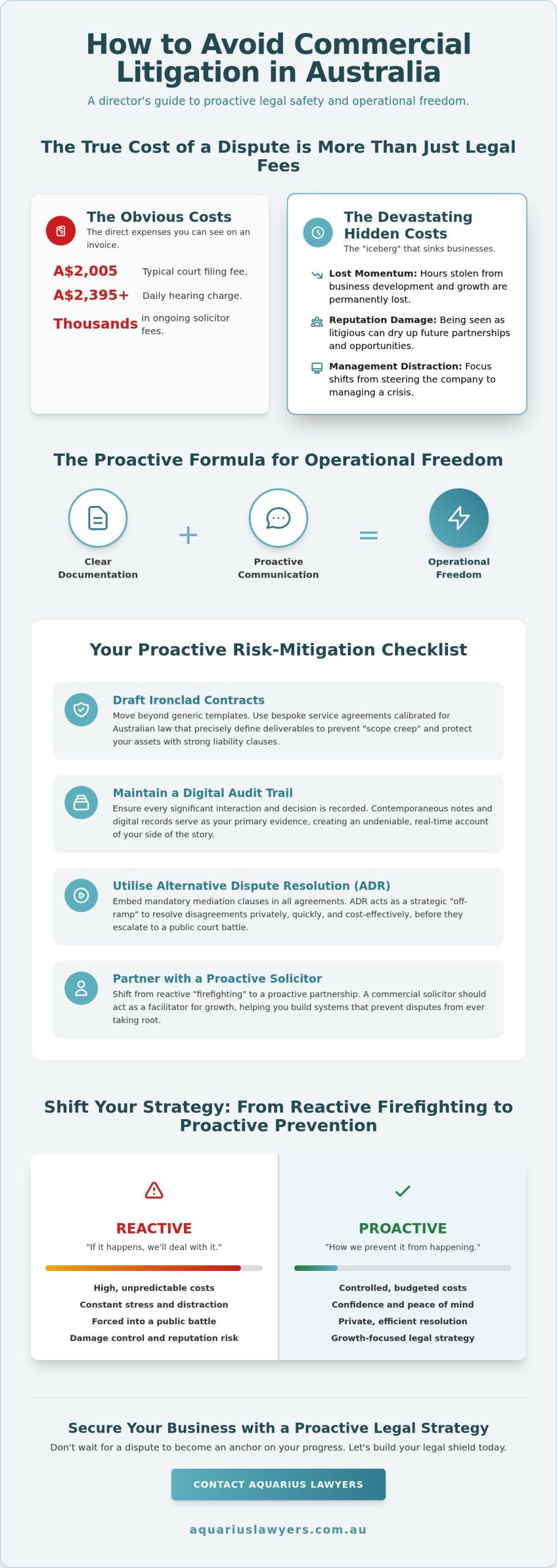
For many Australian directors, the true cost of a legal dispute isn’t just the A$2,005 filing fee or the A$2,395 daily hearing charge; it’s the months of lost momentum and the erosion of a hard-earned reputation. It’s frustrating when economic pressures lead to aggressive contract interpretations or shareholder friction, pulling you away from the work that actually generates revenue. We at Aquarius Lawyers understand that the threat of a court case often feels like an anchor on your progress, especially in a climate where insolvency appointments and class actions are reaching record levels in 2026.
The good news is that legal safety isn’t a matter of luck. It’s a formula: Clear Documentation + Proactive Communication = Operational Freedom. You’re about to discover how to avoid commercial litigation by shifting from a reactive mindset to a strategic, systems-based approach. We’ll provide a practical risk-mitigation checklist and explain how early mediation can resolve conflicts before they become public record, giving you the peace of mind to scale with confidence and stay focused on your core business objectives.
Key Takeaways
- Move beyond generic “off-the-shelf” templates by drafting bespoke service agreements that are specifically designed to withstand an Australian court challenge.
- Establish a rigorous digital audit trail where contemporaneous notes serve as your primary evidence, ensuring your side of the story is documented in real-time.
- Discover how to avoid commercial litigation by utilising Alternative Dispute Resolution (ADR) as a strategic off-ramp to settle disagreements without a judge.
- Shift your legal strategy from reactive “firefighting” to a proactive partnership with a solicitor who acts as a facilitator for your business growth.
- Implement internal operational policies that align with current Australian employment and commercial law to de-escalate conflicts before they gain momentum.
The Real Cost of Commercial Litigation in Australia
When most Australian business owners think about legal disputes, they immediately picture the billable hours. While those invoices are certainly substantial, they represent only the tip of the iceberg. The true financial drain lies in management distraction. Every hour a director spends reviewing evidence or sitting in a deposition is an hour stolen from business development and operational oversight. For a growing company, this loss of momentum can be far more damaging than the legal fees themselves. This is why understanding how to avoid commercial litigation is a fundamental business skill rather than just a legal preference.
We also have to consider the “Fair Go” factor. In the Australian market, your reputation is your currency. Word travels fast in industry circles; being labelled as a “difficult” or overly litigious partner can dry up opportunities before they even reach your desk. The Supreme and Federal Courts of Australia are designed to be final arbiters, but they are public, slow, and inherently adversarial. They are places you want to avoid at all costs. Shifting your mindset from reactive legal spending to proactive risk-layering ensures you aren’t just surviving a crisis; you’re preventing it from ever taking root.
Understanding the Australian Litigation Landscape
In NSW and across the country, common triggers for disputes often stem from ambiguous contract terms or shifting economic conditions. The Australian Consumer Law (ACL) isn’t just for retail customers; it significantly impacts B2B dealings, particularly regarding misleading or deceptive conduct. In the current 2026 economic climate, we’ve seen a sharp rise in debt recovery actions as cash flow tightens across various sectors. Many businesses find themselves dragged into court simply because they didn’t have robust credit control systems in place. Often, a well-structured Alternative Dispute Resolution (ADR) clause in your initial agreement can provide a vital off-ramp before a minor debt turns into a major lawsuit.
The “Innovative Veteran” Perspective on Risk
The days of the “handshake deal” being enough to protect your interests are long gone. In 2026, relying on a verbal agreement is a high-risk gamble that rarely pays off. As an advisor in this space, I’ve seen that the most successful businesses use a synergy of modern technology and traditional legal safeguards. This means using digital audit trails and automated contract management to ensure every obligation is clear and every interaction is recorded. It’s about moving from an “if it happens” mentality to a “how we prevent it” system. When you treat legal protection as an operational habit, you create a shield that allows you to focus on growth without the constant shadow of the courtroom hanging over your head.
Drafting Ironclad Contracts and Service Agreements
A contract is often viewed as a mere formality, but in reality, it is the primary architecture of your business relationships. Many Australian SMEs fall into the trap of using “off-the-shelf” templates found online. These documents frequently fail during an Australian court challenge because they aren’t calibrated to local legislation or specific industry nuances. Precision is protection. When you leave the scope of work vague, you invite the other party to interpret your obligations in whatever way suits their bottom line. Defining your deliverables with surgical precision is the most effective way to prevent “scope creep” from evolving into a high-stakes dispute. Learning how to avoid commercial litigation begins with the document you sign before the first invoice is even raised.
Asset protection relies heavily on the strength of your limitation of liability and indemnity clauses. These aren’t just “fine print” additions; they are the structural supports that keep your business standing if a project goes south. A well-drafted indemnity clause ensures that risk sits with the party best positioned to manage it. If you are unsure if your current agreements are up to standard, seeking a review from a commercial law specialist can prevent a minor oversight from becoming a major liability.
Non-Negotiable Clauses for Every Australian SME
Every commercial agreement should include a mandatory dispute resolution clause. This forces an “off-ramp,” requiring parties to attempt mediation or negotiation before a matter can reach the courtroom. You should also clearly distinguish between termination for convenience and termination for cause. A “convenience” clause allows you to exit a relationship that is no longer viable without needing to prove a breach. Finally, ensure your payment terms include specific late interest rates. This acts as your first line of defence in debt recovery, discouraging clients from using your business as an interest-free credit facility.
Specialised Industry Considerations
Generic contracts are particularly dangerous in niche sectors like maritime and commercial fishing. These industries face unique contractual requirements, ranging from vessel charter complexities to strict Australian fisheries management regulations. In aquaculture, supply chain agreements must account for biological risks and environmental variables that don’t exist in traditional land-based retail. Why niche expertise matters here is simple: a lawyer who doesn’t understand the difference between a quota lease and a vessel mortgage cannot draft a document that truly protects your interests. Using an advisor with deep experience in these specific fields ensures your contracts are built for the reality of your daily operations.
Operational Risk Management: Beyond the Paperwork
A signed contract is a powerful shield, but its effectiveness depends entirely on how your team operates on a Tuesday afternoon. Operational risk management is the bridge between a legal document and your daily workflow. Many disputes arise not from a bad contract, but from poor execution or a lack of documentation during the project lifecycle. If you want to understand how to avoid commercial litigation, you must treat your operational habits as your primary line of defence. This requires moving beyond the paperwork and embedding legal awareness into your company culture through regular “health checks” and staff training.
Your employees are your front line. They are often the first to notice a client’s mounting frustration or a supplier’s missed deadline. Training staff to recognise these “dispute red flags” allows you to intervene early, before a minor friction point escalates into a formal claim. When your team knows how to flag potential issues to management, you gain the opportunity to de-escalate through negotiation rather than being blindsided by a letter of demand. It’s about creating a proactive environment where problems are solved at the source.
The Power of Documentation and “Paper Trails”
In an Australian courtroom, contemporaneous notes are often the most persuasive evidence. These are records made at the time of an event, rather than reconstructed weeks later from memory. Modern project management tools are excellent for this. They allow you to record approvals, variations, and verbal instructions with a clear time stamp. Email etiquette is equally vital. We often see directors inadvertently admitting liability in a well-intentioned apology. You can be professional and empathetic without compromising your legal position. Ensure your records are stored in compliance with Australian statutory requirements, typically for seven years, to ensure you’re protected long after a project concludes.
Due Diligence on Partners and Suppliers
Trust is earned, but in business, it should also be verified. Vetting the financial health of new commercial partners is a non-negotiable step in risk mitigation. While a quick ASIC search provides a baseline, it rarely tells the whole story for high-value partnerships. We recommend the “Fish Lawyer” way of due diligence. This involves verifying specific industry licences, checking regulatory compliance history, and ensuring that a partner’s operational capacity matches their contractual promises. In specialised sectors like maritime or aquaculture, verifying a vessel’s registration or a fishery permit is just as important as checking a credit score. Taking these proactive steps ensures you aren’t tethering your business to a sinking ship. The same rigour applies when entering any major commercial commitment — for instance, applying commercial lease negotiation tips before signing a premises agreement can prevent costly disputes with landlords down the track.
Alternative Dispute Resolution (ADR): The Litigation Off-Ramp
Court is a blunt instrument. It’s designed to declare a winner and a loser, often leaving both parties financially and emotionally drained. Alternative Dispute Resolution (ADR) offers a more nuanced pathway. It is the most effective strategy for how to avoid commercial litigation once a conflict has already surfaced. By choosing ADR, you retain control over the outcome rather than handing your business’s fate to a judge who may not understand the specific pressures of your industry. You avoid the public record and the heavy filing fees, such as the A$2,005 required just to start a corporate application in the Federal Court.
Mediation is the most common form of ADR. It involves a neutral third party facilitating a discussion to find a commercial “middle ground.” Arbitration, while more formal, provides a private alternative to the public court system where an expert makes a binding decision. For many SMEs in New South Wales, the NSW Small Business Commissioner provides an accessible starting point. They offer low-cost mediation that resolves thousands of disputes annually without a single court appearance. If you are facing a stalemate, engaging professional mediation services early can prevent a minor disagreement from spiralling into a multi-year legal battle.
Why Mediation is Often the Smartest Business Move
In business, some bridges are worth saving. Litigation is inherently adversarial and almost always destroys the underlying commercial relationship. Mediation, by contrast, focuses on resolution. It offers a confidentiality advantage that the public court system cannot match; your sensitive business data and trade secrets stay behind closed doors. Perhaps most importantly, it offers speed. A successful mediation can settle a complex matter in days, whereas the Federal Court schedule might see you waiting years for a final hearing. You save on daily hearing fees, which can reach A$2,395 per day for corporations, and keep your team focused on growth.
When to Walk Away vs. When to Fight
Every dispute needs a commercial “litmus test.” Before committing to a legal battle, you must calculate your BATNA, or the Best Alternative to a Negotiated Agreement. If the cost of litigation, including management time and legal fees, outweighs the realistic recovery, walking away is often the most profitable decision. A pragmatic solicitor acts as your steady guide here, helping you strip away the emotion of a “principled stand” to see the cold, hard numbers. Knowing how to avoid commercial litigation often means having the wisdom to settle for a pragmatic “win” today rather than a pyrrhic victory in three years. It’s about protecting your bottom line, not just your ego.
Partnering with a Proactive Commercial Solicitor
Many business owners view their solicitor as a “break glass in case of emergency” contact. This reactive approach is often the most expensive way to manage a company. When you only call a lawyer after a letter of demand arrives, you’ve already lost the advantage of early intervention. A proactive commercial solicitor acts as a business facilitator, identifying friction points before they ignite. By integrating legal strategy into your operational planning, you learn how to avoid commercial litigation through foresight rather than hindsight. Strategy beats luck every time.
This proactive stance is especially critical in specialised sectors. Niche expertise in maritime, fisheries, and aquaculture law isn’t just a bonus; it’s a necessity for risk mitigation. A generalist firm might understand the basics of a contract, but they often lack the deep industry knowledge required to navigate the complex regulatory waters of Australian fisheries or the specific liabilities of commercial vessel operations. Aquarius Lawyers combines decades of traditional experience with modern, tech-driven workflows to provide counsel that is both sophisticated and cost-effective. We focus on building the safeguards that keep you out of the courtroom entirely.
The Aquarius Lawyers Difference
Katherine Hawes, known widely as the “Fish Lawyer,” leads our team with a distinct, down-to-earth pragmatism. We understand that Australian business owners value results over ceremony. Whether you are based in the heart of Sydney or operating in regional NSW, we provide accessible legal support that speaks your language. Our commitment to “plain-English” advice means we strip away the archaic jargon, giving you the clarity needed to make confident decisions. We also believe in transparent fee structures. This allows you to plan your legal budget with the same precision as any other business expense, removing the fear of the unknown.
Next Steps: Securing Your Business Future
Securing your business future requires more than just hope; it requires a system. The first step is often a “no-nonsense” legal consultation to audit your current exposure. We help you move from a defensive position to an offensive one, where your legal structure supports your growth rather than hindering it. Understanding how to avoid commercial litigation is an ongoing process of refinement and vigilance.
- Book a comprehensive contract review to identify and close hidden legal gaps in your existing agreements.
- Organise a risk management workshop to empower your leadership team with the de-escalation skills needed to handle disputes internally.
- Conduct a regulatory audit to ensure your licences and permits are fully compliant with current 2026 standards.
Protect your business today with a proactive legal strategy from Aquarius Lawyers and ensure your focus stays exactly where it belongs: on your growth and success.
Take Control of Your Business Legacy
Litigation is a preventable operational expense, not an inevitable cost of doing business. As we’ve explored, the path to stability involves more than just signing a document; it requires a culture of rigorous documentation and the strategic use of mediation as a primary off-ramp. By shifting your focus from reactive legal spending to proactive risk-layering, you ensure your team stays focused on growth rather than depositions. This systemic approach is how to avoid commercial litigation and protect your hard-earned reputation in the Australian market.
Principal Katherine Hawes is a recognised expert in niche commercial and maritime law, offering over 20 years of experience in providing down-to-earth, pragmatic legal solutions. From specialised fisheries and aquaculture compliance to robust debt recovery systems, we help you build the operational habits that keep you out of the courtroom. Don’t wait for a dispute to surface before you act. The synergy of traditional expertise and modern methodology is your best defence.
Secure your business and avoid the courtroom-contact Aquarius Lawyers for a commercial risk audit. Your business deserves the peace of mind that comes with a steady, common-sense guide at your side.
Frequently Asked Questions
What is the most common cause of commercial litigation in Australia?
Ambiguity in contract terms remains the primary trigger for business disputes in the Australian market. When a “handshake deal” or a generic template fails to define the scope of work with precision, parties often find themselves in conflict over “misleading or deceptive conduct” under the Australian Consumer Law. Establishing clear, bespoke agreements is the most effective way to protect your interests and ensure everyone is on the same page from day one.
Can a verbal agreement be legally enforced in a business dispute?
Yes, verbal agreements are legally binding in Australia, but they are notoriously difficult to prove in court. Without a written record, a judge must rely on the memory and credibility of each party, which turns your business security into a “he-said, she-said” gamble. If you must rely on a verbal instruction, always follow up with a contemporaneous email to create a digital audit trail that serves as your evidentiary shield.
How much does commercial litigation typically cost for a small business?
The financial burden is significant; as of 1 July 2025, filing a corporate application in the Federal Court costs A$2,005. Beyond the initial filing, daily hearing fees for corporations are A$2,395, and these figures don’t include your solicitor’s fees or the cost of management distraction. When you calculate the total investment required for a multi-day trial, it’s clear that investing in proactive risk management is a far more efficient use of your capital.
What is a dispute resolution clause and do I really need one?
A dispute resolution clause is a mandatory “off-ramp” that requires parties to attempt mediation or negotiation before they can commence legal proceedings. You absolutely need one because it prevents a minor disagreement from escalating directly into an expensive court case. It is a vital component for anyone learning how to avoid commercial litigation, as it forces a commercial conversation in a neutral setting while business relationships are still salvageable.
How long do I have to commence legal action for a breach of contract in NSW?
In New South Wales, the Limitation Act 1969 generally provides a six-year window from the date of the breach to start legal action. However, waiting this long is rarely a sound strategy. Evidence can be lost, memories fade, and the financial health of the other party may decline, making any eventual court victory a hollow one. Taking swift, proactive steps to resolve issues as they arise is always the preferred approach.
Is mediation mandatory before going to court in Australia?
While not strictly mandatory for every single commercial case, the Civil Dispute Resolution Act 2011 requires parties to take “genuine steps” to resolve a dispute before filing in Federal Court. Judges increasingly penalise parties who refuse to engage in mediation by awarding costs against them. Embracing mediation early isn’t just about following the rules; it’s a strategic move to settle matters in days rather than the years a court case can take.
How can I recover a debt without going to the Local Court?
Debt recovery is often more successful when handled through Alternative Dispute Resolution or structured statutory demands rather than immediate litigation. A proactive solicitor can facilitate a settlement by highlighting the costs and risks of court to the debtor, often resulting in a repayment plan that preserves your cash flow. This approach is a core part of how to avoid commercial litigation while still ensuring your invoices are paid.
What should I do if I receive a “Letter of Demand”?
Treat a Letter of Demand as an urgent business priority rather than a personal attack. Your first step should be to review the claims against your own contemporaneous notes and documentation to verify the facts. Don’t ignore the letter, as this often triggers the start of formal proceedings; instead, seek a professional legal review to draft a response that de-escalates the situation and proposes a commercial resolution.
Disclaimer
Please note that legal rules change and this is not a substitute nor construed as legal advice. It is general information only.