
Last month, a South Coast fisher discovered that thirty years of experience wasn’t enough to prevent a ‘show cause’ notice over a minor logbook technicality. Whether you are a commercial operator protecting a family legacy or one of the million recreational fishers hitting the water this year, staying on top of fisheries compliance nsw is your only real safeguard against heavy-handed enforcement. The rules are changing fast, and the margin for error has never been thinner.
It’s frustrating when regulations feel like a moving target, especially when your livelihood or peace of mind is on the line. This guide is designed to give you back control by providing a clear strategy to master the Fisheries Management Act 1994 and ensure your operation is always inspection-ready. We will explore current bag and size limits, break down your legal obligations under the latest DPI standards, and provide a professional framework for handling inspections without the stress of costly penalties.
Key Takeaways
- Understand how the Fisheries Management Act 1994 creates the legal framework for all quotas, gear restrictions, and reporting obligations in the state.
- Learn how to master fisheries compliance nsw by treating regulatory adherence as a core business function rather than an administrative burden.
- Discover why “I didn’t know” is not a valid legal defence and how to protect yourself against the high risks of strict liability offences.
- Build a more resilient operation by implementing clear Standard Operating Procedures (SOPs) that keep your crew and gear inspection-ready at all times.
- Identify the critical moments when engaging a specialist in fisheries law can save your commercial licence and protect your multi-generational livelihood.
What is Fisheries Compliance in NSW?
At its core, fisheries compliance nsw is the strict adherence to the Fisheries Management Act 1994 and its associated regulations. It isn’t merely a set of suggestions for a day on the water; it’s a comprehensive legal framework designed to keep our aquatic resources sustainable for the long term. For commercial operators, this compliance acts as your “social licence” to operate. Without it, you risk losing more than just a catch; you risk your entire livelihood. The system is built on a complex web of quotas, gear restrictions, spatial closures, and reporting obligations that can feel overwhelming without a clear strategy. Success in this industry relies on a simple formula: Precision + Documentation = Operational Security.
The Role of the NSW DPI Fisheries Compliance Unit
The NSW Department of Primary Industries (DPI) manages the state’s waters through its dedicated Fisheries Compliance Unit. These officers have broad powers that can feel intrusive if you aren’t prepared. They have the legal authority to board your vessel, inspect your gear, and seize equipment if they suspect a breach of the Act. It’s important to understand that their approach has shifted toward “intelligence-led” policing. This means they use sophisticated data and local reports to target specific regions or sectors where they suspect non-compliance. While many interactions start as educational “advisory” chats, these can quickly escalate into formal enforcement actions if systemic issues or repeat offences are found. Understanding the distinction between a friendly check and a formal investigation is your first line of defence.
Why ‘Near Enough’ Isn’t Good Enough in NSW Waters
Precision is the new standard in Australian waters. The shift toward digital monitoring through platforms like FishOnline means your data is being tracked and analysed in real-time. A simple administrative error in a logbook or a slight delay in reporting a catch can trigger a major investigation. “Near enough” is a dangerous mindset in a regulatory environment where strict liability is the norm. To maintain a compliant operation, you should regularly consult the following resources:
- Fisheries Closures: Check for temporary or permanent bans in your specific fishing zone.
- Spatial Data Portals: Use GPS overlays to ensure you aren’t inadvertently entering marine park sanctuary zones.
- Real-time Reporting: Ensure all FishOnline entries are completed before you hit the wharf.
One technical error can lead to a “show cause” notice that threatens a multi-generational family business. Staying updated isn’t just about following the law; it’s about protecting your assets from the risk of heavy-handed enforcement. By treating compliance as a core business function rather than an afterthought, you ensure your operation remains resilient under scrutiny.
The Legislative Backbone: The Fisheries Management Act 1994
Every hook in the water and every net cast in this state is governed by the Fisheries Management Act 1994. This isn’t just a thick book of rules; it’s the engine room of fisheries compliance nsw. The Act sets out to balance three vital interests: conserving fish stocks, protecting habitats, and promoting quality recreational fishing. To achieve this, the government uses modern Harvest Strategies. These are essentially pre-agreed plans that dictate how much can be taken based on current stock levels. Because marine environments change rapidly, the Act grants the Minister power to issue urgent ‘Fisheries Orders’. These orders can close a fishery or change gear rules overnight, making it vital to stay linked with the NSW DPI Fishing Information portal to avoid unintentional breaches.
Commercial vs. Recreational Compliance Requirements
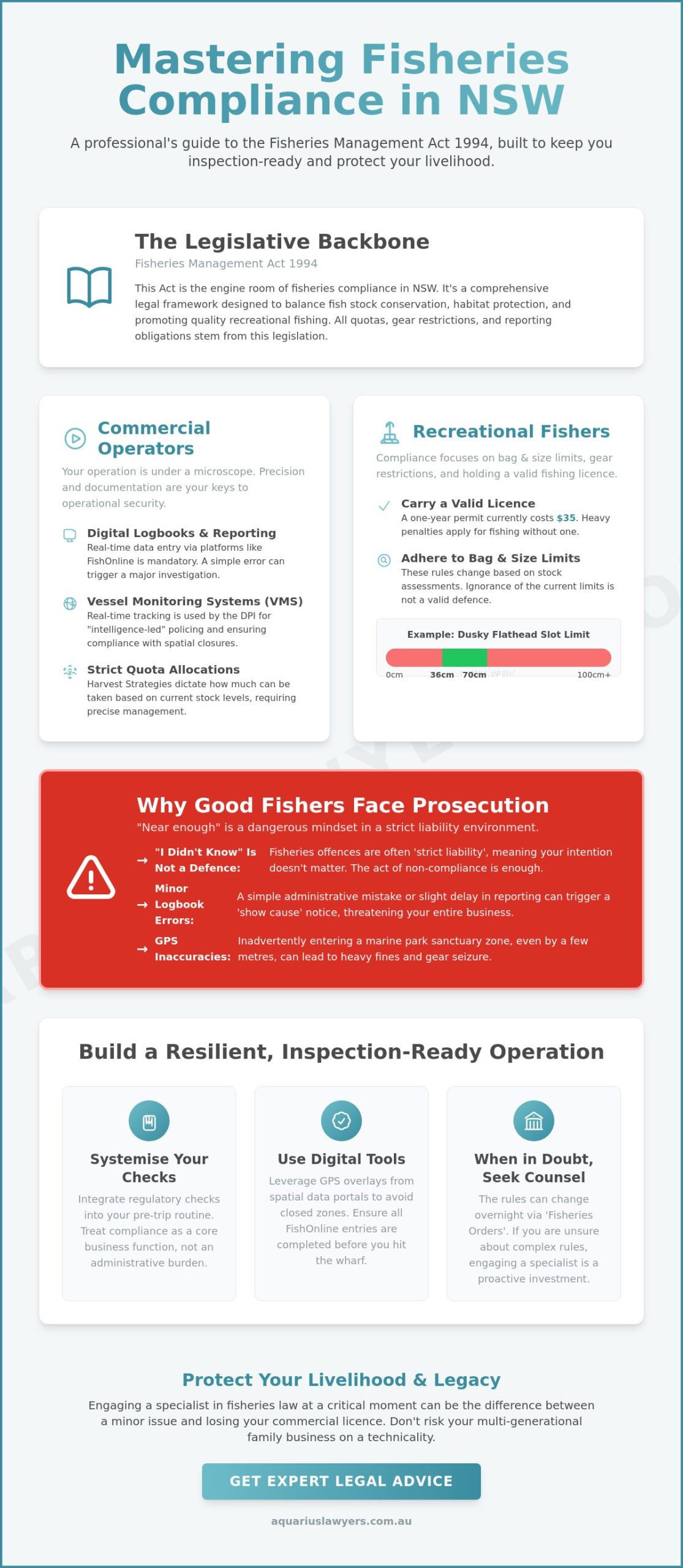
Commercial fishers operate under a microscope. Your world is defined by real-time Vessel Monitoring Systems (VMS), digital logbooks, and strict quota allocations. For recreational fishers, the focus shifts to bag and size limits, such as the 70cm minimum legal length for Mulloway or the 36cm to 70cm slot limit for Dusky Flathead. You must also carry a valid licence, which currently costs $35 for a one-year permit. A unique and often misunderstood area is Aboriginal Cultural Fishing. While the Act aims to protect these traditional practices, the legal landscape remains complex due to the 13-year delay in commencing section 21AA. If you’re unsure how these overlapping rules apply to your specific situation, consulting a specialist in fisheries law can provide the clarity you need to stay on the right side of the law.
Aquaculture and Habitat Protection (Part 7 of the Act)
Compliance isn’t just about what you catch; it’s about where you work. Part 7 of the Act focuses on habitat protection, and it’s where many coastal developers and aquaculture operators trip up. Harming marine vegetation, such as seagrass or mangroves, is a major offence that often leads to significant litigation. Whether you’re dredging a channel, reclaiming land, or obstructing a fish passage, you need a specific permit. This is where fisheries law intersects with broader environmental protection legislation. The DPI doesn’t just look for illegal nets; they look for damaged ecosystems. Maintaining a compliant site requires a proactive understanding of these spatial protections to ensure your project doesn’t run aground on a technicality.
Common Pitfalls: Why Even Good Fishers Face Prosecution
Most fishers assume that as long as they aren’t “black marketing” or intentionally poaching, they’re safe from the courts. This is a dangerous misconception. In the world of fisheries compliance nsw, the vast majority of prosecutions involve honest, hard-working operators who simply made a technical error. The regulator’s focus has shifted from catching “bad guys” to enforcing total precision across the fleet. Whether it’s a slight delay in a FishOnline report or a crew member inadvertently using the wrong gear, the legal consequences remain the same. Ignorance of a specific Fisheries Order is not a valid legal defence. If the rules changed while you were at sea, the law still expects you to be aware of them before you cast your first line.
Liability also extends beyond the person holding the rod or hauling the net. Boat owners often face “vicarious liability” for the actions of their crew. If your deckhand makes a mistake with a bag limit or enters a restricted zone, you could find yourself facing the magistrate alongside them. It is a high-stakes environment where your reputation and your assets are tied to the performance of every person on your vessel. Maintaining a compliant operation requires more than just good intentions; it requires a rigorous system of checks and balances.
Strict Liability and the Burden of Proof
The legal hurdle for the prosecution in fisheries cases is remarkably low. Most offences under the Act are classified as strict liability. Under the Fisheries Management Act 1994, strict liability means that the prosecution only needs to prove the prohibited act occurred, rather than proving the fisher intended to commit an offence. Your state of mind or your “clean” history doesn’t stop the offence from being proven. Today, the NSW Department of Primary Industries relies heavily on digital evidence. High-resolution photographic surveillance and GPS data from Vessel Monitoring Systems (VMS) provide a digital “fingerprint” of your activities that is very difficult to challenge in court without expert legal strategy.
The ‘Show Cause’ Notice: Your First Warning Shot
If the DPI detects a potential breach, they won’t always start with a fine. Often, you’ll receive a “Show Cause” notice. This is a formal letter asking you to explain why the department shouldn’t take further enforcement action against you. Many fishers make the mistake of treating this like an informal chat. They write a long, emotional response that inadvertently admits to the offence. Your written response is a critical piece of legal evidence. It can be used against you in future criminal law proceedings or during a licence suspension hearing. Responding without a clear legal strategy is a massive risk. You need to provide a factual, calculated explanation that protects your interests without handing the prosecution an easy win.
Building a Robust Compliance Strategy for Your Operation
Treating regulatory adherence as a mere administrative burden is the fastest way to attract a DPI audit. High-performing operators realise that robust fisheries compliance nsw is actually a core business function. It is the wall that protects your most valuable asset: your licence. When you shift your perspective from “avoiding fines” to “asset protection,” your entire operational culture changes. The logic is simple: Preparation + Visibility = Reduced Risk. By embedding these protocols into your daily workflow, you transform a potential legal liability into a streamlined, professional asset that can withstand any level of scrutiny.
Investing in staff training and clear Standard Operating Procedures (SOPs) is non-negotiable. Your crew needs to know exactly what is expected of them before the boat leaves the wharf. Utilise technology to automate your reporting and track gear locations with precision. Modern software can flag potential errors in FishOnline entries before they are submitted, providing a vital safety net for your business. Conduct regular internal audits to catch minor discrepancies early. It is far better to identify a reporting error yourself than to have a Fisheries Officer find it during a surprise inspection.
Creating an Internal Compliance Manual
A written manual ensures that your knowledge stays with the business, even if key staff move on. Follow these four steps to build your framework:
- Step 1: Identify every specific regulation, quota requirement, and gear restriction that applies to your particular fishery or aquaculture lease.
- Step 2: Document your daily reporting procedures and implement a “second-set-of-eyes” policy to verify all data against FishOnline entries.
- Step 3: Establish a clear, step-by-step protocol for exactly how your crew should behave when Fisheries Officers board your vessel.
- Step 4: Set a recurring calendar reminder to review and update the manual every quarter to reflect the latest legislative changes or Fisheries Orders.
Managing Inspections and DPI Interactions
When an inspection begins, your primary goal is “professionalism without admission.” You have a legal obligation to assist Fisheries Officers, but you also have the right to document the process. Take your own photos, keep detailed notes of the conversation, and record the names of any witnesses present. If an officer identifies a potential breach, do not attempt to argue the law on the deck. Stay calm and polite. Anything you say during an inspection can be used as evidence later. If you are concerned about your current systems or are facing an upcoming audit, our specialists in fisheries law can help you build a defensible compliance framework that protects your livelihood.
Protecting Your Livelihood: When to Seek Legal Advice
Engaging a specialist in fisheries law should be viewed as a strategic investment rather than a distress signal. While many fishers rely on a generalist local solicitor for everyday matters, the complexities of fisheries compliance nsw require a much deeper level of niche expertise. A generalist might understand court procedures, but they often lack the technical background to challenge DPI evidence or interpret the nuances of a specific Harvest Strategy. Katherine Hawes, known throughout the industry as ‘The Fish Lawyer’, bridges this gap by combining traditional maritime expertise with a sophisticated criminal defence methodology. This specific blend of knowledge ensures that your case is handled with both high-level strategic thinking and relatable, down-to-earth wisdom.
The legal venue for your matter also dictates the strategy required. Minor offences are typically heard in the Local Court, where the focus is often on high-volume sentencing. However, more complex regulatory disputes or habitat protection issues may find their way to the Land and Environment Court. This specialised jurisdiction requires an advocate who understands the intersection of administrative law and environmental science. Having a mentor who knows how to navigate these different systems can be the difference between a manageable fine and a permanent loss of your commercial licence.
The Value of a Legal Audit
The most effective way to handle a DPI inspection is to ensure it never finds a breach in the first place. A proactive legal audit identifies ‘red flags’ in your current operations before they become expensive liabilities. This process involves a meticulous review of your commercial contracts, aquaculture leases, and internal reporting logs to ensure they align with the Fisheries Management Act 1994. We also focus on your business structure. It’s vital to ensure that your personal assets are legally insulated from corporate fines, providing you with the peace of mind that your family’s future is secure even if the business faces regulatory pressure.
Defending a Prosecution: Strategy and Mitigation
If you are facing charges, your immediate goal is to limit the damage. A skilled legal team can often negotiate with the DPI to have charges withdrawn or downgraded by identifying flaws in their evidence or highlighting procedural errors. When a matter does proceed to court, presenting ‘mitigating circumstances’ is a critical part of the process. This involves demonstrating your commitment to compliance and explaining the practical realities of the industry to the magistrate. We also assist with administrative appeals for licence cancellations or quota suspensions, fighting to keep you on the water. Don’t risk your livelihood. Speak with Aquarius Lawyers today.
Securing the Future of Your Operation
Maintaining a robust approach to fisheries compliance nsw is about more than just avoiding a fine; it’s about building a business that can withstand the highest levels of scrutiny. We’ve seen how the strict liability nature of the Fisheries Management Act 1994 leaves no room for technical errors or reporting delays. By treating compliance as a core business function and implementing rigorous internal audits, you transform a potential legal liability into a hallmark of professional excellence.
When the stakes are high and your licence is on the line, you need a partner who understands the unique intersection of marine law and criminal defence. Principal Katherine Hawes, widely known as ‘The Fish Lawyer’, provides the specialised strategic defence that commercial and aquaculture operators need to navigate complex DPI investigations. Whether you’re facing a ‘show cause’ notice or simply want to audit your current systems, expert guidance is your best insurance policy.
Secure your operation with a consultation from ‘The Fish Lawyer’.
Take the proactive steps today to ensure you stay on the water and keep your livelihood secure for generations to come.
Frequently Asked Questions
What are the penalties for a fisheries compliance breach in NSW?
Penalties for a breach of fisheries compliance nsw vary significantly based on the severity of the offence and your prior history. On-the-spot penalty notices can range from a few hundred dollars for minor recreational errors to thousands for commercial breaches. Serious matters escalated to court can result in fines exceeding $22,000 for individuals, the permanent forfeiture of expensive gear or vessels, and even terms of imprisonment for aggravated offences.
Can a Fisheries Officer enter my private property without a warrant?
Fisheries Officers have broad powers under the Fisheries Management Act 1994 to enter lands and board vessels for inspection purposes without a warrant. While they generally require a warrant to enter a private dwelling, they can access your boat, your business premises, or your aquaculture lease at any reasonable time. They are legally entitled to inspect your catch, gear, and records to ensure you are operating within the law.
What should I do if I accidentally catch a protected species?
You must return the protected species to the water immediately with the least possible harm. Even if the fish appears dead or is significantly injured, you cannot legally keep it. Taking or possessing a protected species is a serious offence, so your priority is a swift release. In some commercial sectors, you are also required to record the interaction in your logbook for research and management purposes.
How do I appeal a decision made by the NSW DPI regarding my licence?
You can generally appeal administrative decisions, such as licence suspensions or quota variations, through the NSW Civil and Administrative Tribunal (NCAT). This provides an independent review of the DPI’s decision-making process. It is critical to lodge your appeal within the strict statutory timeframes, which are often as short as 28 days from the date you received the initial notice.
Does a ‘Show Cause’ notice mean I am definitely going to court?
A ‘Show Cause’ notice is an administrative warning shot, not a guaranteed court date. It is your opportunity to provide a written explanation or evidence that might persuade the DPI to issue a formal warning or a minor penalty notice instead of proceeding with a prosecution. How you handle this stage is vital; a poorly drafted response can accidentally provide the prosecution with the evidence they need to take you to court.
Is it mandatory to have a VMS (Vessel Monitoring System) on all commercial boats in NSW?
VMS requirements are not universal but are mandatory for specific commercial fisheries, including the Ocean Trap and Line and Ocean Trawl sectors. These systems provide the DPI with real-time spatial data to ensure vessels aren’t encroaching on closed waters or marine parks. You should verify the specific requirements for your share class, as operating without a functioning VMS where required is a major compliance breach.
Can I be held responsible for my employee’s illegal fishing activities?
Yes, boat owners and masters can be held vicariously liable for the illegal actions of their crew or employees. If a deckhand uses prohibited gear or exceeds a quota while working on your vessel, the law often views this as your responsibility. This is why having documented Standard Operating Procedures and a clear fisheries compliance nsw strategy for your crew is your best legal safeguard.
What is the difference between a penalty notice and a prosecution?
A penalty notice is an on-the-spot fine that, once paid, resolves the matter without a court appearance or a criminal record. A prosecution is a formal legal proceeding where you must appear before a magistrate to answer a charge. Prosecutions are reserved for more serious or repeat offences and carry the risk of much higher fines, criminal convictions, and the potential cancellation of your fishing entitlements.
Disclaimer
Please note that legal rules change and this is not a substitute nor construed as legal advice. It is general information only.