
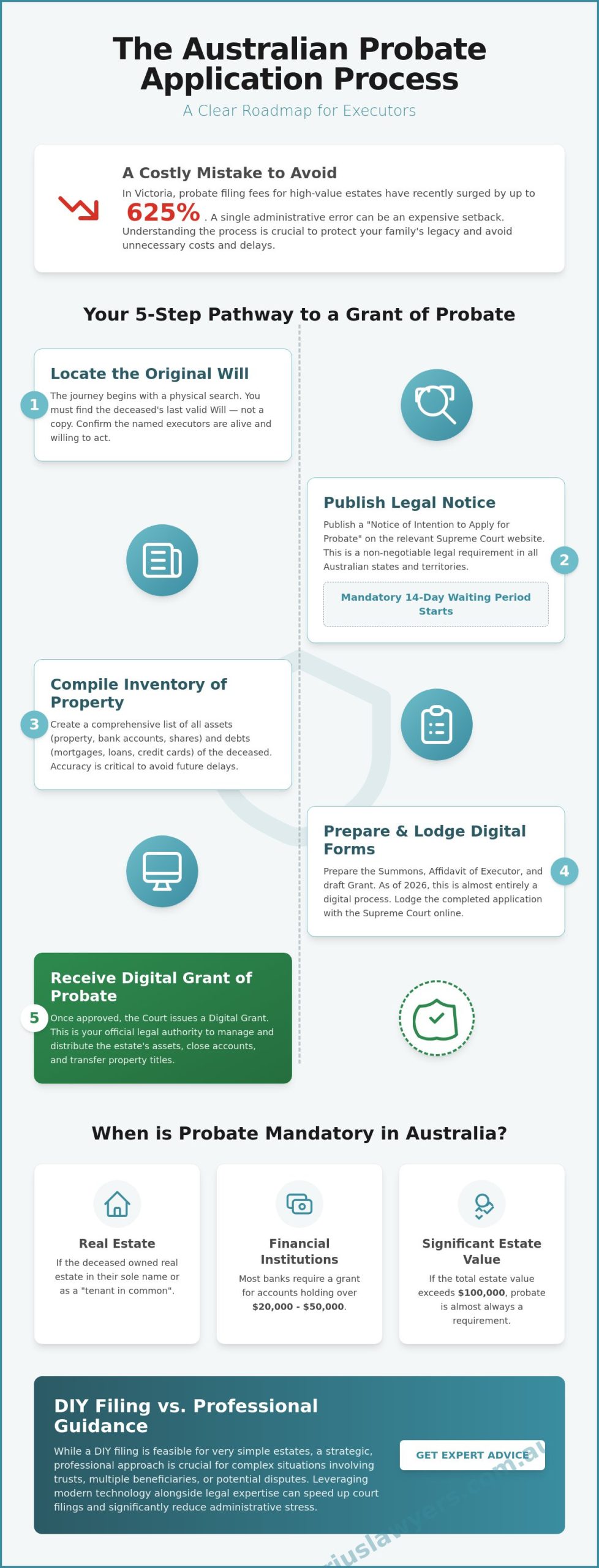
In Victoria, probate filing fees for high-value estates have surged by as much as 625% recently, proving that a single administrative error can now be a very expensive mistake. When you’re grieving, the last thing you need is a legal bottleneck or a rejected filing. Understanding the probate application process isn’t just about ticking boxes; it’s about protecting the legacy your family worked hard to build. We view this as a protective pathway where meticulous digital filing plus strategic estate management equals a successful distribution.
We know that staring down Supreme Court forms and 2026 Federal Budget changes feels overwhelming, especially when you’re trying to distinguish between Probate and Letters of Administration. You want to fulfil your duties as an executor without the constant anxiety of making a costly legal slip-up. This guide provides a common-sense roadmap to help you move from confusion to a clear resolution. We’ll break down the state-by-state fee structures for the 2026 financial year, explain the mandatory 14-day notice periods, and show you how to manage the new digital requirements with total confidence.
Key Takeaways
- Gain a clear understanding of why a Grant of Probate is the vital legal authority needed to manage and distribute a loved one’s assets.
- Follow a logical roadmap for the probate application process, from locating the original Will to publishing mandatory legal notices on the Supreme Court website.
- Identify how to handle common snags like informal Wills or missing executors to ensure the estate distribution stays on track.
- Evaluate whether a DIY filing is feasible for your situation or if a complex estate demands a more strategic, professional approach.
- Learn how leveraging modern technology alongside traditional legal expertise can speed up court filings and reduce administrative stress for Australian families.
Understanding Probate: Why This Legal Step is Essential
A Grant of Probate is the Supreme Court’s official recognition that a Will is valid and legally binding. It’s the moment the law acknowledges you as the person in charge. Without this document, an executor is essentially a leader without a mandate. You might have the original Will in your hand, but until the Court verifies it, you lack the legal standing to manage significant assets. The probate application process serves as the vital bridge between a person’s passing and the rightful distribution of their hard-earned legacy.
This process matters because it provides a clear, indisputable chain of authority. Banks, share registries, and the Land Titles Office aren’t just being difficult when they ask for a grant; they’re protecting themselves from fraud. By obtaining probate, you gain the power to close bank accounts, sell shares, and transfer property. Beyond mere logistics, there’s a heavy “protection factor” involved. Understanding Probate means recognising it as a legal shield. Once the Court issues the grant, it protects the executor from future claims by creditors or beneficiaries, provided the estate is administered according to the law.
When is Probate Mandatory in Australia?
While requirements vary by state, probate is generally mandatory if the deceased owned real estate in their sole name or as a “tenant in common.” You cannot sell or transfer the family home without it. Financial institutions also set their own thresholds. In 2026, most Australian banks require a formal grant for accounts holding between $20,000 and $50,000. If the total estate value exceeds $100,000, you should expect the probate application process to be a non-negotiable requirement of the Supreme Court in your specific state or territory.
The Consequences of Skipping the Process
Attempting to bypass the formal system is a high-risk strategy that often backfires. If you distribute assets without a grant and a previously unknown debt surfaces, you could be held personally liable to repay that creditor from your own funds. It’s a stressful situation that’s easily avoided. Additionally, skipping probate usually results in a total deadlock with superannuation funds and life insurance providers. These entities hold significant death benefits and will rarely release six-figure sums without the certainty that a Supreme Court grant provides.
If the deceased left a valid Will, you’ll seek Probate. If they died “intestate” (without a Will), you’ll likely need Letters of Administration instead. While the paperwork differs, the goal remains the same: obtaining the Court’s blessing to move forward. Probate is the key that unlocks the legal transfer of a legacy.
The Probate Application Process: A Step-by-Step Roadmap
The probate application process is a methodical sequence that requires both precision and patience. It begins with a physical search. You must locate the original Will, not a photocopy, and confirm that the executors named in the document are both alive and willing to take on the legal responsibility. If the named executor has passed away or is unable to act, the pathway shifts toward a different type of grant. Once the original document is secured, you move into the public phase of administration.
Step 2 involves publishing a Notice of Intention to Apply. This is a non-negotiable legal requirement across all Australian jurisdictions. You must wait exactly 14 days after the notice is published before you can lodge your formal application with the Court. During this mandatory waiting period, you’ll tackle Step 3: the Inventory of Property. This is a comprehensive list of every asset and debt the deceased held at the time of their passing. Accuracy here is paramount; missed assets will require a fresh application later, causing significant delays.
Step 4 is the technical core of the journey. You’ll prepare the Summons, the Affidavit of Executor, and the draft Grant. In 2026, this is almost entirely a digital endeavour. Finally, Step 5 is the resolution: receiving the Digital Grant of Probate. This electronic document is your “golden ticket” to close bank accounts and transfer titles. If the paperwork feels daunting, seeking professional Wills and Estates advice can ensure your application is “requisition-proof” from the start.
Advertising Your Intention to Apply
The 14-day waiting period exists to give creditors, beneficiaries, or anyone with a competing Will a fair go to come forward. For those in New South Wales, this notice must be published on the NSW Online Registry. You can find detailed guidance on these specific requirements through the Supreme Court of NSW probate information portal. Failing to wait the full 14 days or using the wrong jurisdiction’s portal is a common error that leads to an immediate rejection. It’s a simple rule, but it’s strictly enforced by Court registrars.
Filing Your Documents Online
By May 2026, digital filing has become the standard across Australia. Whether you are using RedCrest in Victoria or the ORW system in other states, the portals demand high-quality scans and precise data entry. Your Affidavit of Executor must be witnessed correctly by a Justice of the Peace or a solicitor. This isn’t just a formality; it’s a sworn statement of truth that carries significant legal weight. Many families encounter ‘requisitions’, which are formal requests from the Court to fix errors. These usually stem from minor typos or incorrect witnessing. Meticulous filing today equals a faster distribution tomorrow.
Navigating Complexities: When the Standard Process Hits a Snag
Even with a clear roadmap, the probate application process can become complicated when the paperwork isn’t perfect. Life is messy; legal documents often reflect that. You might discover the “Will” is actually a handwritten note or a digital file tucked away on a laptop. These are known as informal Wills. They don’t automatically fail, but they do require a more sophisticated legal strategy to prove the deceased’s intentions to the Court. Dealing with these snags requires a blend of traditional legal knowledge and a modern, common-sense approach to evidence.
Other complexities arise when the named executor is missing, deceased, or simply unwilling to act. In these cases, the pathway shifts. You may need to apply for “Administration with the Will Annexed,” which essentially asks the Court to appoint a suitable administrator to carry out the Will’s instructions. If a family member threatens to challenge the Will, the situation moves from administrative to protective. This is where strategic estate management becomes vital. Resolving these disputes early through mediation often saves the estate from being depleted by lengthy litigation costs.
The Challenge of Informal Wills
When a document doesn’t meet the strict formal requirements of the Succession Act, the Court must be satisfied that the person intended it to be their Will. This involves gathering extrinsic evidence, such as witness statements, text messages, or diary entries, to demonstrate “testamentary intention.” It’s a strategic exercise in building a robust case. We focus on presenting a clear narrative to the Court to ensure the deceased person’s true wishes are honoured, even if they weren’t captured in a standard legal document. These cases are never “template” jobs; they require a bespoke strategy to avoid a flat rejection.
Managing International or Interstate Assets
If the deceased owned a family home in Sydney but also held a holiday unit in Queensland or shares in a foreign company, a single grant might not be enough. You’ll likely need a “Reseal” of the original grant in the second jurisdiction. This streamlined process allows the second Court to recognise the authority already granted, saving you from restarting the probate application process from scratch. It’s an efficient way to avoid paying double court fees and prevents administrative gridlock.
High-stakes assets like aquaculture licences or maritime vessels add another layer of difficulty. These require a deep understanding of specific industry regulations alongside standard estate law. Whether you’re dealing with interstate property or international maritime interests, the goal is a proactive resolution that keeps the distribution moving. Precision in these complex filings ensures that the executor’s legal duties are fulfilled without unnecessary stress or delay.
DIY vs. Legal Representation: Finding the Right Balance
Deciding whether to handle the probate application process solo or with professional guidance depends on the estate’s complexity and your own risk tolerance. A “straightforward” estate typically involves a single property, a few bank accounts, and a sole beneficiary. In these cases, a DIY approach might be feasible if you have the patience for meticulous data entry. However, as the 2026 Federal Budget has introduced stricter tax rules for discretionary trusts, many modern estates now carry a level of complexity that makes professional help a common-sense investment for larger portfolios.
Risk mitigation is the primary reason executors choose a solicitor. You have a fiduciary duty to act in the best interests of the beneficiaries and creditors. If you miscalculate a tax liability or distribute funds before the mandatory waiting periods conclude, you could be held personally liable to make up the difference. Using an expert ensures you don’t accidentally breach these duties. While court filing fees are unavoidable, ranging from $0 for small estates in the ACT to over $16,800 for high-value Victorian estates, professional fees provide the security of a “requisition-proof” filing.
Evaluating Your Capacity as an Executor
Managing an estate isn’t just a weekend task. For a complex portfolio, you could easily spend over 100 hours on paperwork, phone calls, and digital filings. There’s also a significant emotional toll to consider. Grieving while trying to explain legal delays to anxious family members is exhausting. Hiring a solicitor provides a professional “buffer.” We handle the difficult conversations and technical hurdles so you can focus on supporting your family through a difficult time.
Fixed-Fee Probate: Certainty in Uncertain Times
We believe in transparent, no-nonsense pricing. At Aquarius Lawyers, our Wills and Estates team offers fixed-fee arrangements for probate matters, providing you with financial certainty from day one. Our service covers everything from the initial advertising to the final distribution of assets. It is a common relief for many executors to learn that professional legal fees for probate are typically paid by the estate itself, rather than out of the executor’s own pocket. This ensures the cost of protecting the legacy is shared fairly among those who benefit from it.
How Aquarius Lawyers Streamlines Your Probate Journey
At Aquarius Lawyers, we don’t believe in ceremony for the sake of it. We value results over formality. The probate application process is often treated by the industry as a mere administrative hurdle, but we see it as a strategic exercise in asset protection and family resolution. Our “no-nonsense” approach means we cut through the dense legalese to provide you with a clear, actionable pathway. We act as a steady guide, ensuring you feel grounded and confident as you fulfil your legal duties as an executor.
Our methodology is built on a signature formula: Traditional Legal Credentials + Contemporary Digital Proficiency = Accelerated Outcomes. As “innovative veterans,” we possess the deep, traditional expertise required to handle complex estate laws while actively using 2026 digital filing tools to speed up court interactions. We don’t just file papers; we help you realise the full strategy of the Will. This holistic view ensures that every asset is accounted for and every beneficiary’s interest is protected according to the deceased’s true intentions.
Expertise Beyond the Standard Will
Many estates involve more than just a family home and a savings account. We offer a unique capability in managing complex commercial and marine-related estate assets, such as aquaculture licences or commercial fishing entitlements. These niche areas require a sophisticated understanding of both Wills and Estates law and specific industry regulations. Our commitment is to provide cost-effective solutions that preserve the maximum value of the estate for its beneficiaries. We focus on efficiency and the proactive resolution of issues before they turn into expensive court disputes. If you’re ready to move forward, we invite you to start with a confidential consultation to map out your specific requirements.
Your Trusted Advisor in New South Wales
Local expertise is the foundation of our service. With deep roots in Sydney and regional NSW, we provide accessible, down-to-earth support for families across the state. Whether you are visiting our Sydney CBD office or our Shellharbour centre, you will receive authoritative advice delivered with a pragmatic, approachable style. The Aquarius promise is simple: we provide the intellectual versatility of a top-tier firm with the relatable, everyday wisdom of a trusted family mentor. We are here to ensure your transition from executor to administrator is as smooth and stress-free as possible.
Organise a consultation with our Wills and Estates team today to secure the professional support your family deserves.
Moving Forward with Confidence and Clarity
Mastering the probate application process is about more than just filing forms; it’s about fulfilling a final promise to a loved one while protecting your own legal standing. We have explored how the shift to digital registries in 2026 demands absolute precision to avoid costly court requisitions. You now understand that while DIY options exist for simple estates, the personal liability risks often make professional oversight the smarter, more pragmatic choice. Strategic management plus meticulous filing equals a seamless transition of assets.
Principal Katherine Hawes is a recognised innovative veteran in Australian law, bringing a no-nonsense approach to even the most complex estate structures. Whether you are dealing with a standard family home or specialised marine and commercial assets, we provide the steady guidance you need. Our fixed-fee arrangements ensure you have total cost certainty from the start, allowing you to focus on your family instead of the ledger. You don’t have to carry this administrative weight alone.
Secure your legacy with expert probate advice from Aquarius Lawyers and take the first proactive step toward a resolved estate today. We are here to turn a complex legal burden into a straightforward, manageable pathway.
Frequently Asked Questions
How long does the probate application process take in NSW?
In New South Wales, the timeline begins with a mandatory 14-day notice period before you can lodge your documents. Once filed, the Supreme Court of NSW is currently processing most uncontested grants within a window between 2 and 8 May 2026. This efficiency is a direct result of the probate application process moving almost entirely online. Factors like complex assets or court requisitions can extend this duration, so accuracy in your initial filing is essential for a swift result.
What are the current Supreme Court filing fees for probate in 2026?
For the 2025/2026 financial year, fees vary significantly by state. NSW charges between $0 for estates under $100,000 and $7,099 for those over $5 million. Victoria offers exemptions for estates under $250,000, but fees scale up to $16,803.60 for high-value portfolios. Queensland maintains a flat $819.90 filing fee, while Western Australia is $408. In the ACT, fees for estates over $1 million are $2,859.00. Always check your specific state’s Supreme Court website for the most current tiered rates before lodging.
Can I apply for probate online without a lawyer?
Yes, you can lodge a DIY application through the digital portals now standard across Australia. New South Wales transitioned most uncontested matters to the NSW Online Registry in August 2023, making the probate application process more accessible for families. While the digital portal is user-friendly, you’ll still need to ensure your Affidavit is witnessed correctly by a Justice of the Peace or solicitor. If the estate involves complicated commercial structures, seeking professional guidance early can prevent costly administrative errors.
What happens if the original Will cannot be found?
If the original Will is missing, you must apply for a “Grant of Probate on a Lost Will.” This is a complex application that requires the Court to be satisfied that the Will existed and was not intentionally destroyed by the deceased. You’ll need to provide secondary evidence, such as a solicitor’s copy or detailed witness statements. Because the law presumes a missing Will was revoked, these cases require a robust legal strategy and clear evidence to succeed.
Do I need probate if the house was owned as ‘joint tenants’?
No, assets held as “joint tenants” do not require probate to transfer. Under the principle of survivorship, the property automatically passes to the surviving owner upon the other’s passing. You simply need to lodge a “Notice of Death” with the Land Titles Office to update the title. However, if the property was held as “tenants in common,” the deceased’s share forms part of their estate and will likely trigger the need for a grant to manage the distribution.
What is the difference between Probate and Letters of Administration?
The difference lies in whether a valid Will exists. Probate is granted when there is a valid Will and a named executor ready to act. Letters of Administration are required if the deceased died “intestate,” which means without a Will, or if the named executors are unable or unwilling to take on the role. Both documents provide the same legal authority to manage assets, but the rules for asset distribution differ significantly under state intestacy laws.
Can an executor be held personally liable for estate debts?
Yes, an executor can be held personally liable if they fail to follow the law. If you distribute assets to beneficiaries before settling the estate’s debts or without waiting for the mandatory notice periods, creditors can pursue you for the shortfall. This is why obtaining a grant is a vital protective step. It provides a legal framework that shields you from personal financial risk, provided you administer the estate with due care, transparency, and logical precision.
How much does a lawyer charge for a probate application?
Legal fees for probate are typically calculated based on the complexity of the estate rather than a simple flat rate. Most practitioners offer fixed-fee arrangements for standard applications to give families cost certainty during a difficult time. It’s important to remember that these professional fees are considered an estate expense. This means the cost is paid out of the deceased’s assets before the final distribution to beneficiaries, rather than being a personal out-of-pocket cost for the executor.
Disclaimer
Please note that legal rules change and this is not a substitute nor construed as legal advice. It is general information only.