What if the biggest threat to your farm isn’t a biosecurity outbreak, but a single overlooked permit sitting in a jurisdictional gap? For many operators, achieving total aquaculture legal compliance feels like trying to map the ocean floor with a handheld torch. You’re balancing the new Queensland ‘Aquaculture Authority’ requirements against federal environmental standards while the cost of non-compliance penalties continues to climb. It’s a high-stakes environment where a simple administrative oversight can stall investment and invite prosecution.
We know the overlapping maze of state and federal regulations is enough to make any veteran feel like they’re swimming against the tide. You want to focus on growth and sustainability, not drowning in paperwork. This guide provides a practical, common-sense roadmap to master the 2026 regulatory landscape. We’ll break down the latest cost-recovery fee models and the streamlining of Queensland’s framework. By the end, you’ll see how proactive compliance plus modern risk management equals total investment certainty.
Key Takeaways
- Decipher the Australian “regulatory maze” by understanding how federal and state jurisdictions overlap to govern your daily operations.
- Master the four essential pillars of environmental and biosecurity management to protect your business from high-cost penalties and prosecution.
- Learn the specific legal steps for operating in New South Wales, including the critical distinctions between securing aquaculture leases and licences.
- Build a proactive strategy for aquaculture legal compliance through regular internal audits and clear staff reporting protocols.
- Discover how specialised legal reviews provide the certainty and risk management needed to attract investment and scale your operations with confidence.
What is Aquaculture Legal Compliance in Australia?
Defining your operation’s legal boundaries is the first step toward long-term viability. In the eyes of the law, aquaculture isn’t merely the act of farming aquatic organisms; it’s a highly regulated commercial activity that intersects with property rights, environmental law, and biosecurity protocols. Achieving total aquaculture legal compliance means aligning your business with a strict hierarchy of rules that govern everything from the species you can breed to the way you manage waste water.
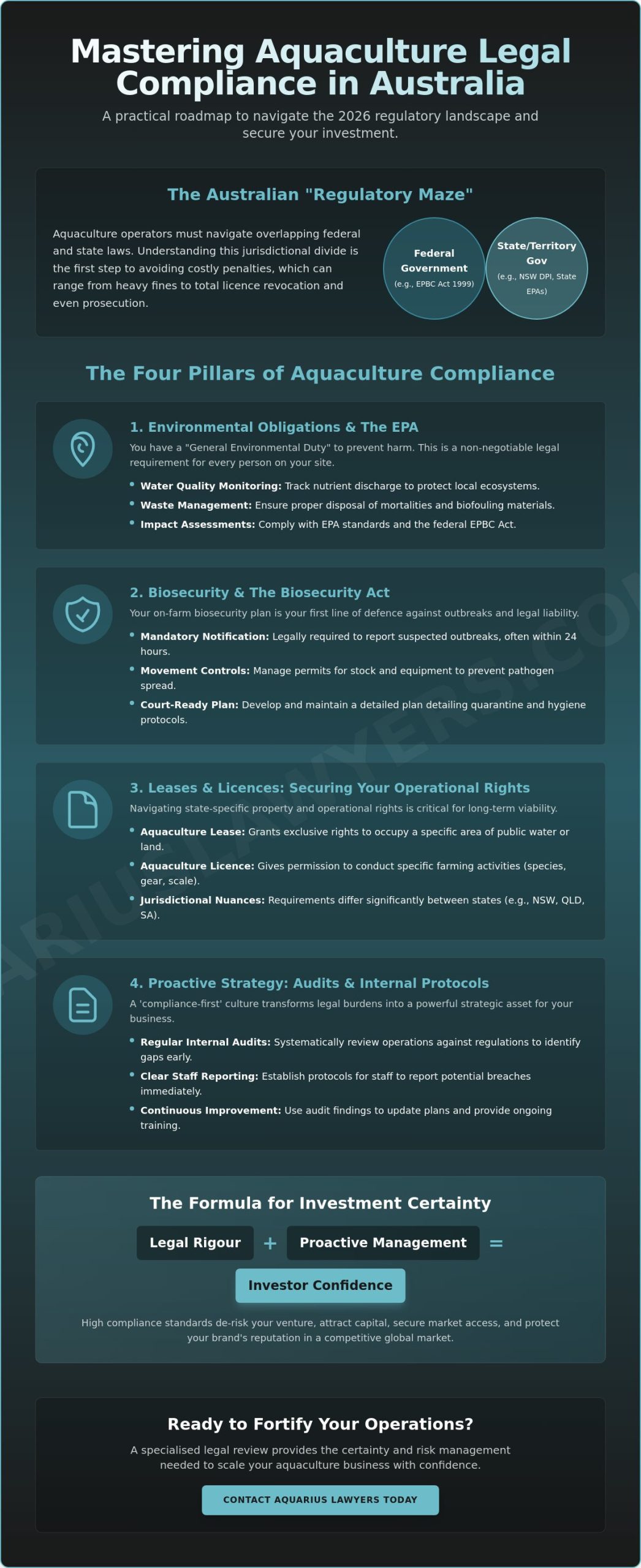
The Australian landscape is unique because it’s managed through a “Regulatory Maze” where federal and state interests often overlap. This isn’t just red tape for the sake of it. It’s a system designed to balance economic growth with the protection of our unique marine ecosystems. However, for a producer, this overlap creates complexity. You might find yourself answering to a state fisheries body for your daily harvest while simultaneously reporting to a federal agency regarding protected migratory species. The cost of getting this wrong is high. Penalties range from heavy administrative fines to the total revocation of your licence, and in some cases, even criminal litigation.
Building a “compliance-first” culture is no longer optional for 2026 ventures. It’s the baseline for entry. When you prioritise legal rigour from day one, you’re effectively de-risking your entire investment. This proactive stance ensures that when regulations shift or fees increase, your business has the structural integrity to adapt without facing a shutdown.
The Commonwealth vs State Divide
Understanding who holds the clipboard is vital. Generally, state and territory governments manage aquaculture within three nautical miles of the coast. This is where you’ll deal with bodies like PIRSA in South Australia, the NSW DPI, or the various state-based EPAs. However, the federal government steps in via the Environment Protection and Biodiversity Conservation Act 1999 (EPBC Act) if your project impacts matters of national environmental significance. These “grey zones” in coastal waters require a sophisticated approach to ensure you don’t fall through the cracks between jurisdictions. A solid foundation in Aquaculture in Australia starts with knowing which regulator has the final say on your specific site.
Sustainable Aquaculture Regulations as a Growth Driver
Smart operators view aquaculture legal compliance as a strategic asset rather than a hurdle. In 2026, investors are looking for ESG (Environmental, Social, and Governance) certainty before they commit capital. High compliance standards act as a filter that separates professional ventures from risky ones. By maintaining a transparent legal framework, you aren’t just avoiding fines; you’re securing market access and protecting your brand’s reputation. It’s a simple formula: Legal Rigour + Proactive Management = Investor Confidence. This transparency makes your business a safer bet for growth and long-term scaling in a competitive global market.
The Four Pillars of Aquaculture Compliance
Mastering aquaculture legal compliance requires more than a casual understanding of the rules; it demands a structured approach to four critical areas of operation. These pillars form the framework that keeps your farm legally buoyant and commercially viable. When you treat these as operational strengths rather than burdens, you build a business that can withstand both regulatory scrutiny and environmental shifts.
Environmental Obligations and the EPA
The Environment Protection Authority (EPA) focuses heavily on what leaves your farm. You’ll need robust water quality monitoring systems to track nutrient discharge limits and ensure you aren’t impacting local ecosystems. Waste management is equally vital, specifically regarding the disposal of mortalities and biofouling materials. Under the Environment Protection Act, you carry a “General Environmental Duty,” which means you must take all reasonable and practicable measures to prevent or minimise environmental harm from your activities. This isn’t a suggestion; it’s a foundational legal requirement that applies to every worker on your site.
Biosecurity and the Biosecurity Act 2015
The Biosecurity Act 2015 sets out your responsibilities for managing pests and diseases. If you suspect an outbreak, the law mandates specific notification periods, often as short as 24 hours. Compliance involves more than just a phone call; you must manage movement permits for stock and equipment to prevent the spread of pathogens. Developing an on-farm biosecurity plan that holds up in court is your best defence. This plan should detail your quarantine protocols and hygiene standards, providing a clear audit trail of your “due diligence” in the event of an incident. Aligning your farm with Australian aquaculture regulations ensures you’re prepared for these high-pressure scenarios.
Native Title and Indigenous Consultation
A frequently overlooked aspect of aquaculture legal compliance is the intersection with Native Title. Many aquaculture sites, whether in coastal marine zones or inland river systems, are subject to Native Title claims or existing rights. Genuine community engagement is a legal necessity for securing long-term tenure. Indigenous Land Use Agreements (ILUAs) provide a formal pathway to manage these relationships, ensuring that your operations respect traditional ownership while providing commercial certainty. Failing to engage early and respectfully can lead to significant delays or even the loss of your lease during the approvals process.
Finally, your operations must meet the rigorous food safety standards set by Food Standards Australia New Zealand (FSANZ) and satisfy Work Health and Safety (WHS) laws. Farming on the water presents unique risks that require specialised safety protocols. If you’re unsure how these pillars apply to your specific species or location, a tailored compliance review can help identify gaps before they become liabilities.
Navigating State-Specific Regulations: A Focus on NSW
While the federal framework provides the broad strokes, your day-to-day aquaculture legal compliance is largely dictated by state-specific rules. In New South Wales, the Department of Primary Industries (DPI) acts as the primary gatekeeper for the industry. You must understand the fundamental distinction between an aquaculture lease and an aquaculture licence. Think of the lease as your “property” right on the water and the licence as your “permission” to operate. You can’t have one without the other; managing both requires meticulous record-keeping and a deep understanding of the Fisheries Management Act 1994.
Local government planning approvals often represent the steepest hurdle for new entrants. If you’re building a land-based recirculating system, you’ll need to navigate a Development Application (DA) through your local council. This process frequently triggers mandatory referrals to the NSW EPA for noise, odour, and water discharge assessments. It’s a complex dance where one misstep in your environmental impact statement can set your project back by months. Staying informed through bodies like the Fisheries Research and Development Corporation is a smart way to anticipate these regulatory shifts. They offer the scientific data needed to back up your DA submissions with technical rigour.
The NSW Aquaculture Licence Application Process
The path to approval starts with a formal inquiry to the DPI to ensure your proposed site is viable. You’ll then progress through site selection and the preparation of a detailed Environmental Impact Statement (EIS). The most common pitfall is underestimating the time required for the DA process. Land-based systems often face “mandatory referrals” where the EPA must sign off on your waste management strategy. If your nutrient discharge levels aren’t precisely modelled or if your waste-water plan lacks detail, the referral process can become a bottleneck. Success requires getting your technical ducks in a row before the first document is filed.
Comparing NSW with SA and TAS Frameworks
Interstate comparisons offer valuable lessons for NSW operators. South Australia’s Aquaculture Act 2001 remains a benchmark for aquaculture legal compliance because it consolidates many approvals into a single, streamlined legislative framework. In contrast, Tasmania’s framework is heavily influenced by the specific legal triggers of the salmon industry, which faces intense public and political scrutiny. Looking back at the regulatory shifts of 2025, we saw a clear national move toward higher indexation of fees and a “cost-recovery” model. This reminds us that the price of compliance is never static; it’s an evolving overhead that requires active management and foresight. Working with an experienced commercial lawyer Sydney operators trust can help you stay ahead of these shifting fee structures and regulatory demands.
Building a Proactive Compliance Strategy for Your Farm
A reactive approach to aquaculture legal compliance is a recipe for disaster. If you’re only checking your permits when a regulator knocks on the gate, you’ve already lost the battle. Success in 2026 requires a shift from “box-ticking” to a living, breathing strategy that permeates every level of your operation. This starts with a comprehensive Compliance Manual that isn’t left to gather dust in a back office. Instead, it should be a dynamic resource that your team uses to guide daily activities, from stock handling to waste disposal.
Training your staff is the most effective way to decentralise risk. Every deckhand and technician must understand their role in incident reporting and biosecurity protocols. When your team knows exactly what to do during a suspected disease outbreak, you reduce the window for error and protect your licence. Staff Competency + Clear Protocols = Operational Security. This culture of accountability ensures that compliance is seen as a shared responsibility rather than a management headache.
Risk Management and Legal Audits
High-risk gaps often hide in plain sight. Regular internal legal audits allow you to identify these vulnerabilities before they attract the attention of the authorities. You should look closely at your chemical storage, water discharge logs, and employee safety records. Preparing for unannounced inspections is also a critical part of the process. If your records are organised and your site is tidy, you project an image of professional control. An independent Aquaculture Law review offers a fresh set of eyes to spot the blind spots that daily operations might overlook.
Tech-Driven Compliance in 2026
Technology is now the backbone of a modern compliance framework. In 2026, many forward-thinking operators are using IoT sensors and blockchain technology to provide ironclad traceability for food safety. These digital logs are more than just efficient; they are a vital shield in the event of a prosecution. If a regulator challenges your environmental impact, having a digital paper trail is your best defence. Automated sensors provide a real-time, tamper-proof data stream that serves as admissible legal evidence of your environmental compliance during regulatory disputes. This level of transparency builds trust with both regulators and consumers, turning your data into a powerful commercial asset.
How Aquarius Lawyers Supports Sustainable Aquaculture
Managing a commercial farm in 2026 requires more than just good husbandry; it requires a legal partner who understands the water as well as you do. Aquarius Lawyers, led by Katherine Hawes, known across the industry as “The Fish Lawyer,” provides the specialized expertise needed to turn regulatory hurdles into competitive advantages. We don’t just interpret the law; we provide a practical roadmap for aquaculture legal compliance that respects the realities of your daily operations. Whether you are a startup looking for a fixed-fee compliance review or a large-scale investor requiring strategic advice on complex property law and commercial structures, we offer a steady hand in a shifting environment.
Our approach is grounded in the synergy between deep, traditional credentials and a forward-thinking methodology. As the 2026 regulatory landscape evolves, particularly with the recent streamlining of Queensland’s framework and the increased focus on biosecurity traceability, having a “no-nonsense” advisor is essential. We represent clients across the full spectrum of Fisheries Law and Aquaculture Law, ensuring that your investment is protected from the high cost of non-compliance. If your business faces a challenge, we provide robust representation in criminal law and fisheries prosecutions, moving quickly to resolve issues before they escalate into litigation.
Our Niche Expertise in Marine and Fisheries Law
Generalist commercial lawyers often miss the technical nuances that define the aquaculture industry. They might understand a standard lease, but they often lack the specialized knowledge required to navigate the *Biosecurity Act 2015* or the specific environmental triggers of the EPBC Act. Our track record in NSW courts and international maritime tribunals gives us a unique perspective on how local regulations fit into the global seafood market. We employ an “Innovative Veteran” approach, blending decades of maritime experience with modern digital tools to ensure your record-keeping is as sharp as your legal strategy.
Next Steps: Securing Your Future on the Water
The best time to address a compliance gap was yesterday; the second best time is today. With the 2026 cost-recovery fee models now in full effect, an unmanaged oversight can quickly become an expensive liability. We help you audit your current licences, update your biosecurity protocols, and prepare for the next wave of regulatory changes with confidence. Don’t leave your farm’s future to chance in a maze of overlapping jurisdictions. You can organise a compliance audit with The Fish Lawyer today to ensure your operation remains sustainable, profitable, and fully protected. Our goal is to provide the legal certainty you need to focus on what you do best: growing the future of Australian seafood.
Securing Your Farm’s Future on the Water
Operating a sustainable venture in 2026 requires a fundamental shift in mindset. You’ve seen how the overlap between state and federal jurisdictions can create risk; however, a proactive strategy turns these hurdles into commercial assets. By mastering the four pillars and integrating tech-driven monitoring, you build a business that is both resilient and attractive to ESG-focused investors. It’s about moving beyond simple box-ticking to create a culture where legal rigour is part of your daily rhythm.
Achieving total aquaculture legal compliance doesn’t have to be a solitary struggle against the tide. Principal Katherine Hawes, a recognised global expert in Marine Law, provides the specialised guidance you need to navigate both commercial and criminal maritime matters. Based in Sydney with a national reach, her team at Aquarius Lawyers bridges the gap between complex regulation and practical farm management. Don’t wait for an inspection to test your protocols. Speak with The Fish Lawyer about your compliance needs today to ensure your operation is legally sound and ready for growth. With the right roadmap in place, you can focus on the harvest while we handle the horizon.
Frequently Asked Questions
Do I need a separate licence for every species I farm?
Most state aquaculture licences specify the exact species you’re permitted to farm on your site. If you decide to diversify from finfish to shellfish, you must apply for a licence amendment or a new authority through your state fisheries body. Operating outside your permitted species list is a breach of your permit conditions and can lead to immediate suspension or heavy administrative fines.
What happens if my aquaculture farm accidentally breaches water quality standards?
You must activate your emergency response plan and notify the relevant EPA or state fisheries body immediately. Self-reporting often acts as a mitigating factor during a legal review, whereas hiding a breach significantly increases the risk of prosecution. Prompt action demonstrates that you’re taking your “General Environmental Duty” seriously and helps protect your long-term aquaculture legal compliance standing.
How much does aquaculture legal compliance cost for a startup?
Costs vary depending on your state’s fee schedule and the scale of your project. For example, Queensland’s framework uses a cost-recovery model, and annual fees for certain fishery symbols in 2026 are set at 402.35 fee units. Beyond government application fees, you should budget for technical environmental assessments and professional legal reviews to ensure your business structure is resilient from day one.
Can I transfer an aquaculture lease to another person or company?
You can transfer an aquaculture lease, but the process requires formal approval from the relevant state authority, such as the NSW DPI. The incoming party must meet “fit and proper person” criteria and demonstrate they can fulfill all environmental and financial obligations. It’s vital to conduct a full legal audit of the lease’s history before finalising any commercial transfer to avoid inheriting undisclosed liabilities.
Does federal law always override state aquaculture regulations?
Federal law doesn’t necessarily override state rules; instead, they usually function as overlapping layers of regulation. While state bodies manage the majority of day-to-day operations, the federal EPBC Act takes precedence if your farm impacts matters of national environmental significance. Achieving total aquaculture legal compliance means satisfying both jurisdictions simultaneously to avoid a regulatory deadlock that could stall your investment.
What are the mandatory reporting requirements for fish diseases in NSW?
In New South Wales, you’re legally required to notify the DPI within 24 hours if you suspect the presence of a “notifiable” disease or pest. Failure to report can result in significant penalties and the potential loss of your licence. Your biosecurity plan should include a current list of these diseases and a clear protocol for immediate notification to ensure you meet this urgent legal deadline.
How often should I conduct a legal audit of my aquaculture business?
We recommend conducting a comprehensive legal audit at least once a year or whenever there’s a shift in state legislation. For instance, the major regulatory overhaul in Queensland on 27 April 2026 made immediate audits essential for all local operators. Regular reviews help you spot administrative errors in your logs before they turn into prosecutable offences during an unannounced inspection by authorities.
Is Indigenous consultation legally required for land-based aquaculture?
Indigenous consultation is often a legal requirement if your land-based site intersects with Native Title claims or specific cultural heritage zones. Even when not strictly mandated by a specific statute, genuine community engagement is a key component of the modern planning approval process. Early consultation through Indigenous Land Use Agreements (ILUAs) provides the long-term certainty needed for sustainable growth and community support.
Disclaimer
Please note that legal rules change and this is not a substitute nor construed as legal advice. It is general information only.