
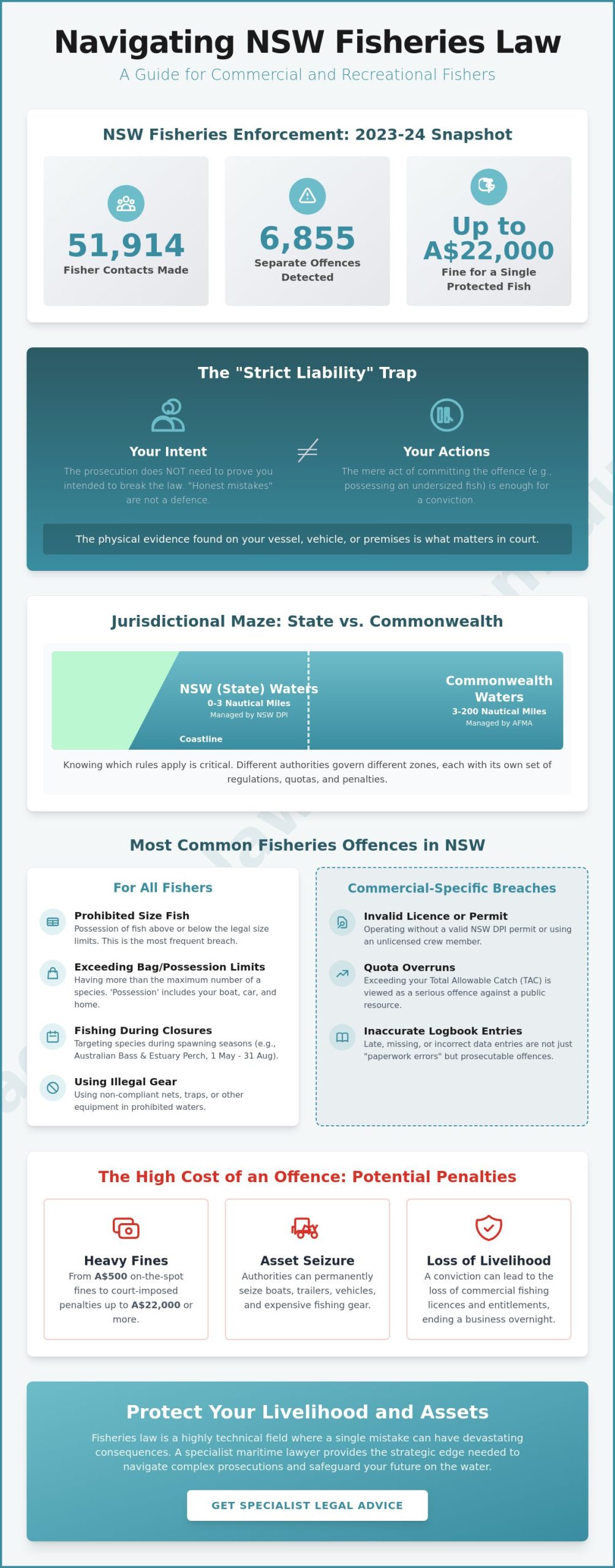
Did you know that NSW Fisheries Officers made exactly 51,914 contacts in the 2023-24 financial year, detecting 6,855 separate offences? It is a staggering figure that proves how active compliance teams have become in our coastal and inland waters. You likely feel that the regulatory environment is becoming a minefield, especially when trying to decipher the overlap between NSW DPI and Commonwealth AFMA rules. The reality is that an honest mistake can lead to the loss of your vessel or a court-imposed fine of up to A$22,000 for a single protected fish.
This guide clarifies the most common fisheries offences nsw authorities target and explains why “strict liability” makes your intent irrelevant in the eyes of the law. We will provide a clear breakdown of jurisdictional boundaries and your rights during a fisheries inspection. By the end, you will have a practical strategy to safeguard your commercial assets and protect your licences from regulatory pressure. Knowledge of the rules combined with a proactive defence equals a more secure livelihood on the water.
Key Takeaways
- Learn why “strict liability” means the prosecution doesn’t need to prove you intended to break the law to secure a conviction.
- Identify the most common fisheries offences nsw fishers face, including possession of prohibited size fish and exceeding bag limits.
- Master the 3-nautical-mile rule to clarify whether your operations fall under NSW DPI or Commonwealth AFMA jurisdiction.
- Understand your rights and obligations during inspections to protect your vessel and commercial gear from permanent seizure.
- Discover how a niche maritime specialist provides the strategic edge needed to defend your livelihood against complex fisheries prosecutions.
Understanding Fisheries Law and the Strict Liability Trap
Fisheries law is not merely a set of environmental guidelines; it is a high-stakes intersection of administrative mandates, criminal penalties, and commercial property rights. Australian fisheries law is the specialised legal framework that balances the commercial viability of the industry with the long-term sustainability of marine resources. For many operators, the most confronting aspect of this field is the “strict liability” nature of the regulations. This means that if you are found in possession of a prohibited species or exceeding a bag limit, the prosecution does not need to prove you intended to break the law. Your state of mind is irrelevant; the mere fact that the act occurred is enough to secure a conviction.
This legal reality creates a significant “trap” for both commercial and recreational fishers. While most criminal charges require a “guilty mind,” common fisheries offences nsw authorities prosecute rely on the physical evidence found on your vessel or at your premises. This framework is designed to ensure maximum compliance in an environment where monitoring every single haul is impossible. Consequently, a simple clerical error in a logbook or a misidentified species can lead to immediate prosecution and life-changing fines.
The Scope of Modern Marine Regulation
Marine regulation in Australia is a layered system that distinguishes sharply between different sectors. Commercial fishers face the most rigorous requirements, including strict quota management and satellite vessel monitoring. Recreational and charter sectors are governed by bag and size limits that can change seasonally, such as the current zero bag limit for Australian Bass and Estuary Perch in coastal rivers until 31 August 2026. Additionally, industries like aquaculture and pearl farming are integrated into this legal umbrella, requiring specific land-use permits and environmental compliance. Local laws also enforce “no-take” zones and Marine Protected Areas (MPAs), where even drifting into a restricted zone with gear deployed can trigger a penalty.
Why a “No-Nonsense” Legal Approach Matters
The financial impact of a fisheries conviction goes far beyond a simple fine. Under the Fisheries Management Act 1994 (NSW), authorities have the power to seize expensive commercial assets, including boats, trailers, and specialised gear. Losing a vessel can end a family business overnight. Because this area of law is so technical, generalist lawyers often overlook the specific jurisdictional boundaries managed by the Australian Fisheries Management Authority (AFMA) versus state-based DPI inspectors. Protecting your commercial fishing entitlements requires a strategy that understands these nuances, ensuring that a single mistake doesn’t result in the permanent forfeiture of your livelihood.
Common Fisheries Offences in NSW: What You Need to Know
The 2023-24 financial year saw 6,855 offences detected by NSW Fisheries Officers. This volume of enforcement highlights why understanding common fisheries offences nsw authorities prioritise is vital for anyone on the water. Prosecution often begins with the most frequent breach: possession of prohibited size fish. Whether you are a commercial trawler or a weekend angler, the law is uncompromising. For example, taking an Eastern Blue Groper can result in a A$500 on-the-spot fine, while court-imposed penalties for serious breaches can reach A$22,000 or even imprisonment.
Possession limits and bag limits are equally critical. In the legal sense, “possession” is not restricted to the fish currently on your hook or deck. It extends to your vehicle, your cool box, and even your home storage. Exceeding these limits, or fishing during spawning closures like the current Australian Bass and Estuary Perch closure (1 May to 31 August 2026), triggers immediate liability. Using illegal gear, such as non-compliant nets or traps, remains a top priority for compliance teams. The formula is simple: unapproved gear plus prohibited waters equals a seized vessel.
Commercial Specific Breaches
For the commercial sector, the regulatory burden is significantly heavier. Operating without a valid NSW DPI permit or using an unlicensed crew member constitutes a major breach that can jeopardise your entire enterprise. Quota overruns are particularly dangerous. Exceeding your Total Allowable Catch (TAC) is viewed as a theft from the public resource, often leading to automatic penalties. Furthermore, the administrative side of the business carries criminal weight. Late or inaccurate logbook entries are not just “paperwork errors”; they are evidence of a failure to comply with the Fisheries Management Act 1994 (NSW). If you are struggling with a complex compliance issue, seeking advice from a fisheries law specialist can help you protect your commercial entitlements.
The Role of Digital Compliance
Modern enforcement relies heavily on digital footprints. Vessel Monitoring Systems (VMS) and electronic reporting are now standard legal requirements for many commercial fisheries. This data provides a minute-by-minute account of your location and activity, which authorities use as primary evidence in prosecutions. Digital data plus historical logbooks equals a comprehensive compliance profile. Implementing your own tech-based due diligence, such as redundant GPS tracking and digital catch verification, is a proactive way to prevent accidental breaches of protected zones or “no-take” Marine Protected Areas (MPAs). In this environment, your digital record is either your best defence or your biggest liability.
Jurisdictional Maze: Commonwealth vs State Waters
The invisible line at three nautical miles offshore is where your legal obligations shift from state to federal control. Understanding this boundary is essential because common fisheries offences nsw fishers encounter often stem from confusion over which authority holds the reins. While the three-mile mark is the standard, the Offshore Constitutional Settlements (OCS) allow for more practical arrangements. These agreements often hand management of specific species back to the NSW Department of Primary Industries (DPI) even in deeper waters, or conversely, give the Australian Fisheries Management Authority (AFMA) control over migratory stocks closer to the coast.
A critical gap in most legal discussions is the recognition of fishing rights as tangible property. Your commercial licence or quota is not just a permission slip; it is a high-value commercial asset. In the jurisdictional maze, the value of this property can fluctuate based on which legislative framework applies. Whether you are dealing with the state-based Fisheries Management Act 1994 or the Commonwealth’s Fisheries Management Act 1991, protecting the equity in your fishing entitlements requires a precise understanding of these overlapping boundaries. A mistake in location plus an incorrect logbook entry equals a direct threat to your business’s balance sheet.
Commonwealth Managed Fisheries
AFMA oversees high-seas operations and species that move across state and international borders, such as Tuna and Billfish. These fisheries are heavily influenced by international treaties, which dictate everything from sustainable harvest levels to gear specifications. Operating in these waters means adhering to the Fisheries Management Act 1991, where the penalties for non-compliance are scaled for industrial-sized operations. Because these stocks are managed as a national resource, the prosecution of common fisheries offences nsw operators might face in Commonwealth waters often involves sophisticated satellite tracking and data analysis to prove boundary breaches.
NSW State Fisheries Management
Coastal, estuarine, and beach-based operations fall under the direct supervision of the NSW DPI. This jurisdiction is governed by specific “Fishery Management Plans” that create unique legal obligations for different regions. For example, an estuary prawn trawl operator faces a different set of rules than a beach hauler. These plans often intersect with state environmental laws, particularly regarding protected marine parks and “no-take” zones. Managing these local regulations requires constant attention to the latest DPI gazettes, as a shift in a local management plan can instantly turn a standard practice into a punishable offence. Success in state waters depends on your ability to align daily operations with these shifting administrative mandates.
Handling Inspections and Prosecution Defence
When a fisheries officer approaches your vessel, the interaction is governed by a specific set of rules that differ significantly from standard police encounters. With 51,914 client contacts made by NSW Fisheries Officers in the 2023-24 period, these inspections are a routine reality of life on the water. However, they are also the primary source of evidence for the 167 prosecution actions commenced annually. Your legal obligations during boarding are immediate; you must produce licences, records, and catch for inspection when requested. Refusing to assist or obstructing an officer is often more legally damaging than the initial suspicion of common fisheries offences nsw inspectors were investigating.
The power of search and seizure is a formidable tool in the DPI’s arsenal. Officers can legally seize not just the illegal catch, but also the “means” of the offence, which frequently includes your boat, trailer, and commercial gear. Getting these assets back requires a strategic legal response, often involving a bond or a court order. To protect yourself, you should document the encounter as it happens. Keep your own log of the time, location, and the specific items inspected or seized. These records often serve as the foundation of a successful defence in the NSW Local or District Court, where the technical accuracy of the officer’s report can be challenged.
Your Rights vs Obligations
Unlike a typical criminal stop, you have a mandatory “produce and assist” requirement. You cannot simply remain silent when asked for your fishing fee receipt or commercial logbook. However, a fine line exists between meeting your statutory obligations and providing unnecessary statements that could lead to self-incrimination. Maintaining a steady, no-nonsense professionalism during the inspection is essential. If an officer detects a breach, your conduct on the deck is often noted in the prosecution brief. If you find yourself facing an investigation, engaging a specialist in Fisheries Law early can prevent a minor inspection from escalating into a full-scale prosecution.
Appeals and Administrative Reviews
A penalty notice is not always the final word. Many DPI decisions, such as the suspension or cancellation of a commercial licence, can be challenged through the Administrative Appeals Tribunal (AAT) or a similar judicial review process. These reviews focus on whether the decision was made fairly and in accordance with the law. In many cases, mediation serves as a strategic alternative to expensive maritime litigation. It allows for a pragmatic resolution that protects your commercial entitlements without the uncertainty of a court trial. Navigating these appeals requires a deep understanding of the administrative machinery behind the Fisheries Management Act 1994.
Why You Need a Fisheries Law Specialist
Dealing with maritime regulations requires more than just a standard legal degree; it demands deep industry immersion. A generalist solicitor might understand the basics of criminal procedure, but they often lack the technical vocabulary to challenge a DPI inspector on net mesh sizes or VMS data discrepancies. This is where the “innovative veteran” advantage becomes your greatest asset. Katherine Hawes, widely known as “The Fish Lawyer,” provides a steady, common-sense guide through the maritime complexity that often overwhelms operators. By combining traditional legal credentials with modern strategic thinking, she helps clients navigate the common fisheries offences nsw compliance teams are currently prioritising.
Waiting for a summons is a high-risk strategy that rarely ends well. Proactive compliance audits allow you to identify regulatory gaps before they turn into expensive court cases. We examine your logbook habits, gear specifications, and jurisdictional boundaries to ensure your operations are airtight. Beyond immediate defence, we assist in organising your corporate structure to insulate your primary assets from maritime liability. If one vessel is involved in a compliance incident, your entire commercial fleet and personal property shouldn’t be at risk. Strategy plus structure equals security.
The Aquarius Lawyers Approach
Strategic legal counsel is never a one-size-fits-all service. For commercial fishers and aquaculture startups, the legal needs are deeply specific and often urgent. Aquarius Lawyers offers cost-effective, tech-forward solutions that bridge the gap between regional wharves and Sydney courtrooms. We focus on protecting your property rights and ensuring your future livelihood remains intact despite shifting political and environmental regulations. Whether you are managing a family-owned trawler or a multi-million dollar aquaculture project, our methodology is designed to produce practical, “no-nonsense” outcomes.
Securing Your Future on the Water
Expert advice is essential during quota transfers and licence renewals, where a single administrative error can devalue your commercial assets. Whether you are seeking a maritime solicitor for a major aquaculture investment or defending a licence suspension, niche expertise is the difference between staying on the water and being forced ashore. Don’t leave your commercial entitlements to chance. Protect your commercial fishing future-consult with Aquarius Lawyers today.
Protect Your Livelihood with Strategic Maritime Defence
Fisheries law is a high-stakes field where the strict liability trap means even an honest mistake can threaten your commercial entitlements. We’ve explored how common fisheries offences nsw inspectors prioritise can lead to the immediate seizure of vessels and why the three-nautical-mile boundary dictates which legislative framework applies to your catch. Safeguarding your property rights requires a blend of traditional maritime experience and modern strategic thinking. Principal Katherine Hawes, known globally as “The Fish Lawyer,” offers specialised expertise in both NSW State and Commonwealth fisheries law to help you navigate this complexity with confidence.
With dedicated offices in Sydney and Shellharbour, Aquarius Lawyers provides accessible regional support for fishers facing inspections or licence disputes. We believe in proactive compliance audits that identify risks before they reach the Local or District Court. Don’t wait for a compliance incident to jeopardise your assets. Secure your commercial fishing future with the experts at Aquarius Lawyers. Your hard-earned expertise belongs on the ocean; let us provide the steady, common-sense guide you need to stay there.
Frequently Asked Questions
Is fisheries law the same as maritime law?
Fisheries law and maritime law are distinct specialisations that often intersect on the water. Maritime law generally governs shipping, navigation, and sea-based commerce, while fisheries law focuses specifically on the harvest, management, and conservation of marine resources. You can think of maritime law as the rules for the vessel’s movement and fisheries law as the rules for the catch it carries.
Can I lose my boat if I am charged with a fisheries offence in NSW?
Yes, the permanent forfeiture of your vessel is a very real risk for serious breaches. NSW Fisheries Officers have broad powers to seize any equipment used in the commission of an offence, including boats, trailers, and commercial gear. For many common fisheries offences nsw authorities prosecute, the court has the discretion to order that these seized assets be forfeited to the Crown.
What is the “3-nautical-mile rule” in Australian fishing?
The 3-nautical-mile rule defines the jurisdictional boundary between state and federal management. Generally, NSW DPI manages fisheries from the low-water mark out to three nautical miles offshore. Beyond this limit, the Australian Fisheries Management Authority (AFMA) usually takes control. However, specific Offshore Constitutional Settlements (OCS) can shift management of certain species between these two authorities regardless of the distance from shore.
How do I appeal a decision made by the NSW DPI or AFMA?
You can challenge administrative decisions through a merits review or a judicial review process. For NSW DPI matters, this often involves the NSW Civil and Administrative Tribunal (NCAT), while Commonwealth AFMA decisions are typically reviewed by the Administrative Appeals Tribunal (AAT). These bodies examine whether the regulator acted fairly and within the bounds of the Fisheries Management Act when issuing penalties or suspending licences.
What is a strict liability offence in fisheries law?
Strict liability means that the prosecution doesn’t need to prove you intended to break the law to secure a conviction. If the prohibited act occurred, such as possessing an undersized fish, you’re legally responsible. While an “honest and reasonable mistake” can sometimes be used as a defence, simply not knowing the rules or not intending to breach them is usually insufficient to avoid a penalty.
Do I need a lawyer for a minor recreational fishing fine?
While you aren’t required to have a lawyer for a simple penalty notice, seeking advice is wise if you intend to challenge the fine in court. A minor A$110 fine for a forgotten licence is one thing, but if the charge involves protected species or spawning closures, a conviction can lead to a criminal record. A specialist ensures your defence is technically sound and protects your future access to the water.
How are commercial fishing quotas legally determined in Australia?
Quotas are set through a Total Allowable Catch (TAC) limit, which is legally determined by independent committees. These committees weigh scientific biomass assessments against economic data to ensure the fishery remains sustainable. Once the TAC is established, it’s divided into Individual Transferable Quotas (ITQs). These ITQs are recognised as a form of commercial property that can be traded, leased, or used as security for business loans.
What happens if I accidentally fish in a protected marine zone?
Accidental entry into a “no-take” or protected marine zone is still a punishable offence due to the nature of strict liability. Fisheries compliance teams use Vessel Monitoring Systems (VMS) and GPS data to pinpoint your exact location with high precision. If your gear is deployed within a restricted boundary, the lack of intent won’t prevent a fine, though it may be a mitigating factor during sentencing.
Disclaimer
Please note that legal rules change and this is not a substitute nor construed as legal advice. It is general information only.