
Your business is a commercial equation, but when a deadlock occurs, the maths rarely adds up in your favour. It’s a common fear for many Sydney directors; watching a lifetime of work stall because of a breakdown in trust or a dispute over dividends. If you’re feeling “frozen out” by the majority or trapped in a stalemate, you aren’t just looking for an argument; you’re looking for a practical resolution. Partnering with a shareholder dispute lawyer sydney ensures you have a steady, common-sense guide to protect your reputation and your bottom line.
We understand that high legal fees shouldn’t be the thing that finally tips your company over the edge. You want a result that preserves value, whether that’s a clean buy-out or the restoration of fair management practices under the Corporations Act. This article outlines how strategic legal solutions, from mediation to fixed-fee arrangements, can resolve conflicts with modern efficiency. You’ll learn how to navigate the complexities of shareholder oppression and move from a state of paralysis to a clear, profitable path forward.
Key Takeaways
- Identify the common friction points, such as vision clashes and profit distribution, that often lead to a commercial deadlock.
- Understand how the Corporations Act 2001 and your bespoke Shareholder Agreement work together to define your legal standing and rights.
- Learn how a shareholder dispute lawyer sydney navigates the choice between mediation and litigation to protect your business continuity.
- Discover the immediate steps to take, such as securing records and reviewing “Buy-Sell” clauses, to safeguard your equity.
- Gain insights into why a pragmatic, no-nonsense approach is the most efficient way to resolve conflicts without draining company profits.
Common Triggers for Shareholder Disputes in Sydney Businesses
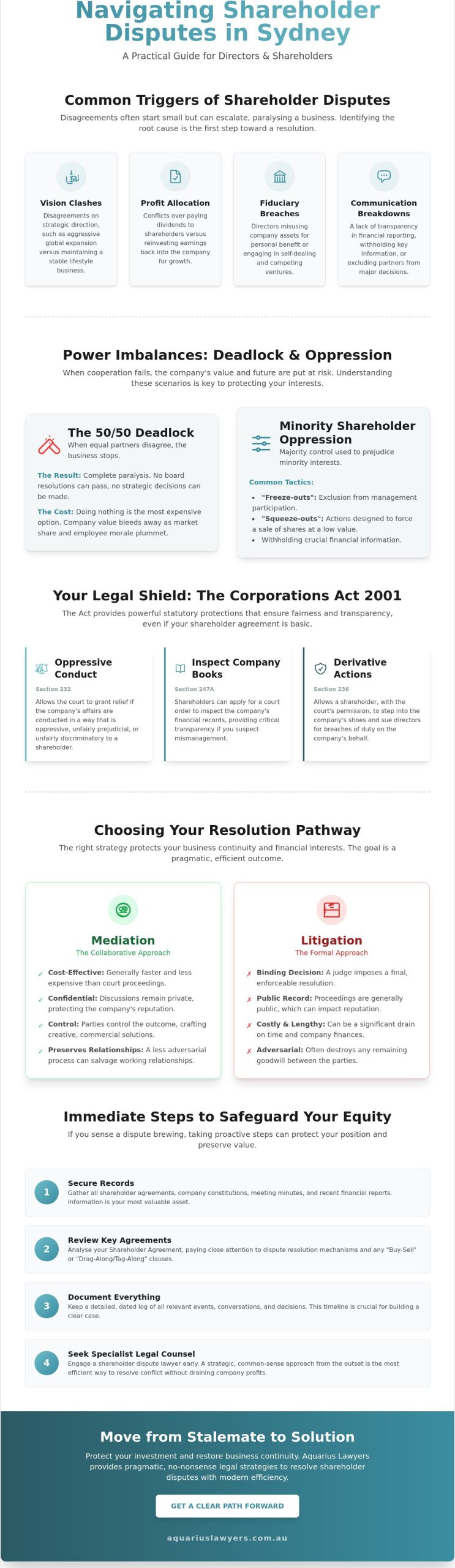
Disputes don’t happen in a vacuum. They’re often the result of a slow erosion of trust or a sudden pivot in company strategy. In Sydney’s competitive market, a disagreement over whether to reinvest profits into a new tech stack or pay out dividends can quickly spiral. When directors also hold shares, the line between their fiduciary duty to the company and their personal financial interest often blurs. This leads to claims of self-dealing or mismanagement that require a shareholder dispute lawyer sydney to unravel. Common triggers include:
- Vision Clashes: One founder wants to scale globally while the other prefers a stable, lifestyle business.
- Profit Allocation: Disputes regarding dividend payments versus the reinvestment of company earnings.
- Fiduciary Breaches: Directors using company assets for personal gain or setting up competing ventures.
- Communication Breakdowns: A lack of transparency regarding financial performance or major contracts.
The 50/50 Deadlock: When Business Stops
Equal partnerships are built on the assumption of permanent consensus. When that consensus breaks, the business stops. A 50/50 deadlock means no board resolutions can pass and no strategic decisions can be made. For a Sydney SME, this paralysis is devastating. Employees sense the tension; this tanks morale and productivity. Creditors may become nervous. Doing nothing is the most expensive option. While the directors are locked in a stalemate, the company’s market share and value bleed away. It’s a commercial equation where zero cooperation equals zero progress.
Minority Shareholder Oppression
Power imbalances frequently lead to shareholder oppression, where the majority uses their control to benefit themselves at the expense of the minority. This isn’t just about hurt feelings. It’s about measurable financial prejudice. You might face “freeze-outs” where you’re excluded from management or “squeeze-outs” designed to force you to sell your shares at an undervalue.
Common examples of unfair prejudice include withholding information or excluding a shareholder from management despite their historical involvement. These tactics are often fuelled by a breakdown in personal relationships. What started as a shared dream becomes a tactical battle for control. If you’re facing these tactics, an experienced shareholder dispute lawyer sydney provides the strategic leverage needed to restore fairness or negotiate a clean exit. The goal is to move from conflict to a resolution that protects your equity and reputation.
Understanding Your Rights Under the Corporations Act 2001
The Corporations Act 2001 (Cth) is the bedrock of corporate governance in Australia. While a bespoke Shareholder Agreement often provides your first line of defence, the Act offers statutory protections that cannot be signed away. These laws ensure that even if your initial paperwork was basic, you have fundamental rights regarding how the company is managed. It’s a safety net designed to maintain commercial integrity when trust fails. Understanding these rights is the first step toward resolving any deadlock or power struggle.
One of the most potent tools in the legislative kit is Section 232. This section allows the court to grant relief if the company’s affairs are being conducted in a way that is oppressive or unfairly prejudicial to a shareholder. This is where a shareholder dispute lawyer sydney becomes essential. They help you translate “unfair treatment” into a formal legal strategy that the court recognises. Whether it’s the withholding of dividends or the dilution of your shares, the Act provides a pathway to rectify the imbalance.
Information is power in any business conflict. Under Section 247A, shareholders have the right to apply for a court order to inspect the company’s books and financial records. If you suspect financial mismanagement or “hidden” profits, this right provides the transparency needed to build a solid case. If you’re feeling kept in the dark, seeking a commercial law expert can help you exercise these statutory rights effectively.
Statutory Derivative Actions
Section 236 allows a shareholder to step into the company’s shoes to sue directors for breaches of duty. This requires leave from the court, which is generally granted if the action is in the best interests of the company and the shareholder is acting in good faith. A derivative action is a surgical tool designed to hold rogue directors accountable when the company itself refuses to act. It ensures that those in power cannot hide behind the corporate veil while draining company assets.
Winding Up on Just and Equitable Grounds
Section 461(1)(k) is the “nuclear option” for resolving a total deadlock. It allows the Supreme Court of NSW to order the winding up of a solvent company if it’s just and equitable to do so. This typically occurs when the “commercial partnership” has collapsed beyond repair. While the court is often reluctant to liquidate a profitable business, the mere threat of a winding-up order frequently creates the leverage needed to negotiate a fair buy-out. It forces all parties to the table by demonstrating that a stalemate will eventually lead to the end of the entity itself.
Resolution Pathways: Mediation vs. Litigation in NSW
Resolving a dispute isn’t just about winning an argument; it’s about protecting your financial future. The right pathway depends on the hostility level and your end goal. Before you act, check your company constitution. It often contains a mandatory dispute resolution clause that dictates how conflicts must be handled. Ignoring this can lead to your case being stayed by the court, costing you time and money. Early intervention stops a “tit-for-tat” legal battle. It keeps the focus on commerce, not ego. A shareholder dispute lawyer sydney helps you determine which route offers the best “commercial equation” for your specific deadlock.
The Power of Mediation and Alternative Dispute Resolution (ADR)
Mediation is often the preferred first step for preserving business value. It’s fast. It’s private. Unlike the public records of the Supreme Court of NSW, mediation happens behind closed doors. This protects your personal and business reputation from the prying eyes of competitors or clients. A skilled mediator doesn’t just listen; they facilitate a “commercial divorce” or a structured buy-out. This approach preserves the equity you’ve built rather than spending it on a prolonged fight. It’s a pragmatic solution for those who want to move on quickly without the “burn the house down” mentality of litigation.
When Litigation is Unavoidable
Sometimes, negotiation fails. When the other side is acting in bad faith or refuses to acknowledge your statutory rights, litigation is unavoidable. Preparing for an oppression claim in the Sydney courts requires a rigorous, data-driven approach. You’ll likely be dealing with the Commercial List of the Supreme Court of NSW. This list is designed for efficiency, but the stakes remain high. The court has broad powers to intervene. It can order a compulsory share purchase at a fair value, or it can make orders to regulate the company’s future conduct.
You must manage the risk of “costs orders.” In NSW, the loser typically pays the winner’s legal fees. This can be a massive financial burden if your case isn’t handled with precision. Litigation is a high-stakes chess match. Every move must be calculated to protect your business continuity and personal assets. A shareholder dispute lawyer sydney ensures your evidence is solid and your strategy is sound before you step into the courtroom. Strategy beats emotion every time. We focus on the outcome, not just the process, to ensure you exit the conflict in the strongest possible position.
Immediate Steps to Protect Your Position in a Dispute
When a conflict surfaces, your first 48 hours are critical. It’s easy to let emotion drive your response, but strategy is what wins. You need to transition from a business partner to a protected party immediately. This means securing your position before the other side can limit your access to information or assets. A shareholder dispute lawyer sydney will tell you that the most prepared party usually dictates the terms of the resolution. Strategy plus preparation equals leverage.
Your first move is a quiet audit. Review your Shareholder Agreement and Company Constitution. Look specifically for “Buy-Sell” clauses or “Shotgun” provisions that might be triggered by certain behaviours or notices. You also need to maintain absolute digital hygiene. Avoid making inflammatory statements in emails, text messages, or on social media. These are often used as evidence of “unclean hands” or bad faith in later proceedings. Most importantly, don’t sign any “mutual separation” agreements or resignations until you’ve had a professional legal review of your documents.
Documentary Evidence: The Paper Trail
Evidence is the currency of commercial litigation. You need to gather every email, board minute, and financial statement while you still have access to the servers. If conversations happen over the phone or in person, record contemporaneous notes. These are notes made at or shortly after the time of the event. They carry significant weight in NSW courts because they’re seen as more reliable than memory. Use modern document management tools to organise and categorise your evidence by date and topic. Having a structured “data room” of evidence allows your legal team to act with speed and precision.
Valuation and Financial Assessment
You can’t negotiate a buy-out if you don’t know what your shares are worth. Get an independent valuation early. In shareholder oppression cases, there’s a vital distinction between “market value” and “fair value.” Market value might include a “minority discount” because a small stake is harder to sell. However, courts often apply a “fair value” standard that removes this discount to ensure you aren’t penalised for being squeezed out. Knowing your “walk-away” number is essential. It’s the point where the cost of continuing the fight outweighs the financial benefit of the settlement. Being grounded in data, rather than ego, ensures you make the right commercial call for your future.
Why Sydney Businesses Choose Aquarius Lawyers
Choosing a shareholder dispute lawyer sydney is about finding a partner who values your time as much as your legal rights. Many firms get bogged down in the ceremony of the law. We don’t. We focus on results. At Aquarius Lawyers, we understand that for a Sydney SME, a legal battle isn’t just a line item; it’s a direct threat to your business continuity. Our approach is grounded in a simple equation: Deep Experience + Modern Efficiency = Practical Resolution. We don’t just identify problems; we facilitate outcomes that allow you to get back to business.
We bring a unique perspective to commercial conflicts, particularly in specialised sectors. While many firms offer general commercial advice, we possess niche expertise in marine and fisheries law. A shareholder dispute in a commercial fishing venture or an aquaculture business involves unique regulatory pressures and high-value asset management that a generalist might overlook. By combining this specific industry knowledge with our broader commercial law practice, we ensure your strategy is robust and tailored to the unique realities of your trade.
The “Innovative Veteran” Advantage
Our firm operates as an “innovative veteran.” This means we possess the traditional credentials you expect from a top-tier firm, but we’re actively engaged with contemporary tools. We use technology to streamline commercial litigation, which significantly reduces the administrative costs that often eat into company profits. We value results over ceremony. Our “trusted advisor” persona is built on providing a steady, common-sense guide through the most stressful deadlocks. We provide a clear pathway to resolution that protects your long-term interests rather than just winning a short-term argument.
Strategic Commercial Counsel
Shareholder disputes rarely exist in isolation. They often bleed into other areas such as property law, debt recovery, or even employment law. Because our team is intellectually versatile, we move easily between these disciplines to provide a holistic defence of your position. We’re committed to accessible, plain-English legal advice. You won’t find us hiding behind dense, archaic jargon. Instead, you’ll receive clear directives and strategic counsel that empowers you to make informed decisions. Whether you are facing a freeze-out or a 50/50 deadlock, we offer the “no-nonsense” attitude required to break the stalemate. Contact Aquarius Lawyers today for a strategic consultation on your shareholder matter and take the first step toward restoring your business continuity.
Breaking the Deadlock and Securing Your Commercial Future
A shareholder conflict doesn’t have to signal the end of your business vision. By understanding your statutory rights and securing documentary evidence early, you shift the focus from reactive stress to strategic control. Whether you’re navigating a 50/50 deadlock or facing minority oppression, the goal remains a pragmatic resolution that preserves your equity and business continuity. Strategy plus preparation equals the leverage you need to move forward.
Partnering with a shareholder dispute lawyer sydney ensures you have a steady, common-sense guide who values results over ceremony. Led by Principal Katherine Hawes, “The Fish Lawyer”, our team brings over 20 years of commercial legal experience in NSW. We offer a unique blend of traditional credentials and modern efficiency, particularly in niche maritime and aquaculture commercial disputes. We don’t prolong fights; we find the most cost-effective pathway to resolve them.
Don’t let a commercial stalemate drain your company profits or damage your personal reputation. It’s time to resolve the deadlock with a clear, data-driven strategy. Protect your business and equity—Consult a Sydney Shareholder Dispute Specialist at Aquarius Lawyers. Your business’s next chapter starts with the right counsel.
Frequently Asked Questions
What is the most common cause of shareholder disputes in Sydney?
Disagreements over the strategic direction of the company and the distribution of profits are the most frequent triggers. One partner may want to reinvest earnings for growth while another requires a dividend payout for personal income. These vision clashes often lead to a breakdown in trust, especially in small to medium enterprises where personal relationships and business operations are closely intertwined.
Can a minority shareholder be forced out of a company in NSW?
Yes, but only under specific circumstances defined in the company constitution or by a court order. While “squeeze-out” tactics are sometimes attempted by the majority, the law provides significant protections against unfair prejudice. If a majority shareholder attempts to force a sale at an undervalue, a shareholder dispute lawyer sydney can help you seek relief under the oppression provisions of the Corporations Act.
How long does it typically take to resolve a shareholder dispute in court?
Litigation in the Supreme Court of NSW can take anywhere from 12 to 24 months to reach a final hearing. The exact timeline depends on the complexity of the evidence and the readiness of both parties. Because of this lengthy duration, many businesses choose mediation or negotiated buy-outs to reach a resolution in a matter of weeks or months instead.
Is a Shareholder Agreement legally binding if it wasn’t signed by everyone?
Generally, a Shareholder Agreement only binds the parties who have signed it. It operates as a private contract between those specific individuals or entities. However, the company constitution remains a public document that binds all members. If some shareholders haven’t signed the agreement, you may face a complex situation where different rules apply to different people, requiring a careful legal audit of your governance documents.
What happens if there is a 50/50 deadlock and no Shareholder Agreement?
The company often enters a state of paralysis where no board resolutions can pass and no strategic progress can be made. Without an agreement to dictate a tie-break or buy-out process, the parties must rely on the Replaceable Rules under the Corporations Act. If the deadlock cannot be broken through negotiation, the court may eventually order the company to be wound up on just and equitable grounds.
Can I sue a director for mismanaging the company as a shareholder?
Yes, you can apply to the court for leave to bring a statutory derivative action on behalf of the company. This allows you to hold a director accountable for a breach of duty, such as misusing company assets or failing to act in the entity’s best interests. It’s a powerful tool for shareholders when the board itself refuses to take action against a rogue director.
How much does a shareholder dispute lawyer in Sydney cost?
Legal costs vary based on the complexity of the conflict and whether the matter proceeds to litigation or is settled through mediation. Many firms now offer fixed-fee arrangements for initial consultations or specific stages of the dispute to provide clients with greater cost certainty. Engaging a shareholder dispute lawyer sydney early often reduces the total spend by preventing a minor disagreement from escalating into a multi-year court battle.
Will my dispute be kept confidential if we go to mediation?
Yes, mediation is a strictly confidential process and statements made during the session generally cannot be used as evidence in court later. This is one of the primary benefits of Alternative Dispute Resolution. It allows all parties to discuss sensitive financial data and personal grievances without the risk of those details becoming part of the public record, which is vital for protecting your business reputation.
Disclaimer
Please note that legal rules change and this is not a substitute nor construed as legal advice. It is general information only.