
A commercial fishing licence transfer in NSW is a high-stakes business acquisition, not just a routine piece of administrative paperwork. When you’re dealing with an industry where the wild harvest sector alone is valued at $110 million, every share and quota point represents a significant financial asset that requires rigorous protection. You likely already know that the Department of Primary Industries (DPI) doesn’t make the process simple; one overlooked lien or a mismanaged share transfer can stall your operations for months. It’s a stressful reality where technical precision plus legal foresight equals long-term business security.
We understand that the current share management system often feels like a maze of opaque requirements and shifting goalposts. This 2026 legal guide is designed to help you master the complexities of a commercial fishing licence transfer nsw while protecting your hard-earned assets with expert clarity. You’ll learn how to navigate the Fisheries Management Act 1994, avoid the risks of undisclosed encumbrances, and ensure a seamless title transfer. We’re moving past the jargon to provide a clear pathway for securing your quota and maintaining full compliance in a modern, competitive maritime landscape.
Key Takeaways
- Recognise your licence as a transferable commercial asset under the Fisheries Management Act 1994 to ensure your business structure remains compliant.
- Protect your capital by performing essential due diligence, including PPSR searches, to avoid inheriting hidden liabilities or encumbrances.
- Navigate the commercial fishing licence transfer nsw with a clear roadmap for executing bespoke contracts and lodging specific DPI forms.
- Master the post-transfer management of Total Allowable Catch (TAC) and understand the legal frameworks for leasing shares to maximise your asset’s value.
- Reduce operational risk by leveraging niche legal expertise to handle complex DPI interactions and safeguard your long-term maritime interests.
Understanding NSW Commercial Fishing Licence Transfers
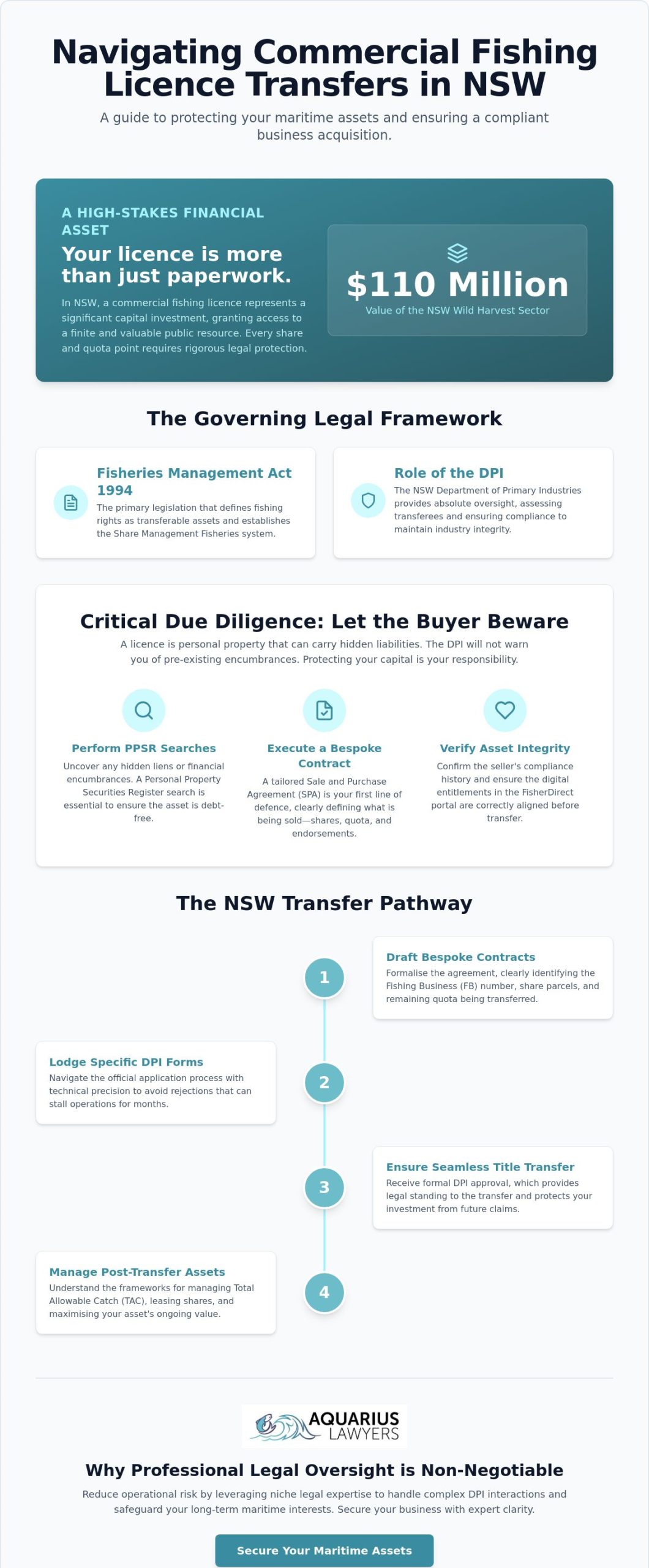
Transferring a commercial fishing licence in NSW is a business transaction involving significant capital and complex statutory rights. It’s a mistake to view this as mere paperwork; in the eyes of the law, a fishing licence is a transferable asset with a distinct market value. This value is derived from the access it grants to a finite public resource. Because the wild harvest sector in NSW is valued at approximately $110 million, the legal framework surrounding these assets is intentionally rigid to prevent over-exploitation and ensure industry stability.
The legal foundation for every commercial fishing licence transfer nsw is the Fisheries Management Act 1994. This legislation, alongside the Fisheries Management (General) Regulation 2019, dictates who can fish, where they can fish, and what gear they can use. The NSW Department of Primary Industries (DPI) maintains absolute oversight of this process. They don’t just rubber-stamp applications. Instead, they conduct a rigorous assessment to ensure the transferee meets “fit and proper person” criteria, maintaining the integrity of the state’s maritime economy. Without formal DPI approval, a transfer has no legal standing, leaving your investment unprotected and your operations at risk of heavy penalties.
The Statutory Framework for Fisheries
The Fisheries Management Act 1994 creates a structured environment where commercial access is managed through a Share Management Fisheries system. This system turns fishing rights into a form of “equity” within specific fisheries, such as the Estuary General or Ocean Hauling sectors. While the Australian Fisheries Management Authority (AFMA) manages Commonwealth fisheries that often sit adjacent to state waters, the DPI holds the reins for everything within the three-nautical-mile limit. A Fishing Business (FB) is the legal entity that bundles these shares, endorsements, and authorities into a single, recognisable unit for the purpose of trade and regulation.
Types of Entitlements Subject to Transfer
It’s vital to distinguish between the different components of a maritime business. A Commercial Fishing Licence belongs to the individual, whereas the Fishing Business (FB) contains the shares and endorsements required to actually work. While commercial fishing boat licences were largely removed in 2022 to streamline the industry, Charter Fishing Boat Licences remain distinct assets that must be transferred as a complete package.
By 2026, managing a commercial fishing licence transfer nsw requires a high degree of digital literacy. The DPI now prioritises the FisherDirect portal for real-time management of “effort units” and “quota” allocations. These units are the lifeblood of your operation, representing the specific amount of time or weight of catch you’re legally permitted to harvest. Ensuring these digital entitlements are correctly aligned during a transfer is the difference between a profitable season and a legal nightmare.
Due Diligence: Protecting Your Investment Before the Transfer
In the maritime industry, the principle of “Caveat Emptor”, or let the buyer beware, is the rule of the sea. When you initiate a commercial fishing licence transfer nsw, you’re doing more than just updating a government database. You’re acquiring a complex bundle of rights that may come with hidden strings attached. Unlike a standard property purchase, the DPI won’t necessarily warn you if the seller has a history of non-compliance or if the assets are tied up as collateral for a bank loan. You must verify the integrity of the asset yourself. Relying solely on the DPI’s administrative forms for protection is a strategy that often leads to expensive litigation.
A robust Sale and Purchase Agreement (SPA) is your first line of defence. This contract should be bespoke to fisheries law, clearly outlining exactly what is being sold: the fishing business number, the specific share parcels, and any remaining quota for the season. Without a formal agreement, you have very little recourse if the asset delivered doesn’t match the asset promised. Seeking advice from a firm that specialises in fisheries law is the most effective way to identify these hidden risks before they become your financial burden.
Searching for Liens and Encumbrances
A licence is legally classified as personal property, which means it can be used as security for a loan. Before settlement, you must conduct a search of the Personal Property Securities Register (PPSR). If a bank or a third party has registered an interest in the shares, that debt follows the asset. You could find yourself in a position where you’ve paid for a licence that you don’t actually own clear title to. Additionally, you should request a “Letter of Good Standing” from the DPI. This document confirms if there are pending prosecutions or demerit points against the business. Buying a licence with a history of demerit points is a liability; those points can lead to future suspensions, even under your new ownership.
Verifying Quota and Share Parcels
Never take a seller’s word regarding the number of shares or the amount of “Total Allowable Catch” (TAC) remaining. Use the Fisheries Business Register to confirm the exact ownership and quantity of shares currently held by the business. You need to be particularly wary of “quota leakage” during the settlement period. Quota leakage occurs when a seller continues to fish against the business’s allocation after the contract is signed but before the transfer is finalised, effectively draining the asset’s value before you take the helm. Your contract must include a clause that accounts for quota usage during this window to ensure you get exactly what you paid for.
The Step-by-Step Transfer Process in NSW
Moving from due diligence to the actual execution of a commercial fishing licence transfer nsw requires a disciplined sequence of actions. It’s a two-stage process: the private legal settlement between parties and the subsequent administrative registration with the state regulator. Many fishers make the mistake of treating these as the same thing. In reality, the DPI registration is the final “handshake” that confirms what your legal contract has already established. Missing a step here doesn’t just cause delays; it can leave you legally liable for a business you no longer control or financially committed to an asset you can’t yet use.
Executing the Contract of Sale
A standard commercial contract is rarely enough to protect a maritime buyer. You need a bespoke agreement that includes specific warranties regarding catch history and share authenticity. This contract must also address the “Commercial Fishing Trust” levies; you must ensure the seller has cleared all outstanding industry contributions before the keys change hands. While NSW has abolished stamp duty on most intangible business assets, you should still verify if any land-based components of the business, such as oyster leases or sheds, trigger a duty liability. Your solicitor should hold the deposit in a trust account, only releasing funds once the DPI provides formal notification that the transfer is approved. This protection is your only leverage if the regulator identifies a “red flag” during their assessment.
Lodge with the Department of Primary Industries
By 2026, the DPI has moved toward more rigorous digital lodgement requirements. You’ll typically use Form FB-1 for a standard fishing business or Form CB-2 for charter operations. Be prepared for the “Fit and Proper Person” test. The DPI evaluates your history of fisheries compliance; a significant record of offences can lead to a transfer being blocked entirely. Once lodged, the DPI processing timeline can vary. If they find an error in your share parcels or an undisclosed lien, they’ll issue a “stop-the-clock” request. This pauses the application until you provide further evidence, which is why having your paperwork verified by a fisheries lawyer beforehand is a pragmatic move that saves weeks of administrative back-and-forth.
Once the DPI approves the transfer, the final steps are operational. You must settle the financial balance through your solicitor’s trust account and immediately update the digital FishOnline portal. If you aren’t the one physically pulling the nets, you must lodge a notification to change the “Nominated Fisher” on the licence. This ensures that the person on the water is legally linked to your business. Finally, verify that your “Total Allowable Catch” (TAC) and effort units have migrated correctly into your digital account. If the numbers don’t match your contract, you must raise the issue immediately before the season progresses.
Managing Quotas, Shares, and Effort Units Post-Transfer
Once the commercial fishing licence transfer nsw is registered in your name, the focus shifts from acquisition to active asset management. Your shares aren’t just entries in a register; they are the engine of your business productivity. In NSW, many fisheries operate under a Total Allowable Catch (TAC) model, where your shareholding translates into a specific weight of fish you can harvest each season. This allocation is dynamic. It can fluctuate based on scientific assessments of fish stocks, meaning your business strategy must be flexible enough to handle varying yields. Efficient management equals long-term profitability.
You have a choice: work the shares yourself or lease them out. Leasing is a common strategy for diversifying income or managing seasonal downtime. However, the legalities of a lease agreement are just as rigorous as the initial transfer. You must ensure that the lessee complies with all environmental and catch reporting requirements, as their mistakes can ultimately reflect on the standing of your fishing business. If you need help structuring these agreements to protect your interests, contact our fisheries law team to ensure your assets are legally secured.
Share Management and Leasing Strategies
There is a distinct legal separation between being a shareholder and being a “Nominated Fisher”. You can own the business while appointing a skipper to operate the vessel. When structuring a lease for effort units, your contract must clearly define the duration, the specific quota being leased, and the reporting responsibilities. One vital piece of advice: always track your “Catch History”. In future industry restructures or buy-back schemes, your catch history often determines the compensation or future allocation you receive. It is the documented proof of your asset’s performance and is essential for maintaining the long-term value of your investment.
Compliance and Reporting Obligations
Post-transfer, your primary interface with the DPI is the FishOnline portal. This digital system is where you report your catch and manage your quota in real-time. Failing to lodge accurate reports isn’t just a minor oversight; it’s a breach of the Fisheries Management Act 1994 that carries heavy fines. Your logbook serves as the primary legal record of your activities and must be kept up to date to maintain licence validity. You must also account for the Commercial Fishing Trust levies. These are annual contributions that fund industry research and management; failing to pay these can result in the DPI suspending your ability to transfer or lease shares in the future.
Finally, be aware of “use it or lose it” provisions. In some NSW share fisheries, prolonged inactivity can lead to the cancellation of endorsements. This makes active participation or strategic leasing essential to maintaining your licence’s validity. You should also monitor marine park zoning changes. A transfer of rights into a region that is later declared a sanctuary zone can significantly impact your operational capacity, so staying informed about spatial management is a core part of your compliance routine.
Why Professional Legal Oversight is Non-Negotiable
Navigating a commercial fishing licence transfer nsw without specialised legal support is a high-risk strategy. The DPI operates as a regulator, not a business mentor, meaning their primary goal is compliance rather than your commercial success. This is why Katherine Hawes, known throughout the industry as “The Fish Lawyer”, is a vital asset for any maritime business owner. Katherine brings a unique blend of academic distinction and practical experience to every transaction. She understands the synergy between traditional fishing practices and the complex, modern legal requirements that define the current industry landscape. It’s about more than just filling out forms; it’s about protecting a multi-generational legacy.
Aquarius Lawyers acts as your trusted advisor, ensuring that every DPI lodgement is technically perfect. A single error in a Form FB-1 or a misunderstood share parcel can lead to months of administrative delays or even the rejection of your application. We prevent these costly mistakes by acting as a “no-nonsense” filter for your paperwork. If a transfer is contested by a third party or a seller fails to deliver the promised quota, our team is equipped to handle complex litigation. We move quickly to resolve issues, prioritising your ability to get back on the water and start generating a return on your investment.
Strategic Advice from “The Fish Lawyer”
Katherine Hawes integrates modern technology with traditional maritime law to offer a streamlined experience for fishers. We use digital tools to verify PPSR filings and FishOnline records rapidly, ensuring your data is accurate before the first signature is even penned. To provide our clients with financial certainty, we often utilise fixed-fee arrangements for licence conveyancing. This transparency ensures you know exactly what your legal costs are upfront, allowing you to budget for your new venture without hidden surprises. Our approach combines high-level strategic thinking with relatable, everyday wisdom to get the job done right.
Protect your commercial fishing future—contact Aquarius Lawyers today.
Beyond the Transfer: Ongoing Fisheries Support
Our relationship with clients rarely ends at the settlement table. We provide ongoing support for fisheries prosecution defence and comprehensive compliance audits to keep your business on the right side of the law. Given the high value of NSW fishing businesses, we also specialise in estate planning and succession law. Ensuring your shares and licences are correctly structured for the next generation is a proactive step that prevents future family disputes and unnecessary tax liabilities. We offer a pathway to long-term security, acting as a facilitator of positive outcomes in an increasingly regulated environment.
Organise a consultation with Katherine Hawes to secure your assets.
Secure Your Maritime Legacy and Assets
A successful transition in the fisheries industry requires more than just submitting forms; it demands a strategic approach to asset protection and regulatory compliance. By prioritising thorough due diligence and executing bespoke contracts, you safeguard your business against hidden liens and quota leakage. Remember that the administrative registration with the DPI is only the final step of a much larger legal journey. Mastering your commercial fishing licence transfer nsw ensures that your hard-earned shares and effort units remain productive and legally secure for years to come.
Protecting your livelihood shouldn’t be a guessing game. Principal Katherine Hawes, widely recognised as “The Fish Lawyer”, provides the specialist expertise in the Fisheries Management Act 1994 needed to navigate this complex bureaucracy. We offer fixed-fee options for maritime conveyancing, giving you total financial clarity from the start. Secure your NSW fishing licence transfer with Aquarius Lawyers and gain the confidence of having a veteran advisor by your side. We’re here to help you turn legal hurdles into a clear pathway for commercial growth and long-term stability.
Frequently Asked Questions
How long does a commercial fishing licence transfer take in NSW?
A standard transfer typically takes between four and six weeks once the DPI receives a complete and correct application. This timeline depends heavily on the accuracy of your paperwork and the current administrative workload at the department. If the regulator identifies errors or requires additional evidence, they’ll issue a notice that pauses the clock until the issue is resolved.
Can I transfer my NSW fishing licence to a family trust or company?
You can absolutely hold a fishing business in the name of a company or a partnership to suit your business structure. While a family trust isn’t a legal person itself, it can hold the licence through a corporate trustee. This is a common strategy for asset protection and tax planning; however, you must still nominate a natural person to physically conduct the fishing activities on the water.
What happens to my quota if the DPI rejects the transfer application?
If the DPI rejects the application, the quota and shares remain the legal property of the original owner. This is why financial settlement should never occur until you receive formal notification of approval from the regulator. If you’ve already paid the seller, you’ll need to rely on the specific dispute resolution or refund clauses in your contract of sale to recover your funds.
Are there stamp duty implications for transferring a fishing business in NSW?
There is generally no stamp duty on the transfer of intangible assets like fishing licences or shares in NSW. This tax was abolished for most business transfers several years ago to encourage industry investment. However, if the sale includes dutiable property such as land, oyster leases, or permanent structures, you may still face a duty liability. It’s a pragmatic step to have your solicitor verify the specific components of your deal.
What is the difference between a “Nominated Fisher” and a licence owner?
The licence owner is the entity that holds the legal title and capital value of the shares, while the Nominated Fisher is the individual authorised to physically operate under that licence. You don’t have to be the person pulling the nets just because you own the business. This distinction allows investors or retired fishers to maintain their assets while appointing a skipper to handle the daily operations.
Can a licence be transferred if there is an ongoing fisheries prosecution?
Transferring a licence during an active prosecution is possible but extremely difficult and carries significant risk. The DPI has the power to refuse a commercial fishing licence transfer nsw if they believe the transaction is intended to circumvent legal penalties or demerit points. Any buyer should be wary of these situations; as discussed earlier, demerit points can sometimes stay with the business even after the ownership changes.
How do I check if a fishing licence has any undisclosed debts or liens?
You check for undisclosed interests by conducting a search of the Personal Property Securities Register (PPSR) and requesting a “Letter of Good Standing” from the DPI. The PPSR reveals if a bank or creditor has a registered charge over the shares. The DPI letter confirms if there are any outstanding levies or industry contributions that could prevent a clean title transfer or lead to future suspensions.
What are the DPI fees for a licence transfer in 2026?
As of 2026, the fee for a standard commercial fishing licence transfer nsw involving restricted fishery endorsements or the registration of dealing in shares is $320.00. If you’re registering a mortgage or other interest in the shares, the cost is $561.00. Manual transfers of quota attract a fee of $240.00. These fees are set by the DPI and are subject to annual adjustments, so always verify the current rates on the FisherDirect portal.
Disclaimer
Please note that legal rules change and this is not a substitute nor construed as legal advice. It is general information only.