
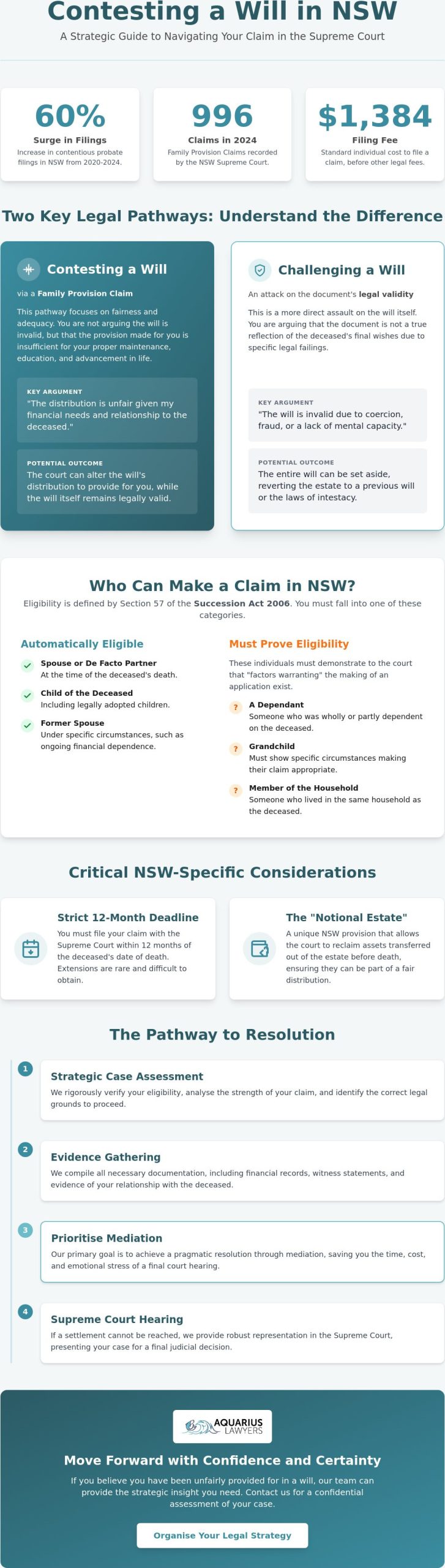
Did you know that contentious probate filings in New South Wales surged by 60% between 2020 and 2024? This spike isn’t just about family friction; it’s a direct result of soaring property values and the rise of complex blended families. If you feel you’ve been unfairly left out, you’re likely searching for the specific grounds for contesting a will nsw to see if your case has legs before the strict 12-month deadline passes.
We understand that facing the Supreme Court is daunting, especially when you’re balancing emotional grief with a $1,384 individual filing fee. It’s a high-stakes environment where personal distress meets rigid legal criteria. You need a clear, no-nonsense roadmap that cuts through the confusion between “challenging” a will’s validity and “contesting” its provisions for your maintenance and support.
This guide provides that clarity. We’ll explore the unique “notional estate” provisions that exist only in NSW and detail the eligibility requirements under the Succession Act 2006. You’ll learn how to navigate the mediation process and understand exactly what the court looks for when deciding to redistribute assets. Our goal is to give you the strategic insight needed to move forward with confidence and certainty.
Key Takeaways
- Distinguish between challenging a will’s validity and contesting for fair provision to ensure your legal strategy hits the mark from the start.
- Verify your status as an “eligible person” under the Succession Act, as being a relative doesn’t always equate to a legal right to a claim.
- Identify the specific legal grounds for contesting a will nsw, from proving a lack of testamentary capacity to uncovering evidence of undue influence.
- Navigate the strict 12-month filing deadline and learn how unique NSW “notional estate” rules can pull shifted assets back into the pool for distribution.
- Discover a pragmatic resolution pathway that prioritises mediation, aiming to settle your case efficiently before it reaches a costly final hearing.
Understanding the Legal Grounds for Contesting a Will in NSW
Many people use the terms “contesting” and “challenging” interchangeably, but in the legal world, they represent two very different strategic pathways. Getting this distinction right is the first step toward a successful outcome. Our approach at Aquarius Lawyers combines traditional legal rigour with a pragmatic, solution-oriented methodology. We don’t just look at the law; we look at the most efficient way to resolve your dispute. We act as your trusted advisor, focusing on results over ceremony to ensure you aren’t bogged down in unnecessary litigation.
The Supreme Court of New South Wales holds the exclusive power to determine these estate disputes. It acts as the final gatekeeper of fairness. In 2024 alone, the court recorded 996 family provision claims, reflecting a growing trend of individuals seeking a more equitable distribution of assets. A Family Provision Claim is the primary vehicle for contesting a will in NSW.
Contesting a Will: The Family Provision Pathway
This pathway focuses on the adequacy of the provision left to you. It isn’t about whether the document is legally binding; it’s about whether the outcome is fair based on your specific circumstances. The court examines your current financial needs and the nature of your relationship with the deceased person. If the provision is deemed insufficient for your proper maintenance and support, the court has the power to alter the distribution. This process doesn’t necessarily mean the will itself is invalid. Instead, it’s a strategic adjustment to ensure moral obligations are met. Success in these cases often follows a simple formula: Proven Eligibility + Demonstrated Financial Need = Court-Ordered Provision.
Challenging a Will: Attacking the Validity
Challenging a will is a more aggressive stance that targets the document’s legal standing. You’re essentially arguing that the will isn’t a true reflection of the deceased’s final wishes. Common grounds for contesting a will on validity bases include a lack of testamentary capacity, fraud, or undue influence. If you can prove that the deceased was coerced or lacked the mental clarity to understand the document’s impact, the court can set the entire will aside. This often reverts the estate to a previous will or triggers the laws of intestacy. Identifying the correct grounds for contesting a will nsw is vital, as a validity challenge requires a much higher threshold of evidence than a family provision claim.
Eligibility: Who Has the Right to Make a Claim?
Not everyone who feels slighted by a will has the legal standing to do something about it. In New South Wales, the law is quite specific about who can step into the ring. Section 57 of the Succession Act 2006 (NSW) acts as a gatekeeper, listing the exact categories of “eligible persons.” If you don’t fall into one of these buckets, your case won’t even reach the starting blocks. Many people mistakenly believe that being a blood relative automatically entitles them to a “fair go” in court. This isn’t the case. The law prioritises those to whom the deceased had a clear moral obligation to provide maintenance and support.
Eligibility is the foundation of your case. Without it, you have no pathway to a resolution. If you’re unsure where you sit on the eligibility spectrum, our team can help you organise your legal strategy to determine if you have a viable claim before you invest in court fees.
Immediate Family and Spouses
Spouses and de facto partners sit at the top of the eligibility hierarchy. This includes current husbands, wives, and de facto partners, regardless of gender. In NSW, proving a de facto relationship involves looking at the “nature and extent” of your common residence, financial interdependence, and the care and support of children. Children of the deceased, including legally adopted children, also have an automatic right to claim. Former spouses are a more complex category. They generally only have standing if they haven’t entered into a final property settlement or if they can demonstrate a continued financial dependence that creates a moral obligation.
Dependants and Extended Family
Grandchildren and members of the deceased’s household face a steeper climb. These individuals aren’t automatically eligible; they must pass the “factors warranting” test. This means they must prove to the Supreme Court that there are specific circumstances that make their claim appropriate. Usually, this involves demonstrating that you were wholly or partly dependent on the deceased at some point in your life. In a modern Australian context, this dependency isn’t just about cash transfers. It can include housing, significant gifts, or ongoing domestic support. If you can’t prove this dependency, you likely won’t have the grounds for contesting a will nsw as an extended family member. The court is wary of “estate raiding” and requires concrete evidence that a genuine relationship of reliance existed.
Grounds for Challenging Validity: Capacity and Influence
While Section 2 covered who can legally step into the ring, this section focuses on the fight itself. Challenging a will’s validity is a technical process that requires more than just a feeling of unfairness. It’s about proving the document is a legal fiction. To succeed, you must meet specific Supreme Court of NSW proceedings criteria that haven’t changed much in principle, even as technology evolves. The most common grounds for contesting a will nsw on validity grounds involve capacity and influence.
The “Banks v Goodfellow” test remains the benchmark in 2026. For a will to be valid, the deceased must have understood the effect of making a will, the extent of their assets, and the moral claims of potential beneficiaries. If they were suffering from a disorder of the mind that poisoned their affections, the will is vulnerable. Knowledge and approval go a step further. It’s not enough to have capacity; the person must have actually known and approved the contents of the document they signed. Fraud and forgery are the rarest grounds because the bar for proving criminal intent in a civil court is exceptionally high.
Proving Lack of Testamentary Capacity
Capacity isn’t a black-and-white medical diagnosis. It’s a legal determination. We often see cases where a person has early-stage dementia but experiences a “lucid interval” during which they can legally sign a will. Proving a lack of capacity requires a strategic blend of medical records, nursing home notes, and witness testimony. We organise expert medical witnesses who can translate complex clinical data into the specific legal language the court requires. This intersection of medical evidence and legal standards is where many cases are won or lost.
Suspicious Circumstances and Undue Influence
Undue influence is notoriously difficult to prove in Australian law. It requires evidence of coercion, not just persuasion or “nagging.” You must show that the deceased’s will was overborne, effectively making the document the beneficiary’s will rather than their own. Warning signs often include a will made in secret shortly before death or a sudden, drastic change in beneficiaries. Our “Fish Lawyer” approach takes a no-nonsense look at these suspicious circumstances. We peel back the layers of the evidence to see if the deceased was a free agent or a victim of pressure. This pragmatic methodology ensures we focus on the facts that actually influence a judge’s decision.
The NSW Notional Estate and Critical Time Limits
Timing is everything when it comes to estate disputes. In New South Wales, the clock starts ticking the moment a person passes away. You have a strict 12-month window from the date of death to file a Family Provision Claim. Missing this deadline is often fatal to your case. While you might be searching for the legal grounds for contesting a will nsw, the best legal argument in the world won’t help if you’re a day late. This timeframe exists to allow executors to distribute assets with certainty, but it places immense pressure on you to act while you’re still grieving.
New South Wales is the only state in Australia with “notional estate” provisions under the Succession Act 2006. This is a game-changer for fairness. It prevents people from deliberately emptying their bank accounts or transferring property to others before they die just to spite a potential claimant. The Supreme Court can designate property as “notional estate” even if it wasn’t owned by the deceased at the time of their death. This includes assets transferred up to three years before death if there was an intent to deny a claim, or within one year if a moral obligation existed. It’s a powerful tool that ensures the “pot” available for distribution actually reflects the deceased’s true wealth.
Assets Outside the Direct Estate
Many people believe that jointly held property or superannuation is “off-limits” because of the right of survivorship. This is a common myth. In NSW, these assets can be clawed back into the estate pool. Family trusts are also vulnerable. If the deceased had the power to control the trust or redirect its assets, those funds might be designated as part of the notional estate to satisfy a claim. The Supreme Court can designate property as “notional estate” to ensure that an eligible person receives the provision they deserve, regardless of how the assets were titled at the time of death.
Navigating Time Limits and Extensions
Waiting until the eleventh month is a high-risk strategy. If an executor distributes the estate assets before you file, recovering them becomes significantly more difficult and expensive. You must proactively notify the executor of your intention to claim. If you have already missed the 12-month mark, the court requires you to show “sufficient cause” for the delay. This isn’t easy. You’ll need to prove that the delay was reasonable or that you were unaware of your rights. To protect your interests before the clock runs out, you should contact our Wills and Estates experts to secure your position and begin the notification process.
The Pathway to Resolution: How Aquarius Lawyers Organises Your Case
Resolving an estate dispute shouldn’t feel like an endless battle. At Aquarius Lawyers, we prioritise a pragmatic “Pathway” strategy that values your time and emotional well-being. While you’ve identified the grounds for contesting a will nsw, the next step is a strategic calculation of risk versus reward. We focus on mediation over litigation because it offers a faster, more private resolution than a public court hearing. Statistics from across the legal industry suggest that approximately 90% of NSW will contests settle before reaching a final hearing. This shift is reflected in the court’s own data, with court-annexed mediations in succession and probate cases rising significantly to 735 in 2025.
The engine room of your claim is the “Affidavit of Evidence.” This document isn’t just a statement; it’s a comprehensive map of your financial history, your current needs, and the nature of your relationship with the deceased. We help you build this evidence meticulously to demonstrate why the current provision is inadequate. Regarding expenses, the general principle in successful or meritorious claims is that costs are paid out of the estate. This ensures that legal fees don’t become an insurmountable barrier to seeking a fair outcome, provided your claim has a solid legal foundation.
The Compulsory Mediation Process
Mediation is a mandatory step in the Supreme Court process. It brings all parties together with an independent mediator to find a common-sense middle ground. We prepare your case to maximise leverage during these negotiations, ensuring you enter the room from a position of strength. A successful mediation avoids the unpredictability of a judge’s ruling. It also keeps the sensitive details of your family dispute out of the public record, maintaining a level of privacy that a courtroom cannot offer.
Strategic Litigation in the Supreme Court
Sometimes, a settlement isn’t possible. If a court hearing becomes unavoidable, your case will be heard in the Equity Division of the Supreme Court. We integrate modern technology to streamline document management and evidence, ensuring your story is told with clarity and precision. This tech-savvy approach allows us to manage complex estate data efficiently, keeping the focus on the strategic resolution of your claim. Organise a consultation with Aquarius Lawyers to assess your grounds and determine the most effective pathway for your specific situation.
Take the First Step Toward a Fair Resolution
Securing your future requires more than just a sense of unfairness; it demands a strategic understanding of your legal standing. You now know that the 12-month filing deadline is a hard limit and that the unique notional estate rules in NSW ensure that shifted assets aren’t out of reach. Identifying the valid grounds for contesting a will nsw is the essential first step toward achieving an equitable outcome. Success depends on the synergy between precise evidence, financial documentation, and a clear moral claim for support.
Principal Katherine Hawes is a recognised “innovative veteran” in NSW law with specific expertise in complex maritime and commercial estates. With multiple office locations across the state, we provide local access to high-level strategic thinking and down-to-earth advice. We focus on pragmatic pathways that prioritise mediation to save you the significant costs and stress of a full court hearing. Our methodology is designed to provide you with a clear solution rather than just an endless legal process.
Secure your legacy and organise a strategy session with Katherine Hawes today. Taking proactive steps now provides the clarity and confidence you need to resolve these challenging family matters. You don’t have to face the Supreme Court alone; we’re here to guide you through every step of the journey.
Frequently Asked Questions
How long do I have to contest a will in NSW?
You have exactly 12 months from the date of the deceased’s death to file a Family Provision Claim in the Supreme Court. This is a strict statutory deadline stipulated by the Succession Act 2006 (NSW). While the court can grant an extension if you show “sufficient cause” for the delay, these applications are complex and often expensive, making it vital to act within the first year.
Can I contest a will if I was intentionally left out?
Yes, you can still make a claim even if the deceased explicitly stated they wanted to exclude you from their will. The court prioritises whether the deceased had a moral obligation to provide for your maintenance and support over their personal desire to disinherit you. If you are an “eligible person” with a demonstrated financial need, the court has the power to override the written instructions in the will.
What are the legal costs for contesting a will, and who pays?
The filing fee to start a probate matter in the Supreme Court is $1,384 for an individual as of July 2025. While you’ll need to cover your initial legal costs, the general rule in NSW is that if your claim is successful or has significant merit, the court will order your costs to be paid out of the estate. This ensures that eligible persons aren’t barred from seeking justice due to their own financial situation.
Do I have to go to court to contest a will in Sydney?
Most disputes are resolved through mediation rather than a public court hearing. In 2025, there were 735 court-annexed mediations in succession cases, and roughly 90% of these matters settle before reaching a final judge’s ruling. Mediation is a compulsory, private process that allows all parties to find a common-sense middle ground without the stress and expense of a full trial.
Can a grandchild contest a will in NSW?
Grandchildren are eligible to claim, but they must pass the “factors warranting” test to show why their claim is appropriate. This usually involves proving you were wholly or partly dependent on your grandparent at some point in your life. Identifying the specific grounds for contesting a will nsw is particularly important for grandchildren, as the court requires concrete evidence of a genuine relationship of reliance.
What happens if the deceased died without a will (intestacy)?
If there is no will, the estate is distributed according to a strict legal formula known as the laws of intestacy. With nearly 60% of people in NSW dying without a valid will, this situation is increasingly common. If the intestacy formula doesn’t provide you with a fair share, you can still make a Family Provision Claim to seek a distribution that reflects your actual financial needs and relationship.
Can I contest a will if I’ve already received a small gift?
Receiving a small legacy or “token” gift doesn’t prevent you from seeking a larger share of the estate. The legal threshold is whether the provision left for you is “adequate” for your proper maintenance and support. If your financial circumstances and the total value of the estate justify a larger amount, the court can increase your share regardless of any initial gift mentioned in the will.
Is a ‘DIY Will’ easier to contest than one drafted by a solicitor?
DIY wills are often more vulnerable to challenges because they frequently contain technical errors or vague language that a solicitor would avoid. These documents are more likely to be contested on the grounds of “knowledge and approval” or improper execution. A professionally drafted will provides a much higher level of certainty, whereas a DIY version often creates more opportunities for a validity challenge in the Supreme Court.
Disclaimer
Please note that legal rules change and this is not a substitute nor construed as legal advice. It is general information only.