
What if the legacy you’ve spent a lifetime building isn’t decided by your final wishes, but by a rigid mathematical formula dictated by the government? Many people worry that failing to leave a legal document means the State simply takes everything, or that their family will be left in a spiral of expensive legal disputes. It’s a valid concern, especially when you’re trying to understand exactly what happens if you die without a will in nsw. The process of applying for Letters of Administration often feels like a complex maze, but it shouldn’t be a source of constant anxiety.
This guide provides the clarity you need by explaining how the Succession Act 2006 (NSW) distributes assets and protects your loved ones. You’ll discover the specific 2026 inheritance hierarchy, including the current statutory legacy amount of $611,387.84 for spouses. We’ll also outline the practical steps to secure legal authority over an estate, giving you the confidence that your family’s interests remain the priority throughout the administration process.
Key Takeaways
- Understand how the Succession Act 2006 (NSW) operates as a default legal blueprint for your estate when no valid will is in place.
- Gain a clear breakdown of what happens if you die without a will in nsw, including how assets are divided between spouses and children under current 2026 regulations.
- Learn the essential steps for applying for Letters of Administration, including how to identify the correct administrator and satisfy the Court’s search requirements.
- Identify the hidden financial risks and legal complexities of intestacy, from increased court fees to the heightened potential for family provision claims.
- Discover how strategic legal guidance can streamline the resolution of complex estates involving property or commercial interests to protect your family’s legacy.
Understanding Intestacy: What it Means to Die Without a Will in NSW
Dying ‘intestate’ simply means passing away without leaving a valid will. In New South Wales, this triggers a specific legal sequence where the State doesn’t just guess your intentions. Instead, the Succession Act 2006 (NSW) steps in as a pre-written, default will for the deceased. This legislation provides a rigid framework to determine who receives your property, money, and personal effects. While it offers a safety net, it lacks the nuance of a personal document. Understanding Intestacy is the first step in realising why a proactive approach to estate planning is vital for protecting your family’s future.
When families ask exactly what happens if you die without a will in nsw, they’re often looking for certainty during a period of grief. The reality is that your assets are distributed according to a strict hierarchy of ‘eligible relatives’ rather than your personal preferences. This shift also changes the legal terminology and the burden of proof. You no longer have an ‘Executor’ named in a will; instead, the Supreme Court of NSW appoints an ‘Administrator’ through a process called Letters of Administration. This individual takes on the legal responsibility of settling debts and distributing what remains.
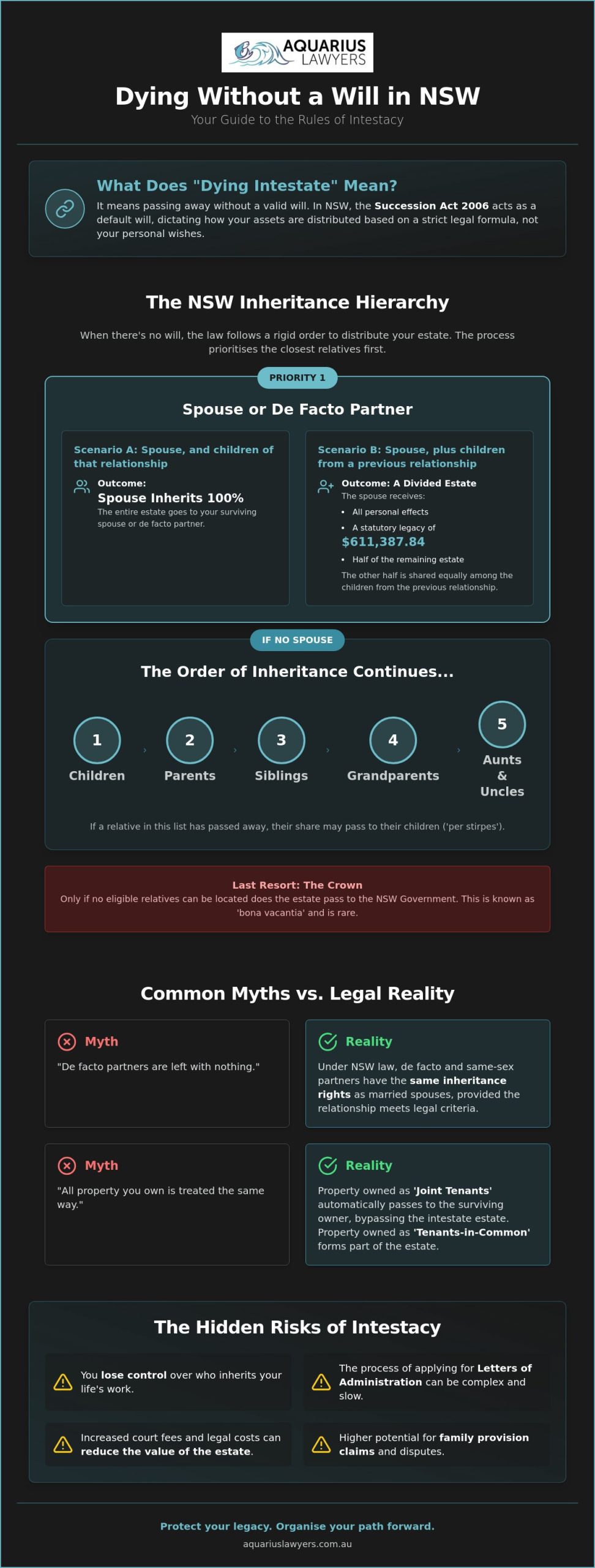
There’s a persistent fear that the ‘State’ or the ‘Crown’ will simply seize your bank accounts. Rest assured that this only happens as a final resort, a legal concept known as ‘bona vacantia’. It only applies if the Court determines that no eligible relatives, including distant cousins, can be located. The law is designed to keep assets within the family tree whenever possible, even if the resulting distribution isn’t what you would have chosen.
The Legal Reality of the Succession Act 2006
The NSW Parliament designed this Act to provide a predictable outcome for estates. It prioritises spouses, de facto partners, and children above all others. If you have a straightforward family structure, the law might align with your wishes. However, it often fails to account for modern family dynamics, such as step-children or close friends you consider family. The legal pathway also differs significantly. While a valid will requires a Grant of Probate, an intestate estate requires Letters of Administration. This often involves more rigorous proof of kinship and asset value to satisfy the Court’s requirements.
Common Misconceptions About Intestacy
Many people believe de facto partners are left with nothing if there’s no will. Under NSW law, de facto and same-sex partners have the same inheritance rights as married spouses, provided the relationship meets specific criteria of duration or shared life. Another critical factor is how you own property. If you own a home as ‘joint tenants’ with someone else, that property usually passes to the survivor regardless of what happens if you die without a will in nsw. However, if you are ‘tenants-in-common’, your specific share becomes part of the intestate estate. This distinction can lead to significant family friction if not managed with professional strategy.
The NSW Intestacy Hierarchy: Who Inherits What?
The distribution of an estate without a will isn’t a random process. It follows a rigid, tiered hierarchy established by the Succession Act 2006 (NSW). This system ensures that the closest relatives are prioritised. If you die leaving only a spouse or de facto partner, and any children you have are also their children, that spouse inherits the entire estate. This is the simplest scenario. However, the complexity increases significantly in blended family situations. If you have children from a previous relationship, the law divides the assets between your current spouse and those children. This often leads to the family home being sold to satisfy the legal entitlements of different parties.
When there is no spouse and no children, the law searches further down the family tree. The order moves to parents, then siblings, and eventually to grandparents or aunts and uncles. A key concept here is ‘per stirpes’. If a sibling was supposed to inherit but has already passed away, their share is divided among their own children (your nieces and nephews). This ensures the lineage is respected, though it can make the administration process quite cumbersome. If you’re managing a complex family structure after a loss, seeking advice on wills and estates can help clarify these entitlements quickly.
Defining a “Spouse” in 2026 NSW Law
In 2026, the definition of a spouse includes married partners and de facto partners, including same-sex couples. To qualify as a de facto spouse, you generally must have lived together for at least two years or have a child together. For the period of 30 April 2026 to 29 July 2026, a spouse’s ‘Statutory Legacy’ is $611,387.84. This is the first amount paid to a spouse from the estate before other beneficiaries are considered. If there are multiple spouses, such as a legal wife and a de facto partner, they may have to share this legacy. This is a common point of contention that requires precise legal navigation to resolve.
When Children Inherit: Rights and Restrictions
All biological and legally adopted children have equal rights to the estate. It’s a common shock to many families that step-children are generally excluded from this hierarchy. Unless a step-child was legally adopted, they do not automatically inherit when considering what happens if you die without a will in nsw. For minor children, their portion of the inheritance is usually held in trust. This is often managed by the NSW Trustee and Guardian or a private trustee until the child turns 18. This safeguard ensures the funds are preserved, but it can limit the surviving parent’s immediate access to capital for the child’s upbringing.
How to Apply for Letters of Administration in NSW
Securing the legal authority to manage an estate when there is no will requires a specific application to the Supreme Court of NSW. This process results in a document known as ‘Letters of Administration’. It effectively replaces a Grant of Probate. The first step is identifying the correct Administrator. Usually, this is the person with the largest entitlement to the estate, such as a spouse or the next of kin. This individual takes on the responsibility of a fiduciary, meaning they must act in the best interests of all beneficiaries and creditors. If you are unsure who should lead this process, seeking advice on what happens if you die without a will in nsw can prevent early procedural errors.
Before the Court considers an application, you must prove that a will doesn’t exist. This isn’t a casual check. You must search the deceased’s home, contact their previous solicitors, and check with the NSW Trustee and Guardian. Once you are certain the deceased died intestate, you must publish a Notice of Intended Application on the NSW Online Registry. You must then wait at least 14 days before lodging your formal papers. This waiting period allows any potential executors or creditors to come forward.
The formal application involves several critical documents. You must prepare an ‘Affidavit of Applicant’ which outlines the family tree and confirms that a thorough search for a will was conducted. Currently, the Supreme Court of NSW filing fee for a Letters of Administration application starts at $895. If there is more than one administrator, an additional $175 is charged for each extra person. These costs are usually reimbursed from the estate assets once the grant is issued.
Required Documentation and Evidence
The Court requires the original Death Certificate issued by the Registry of Births, Deaths and Marriages. You also need a comprehensive list of assets and liabilities. This includes recent valuations for real estate, bank statements, and share portfolio summaries. If the family structure is complex, the Court may require a formal ‘Genealogy Search’. This report, often prepared by professional researchers, proves the identity of all eligible relatives to ensure no one is unfairly excluded from their inheritance.
Timeline and Court Expectations
In 2026, the Supreme Court typically processes straightforward applications within four to six weeks. However, ‘requisitions’ or formal questions from the Court Registry can cause significant delays. These usually happen if the family tree evidence is incomplete or if asset valuations are vague. A critical rule for every Administrator is the ‘6-month rule’. You should generally wait six months from the date of death before distributing assets. This protects you from personal liability if a surprise creditor or a family provision claim arises later.
The Hidden Risks: Why Intestacy is a Legal Headache
The financial burden of intestacy often catches families off guard. While a simple Grant of Probate is a streamlined confirmation of a will, Letters of Administration involve a higher degree of scrutiny. This translates to higher legal fees and more rigorous evidentiary requirements. Mistakes aren’t cheap. Court applications to rectify errors in an intestate estate can cost between $10,000 and $30,000. This is a significant drain on the assets you intended for your loved ones. When you consider what happens if you die without a will in nsw, you must account for these avoidable administrative leaks.
Tax planning is another casualty of dying without a will. You lose the opportunity to establish testamentary trusts. These are powerful tools for protecting assets and minimising tax for your beneficiaries. Without these structures, your heirs might face immediate Capital Gains Tax (CGT) liabilities that could have been deferred or reduced. Beyond the money, you lose the right to choose who manages your legacy. An ‘Administrator’ is appointed by the Court based on legal interest. They aren’t necessarily the person you would have trusted to handle your affairs with the right temperament or skill.
Rigid legal formulas also fuel family disputes. Intestacy often triggers ‘Family Provision’ claims under the Succession Act, as the default distribution may not reflect the actual financial needs of your dependants. These claims are notoriously expensive. Legal fees for such disputes frequently range from $20,000 to over $100,000, quickly eroding the value of the estate. To avoid these pitfalls, it’s vital to organise your estate planning with a strategy that considers both legal and commercial realities.
Special Risks for Business Owners and Primary Producers
For those in the maritime or primary production sectors, the risks are even more acute. What happens to commercial fishing licences or aquaculture permits? Without a will, these specialised assets can enter a state of legal limbo. A business can easily stagnate while waiting four to six weeks for a Grant of Administration. During this time, critical operational decisions cannot be made. This delay can lead to the loss of seasonal income or the expiration of time-sensitive permits. Protecting these unique commercial interests requires a veteran’s perspective on maritime law.
The Emotional Toll on Grieving Families
The process of proving a family tree to the Court is emotionally draining. It forces grieving relatives to document their private lives and relationships during their most vulnerable moments. Intestacy can also cause ‘missing’ relatives to emerge. Distant cousins who haven’t been in contact for decades might suddenly have a legal claim to your assets. This often leads to bitter arguments over sentimental items and family heirlooms, as there are no clear instructions to guide the division of personal chattels.
How Aquarius Lawyers Organises Your Path Forward
Dealing with the aftermath of a loss is difficult enough without the added weight of legal uncertainty. When you’re forced to confront what happens if you die without a will in nsw, you need more than just a solicitor. You need a trusted advisor who can cut through the procedural noise and provide a clear pathway to resolution. We specialise in taking the burden of intestacy off your shoulders. Our team blends deep, traditional credentials with a modern, tech-forward methodology to ensure that assets are protected and distributed with minimal friction.
Whether the estate involves a family home in Sydney or complex commercial assets like fisheries permits and maritime vessels, we apply a no-nonsense pragmatism to every matter. We understand that efficiency is the priority. Our approach is designed to move your application through the Supreme Court of NSW as quickly as possible, avoiding the stagnation that often plagues intestate estates. By layering expert strategy over practical application, we transform a stressful legal requirement into a structured process of resolution and progress.
Our role is to facilitate outcomes that respect the deceased’s life while protecting the survivors. We move easily between different areas of focus, from property law to debt recovery, ensuring that every liability is settled and every asset is accounted for. This intellectual versatility is what defines our firm. We value results over ceremony, providing you with grounded, common-sense guidance that restores your confidence during a complex time.
Our Approach to Letters of Administration
We’ve refined the evidence-gathering process to save families valuable time. Our methodology involves using advanced tools to track down bank accounts, shares, and property titles across multiple jurisdictions. This perspective ensures that your ‘Affidavit of Applicant’ is exhaustive and accurate, significantly reducing the risk of Court requisitions. We also act as a professional buffer. By managing communications between beneficiaries, we proactively resolve tensions before they escalate into costly litigation.
Securing Your Legacy Today
The best way to handle intestacy is to prevent it from ever happening again. Once we’ve resolved the immediate crisis, we work with you to transition from the chaos of an unplanned estate to a robust, future-proof strategy. We provide the ‘innovative veteran’ guide to drafting wills that are designed to stand up to the most rigorous legal challenges. This is particularly vital for those in the aquaculture and maritime industries, where standard templates often fail to capture the complexity of commercial licences and international interests.
Book a consultation with Aquarius Lawyers to protect your estate and ensure your legacy is managed on your own terms, not the government’s.
Take Control of Your Family’s Legal Future
Dying without a will doesn’t have to mean your legacy is lost to administrative chaos. By understanding the NSW intestacy hierarchy and the specific steps required for Letters of Administration, you can navigate even the most complex estates with clarity. Protecting commercial assets, especially within the maritime and aquaculture sectors, requires a strategy that goes beyond standard legal templates. It’s about ensuring your hard work benefits the people you choose, rather than following a default government formula.
Principal Katherine Hawes is a recognised expert in NSW Succession Law. She brings authoritative guidance and a pragmatic, down-to-earth approach to every matter. Our firm offers specialised expertise in commercial and maritime estate matters, ensuring no asset is left in legal limbo. Understanding exactly what happens if you die without a will in nsw is the first step toward preventing a legal headache for your loved ones. You have the power to replace confusion with a clear, professional plan.
Secure your family’s future with expert estate planning from Aquarius Lawyers. With the right advisor by your side, you can move forward with total confidence.
Frequently Asked Questions
Can a de facto partner inherit if there is no will in NSW?
Yes, de facto partners have the same inheritance rights as married spouses under the Succession Act 2006 (NSW). To qualify, you must prove the relationship existed for at least two years or resulted in the birth of a child. The Court looks for evidence of a shared life, such as joint financial commitments, shared property, and a public reputation as a couple. It’s a pragmatic approach that ensures modern domestic arrangements are legally recognised.
How much does it cost to get Letters of Administration in NSW?
The Supreme Court of NSW currently sets the filing fee for a Letters of Administration application at $895. If the estate requires more than one administrator, an additional fee of $175 applies for each extra person. These are the standard filing costs, but you should also account for the cost of publishing notices on the Online Registry. Professional legal fees are separate and depend on the complexity of the family tree and the assets involved.
What happens to the family home if my spouse dies without a will?
The outcome depends on how the property title is held. If you owned the home as ‘joint tenants’, the property passes automatically to you through the right of survivorship, bypassing the intestate estate entirely. However, if the home was held as ‘tenants-in-common’, your spouse’s specific share becomes part of the estate. This share is then distributed according to the legal hierarchy, which might involve splitting the value with children from a previous relationship.
How long do I have to apply for Letters of Administration after someone dies?
You should aim to lodge your application within six months of the date of death. While the Court will still accept later applications, you’ll be required to file an ‘Affidavit of Delay’ explaining why the process took longer. Applying promptly is a proactive step that prevents assets from stagnating and reduces the risk of creditors or other parties complicating the administration. It’s about maintaining momentum and protecting the estate’s value.
Does the government take your money if you die without a will in Australia?
The government only takes your assets as a final resort under a legal concept called ‘bona vacantia’. This only happens if a thorough search fails to find any eligible relatives, including distant cousins or aunts and uncles. In the vast majority of cases involving what happens if you die without a will in nsw, the law successfully identifies a family member to inherit. The State’s priority is to keep assets within the family line whenever possible.
What is the difference between Probate and Letters of Administration?
A Grant of Probate is the Court’s confirmation of a valid will and the executor’s authority to act. Letters of Administration are required when there is no will, or when the named executor cannot perform their duties. The latter process is generally more demanding because the applicant must prove their relationship to the deceased and satisfy the Court that no will exists. It replaces the deceased’s private instructions with a default legal formula.
Can I contest the distribution of an intestate estate in NSW?
Yes, you can contest the distribution by filing a ‘Family Provision’ claim under the Succession Act. This is a common solution if an eligible person, such as a child or dependant, feels the default legal hierarchy doesn’t provide for their proper maintenance and support. These claims are often complex and can lead to significant legal costs. Strategic mediation is usually the best pathway to resolve these disputes without exhausting the estate’s funds in court.
What happens to my superannuation if I die without a will?
Superannuation is not automatically part of your estate. The fund trustee usually decides who receives your balance unless you’ve made a valid, binding death benefit nomination. If no nomination exists, the trustee may pay the funds to your dependants or to your legal personal representative. If paid to your representative, the money enters your estate and follows the rules of what happens if you die without a will in nsw, potentially leading to unintended tax consequences.
Disclaimer
Please note that legal rules change and this is not a substitute nor construed as legal advice. It is general information only.