
Waiting for probate to be granted before you contest a will is the fastest way to lose your legal rights in New South Wales. Many people mistakenly believe the clock starts when the executor begins their work or when the will is finally read, but the law is much more urgent. Under the Succession Act 2006 (NSW), the family provision claim time limits nsw are strictly set at 12 months from the date of death.
It’s completely normal to feel overwhelmed by the pressure of legal deadlines while you’re still grieving. You likely want to ensure your future is secure without triggering a permanent family rift or spending years in a courtroom. This guide provides a clear pathway to help you understand these critical deadlines and protect your interests before time runs out. We’ll break down the common confusion between the date of death and the date of probate, explain the specific circumstances that allow for an extension, and show you how to resolve disputes efficiently through mediation instead of endless litigation.
Key Takeaways
- Realise that the 12-month countdown begins on the date of death, making it vital to act long before probate is finalised.
- Navigate the family provision claim time limits nsw with confidence by understanding the strict requirements of the Succession Act 2006.
- Avoid the “probate trap” by initiating your claim while evidence is fresh, rather than waiting for the executor to distribute assets.
- Learn what constitutes “sufficient cause” for a late application and why the court rarely grants extensions without a compelling reason.
- Gain a clear strategic pathway to resolve estate disputes through efficient mediation, protecting your share without the need for prolonged litigation.
Understanding the 12-Month Rule for Family Provision Claims in NSW
The Succession Act 2006 (NSW) serves as the primary rulebook for estate disputes in our state. Within this legislation, Section 58(2) acts as a high-tensile boundary that many people don’t notice until they’ve already tripped over it. It dictates that any application for a family provision order must be filed with the Supreme Court within exactly 12 months of the deceased person’s passing. This isn’t a “soft” suggestion or a guideline that shifts based on how long it takes to find the paperwork.
The family provision claim time limits nsw apply even if you didn’t know the will existed until month eleven. If you miss this window, your legal right to seek a share of the estate usually vanishes forever. It is a binary outcome. You are either within the time limit and protected, or you are outside it and facing a very difficult uphill battle for an extension. The court’s perspective is that estates need to be finalised efficiently so beneficiaries can move on with their lives. This is why the law prioritises certainty over individual delays.
What Exactly is a Family Provision Claim?
Think of a family provision claim as a legal safety net designed to ensure a “fair go” for those closest to the deceased. It is a formal application to the Supreme Court asking for a share, or perhaps a larger share, of an estate. This process is often necessary when a person’s Understanding Wills reveals that they haven’t made adequate provision for the proper maintenance, education, or advancement in life of an “eligible person”.
To qualify as an eligible person, you must fall into specific categories. This typically includes spouses, de facto partners, children, and certain dependants who relied on the deceased for support. The court looks at your financial needs, the size of the estate, and your relationship with the deceased to determine if the current distribution is fair. If it isn’t, the court has the power to redistribute assets to provide you with the support you deserve.
Calculating Your Deadline: The Anniversary Rule
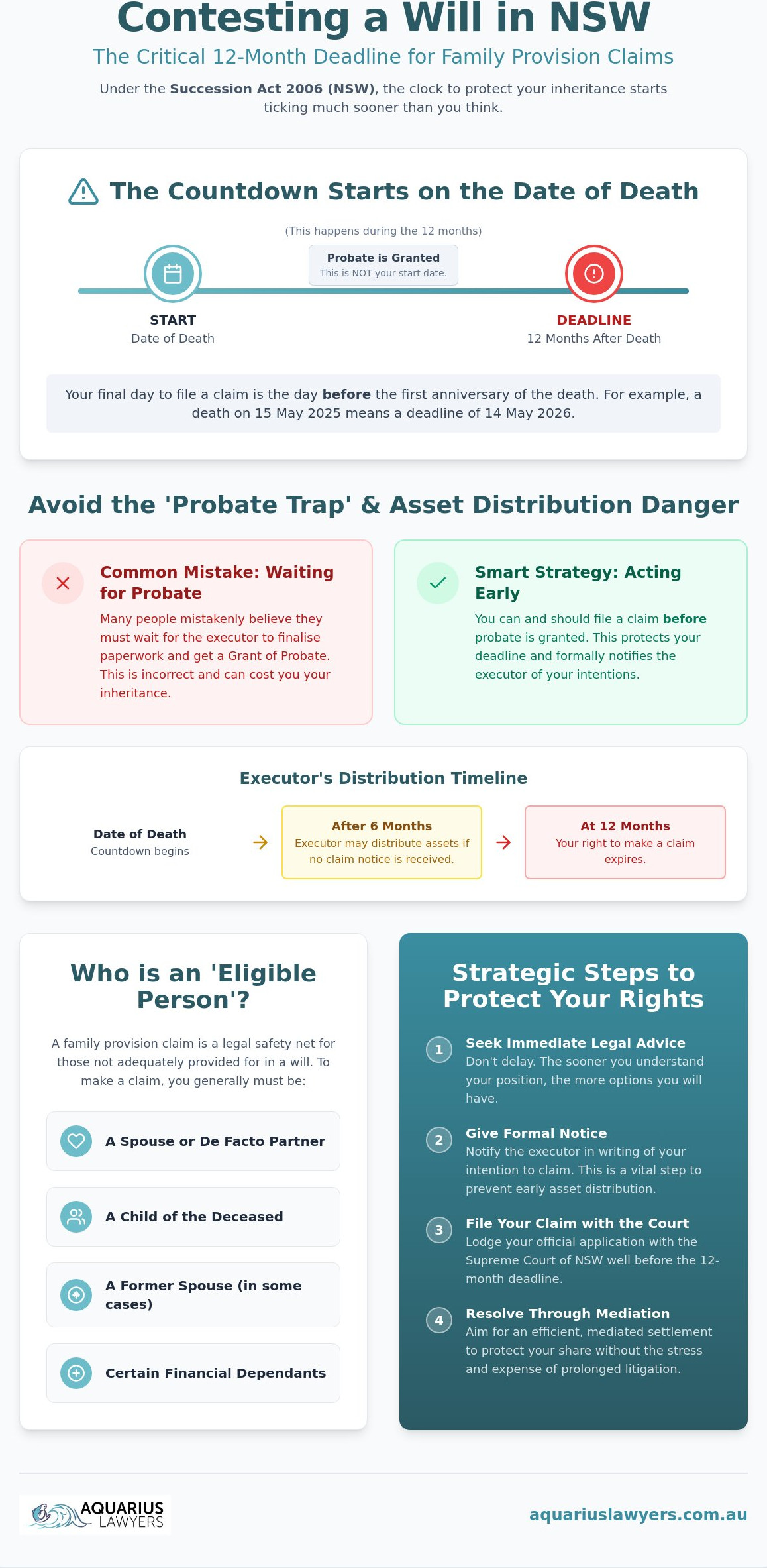
Precision matters when you’re counting down to a legal deadline. The 12-month clock starts ticking the very moment a person passes away, not when probate is granted or when the funeral takes place. We call this the anniversary rule. To keep things simple, use this formula: the deadline is the day before the first anniversary of the death. For instance, if a loved one passed away on 15 May 2025, your final date to file a claim is 14 May 2026. Under the Succession Act 2006 (NSW), the 12-month limit is a hard boundary that serves to finalise estate distributions with certainty.
The Probate Trap: Why You Shouldn’t Wait for the Will to be Settled
The “probate trap” is a common misunderstanding that often costs people their rightful inheritance. Many claimants believe they must wait for the Supreme Court to issue a Grant of Probate before they can even think about legal action. They assume the executor needs time to organise the estate or that the will isn’t “official” until the court stamps it. This assumption is a mistake. While you are waiting for the paperwork to clear, the family provision claim time limits nsw are steadily expiring.
The law actually allows you to file a claim before probate is granted. In fact, filing early is often the smartest move you can make. It signals to the court and the executor that you are serious about your rights. It also ensures that the 12-month deadline doesn’t catch you off guard while the executor is managing the initial administrative hurdles. The Succession Act 2006 provides the legal framework for these claims, and it doesn’t require you to wait for the executor to be “ready” before you lodge your application. Acting quickly is the only way to guarantee your seat at the table.
The Danger of Asset Distribution
Executors have a legal protection window that opens sooner than most people realise. In NSW, an executor can generally begin distributing assets six months after the date of death if they haven’t received formal notice of an intended claim. If they distribute the estate’s funds to other beneficiaries, “clawing back” those assets is an incredibly complex and expensive process. Once the money is spent or the property is transferred, your pathway to a fair share becomes significantly more difficult. Giving formal notice of your intention to claim is a vital protective step that effectively freezes the distribution process.
The Role of the Executor in the Timeline
It is important to remember that the executor’s primary duty is to the estate, not to you. While they must preserve the assets, they aren’t obligated to remind you of the deadline or help you prepare your case. A no-nonsense approach requires you to act independently of the executor’s schedule. Waiting for them to finish their work is a gamble you don’t need to take. If you are feeling pressured by time, seeking specialised estate advice can help you determine the exact status of the assets without relying on the executor’s updates. This proactive stance ensures you remain in control of your own legal timeline.
Can You Claim After 12 Months? Extensions and Sufficient Cause
Missing the one-year mark doesn’t always mean your case is dead, but it does mean the rules of engagement change instantly. While Section 58(2) of the Succession Act 2006 (NSW) provides a mechanism for extensions, the court doesn’t grant them lightly. The legal burden shifts entirely onto your shoulders. You must prove to a judge that there is “sufficient cause” for the delay, which is a significantly higher bar than simply being unaware of the family provision claim time limits nsw.
The Supreme Court operates on a principle of balance. On one hand, the law wants to ensure every eligible person gets a “fair go” at the assets they need for their maintenance and support. On the other hand, beneficiaries have a legal right to certainty. They shouldn’t have to live with the threat of a claim hanging over their heads indefinitely. If the estate has already been distributed and spent, the court is much less likely to let you reopen the matter. It’s a pragmatic approach that values finality over late-stage changes of heart.
Don’t assume that “waiting for legal advice” or “being too busy” will count as a valid excuse. The court expects you to be proactive. If you’ve known about the death for months and simply didn’t act, your application for an extension will likely be rejected. Judges look for genuine obstacles that made filing on time impossible, not just inconvenient.
The Four Pillars of a Successful Extension
To win an extension, your case usually needs to stand firm on four specific pillars. First is the reason for the delay. Did you only just discover the death, or was there an element of fraud or serious illness involved? Second, the court examines the merits of your claim. If your case for a share of the estate is weak, the judge won’t bother breaking the time rules to hear it. Third is prejudice. The court asks if an extension would unfairly harm the beneficiaries who have already planned their lives around the current will. Finally, your conduct is scrutinised. You must show that you acted with extreme speed the moment you realised you were left out or that a deadline was approaching.
When All Parties Agree to an Extension
There is one specific scenario where the process becomes significantly smoother. If every beneficiary and the executor of the estate consents to your late application, the court is much more likely to allow it. This agreement must be documented formally and presented to the Supreme Court to be legally recognised. Consent is the only way to bypass the Court’s “sufficient cause” test.
Strategic Timeline: Steps to Take Before the Deadline
Success in estate law isn’t just about knowing the rules. It’s about execution. A proactive strategy is the most effective way to bypass the high-octane stress of a last-minute application. By building a “Protective Pathway” early, you ensure that you aren’t just reacting to the family provision claim time limits nsw, but actively managing them. This approach allows you to secure your fair share while maintaining as much family harmony as possible.
The core of this strategy involves gathering evidence while it is still fresh. Records disappear and memories fade. Acting early also gives you the leverage needed to settle the matter through mediation. This often avoids the high costs and emotional toll of a full court hearing. One of the most vital steps is providing a formal “Notice of Claim” to the executor, which officially puts them on notice and protects the estate assets from being distributed prematurely.
Immediate Actions (Months 1–3)
Your first 90 days are about establishing the facts. You need to confirm your eligibility as a claimant. In NSW, this usually includes spouses, de facto partners, and children. You also have a legislated right to see the will. If the executor is being difficult, remember that you don’t need their permission to seek a copy. An initial consultation during this window is essential to assess the potential value of your claim and determine if the legal costs are proportionate to the expected outcome.
Gathering Your Evidence (Months 4–8)
This phase is where the heavy lifting happens. You must document your financial need and the history of your relationship with the deceased. The court looks at your current assets, your future earning capacity, and any health issues that require funding. You should also identify the full scope of the estate, including:
- Real estate holdings and property valuations
- Share portfolios and investment accounts
- Superannuation death benefits and life insurance
- Personal items of significant value
Start organising your bank statements, tax returns, and medical reports now. Having a clean, tech-enabled record of these documents makes the process significantly faster and more efficient.
The Final Countdown (Months 9–12)
As the deadline approaches, the focus shifts to resolution. Most claims in NSW are settled through “without prejudice” negotiations or formal mediation. This is your chance to reach a common-sense agreement without a judge’s intervention. However, if negotiations stall, you cannot afford to wait. You must file a Summons and Affidavit in the Supreme Court before the 12-month anniversary of the death. If you are unsure where you stand in this timeline, contact Aquarius Lawyers for a strategic assessment of your rights. Ensuring all paperwork is served correctly on the executor is the final, non-negotiable step in protecting your claim.
How Aquarius Lawyers Protects Your Estate Rights
At Aquarius Lawyers, we understand that contesting a will is rarely just about the money. It’s about fairness, recognition, and your future security. Dealing with family provision claim time limits nsw requires a blend of sharp legal strategy and down-to-earth pragmatism. Our team, led by Principal Katherine Hawes, provides the authoritative guidance you need to navigate these strict deadlines without getting bogged down in unnecessary legal jargon. We act as your trusted advisor, focusing on results rather than ceremony.
We call our methodology the “innovative veteran” approach. It combines decades of traditional legal expertise with contemporary technology to streamline the evidence gathering process. This synergy creates a clear advantage: traditional wisdom + modern efficiency = faster resolutions. We use digital tools to organise complex financial records and property valuations, turning what could be months of paperwork into a clear, actionable strategy. This ensures your application is filed well before the 12-month window closes, protecting your rights from the very start.
Our priority is always to protect your inheritance from being consumed by excessive legal fees. We focus heavily on cost-effective mediation and alternative dispute resolution. Most estate disputes in NSW can be settled through smart negotiation, provided you have a strong evidentiary foundation. This pathway offers a faster resolution and helps preserve family relationships that might otherwise be destroyed by years of litigation in the Supreme Court. We provide the steady hand you need to resolve these issues with dignity and efficiency.
Why a ‘No-Nonsense’ Approach Matters
We don’t waste time on fluff. We get straight to the merits of your claim. Our deep experience in NSW courts means we’ve seen how the 12-month rule is applied in practice, and we know exactly what judges look for when assessing eligibility. During the emotional turmoil of a contested will, we act as your grounded guide. We provide the clarity you need to make informed decisions about your future, ensuring you don’t miss critical opportunities due to administrative delays or confusion.
Take the First Step Toward a Fair Outcome
Don’t let the clock run out on your inheritance rights. The 12-month deadline is unforgiving, and every day you wait is a day the estate assets could be moving further out of reach. Whether you visit our Sydney or Shellharbour office, we are ready to provide a confidential discussion about your situation and the family provision claim time limits nsw that apply to your case. We’ll help you map out a clear pathway to the share you deserve.
Protect your fair share—Contact Aquarius Lawyers today
Secure Your Future Before the Clock Stops
Time is the most unforgiving element of estate law in New South Wales. The 12-month deadline from the date of death is a hard boundary that rarely bends for those who wait. Relying on the “probate trap” or expecting the executor to protect your interests is a gamble that often results in the permanent loss of inheritance rights. Precision and speed are the two most powerful tools in your legal arsenal.
Navigating the family provision claim time limits nsw requires a blend of traditional legal expertise and a proactive, modern strategy. Led by Principal Katherine Hawes, our team at Aquarius Lawyers specialises in NSW Succession Law. We operate from multiple locations in Sydney and Shellharbour, providing a steady, common-sense pathway through the complexities of contested wills. Our focus remains on resolving disputes efficiently to ensure your fair share is secured without unnecessary litigation costs.
You don’t have to face this pressure alone. Taking action now is the best way to protect your rights and find peace of mind during a difficult time. Secure your legal rights—speak with an Estate Specialist at Aquarius Lawyers today. We are here to help you move forward with confidence and clarity.
Frequently Asked Questions
Is the time limit to contest a will different in NSW compared to other states?
Yes, the 12-month limit in NSW is distinct because it starts on the date of death. In many other Australian states, the clock only begins once probate is granted. This makes the family provision claim time limits nsw some of the most urgent in the country. You don’t have the luxury of waiting for the executor to start the paperwork before your time begins to vanish.
What happens if I didn’t find out about the death until after 12 months?
Late discovery of a death can be argued as “sufficient cause” for an extension under the Succession Act 2006. However, you must prove that you acted with extreme speed the moment you became aware of the passing. The court will scrutinise whether the estate has already been distributed. If the assets are gone, an extension is much harder to secure even with a valid excuse.
Can a grandchild make a family provision claim in NSW after the deadline?
Grandchildren must first prove they were at least partially dependent on the deceased to be considered an “eligible person”. Once eligibility is established, the same 12-month deadline applies. A grandchild making a late claim faces the same high bar as any other applicant. They must demonstrate that their financial need outweighs the prejudice caused to other beneficiaries by the delay.
Does the 12-month rule apply if there is no will (intestacy)?
The 12-month rule applies to every estate, regardless of whether a will exists. If someone dies “intestate”, the law follows a set formula to distribute assets. If this formula fails to provide for you adequately, you can still file a claim. The countdown still begins on the date of death, so you shouldn’t wait for letters of administration to be granted before seeking advice.
How much does it cost to file a family provision claim in the Supreme Court?
Filing fees in the NSW Supreme Court are subject to annual adjustments. As of 1 July 2026, court fees increased by 4.2%. While the exact cost to initiate a claim depends on the specific summons, probate-related filing fees for the 2025/2026 period started at $921 for smaller estates and climbed to over $7,099 for estates exceeding $5 million. You should also be aware that the court often caps legal costs in smaller estates to preserve the inheritance.
Can I stop the executor from selling the family home while I make a claim?
You can take legal steps to prevent an executor from disposing of estate assets like the family home. Providing a formal “Notice of Intended Claim” is the first step to freeze the distribution process. If the executor ignores this, you can apply for an injunction. NSW is unique because our “notional estate” laws allow the court to claw back assets sold or transferred up to three years before death if the intent was to evade a claim.
What is considered ‘adequate provision’ for a child in a NSW will?
Adequate provision is a flexible concept that changes based on your specific circumstances. There is no fixed dollar amount or percentage for a child. Instead, the court looks at your financial position, your future earning capacity, and the size of the estate. The goal is to ensure you have what is necessary for your proper maintenance, education, and advancement in life compared to other beneficiaries.
Do I have to go to court, or can we settle the claim privately?
Most family provision claims in NSW are settled through mediation without ever reaching a final court hearing. The Supreme Court actively encourages this pathway to keep costs proportionate, especially for estates valued under $1 million. A private settlement is often the most efficient way to secure your share. It allows you to reach a common-sense agreement that avoids the emotional and financial drain of a full trial.
Disclaimer
Please note that legal rules change and this is not a substitute nor construed as legal advice. It is general information only.