
Did you know that nearly 60% of people in NSW are currently passing away without a valid Will? It’s a staggering figure that often leads to the very family disputes and legal confusion you’re likely hoping to avoid. You’ve worked hard to build your life. It’s completely natural to feel anxious about the complexity of estate law or how your superannuation interacts with your other assets. Effective will and estate planning for peace of mind isn’t just about ticking a box. It’s about creating a bulletproof strategy that protects your business and ensures your legacy remains intact.
This guide provides a no-nonsense roadmap to securing your family’s future using the latest 2026 NSW legal frameworks. We’ll clear the fog around required documents, explain how to shield your niche assets, and show you exactly how to make your wishes legally binding. By the end of this article, you’ll have the clarity needed to transform your estate from a source of stress into a secure foundation for the next generation.
Key Takeaways
- Learn how to move beyond a simple document by building a holistic strategy for will and estate planning for peace of mind.
- Identify the essential legal pillars, including Wills and Enduring Powers of Attorney, required to protect your interests both now and in the future.
- Discover how to integrate niche assets like family trusts, companies, and commercial fishing licences into a seamless asset protection plan.
- Action a clear five-step roadmap to audit your assets and blueprint your beneficiaries with absolute legal certainty.
- Understand why DIY “Post Office Wills” often lead to expensive litigation and how professional oversight secures your legacy against common legal traps.
What is Will and Estate Planning for Peace of Mind?
Estate planning is often misunderstood as a grim task reserved for the elderly or the ultra-wealthy. In reality, it is a sophisticated framework designed to protect your assets while you are healthy and ensure their seamless transition after you are gone. To gain a comprehensive overview of estate planning, you have to look beyond a single piece of paper. It is a holistic strategy that combines Wills, Powers of Attorney, and robust asset protection structures into a unified shield for your legacy.
The true return on investment for will and estate planning for peace of mind isn’t found in a financial ledger. It is the certainty that your family won’t be left to untangle a legal thicket during their time of grief. Without a valid plan, you fall under the rigid rules of the Succession Act 2006 (NSW). Dying “intestate” means the state government, not you, decides how your life’s work is carved up. This often leads to outcomes that contradict your actual wishes and can leave certain loved ones vulnerable.
Our “innovative veteran” approach bridges the gap between traditional legal wisdom and modern asset complexity. We don’t just draft documents; we build strategies. By blending decades of experience with a forward-thinking perspective on digital assets and complex business structures, we ensure your plan is ready for the challenges of 2026 and beyond.
The Difference Between a Simple Will and a Comprehensive Estate Plan
A simple Will is a single document. A comprehensive estate plan is a protective ecosystem. Many Australians are surprised to learn that their superannuation and life insurance policies often sit outside their Will. These are “non-estate” assets. To control where that money goes, you need a Binding Death Benefit Nomination (BDBN). Without this specific legal directive, a super fund trustee may decide who receives your balance, which can lead to unintended tax consequences or family friction. A strategic plan ensures every moving part of your wealth works in harmony.
Why Procrastination is a Risk to Your Legacy
Procrastination is the greatest threat to your family’s security. The “it won’t happen to me” mindset ignores the reality that incapacity can strike at any age. In NSW, the rise of blended families and high property values has made estates more litigious than ever. Estate planning is the proactive organisation of your life’s work to prevent future litigation. Waiting until a crisis occurs often means it’s too late to protect what matters most. Engaging in will and estate planning for peace of mind today ensures you remain the architect of your own story tomorrow.
The Three Pillars of a Secure NSW Estate Plan
Think of your estate plan as a tripod. If one leg is missing, the whole structure collapses under pressure. In the context of NSW law, we view will and estate planning for peace of mind as a logical equation: Security + Control = Certainty. To achieve this, you need three distinct legal instruments working in tandem. While most people focus solely on what happens after they pass, a truly robust plan protects you while you are still here but perhaps unable to speak for yourself.
The first pillar is your Last Will and Testament. It is the bedrock of asset distribution. In 2024, over 1,400 estate disputes were filed in NSW, including nearly 1,000 family provision claims. This highlights why a “she’ll be right” approach to drafting is a recipe for disaster. Your Will must be precise, legally compliant, and reflective of modern asset structures to survive a challenge in the Supreme Court.
Drafting a Valid Will in New South Wales
For a Will to be admitted to probate, it must meet strict criteria under the Succession Act 2006. This involves more than just a signature and two witnesses. You must choose an Executor who acts as an “innovative veteran” of your affairs; someone with the pragmatism to manage complex distributions and the integrity to follow your instructions to the letter. We also focus on identifying “excluded” persons. By addressing potential family provision claims early, we reduce the likelihood of your estate being drained by future litigation. For those starting from scratch, this NSW Government guide to making a will offers a helpful baseline for what the court expects.
Powers of Attorney and Guardianship: The Living Legacy
The remaining two pillars are often more critical for your daily wellbeing than the Will itself. An Enduring Power of Attorney (EPA) allows a trusted person to manage your financial affairs if you lose capacity. Conversely, an Appointment of Enduring Guardian (EG) covers your medical and lifestyle decisions, such as where you live or what healthcare you receive. It’s vital to distinguish these from “General” powers, which cease the moment you lose mental capacity. Without these documents, your family may have to apply to the NSW Civil and Administrative Tribunal (NCAT) just to pay your bills. This adds unnecessary stress and cost during an already difficult time. Ensuring these documents are correctly drafted is a hallmark of our Wills and Estates service, providing a safety net that catches you before a crisis hits.
Protecting Complex Assets: From Family Homes to Fishing Licences
Standard Wills often fail when they meet the reality of modern wealth. If you own a business, hold assets in a family trust, or manage a commercial fishing quota, a simple document isn’t enough. These are frequently classified as “non-estate assets,” meaning they don’t automatically fall under the control of your Will. True will and estate planning for peace of mind requires a strategy that bridges the gap between personal legacy and commercial reality. We apply an “innovative veteran” lens to these complexities, ensuring your marine or fisheries interests are just as secure as your family home.
The “Aquarius Advantage” lies in our ability to integrate commercial, maritime, and fisheries law into your estate plan. For instance, a commercial fishing licence or an aquaculture permit isn’t just a piece of paper; it’s a high-value business asset with specific regulatory requirements. If your plan doesn’t account for the transfer rules of the NSW Department of Primary Industries, your beneficiaries could face a bureaucratic nightmare. We ensure that these niche interests are protected through bespoke structures that respect both the law of the sea and the law of the land.
Blended families add another layer of risk, specifically “sideways disinheritance.” This occurs when assets intended for your children end up with a new spouse’s family instead. Strategy + Structure = Protection. By using specific clauses and trust arrangements, we can ensure your spouse is cared for while guaranteeing that the core of your wealth eventually passes to your biological or chosen heirs.
Testamentary Trusts for Asset Protection
A Testamentary Trust is a “Will within a Will” that offers superior control over legacy. Unlike a standard distribution, this structure keeps assets within a protected environment. This offers two major benefits: it shields the inheritance from a beneficiary’s potential divorce or bankruptcy, and it allows for tax-effective income streaming. With the Australian Federal Budget 2026-27 announcing a 30% minimum tax on discretionary trusts from July 1, 2028, having an expert-drafted Testamentary Trust is becoming a vital tool for tax optimisation.
Business Succession Planning for NSW Business Owners
Ensuring your business survives your passing is about more than just naming a successor. It requires a formal Buy-Sell Agreement, funded by appropriate insurance, to allow remaining partners to buy out your share fairly. Consider a family-run fishery or a commercial maritime fleet. Without a clear pathway, the sudden loss of a key stakeholder can lead to frozen bank accounts and operational chaos. We coordinate your business documents with your personal Will to ensure a seamless transition that maintains the value of your life’s work.
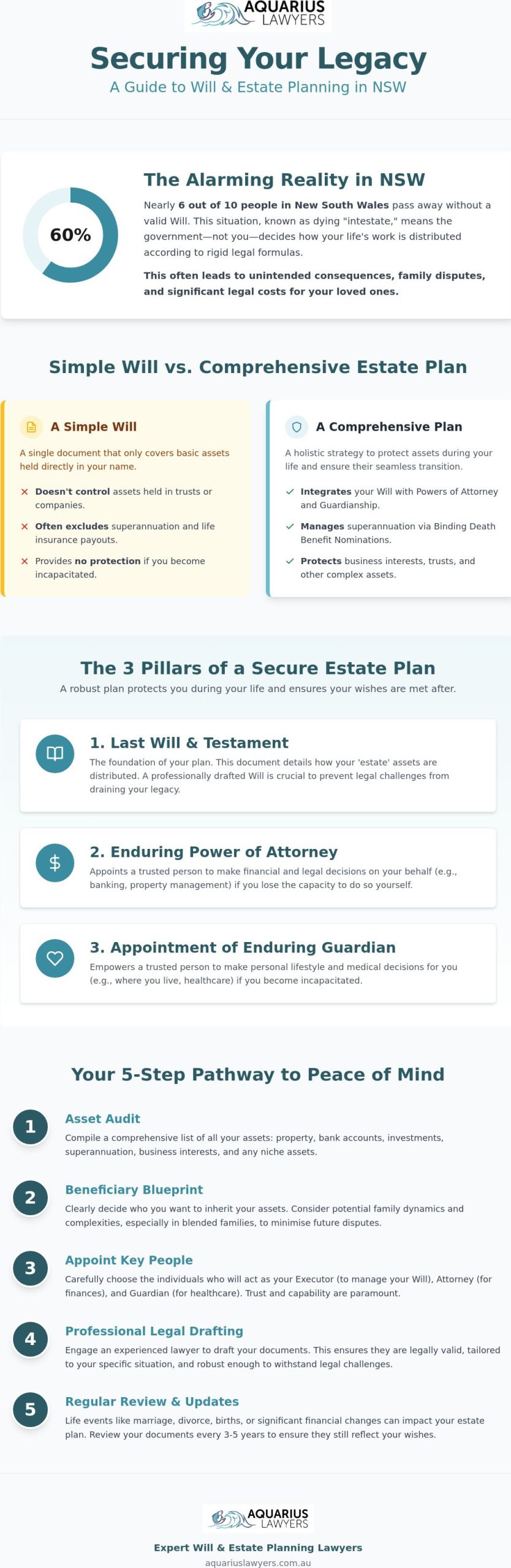
Your Pathway to Peace of Mind: A 5-Step Process
Moving from the “to-do” list to a finished document doesn’t have to be a grind. We use a methodical approach to turn your intentions into a legally enforceable shield. Effective will and estate planning for peace of mind follows a logical equation: Preparation + Precision = Protection. By breaking the process into clear stages, we strip away the anxiety and replace it with a sense of control.
- Step 1: The Asset Audit. Organise a list of everything you own and owe. This includes traditional property, superannuation, and modern digital assets like cryptocurrency or NFTs, which are now subject to the Corporations Amendment (Digital Assets Framework) Act 2026.
- Step 2: The Beneficiary Blueprint. Decide who gets what and why. This is where you consider the needs of your family, your business partners, and any charitable legacies you wish to leave behind.
- Step 3: The Professional Consultation. Meet with a specialised solicitor to translate your blueprint into a strategic legal framework. This is about more than just writing names on a page; it’s about spotting risks before they become disputes.
- Step 4: The Execution. Sign and witness your documents according to strict NSW law. A small error in how a document is signed can lead to an expensive “informal Will” application in the Supreme Court later.
- Step 5: The Safe Storage. Keep your original documents in a secure, fireproof location. While it sounds like a cliché, the fridge or a random shoebox are common places where Wills are lost or destroyed. If the original isn’t found, the court may presume you intended to revoke it.
Preparing for Your First Consultation
You don’t need to have all the answers before we meet. To make the most of your time, bring your ID, your asset audit, and your most pressing “no-nonsense” questions. We use modern technology to streamline the data-gathering phase, allowing us to focus on high-level strategy rather than basic admin. If you’re wondering where to start, reading up on How to make a legal Will in Australia can help you frame your goals before our first sit-down.
Reviewing and Updating Your Plan
A Will isn’t a “set and forget” document. We recommend the “Life Event” rule: update your plan whenever you experience marriage, divorce, a birth, or a significant property purchase. In NSW, marriage generally revokes an existing Will unless it was specifically made in contemplation of that marriage. Conversely, divorce revokes any gifts or appointments related to your former spouse. A plan drafted in 2010 might be dead weight by 2026 because law and family dynamics change. To ensure your documents still reflect your reality, contact us for a strategic consultation to review your current arrangements.
Why Expert Legal Oversight is Non-Negotiable
The “Post Office Will” trap is a common pitfall for many Sydney residents looking to save time. While a DIY kit might seem like a bargain at the checkout, it often becomes a financial burden for those left behind. These templates are static; they cannot ask you about your family trusts, your maritime business interests, or the nuances of your blended family. In the eyes of the law, a small clerical error or an ambiguous phrase can render a document “informal,” leading to expensive Supreme Court litigation that quickly eclipses any initial savings. Expert Insight + Precise Drafting = Legal Certainty.
This is where the “innovative veteran” benefit becomes your greatest asset. A specialised solicitor doesn’t just fill in blanks. We spot the risks that a template ignores, such as potential family provision claims or the tax implications of the 2028 trust changes. At Aquarius Lawyers, Katherine Hawes and the team provide a no-nonsense, strategic approach that treats your estate plan as a living business document. We don’t just draft for today; we engineer for the future. Professional fees are an investment in the certainty that your life’s work won’t be picked apart by legal challenges.
Avoiding the Pitfalls of Informal Wills
Common mistakes, such as incorrect witnessing or failing to account for “non-estate” assets, frequently lead to Wills being contested. The emotional and financial toll on a grieving family is immense when they are forced to spend months in court defending your intentions. Professional drafting ensures your will and estate planning for peace of mind is legally enforceable from the moment the ink dries. We focus on creating a “bulletproof” document that leaves no room for interpretation or dispute.
The Aquarius Methodology: Modern, Pragmatic, Protective
Our methodology is built on efficiency and the proactive resolution of issues before they escalate. We combine deep, traditional legal credentials with a modern, tech-savvy perspective to deliver results over ceremony. Because we possess niche expertise in maritime and commercial law, we bring a higher level of intellectual versatility to everyday estate planning. We understand how to shield a commercial fishing quota just as effectively as a family home in the suburbs. This blend of high-level strategy and relatable wisdom ensures your legacy is in safe hands. Organise your peace of mind with Aquarius Lawyers today and secure your family’s future with a plan that actually works.
Take Control of Your Legacy Today
Securing your will and estate planning for peace of mind is a proactive step that moves you from uncertainty to total control. You now have the roadmap to navigate the 2026 NSW legal landscape with confidence. Remember that a valid Will, an Enduring Power of Attorney, and an Appointment of Enduring Guardian form the essential tripod of your security. Whether you are protecting a family home in Shellharbour or a complex commercial fishing quota, professional oversight ensures your wishes remain legally binding and your family remains protected from unnecessary litigation.
At Aquarius Lawyers, we blend traditional experience with a modern, no-nonsense methodology. Led by Katherine Hawes, known as “The Fish Lawyer”, our team provides specialised expertise in complex commercial and maritime estates that many generalist firms overlook. With offices in Sydney and Shellharbour, we offer NSW-wide service designed to deliver results over ceremony. Don’t leave your life’s work to chance or outdated DIY templates that fail to account for your unique business interests.
Secure your family’s future and book a consultation with our Sydney estate planning specialists. It’s the most significant gift you can give to those you love.
Frequently Asked Questions
How much does a Will cost in NSW for 2026?
The cost of a Will depends on the complexity of your financial situation and the level of asset protection you require. A simple document is naturally less of an investment than a comprehensive estate plan involving testamentary trusts or business succession strategies. While you may find various price points across Sydney, professional drafting is a strategic expense that prevents the massive legal fees your family would face if an informal document is challenged.
Can I write my own Will or do I need a solicitor?
You can legally write your own Will, but it is a high-risk move that often leads to failure. DIY kits rarely account for the nuances required for will and estate planning for peace of mind, such as handling non-estate assets or blended family dynamics. Most “home-made” Wills are found to be invalid due to signing errors or ambiguous language, forcing families into expensive Supreme Court litigation to prove your intentions.
What happens if I die without a Will in Sydney?
Dying without a Will means your assets are distributed according to the “intestacy” rules set out in the Succession Act 2006 (NSW). The state government follows a rigid formula to decide who inherits your life’s work, which often contradicts your actual wishes. For instance, the statutory legacy for a spouse in a blended family is currently $611,387.84 as of mid-2026. This process is generally slower, more expensive, and more stressful for your survivors.
Is my superannuation included in my Will?
Superannuation is generally not automatically included in your Will because it is held in a trust by your fund. To ensure your super and any linked life insurance go to your preferred beneficiaries, you must sign a valid Binding Death Benefit Nomination (BDBN). Correctly aligning these nominations with your broader strategy is a vital part of will and estate planning for peace of mind to avoid unintended tax or distribution outcomes.
How often should I review my estate planning documents?
We recommend reviewing your estate plan every three to five years or whenever you experience a major life change. Significant events like marriage, divorce, the birth of a child, or purchasing a new business asset are critical triggers for an update. In NSW, marriage usually revokes an existing Will unless it was made specifically in contemplation of that marriage. Regular reviews ensure your documents stay relevant as laws and family structures evolve.
What is the difference between an Executor and a Power of Attorney?
The main difference is the timing of their authority. A Power of Attorney is a legal document that allows someone to manage your financial affairs while you are still alive but unable to do so yourself. An Executor only begins their role after you have passed away, taking responsibility for the probate process and distributing your assets. Both roles are essential pillars of a secure plan, but they operate at different stages of your life.
Can someone contest my Will if I leave them out?
Yes, certain eligible people can file a “family provision claim” in the NSW Supreme Court if they feel they have been unfairly excluded. This includes spouses, de facto partners, children, and certain individuals who were dependent on you. While you have the freedom to choose your beneficiaries, the court has the power to adjust distributions. Professional legal drafting helps you document your reasons and structure your assets to minimise the success of such claims.
Where is the best place to store my original Will in NSW?
The safest place to store your original Will is in your solicitor’s safe custody vault or with the NSW Trustee and Guardian. You should never keep the original in a home safe, a shoebox, or a fridge where it could be lost or destroyed. If the original document cannot be produced after your death, the court may presume you intended to revoke it, which creates an immense legal hurdle for your grieving family.
Disclaimer
Please note that legal rules change and this is not a substitute nor construed as legal advice. It is general information only.