
You’ve just spent twelve hours on the water only to return to a NSW DPI ‘show cause’ notice waiting on the wharf. In that moment, the complex mesh of the Fisheries Management Act 1994 feels less like a regulation and more like a direct threat to your family’s future. Finding the best fisheries lawyer nsw isn’t about hiring the person with the flashiest office; it’s about securing a partner who understands that your commercial fishing licence is your most valuable asset. We know that the 2026 regulatory landscape, from new TAC determinations to shifting biosecurity protocols, can feel like navigating through a thick fog without a GPS.
It’s frustrating when generalist lawyers don’t know the difference between a trawl and a trap, yet expect you to trust them with your livelihood. This article will show you how to secure expert legal defence that bridges the gap between maritime tradition and modern strategy. You’ll learn the essential steps to retaining your commercial quotas, appealing heavy DPI fines, and ensuring that a compliance breach doesn’t end your career on the water. We will explore how a no-nonsense approach to fisheries law can turn a stressful prosecution into a manageable resolution.
Key Takeaways
- Recognise why generalist solicitors often miss the technicalities of the *Fisheries Management Act 1994* and why niche expertise is vital for your defence.
- Identify the four critical benchmarks for selecting the best fisheries lawyer nsw, focusing on their proven track record in NSW Local Courts and quota management.
- Learn how to manage your fishing shares as a property right to ensure your licences and assets remain legally protected during commercial transfers.
- Discover the immediate steps to take when facing a DPI ‘show cause’ notice to minimise potential fines and protect your right to work.
- Find out how the team at Aquarius Lawyers combines traditional maritime experience with modern legal strategy to provide a steady guide through complex 2026 regulations.
What Defines the Best Fisheries Lawyer in NSW?
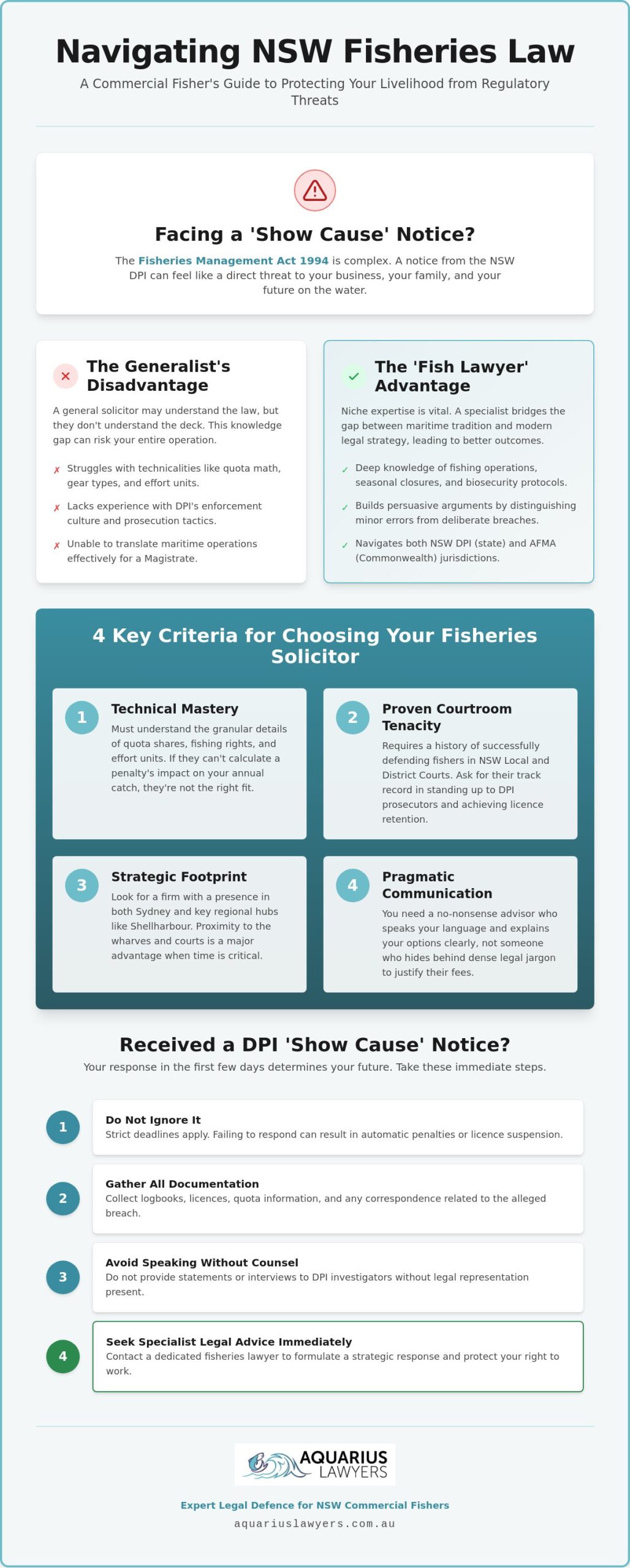
A fisheries lawyer is a legal specialist who focuses almost exclusively on the Fisheries Management Act 1994 and the complex web of maritime regulations that govern our waters. Finding the best fisheries lawyer nsw means looking beyond a standard criminal or commercial firm. Generalist solicitors often struggle with the technicalities of marine biology and the intricate “quota math” required to calculate effort units or share allocations. They might understand the law, but they don’t understand the deck. The best representation is a unique hybrid; it combines the sharp edge of criminal defence with the strategic foresight of administrative and commercial law. You need someone who understands the DPI’s enforcement culture, which often leans towards heavy-handed prosecutions rather than cooperative compliance.
The ‘Fish Lawyer’ Advantage: Why Industry Specialisation Matters
There is a massive gap between reading a statute and knowing how a prawn trawl actually operates. Industry specialisation matters because it changes how a case is built. A specialist knows about seasonal closures, specific gear types, and the practical realities of a working wharf. This deep-seated knowledge leads to better outcomes during negotiations with the authorities. When a lawyer understands the difference between a minor reporting error and a deliberate attempt to bypass quota, they can present a much more persuasive argument. You need a solicitor who can translate complex maritime operations for a Magistrate who has likely never stepped foot on a commercial vessel. It’s about being a bridge between the industry and the bench.
Navigating the NSW DPI and AFMA Regulatory Landscape
The regulatory environment in Australia is split between state and federal jurisdictions. While the NSW DPI handles most local commercial matters, the Australian Fisheries Management Authority (AFMA) manages Commonwealth fisheries that extend beyond the three-nautical-mile limit. Your lawyer must be comfortable moving between these two worlds. They need to understand the “precautionary principle,” which is a legal standard stating that a lack of full scientific certainty shouldn’t be used as a reason to postpone measures to prevent environmental degradation. It’s a high bar. Defending against it requires a lawyer who knows the science as well as the statutes. Navigating this landscape requires a steady hand and a deep understanding of how these agencies interact to ensure your business remains compliant across all borders.
4 Key Criteria for Choosing Your Fisheries Solicitor
Selecting the best fisheries lawyer nsw is a strategic business decision that directly impacts your ability to stay on the water. It’s not just about finding someone with a law degree; it’s about finding a partner who understands that your commercial fishing licence is your livelihood. You need a specialist who can navigate the specific pressures of the industry in 2026. Here are the four non-negotiable criteria you should use to vet your legal representation:
- Technical Mastery: They must understand the granular details of quota shares and effort units. If a lawyer can’t calculate the impact of a proposed penalty on your annual catch, they aren’t the right fit.
- Proven Courtroom Tenacity: Fisheries prosecutions in NSW Local and District Courts are unique. Your solicitor needs a history of standing up to DPI prosecutors and winning.
- Strategic Footprint: Look for a firm with a presence in both Sydney and regional hubs like Shellharbour. Proximity to the wharves and the courts matters when time is of the essence.
- Pragmatic Communication: You need a “no-nonsense” advisor who speaks your language, not someone who hides behind dense legal jargon to justify their fees.
Proven Track Record in Fisheries Prosecutions
When your livelihood is on the line, you can’t afford to be someone’s “test case.” Always ask a prospective solicitor for examples of successful licence retention. Experience with ‘Show Cause’ notices is particularly vital. These notices are often the first step the DPI takes toward cancelling a licence, and the way you respond in those first few days determines your future. A deep understanding of the NSW fishing rules and regulations allows a lawyer to spot procedural errors or evidentiary gaps that a generalist would simply miss. Your lawyer’s litigation history should reflect a consistent ability to minimise penalties and protect commercial interests.
Understanding Quota Management and Commercial Licensing
The NSW Share Management Fisheries system is notoriously complex. It treats fishing rights as property, which means your lawyer needs to be as much of a commercial strategist as they are a litigator. They must understand how legal decisions today will affect the long-term value of your business assets. Whether you are transferring, leasing, or defending your shares, the math has to be right. Miscalculating an effort unit can be just as damaging as a court conviction. Getting a clear legal assessment of your quota position ensures you aren’t flying blind when regulatory changes occur. The best representation protects your assets by treating every share like the high-value property it is.
Protecting Your Commercial Fishing Quotas and Licences
In New South Wales, commercial fishing shares are legally recognised as a form of property right. This means your quota isn’t just a permit; it’s an asset with a specific market value that can be traded, leased, or used as security. Because these rights are so substantial, protecting them requires more than just basic administrative filing. A specialist lawyer ensures that every transaction involving your shares is legally sound and protected from future regulatory clawbacks. The best fisheries lawyer nsw applies a specific equation to your business: Property Law Expertise + Administrative Precision = Asset Security. Without this oversight, you risk losing equity through poorly drafted leasing agreements or misunderstandings of the current share management system.
Managing these assets also involves dealing with the NSW Civil and Administrative Tribunal (NCAT) when licensing disputes arise. Whether you’re dealing with a transfer of restricted fishery endorsements or registering a mortgage over shares, the legal paperwork must be flawless. Errors in these processes don’t just cause delays; they can lead to the loss of endorsements that have taken decades to build. We focus on providing a clear pathway through these administrative hurdles, ensuring your commercial interests remain the priority.
Appealing NSW DPI Licensing Decisions
If the DPI issues a notice to suspend or cancel your licence, the clock starts ticking immediately. You generally have a strict 28-day window to lodge an application for review with NCAT. Successful appeals often hinge on identifying procedural unfairness or demonstrating that the DPI has misapplied its own policies. Many fishers attempt ‘self-representation’ to save on costs, but this is a high-risk strategy. The tribunal is a formal environment where technical legal arguments carry more weight than emotional pleas. Professional counsel is essential to navigate the rules of evidence and ensure your side of the story is heard effectively.
Aquaculture Compliance and Strategic Growth
Aquaculture operations, particularly oyster leases and land-based farms, face a different set of legal challenges. You must manage complex development approvals (DA), biosecurity protocols, and environmental impact statements (EIS) simultaneously. In this sector, the link between compliance and business valuation is absolute. A lease with a history of environmental breaches or biosecurity failures is worth significantly less than a clean operation. We help you manage these risks by ensuring your environmental management plans are robust and your land-use rights are fully protected. Strategic growth in aquaculture is only possible when your legal foundation is as strong as your production methods.
Defending Fisheries Prosecutions: What to Do When Charged
Receiving a Court Attendance Notice (CAN) or a heavy infringement notice can feel like the end of your career. It isn’t. The first and most critical step is to remain calm. Do not try to argue your way out of the situation on the wharf or “explain away” the incident to a fisheries officer. You have a legal right to silence, and you should exercise it until you’ve consulted with a specialist. Anything you say in the heat of the moment can, and likely will, be used against you in the NSW Local Court. Finding the best fisheries lawyer nsw is about securing someone who can step in immediately to manage the communication between you and the authorities.
Once you are home, gather every scrap of evidence. This includes GPS data, logbook entries, and Vessel Monitoring System (VMS) records. In 2026, digital evidence is often the difference between a conviction and a dismissal. Review the CAN carefully to identify exactly which sections of the Act are being cited. Engaging a solicitor to negotiate with DPI prosecutors before the first mention date is a high-impact strategy. Often, a well-reasoned legal argument can lead to charges being withdrawn or downgraded before you even step foot in a courtroom. If you are facing charges, securing expert fisheries defence is the most proactive step you can take to protect your livelihood.
Common Fisheries Offences in NSW
Most prosecutions involve the illegal use of gear, exceeding bag limits, or accidentally drifting into sanctuary zones. While these might seem like technicalities, the DPI treats them with extreme seriousness. However, the most damaging charges are often ‘obstruction’ or ‘assault’ of a fisheries officer. These carry much heavier penalties and almost always lead to a licence review. Even seemingly minor infringements shouldn’t be ignored. NSW operates on a points-based system; enough small fines will eventually trigger a mandatory licence suspension, effectively grounding your business.
Mitigating Penalties and Avoiding Conviction
If the evidence against you is strong, the focus shifts to mitigation. In the NSW Local Court, a ‘Section 10’ dismissal is the gold standard, as it means the offence is proven but no conviction is recorded. Achieving this requires a sophisticated approach. We use character references and your industry history to show the Magistrate that the incident was an out-of-character oversight. Demonstrating a ‘proactive compliance’ mindset is equally important. Showing that you’ve updated your gear or improved your reporting systems since the incident proves to the court that you are a responsible operator who deserves to keep their licence.
Why Aquarius Lawyers is the Leading Choice for NSW Fishers
Katherine Hawes is widely recognised as ‘The Fish Lawyer’ for a reason. With more than 20 years of specialised experience, she has established Aquarius Lawyers as the premier choice for those seeking the best fisheries lawyer nsw. Our firm operates with a distinct “innovative veteran” persona. This means we combine decades of traditional maritime credentials with a mastery of contemporary tools. We don’t just rely on old textbooks; we use modern tech-integrated strategies to challenge DPI evidence and protect your commercial interests. Our presence in both Sydney and Shellharbour ensures we can serve the entire NSW coast, providing a local perspective with high-level legal precision.
We understand that most NSW fishing operations are small, family-run businesses. High legal fees shouldn’t be another barrier to justice. We are committed to offering cost-effective, fixed-fee arrangements where possible, giving you the financial certainty you need to fight for your future. This no-nonsense approach to pricing reflects our broader philosophy: results matter more than ceremony. We act as a trusted advisor, moving easily between technical quota math and the practical realities of a working vessel. Our goal is to provide a steady, common-sense guide through what can be a very stressful and detached legal system.
A Personalised Approach to Maritime Law
Aquarius Lawyers focuses on building long-term relationships with the people who actually work the water. We take the time to understand the specific nuances of your fishery, whether you are trapping mud crabs or trawling for prawns. Our advisory style is grounded and approachable, designed to provide clarity when the regulatory fog feels thickest. This down-to-earth pragmatism has led to numerous success stories in licence restoration and quota protection. We treat your livelihood with the same urgency you do, ensuring that every legal step serves a clear, protective purpose. We value your results over formal ceremony, focusing on what keeps your boat in the water.
Contact Aquarius Lawyers for a Strategic Consultation
Don’t wait for a ‘show cause’ notice to turn into a court date. Acting early is the most efficient way to resolve compliance breaches before they escalate into something that threatens your entire career. Our initial consultation process is designed to get to the heart of your matter quickly. We recommend bringing all relevant logbooks, GPS records, and DPI correspondence to our meeting so we can provide an immediate strategic assessment. This proactive approach is the most effective way to minimise penalties and keep your business operational. Secure your livelihood today with Aquarius Lawyers and ensure you have the industry’s leading advocate on your side.
Secure Your Future on the Water with Expert Legal Defence
Your commercial fishing licence is more than just a permit; it’s the foundation of your family’s future and your hard-earned livelihood. We’ve explored how navigating the *Fisheries Management Act 1994* requires a specific blend of maritime knowledge and courtroom tenacity that generalist solicitors simply cannot provide. Remember that your quotas are valuable property rights that deserve strategic protection, and reacting quickly to a DPI ‘show cause’ notice can prevent a minor error from becoming a career-ending conviction. Finding the best fisheries lawyer nsw means choosing a partner who understands the difference between a trawl and a trap.
Principal Katherine Hawes, widely known as ‘The Fish Lawyer’, brings over 20 years of specialised expertise to every case. With offices in Sydney and Shellharbour, Aquarius Lawyers provides the pragmatic, no-nonsense advice you need to stay operational across the entire NSW coast. Don’t leave your business to chance or settle for a lawyer who doesn’t understand the nuances of the industry. Book a consultation with The Fish Lawyer today and gain the clarity you need to move forward with confidence. You’ve worked hard to build your business, and we’re here to help you protect it.
Frequently Asked Questions
What should I do if a NSW Fisheries officer stops me?
Remain polite and provide your identification and licence details as required by law, but exercise your right to silence regarding the specifics of your catch or gear. Avoid the temptation to explain away a perceived mistake on the spot. Note the officer’s name, the time of the stop, and the exact location. It’s always better to wait and speak with the best fisheries lawyer nsw before making any formal statements that could be used against you in court.
Can I lose my commercial fishing licence for a first-time offence?
Yes, it is possible to lose your licence for a single serious breach, such as fishing in a sanctuary zone or the obstruction of an officer. NSW also uses a demerit points system where even minor infringements accumulate over time. Once you reach a certain threshold, the DPI can move to suspend or cancel your authority to fish. Treating every infringement notice as a threat to your livelihood is the only way to ensure long-term business security.
How much does a fisheries lawyer cost in NSW?
The cost depends entirely on the complexity of your case, such as whether it’s a straightforward fine or a multi-day District Court trial. Many specialist firms prefer to use fixed-fee arrangements for initial consultations or specific stages of a prosecution to give you price certainty. You should always receive a written cost disclosure before any legal work begins so there are no surprises later. Investing in specialist advice early often saves you more in the long run by avoiding heavy fines and licence suspensions.
Is it worth fighting a fisheries infringement notice in court?
It is often worth fighting a notice if the demerit points associated with it put your licence at risk. Simply paying a fine is an admission of guilt, which then stays on your commercial record and can impact your future business dealings or quota allocations. A specialist lawyer can review the evidence to see if the DPI followed correct procedures. If there are flaws in their case, you may be able to have the charges withdrawn or the penalties significantly reduced.
What is the difference between a state and a federal fisheries offence?
State offences occur within three nautical miles of the coast and are prosecuted under the *Fisheries Management Act 1994* by the NSW DPI. Federal offences involve Commonwealth-managed species or activities occurring beyond the three-mile limit and fall under the jurisdiction of the Australian Fisheries Management Authority (AFMA). Each system has different reporting requirements and court jurisdictions. Your solicitor must be comfortable navigating both state and federal regulations to provide a complete defence.
Can a fisheries lawyer help with aquaculture DA approvals in Sydney?
Yes, a lawyer specialising in aquaculture law is vital for managing the development approval (DA) process for both land-based and marine farms. They help you navigate the overlapping requirements of local councils, the DPI, and environmental protection agencies. Specialist legal support ensures your environmental impact statements are compliant and your land-use rights are secure. This proactive approach prevents your project from being stalled by bureaucratic red tape or community objections.
How do I appeal a quota allocation decision by the DPI?
You can appeal a quota decision by lodging an application for an administrative review with the NSW Civil and Administrative Tribunal (NCAT). You must act quickly, as there is usually a strict 28-day deadline from the moment you receive the official decision. The best fisheries lawyer nsw will help you identify if the DPI made a legal error or failed to consider relevant facts during the allocation process. NCAT provides an independent forum to challenge decisions that you believe are unfair or incorrect.
What is a ‘show cause’ notice in the context of NSW fisheries?
A ‘show cause’ notice is a formal warning that the DPI is considering taking administrative action against your licence, such as a suspension or permanent cancellation. It is your final opportunity to provide a written argument explaining why this action should not proceed. You must address the specific allegations with evidence and a clear legal strategy. This is a high-stakes document; the quality of your response often determines whether you stay in business or lose your right to fish entirely.
Disclaimer
Please note that legal rules change and this is not a substitute nor construed as legal advice. It is general information only.