
A single mistake in interpreting your licence conditions isn’t just a minor paperwork error; it’s a direct threat to your livelihood and the future of our oceans. Many operators only stop to ask, “what is fisheries law” when they’re already facing a compliance audit or a notice from a fisheries officer. It’s a high-stakes equation where environmental sustainability + commercial viability = strict regulatory compliance. If you don’t get the math right, the penalties can be devastating.
We understand that the current regulatory landscape feels like a tangled net. Between the nuances of the Fisheries Management Act 1991 and the confusing overlap of State and Commonwealth jurisdictions, it’s easy to feel overwhelmed. You want to focus on your catch, not on the fear of heavy fines or losing your licence. This guide provides the clarity you need to manage these requirements safely.
You’ll learn exactly how to meet your compliance obligations and protect your valuable commercial quotas. We’ll break down the jurisdictional divide and provide practical strategies for dealing with authorities, ensuring you can operate with the confidence of a professional who knows exactly where they stand.
Key Takeaways
- Gain a clear definition of what is fisheries law and how it functions as a framework to balance ecological health with the economic needs of the Australian seafood sector.
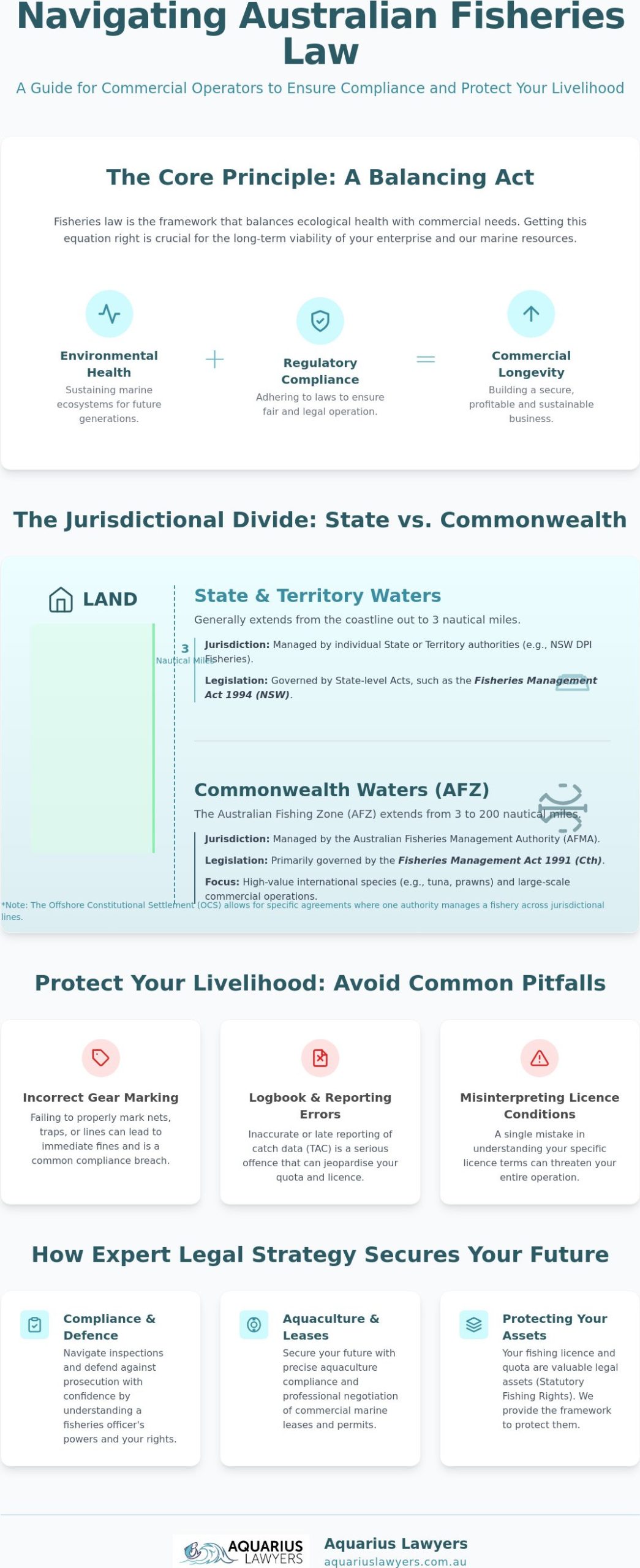
- Master the jurisdictional divide by understanding the “Three Nautical Mile” rule, which dictates whether you fall under State authority or Commonwealth management via AFMA.
- Protect your commercial livelihood by identifying common compliance pitfalls, such as gear marking and logbook errors, that often lead to licence cancellations or heavy fines.
- Understand the extent of a fisheries officer’s powers during an inspection to ensure you remain compliant while confidently protecting your business interests.
- See how expert legal strategy can secure your future through precise aquaculture compliance and the professional negotiation of commercial marine leases.
Defining Fisheries Law in the Australian Context
To understand the Australian seafood industry, you must first understand its boundaries. At its core, fisheries law is the body of regulations governing the harvest and management of marine resources within our waters. If you are trying to determine what is fisheries law in a functional sense, think of it as a tool for resource equity and conservation. It is the mechanism that prevents a “free-for-all” and ensures that our marine environment isn’t sacrificed for short-term gain.
In Australia, this isn’t a simple, single-page document. It is a sophisticated, multi-layered system involving both Federal and State authorities. This legal structure is designed to balance ecological sustainability with the economic interests of the fishing industry. We see this as a vital equation: Environmental Health + Regulatory Compliance = Commercial Longevity. If you’re asking what is fisheries law in terms of its daily impact, it’s the framework that defines the rules of engagement for one of our most valuable primary industries.
The Scope of Marine Governance
Marine governance is broad and inclusive, touching every facet of life on the water. It manages everything from high-level commercial licensing and the protection of endangered species to the specific management of ‘Total Allowable Catch’ (TAC). These TAC limits are then broken down into individual quota allocations, which effectively dictate the “what, where, and how much” of your daily operations. Governance typically covers:
- The type and size of fishing gear permitted in specific waters.
- The exact dates and durations of harvest seasons.
- The boundaries of restricted zones and marine parks.
These rules aren’t there to hinder you. They exist to maintain the delicate balance required for a productive ocean, ensuring that every operator plays on a level playing field.
Why It Matters to Your Enterprise
Your fishing licence or aquaculture permit is more than just a piece of paper; it’s a legal asset that requires protection. Fisheries law provides the framework for Statutory Fishing Rights (SFRs), which gives your business a secure and bankable interest in the resource. This legal certainty is what allows you to invest in better vessels, modern technology, and sustainable practices. It also serves as your primary defence against Fisheries crime. By cracking down on illegal, unreported, and unregulated (IUU) fishing, the law ensures that those who play by the rules aren’t undercut by those who don’t. Protecting the resource is, quite literally, protecting your bottom line.
Navigating the Jurisdictional Divide: State vs Commonwealth
Most fishers know the coastline like the back of their hand, but the legal landscape changes the moment you cross the three-nautical-mile mark. This is the “Three Nautical Mile” rule. It’s the invisible line where State jurisdiction ends and Commonwealth authority begins. Understanding what is fisheries law requires a clear map of who holds the power in which waters. This isn’t just a matter of geography; it’s about which set of rules can land you in a tribunal or a criminal court.
The Offshore Constitutional Settlement (OCS) is the pragmatic agreement that prevents total chaos. It allows the Commonwealth and States to agree on who manages specific fisheries, even when they cross borders. Without this “common-sense equation,” you would be forced to juggle two sets of laws for the same vessel. When you ask what is fisheries law in the context of your daily operations, you’re really asking which jurisdiction owns the water beneath your keel and which agency has the power to inspect your hold.
Commonwealth Jurisdiction and the AFZ
Commonwealth waters are managed by the Australian Fisheries Management Authority (AFMA). They oversee the Australian Fishing Zone (AFZ), which stretches an impressive 200 nautical miles from the coast. This is the primary arena for high-value species like tuna, prawns, and deep-water finfish. The Fisheries Management Act 1991 (Cth) is the central instrument here. It dictates everything from the allocation of Statutory Fishing Rights to the heavy penalties for zone incursions. Federal oversight is rigorous, and the focus is often on large-scale commercial sustainability and international maritime obligations.
State-Based Regulation: Focus on NSW
Closer to the shore, the Fisheries Management Act 1994 (NSW) takes the lead. This state instrument governs our coastal estuaries, beaches, and inland waterways. If you are operating near regional hubs like Shellharbour or Sydney, you are likely under the watchful eye of NSW authorities. They focus on localised management plans tailored to specific regional stocks. This includes regulating everything from commercial beach hauling to the specific permits required for local aquaculture ventures.
There is a critical distinction many operators miss. Administrative law handles your quotas and licence renewals, while criminal law handles the prosecution if you’re accused of a breach. Navigating both requires a specialized strategy. If you’re unsure where your activity sits, getting expert fisheries law advice early can prevent a minor administrative error from becoming a criminal headache. It’s a high-stakes environment. You need to know which badge is knocking on your hull before they even pull alongside.
Commercial vs Recreational Fishing: Legal Distinctions
While both commercial and recreational fishers might target the same species in the same swell, the legal frameworks governing them are worlds apart. If you’re trying to pin down what is fisheries law in a practical sense, you have to look at the intent and scale of the activity. For the recreational fisher, the law is a set of social and environmental guardrails. For the commercial operator, it is a complex regulatory environment that dictates every aspect of their business viability.
Most fisheries offences are strict liability, meaning that proving you didn’t intend to break the law is rarely a valid legal defence. This high standard of accountability is why understanding your specific category is vital. Problems often arise when the lines blur, particularly in “sham” fishing scenarios. This occurs when an individual uses a recreational permit to harvest fish for commercial sale. The legal consequences for this are severe, often involving massive fines and the permanent forfeiture of gear and vessels, as authorities view this as a direct theft from the legitimate commercial sector.
Commercial Licencing and Quota Management
In New South Wales, commercial activity is managed through a sophisticated Share Management system. This effectively turns your right to fish into a form of property. These shares can be leased or transferred, but the process is a formal legal transaction that requires precise documentation. Beyond the shares themselves, commercial operators must navigate the Vessel Monitoring System (VMS) requirements. This technology provides real-time tracking to ensure compliance with zone boundaries. Research from institutions like the Australian National Centre for Ocean Resources and Security (ANCORS) highlights how these management strategies maintain resource security for all users by providing a data-driven approach to harvest limits.
Recreational Compliance and Bag Limits
For the weekend angler, what is fisheries law usually boils down to bag limits, size restrictions, and the Recreational Fishing Fee. In NSW, this fee is a mandatory contribution that funds the improvement of recreational fishing across the state. Compliance here is about knowing your “regulated waters” and seasonal closures. Ignorance of a specific area’s rules, such as sanctuary zones in marine parks, won’t protect you from a penalty notice. Using prohibited gear or exceeding possession limits can result in on-the-spot fines that quickly drain the enjoyment out of a day on the water. Whether you are a professional or a hobbyist, the law expects you to know the rules before you cast a line.
Fisheries Prosecution and Compliance Strategy
Facing a fisheries officer on your deck is a high-pressure moment. At this point, the question of what is fisheries law shifts from a theoretical concept to a very practical reality. Compliance isn’t just about following the big rules; it’s often the small, administrative details that lead to prosecution. We frequently see operators tripped up by gear marking errors, logbook inaccuracies, or accidental area incursions. These aren’t just minor oversights. In the eyes of the department, they are breaches that threaten the integrity of the entire management system.
One of the most challenging aspects of these regulations is the principle of strict liability. This means the prosecution doesn’t have to prove you intended to break the law. If the gear wasn’t marked or the logbook was incomplete, the offence is committed regardless of your state of mind. Intent doesn’t matter in court. This “no-nonsense” approach by the authorities makes it vital to have an airtight compliance strategy. If you do receive an unfavourable department ruling, remember that you often have a right to an internal review or an appeal, provided you act within the strict statutory timeframes.
Dealing with Fisheries Prosecutions
There is a massive difference between receiving an on-the-spot infringement notice and a court attendance notice. An infringement notice is usually a fine you can pay to settle the matter, whereas a court notice means you are facing a criminal charge. This is where you need a specialist “Fish Lawyer” who understands the niche intersection of maritime and criminal law. Defending these cases requires more than just a general legal background. It requires a deep understanding of the Fisheries Management Act and the specific technicalities of the industry. We focus on mitigating penalties and defending wrongful accusations by identifying flaws in the prosecution’s evidence or the officer’s exercise of power.
Fisheries officers have broad powers to board vessels, search equipment, and seize catch. However, these powers are not unlimited. Knowing where their authority ends is just as important as knowing your own obligations. If you’re facing a potential prosecution, contact a specialist fisheries lawyer to protect your rights and your livelihood before the matter escalates.
Proactive Risk Management for Marine Businesses
The best defence is a proactive offence. Instead of waiting for an inspection to go wrong, marine businesses should conduct regular legal audits of their operations. This involves reviewing your permits, checking your gear against current standards, and ensuring your reporting systems are flawless. Training your crew is also a vital part of this equation. When your staff understands the latest NSW and Commonwealth regulation changes, the risk of a costly mistake drops significantly. Developing a clear “Standard Operating Procedure” for boarding and inspections ensures that everyone on your vessel knows how to interact with officers professionally and safely, reducing the chance of unnecessary conflict or self-incrimination.
How Aquarius Lawyers Protects Your Maritime Interests
Managing a business on the water requires more than just a good hull and a reliable crew; it demands a legal partner who understands the currents of the industry. Knowing what is fisheries law in theory is one thing; applying it to protect a multi-million dollar quota or a family legacy is quite another. We bridge the gap between complex legislation and practical, on-water results. Our role is to act as your steady guide through the regulatory fog, ensuring your operations remain both profitable and compliant.
Principal Katherine Hawes, widely known as “The Fish Lawyer,” brings a lifetime of niche expertise to every case. She doesn’t just read the law; she understands the operational realities of the seafood sector. This deep, traditional credentialing combined with forward-thinking methodology allows us to offer strategic advice that keeps you ahead of regulatory shifts. Whether you’re negotiating a commercial lease for an aquaculture venture or facing a high-stakes prosecution, our approach is always grounded in pragmatism and a “no-nonsense” attitude. We value results over ceremony.
Our services extend beyond the courtroom. We provide strategic advice on aquaculture compliance to ensure your farm investments are protected from the outset. For our clients in regional NSW, we offer fixed-fee arrangements for property and conveyancing. This provides price certainty for those looking to buy or sell marine-related assets. We view every legal challenge as a solvable equation: Expert Knowledge + Strategic Action = Protected Interests. This formula ensures that every step we take serves a clear, protective purpose for your enterprise.
Expertise Across the Blue Economy
We support a diverse range of clients across the entire maritime sector. Our team works with everyone from small-scale commercial fishers to large international aquaculture investors. Because we offer integrated legal solutions, we can handle the commercial, property, and criminal law aspects of your business simultaneously. This intellectual versatility is what sets us apart. With offices in Sydney and Shellharbour, we remain accessible to both metropolitan and regional operators who need a trusted advisor in their corner.
Securing Your Future on the Water
Your maritime legacy is built on years of hard work. We help you protect that investment by securing your commercial fishing licences and organising family estates to ensure a smooth transition between generations. Our team also manages robust contracts for maritime employment and handles debt recovery to keep your cash flow healthy. We focus on the details so you can focus on the water. Don’t leave your livelihood to chance. Contact Aquarius Lawyers today to secure your maritime legacy.
Secure Your Future in Australian Waters
Operating in the Australian marine sector requires more than just technical skill; it demands a precise understanding of the legal framework that supports your industry. We have explored the jurisdictional divide between State and Commonwealth waters and the high-stakes reality of strict liability offences. Ultimately, what is fisheries law if not the essential foundation for your commercial longevity? By mastering these regulations, you transform a complex burden into a strategic advantage for your business.
Principal Katherine Hawes, known as “The Fish Lawyer,” provides specialist expertise in the Fisheries Management Act 1991 to help you navigate these waters safely. Whether you need a robust defence against a prosecution or strategic advice on maritime commercial matters, we offer fixed-fee options to ensure you have cost certainty. Protecting your quota is about protecting your legacy. It’s about ensuring your hard work isn’t undone by a single administrative error.
Book a consultation with The Fish Lawyer to discuss your compliance needs and gain the confidence to lead your enterprise forward. The ocean is full of opportunities; make sure your legal strategy is strong enough to catch them.
Frequently Asked Questions
What is the primary law governing fishing in Australia?
Australia uses a dual-level legislative system. The Fisheries Management Act 1991 (Cth) governs federal waters, while each state has its own specific legislation, such as the Fisheries Management Act 1994 in NSW. Understanding what is fisheries law requires knowing which of these acts applies to your specific location and activity. These laws work together to manage everything from commercial quotas to protected species conservation across the country.
Can I lose my commercial fishing licence for a minor offence?
Yes, you can lose your licence if minor offences accumulate or if a specific breach carries a mandatory suspension. Many fisheries regulations operate on a demerit point system. Small errors like incorrect gear marking or logbook omissions might seem trivial, but they build a record of non-compliance. Over time, this record can lead to the cancellation of your commercial fishing shares or the suspension of your operating permits.
What is the difference between AFMA and NSW DPI?
The main difference lies in jurisdiction and geography. AFMA manages Commonwealth fisheries from three nautical miles out to the 200-mile limit of the Australian Fishing Zone. NSW DPI Fisheries handles everything from the shoreline out to that three-mile mark, including estuaries and inland rivers. While they often cooperate on shared stocks, each agency has its own distinct set of compliance officers, reporting requirements, and licensing fees.
How are fishing quotas legally determined and allocated?
Quotas are legally determined by setting a Total Allowable Catch (TAC) based on biological data and stock assessments. Once the TAC is set, it is allocated to fishers based on the number of shares they hold in a specific fishery. This system ensures that the harvest remains sustainable while providing operators with a tradeable legal asset. These allocations are usually reviewed annually to reflect changes in the marine environment.
What should I do if a Fisheries Officer boards my vessel?
You should remain professional, follow all reasonable directions, and provide requested documentation immediately. Officers have broad powers to inspect your catch, gear, and records without a warrant. While you must cooperate to avoid obstruction charges, you also have the right to be treated fairly. It is a good idea to note exactly what was discussed or seized if the inspection leads to an allegation of a breach.
Does fisheries law apply to aquaculture farms on private land?
Yes, fisheries law applies to aquaculture even when the facility is located on private property. You still need specific permits to culture and sell fish, and you must comply with regulations regarding water discharge and species transport. The law ensures that private operations don’t accidentally introduce diseases or invasive species into the broader Australian marine environment. It is a comprehensive framework that covers the entire lifecycle of the product.
How much does it cost to defend a fisheries prosecution in NSW?
The cost of defending a fisheries prosecution in NSW depends on the complexity of the charges and whether the matter proceeds to a full court hearing. Simple infringement notice disputes are generally less expensive than defending criminal charges in the Local or District Court. While we don’t provide a universal figure, many operators find that investing in specialised legal advice early prevents much larger financial losses from fines and licence forfeitures.
Can I appeal a decision made by the Fisheries Department?
You certainly can appeal, but you must act quickly as strict time limits apply to these challenges. Most departments offer an internal review process where a senior officer re-examines the original decision. If that doesn’t resolve the issue, you can often take the matter to an independent tribunal, such as NCAT in NSW or the AAT for Commonwealth matters. This is a vital part of what is fisheries law, as it provides a check on administrative power.
Disclaimer
Please note that legal rules change and this is not a substitute nor construed as legal advice. It is general information only.