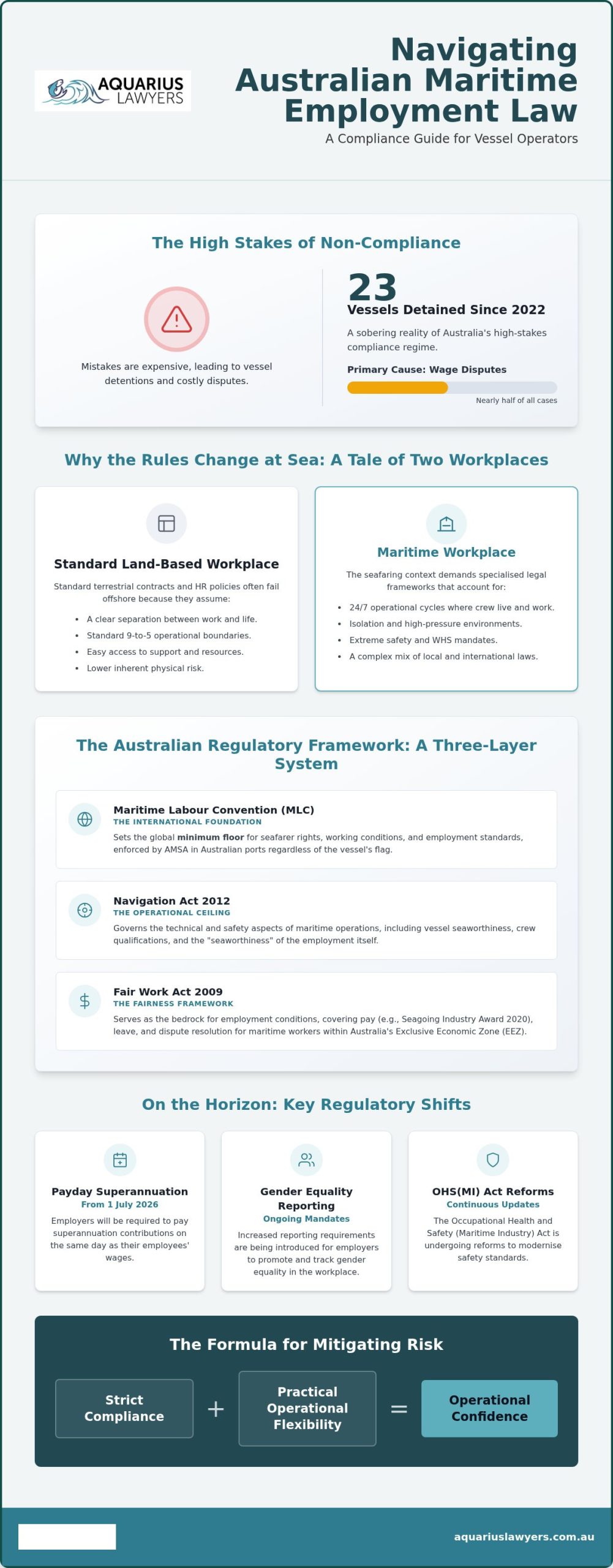
Did you know that since 2022, Australian authorities have detained 23 vessels for failing to meet basic standards, with nearly half of those cases triggered by wage disputes? It’s a sobering reality that maritime employment law in Australia is a high-stakes compliance regime where mistakes are expensive. You likely find the overlap between the Fair Work Act, the Maritime Labour Convention, and local OHS laws incredibly confusing. Managing a crew in isolated offshore environments is difficult enough without the constant fear of a Fair Work Ombudsman investigation or a sudden vessel ban.
We believe that expert legal clarity leads to operational confidence. This guide helps you master the intersection of Australian workplace regulations and international conventions with a no-nonsense approach. We’ll preview the 2026 Payday Super requirements, the ongoing OHS(MI) Act reforms, and the essential steps for drafting compliant employment contracts. You’ll gain a clear understanding of seafarer rights and a practical strategy to mitigate the risk of industrial action, ensuring your business stays on course and out of the headlines.
Key Takeaways
- Identify how the Fair Work Act 2009 and AMSA regulations work together to define modern workplace standards for the Australian maritime sector.
- Discover the mandatory clauses required in Seafarer Employment Agreements (SEAs) to maintain full compliance with maritime employment law and international conventions.
- Learn to manage crew disputes and health and safety requirements effectively within the high-pressure, isolated environments of offshore operations.
- Stay ahead of 2026 regulatory shifts, including new payday superannuation rules and gender equality reporting mandates for maritime employers.
- Gain practical insights into mitigating the risk of industrial action and vessel detentions through proactive legal audits and tailored contract management.
Understanding Maritime Employment Law: Why the Rules Change at Sea
Maritime employment law isn’t your standard office-based HR framework. It is a specialised synthesis of industrial relations and admiralty law. This legal hybrid exists because the ocean doesn’t respect standard 9-to-5 boundaries. Historically, Australia has a deep-seated relationship with these complexities, dating back to the 1890 Australian maritime dispute, which helped shape our modern industrial landscape. Today, the rules change at sea because the environment is inherently high-risk. Isolation, 24/7 operational cycles, and extreme safety mandates mean that a standard terrestrial contract often fails the moment a vessel leaves the wharf. If your contract doesn’t account for the unique pressures of a seafaring context, you’re leaving your business exposed to significant liability.
Standard workplace agreements usually assume a level of separation between life and work that simply doesn’t exist on a vessel. When your employees live where they work, the definition of “duty” expands. We see many employers struggle because they’ve tried to port a land-based agreement onto a commercial vessel. This creates friction. In the maritime world, compliance isn’t just about avoiding a fine; it’s about maintaining the safety of the entire crew in an environment where help might be hours or days away. To succeed, your legal strategy must follow a simple equation: Strict Compliance + Practical Operational Flexibility = Risk Mitigation.
Defining Maritime Workers and Jurisdictions
Under the Navigation Act 2012, a “seafarer” isn’t just anyone on a boat. It generally covers those employed or engaged in any capacity on board a vessel, but the nuances are critical. Identifying the “Australian employer” gets tricky in offshore structures involving parent companies and international subsidiaries. Generally, if your business is based in Australia and you’re operating within the Exclusive Economic Zone (EEZ), the Fair Work Act follows you. Clarity on jurisdiction is vital. You don’t want to be arguing about which law applies while a dispute is already boiling over in the middle of the Bass Strait. Knowing exactly where State law ends and Federal law begins is the first step in protecting your fleet.
The Impact of Flag States on Employment Rights
The “Law of the Flag” is a fundamental principle where the ship is seen as a floating piece of its home country’s territory. This often creates a friction point with Australian workplace protections. While a foreign-flagged vessel might technically operate under the laws of Panama or Liberia, the Australian Maritime Safety Authority (AMSA) has proven they won’t hesitate to enforce the Maritime Labour Convention (MLC) standards for any crew in Australian ports. For Australian operators using foreign-flagged vessels, the legal strategy must be airtight. You need to balance international maritime conventions with local industrial expectations to avoid vessel detentions or Fair Work Ombudsman interventions. We help you bridge that gap, ensuring your crew’s rights are respected while your commercial interests remain protected.
The Australian Regulatory Framework: Fair Work Act and Beyond
For most Australian maritime operators, the Fair Work Act 2009 serves as the bedrock of the employment relationship. However, it doesn’t operate in a vacuum. It sits within a complex hierarchy where international conventions like the Maritime Labour Convention (MLC) provide the minimum floor, while federal statutes like the Navigation Act 2012 set the operational ceiling. Understanding how these layers interact is the only way to ensure your business remains compliant. If you only look at terrestrial industrial relations law, you’re missing half the picture. The Navigation Act 2012 handles the safety and “seaworthiness” of the employment, while the Fair Work Act handles the “fairness” of the pay and conditions.
The synergy between these laws creates a unique regulatory environment. For example, while the Navigation Act dictates who can be a master or an officer, the Seagoing Industry Award 2020 dictates what they must be paid. In 2026, this framework is becoming even more rigorous with the introduction of Payday Superannuation on 1 July, requiring employers to align super payments with wage cycles. Balancing these technical requirements with the day-to-day realities of running a vessel requires a strategic legal partner who understands both the wharf and the courtroom.
The Role of the Fair Work Ombudsman and AMSA
AMSA and the Fair Work Ombudsman (FWO) often work in tandem to police Australian waters. AMSA is the front line. Under the 2026-27 National Compliance Plan, they have committed to 2,400 Port State Control inspections, which now include specific audits under the Occupational Health and Safety (Maritime Industry) Act 1993. While AMSA checks for physical safety and MLC breaches, the FWO investigates underpayment claims and National Employment Standards (NES) violations. AMSA ensures the ship is fit for the crew, while the FWO ensures the contract is fit for the law.
National Employment Standards (NES) at Sea
Applying the NES to a seafaring roster is notoriously difficult. The standard 38-hour week is a rare luxury on a commercial vessel. Instead, maritime employment law relies heavily on the concept of “reasonable additional hours” to manage watch-keeping schedules and emergency situations. However, “reasonable” has limits. You must ensure that your crew’s leave entitlements and rest periods comply with both the NES and the MLC’s strict safety mandates. As of 2026, private sector employers must also navigate new gender equality reporting targets, adding another layer of administrative responsibility to your HR department. Managing these overlapping requirements is a matter of precision:
- Align watch-keeping rosters with MLC rest requirements to avoid AMSA detentions.
- Ensure “reasonable additional hours” are clearly defined in contracts to prevent FWO disputes.
- Update payroll systems for the July 2026 Payday Super transition.
Essential Components of Maritime Employment Contracts
A maritime contract is more than a record of pay; it is a vital operational safety net. In the high-stakes world of maritime employment law, your contracts must serve as a bridge between the Fair Work Act and the Maritime Labour Convention (MLC). For vessels regulated by the MLC, the standard employment contract is replaced by the Seafarer Employment Agreement (SEA). This document is a mandatory requirement that AMSA inspectors check with zero tolerance. If your SEA lacks specific provisions for repatriation or medical care, your vessel risks being part of the growing number of detentions in Australian ports.
Effective drafting requires you to look beyond the wage column. You must include clear provisions for repatriation, which is a non-negotiable right for seafarers. If a contract terminates while the vessel is away from the home port, the employer is responsible for the logistics and costs of getting that crew member home. Similarly, the right to shore leave and access to medical care while on board are not “perks” but legal mandates. When drafting for termination, you need to account for offshore logistics. You cannot simply end an agreement in the middle of the ocean; your contract must specify how and where the notice period concludes to ensure a safe and legal handover.
Industrial Awards and the Seagoing Industry
Most maritime businesses operate under a specific industrial award. The Seagoing Industry Award 2020 remains the primary instrument for 2026, though you must stay alert to the Annual Wage Review. With the ACTU proposing a five percent increase to the national minimum wage for July 2026, your payroll budgeting needs to be proactive. Depending on your fleet, you might also fall under the Port Authorities Award or the Marine Tourism and Charter Vessels Award. Identifying the correct award is the first step in ensuring your base rates and overtime loadings are compliant. Using the wrong award is a common shortcut to a Fair Work investigation.
Specialised Clauses for Fisheries and Aquaculture
The fisheries and aquaculture sectors require a different level of precision. Many Australian commercial fishing operations utilise “share-fishing” arrangements, where crew members receive a percentage of the catch value. These must be drafted with extreme care to clarify the employment status and tax obligations of the crew. In the aquaculture space, where intellectual property and sensitive environmental data are at stake, robust confidentiality and non-compete clauses are essential. Finally, your contracts should explicitly address workplace health and safety (WHS) duties specific to the hazards of commercial fishing. Clear drafting ensures that safety protocols are an enforceable part of the job description, not just a suggestion in a handbook.
Managing Crew Disputes and Workplace Health and Safety (WHS)
Managing a crew in the middle of the ocean is a logistical and legal pressure cooker. When you’re miles from the nearest port, a simple disagreement can escalate into a major industrial or safety risk. In the context of maritime employment law, your duty of care doesn’t end at the gangway. It extends to every facet of life on board. With 46 serious crew injuries reported across Australian and foreign-flagged vessels in 2025, the stakes for WHS compliance have never been higher. As of June 2026, the Department of Employment and Workplace Relations has closed submissions for the reform of the Occupational Health and Safety (Maritime Industry) Act 1993. This reform aims to harmonise maritime safety with modern national standards, meaning your “Fit for Work” assessments and medical fitness protocols must be more rigorous than ever.
Isolation breeds unique challenges, particularly regarding mental health, bullying, and harassment. A vessel is a 24/7 workplace where there is no “going home” to escape a toxic environment. If you don’t have robust, clear grievance procedures tailored for isolated environments, you’re inviting a Fair Work Ombudsman investigation. We see a simple equation in successful fleet management: Proactive Dispute Resolution + Strict WHS Compliance = Operational Continuity. If an accident occurs and you’re found to be in breach of your safety duties, the legal consequences can include massive fines, vessel detentions, and even criminal prosecution for negligence.
Seafarer Rights and the Maritime Labour Convention (MLC)
The MLC acts as a “Bill of Rights” for seafarers, setting strict minimums for training, food, and accommodation. One of the most contentious areas is the right to repatriation. If a contract ends early, the question of “who pays?” is often the spark for a dispute. Under the MLC, the employer is generally responsible for the cost of returning the seafarer to their home country. Furthermore, you must strictly adhere to MLC Regulation 2.3 regarding hours of work and rest. AMSA is currently demonstrating a zero-tolerance approach to breaches, as seen in the recent ban of the ‘Ocean Bright’ until September 2026 due to wage and welfare failures.
Dispute Resolution and Litigation Strategy
When a crew member lodges a claim with the Fair Work Commission (FWC), your response must be immediate and evidence-based. Mediation is often the most cost-effective pathway to resolve maritime conflicts before they reach the Federal Court of Australia. However, preparing for litigation requires a deep understanding of how terrestrial workplace rights intersect with admiralty law. If you are facing a complex crew dispute or need to audit your safety protocols, it’s time to protect your maritime operations with expert legal advice. Whether it’s a wage claim or an industrial standoff, having a clear litigation strategy ensures that a single dispute doesn’t sink your entire commercial operation.
How Aquarius Lawyers Streamlines Maritime Workforce Compliance
Managing the intersection of industrial relations and admiralty law is a full-time job. You shouldn’t have to be a legal scholar to run a fleet. Complexity is the enemy of compliance. At Aquarius Lawyers, we act as the bridge between dense maritime employment law and the practical realities of your business. We provide tailored legal audits that identify hidden liabilities before AMSA or the Fair Work Ombudsman does. Our approach is built on a simple formula: Deep Industry Knowledge + Modern Legal Technology = Streamlined Risk Management.
We don’t believe in “off-the-shelf” contracts. A generic agreement is often worse than no agreement at all because it provides a false sense of security while leaving you exposed to 2026 regulatory shifts. We draft custom employment agreements that balance the need for crew protection with the necessity of operational productivity. By integrating commercial and employment advice, we ensure your business is protected from both industrial disputes and contractual failures. Whether you’re managing a single commercial trawler or a multi-vessel offshore operation, our goal is to keep your workforce stable and your vessels moving.
Expert Representation from ‘The Fish Lawyer’
Principal Katherine Hawes, widely known as “The Fish Lawyer”, brings a unique perspective to maritime and fisheries law. She understands that your business operates in a niche environment where traditional legal firms often feel out of their depth. Our firm projects the personality of a trusted advisor who values results over ceremony. We offer a no-nonsense attitude and intellectual versatility, moving easily between fisheries compliance and high-level Federal Court litigation. With multiple offices in Sydney and regional NSW, we provide the local expertise you need with an international perspective. We pride ourselves on being cost-effective and pragmatic, ensuring that our legal solutions actually work in the real world.
Proactive Compliance for 2026 and Beyond
The maritime landscape is shifting rapidly. With Payday Superannuation starting on 1 July 2026 and new gender equality reporting targets for the private sector between April and May, the administrative burden on employers is growing. We help you stay ahead of these legislative changes by training your management team on maritime WHS and the latest industrial relations reforms. This proactive stance is your best defence against the “zero tolerance” enforcement trend we’ve seen from AMSA this year. Don’t wait for a dispute to arise before you secure your legal foundation. Now is the time to organise a consultation with Aquarius Lawyers to secure your maritime workforce and ensure your operations remain compliant throughout 2026 and into the future.
Charting a Compliant Course for Your Maritime Operations
Mastering maritime employment law requires more than just a passing knowledge of the Fair Work Act. It demands a strategic synthesis of international conventions and local safety mandates. By now, you understand that a compliant operation relies on precisely drafted Seafarer Employment Agreements and a proactive approach to crew welfare. Whether you’re navigating the 2026 Payday Super transition or managing an isolated offshore team, the right legal framework is your most valuable asset. Operational safety + legal precision = commercial longevity.
Don’t let regulatory complexity stall your progress. With specialised expertise in marine, fisheries, and aquaculture law, Aquarius Lawyers provides the grounded, tech-forward guidance you need to stay ahead. Principal Katherine Hawes, known as “The Fish Lawyer”, and our team across Sydney and regional NSW are ready to help you mitigate risk and resolve disputes before they escalate. Protect your maritime operations with expert legal advice from Katherine Hawes and ensure your business remains on a steady course. We’re here to help you navigate these waters with confidence and clarity.
Frequently Asked Questions
Does the Fair Work Act apply to foreign crew on vessels in Australia?
Yes, the Fair Work Act applies to foreign crew if the vessel is engaged in coastal trading or is an Australian-flagged ship. Even on foreign-flagged vessels, the Australian Maritime Safety Authority (AMSA) enforces the Maritime Labour Convention (MLC) to ensure basic welfare standards are met while in Australian ports. It’s a complex jurisdictional area that depends more on the vessel’s activity than the crew’s nationality.
What is a Seafarer Employment Agreement (SEA) and is it mandatory?
A Seafarer Employment Agreement (SEA) is a formal contract mandated by the MLC. It is absolutely mandatory for all crew members on regulated Australian vessels and foreign vessels in Australian waters. The SEA must clearly outline entitlements like wages, leave, and repatriation. If an AMSA inspector finds a crew member without a valid SEA, they can detain the vessel until the paperwork is corrected.
How do I determine which maritime award applies to my employees?
You determine the correct award by reviewing the “coverage” clause of the various maritime industrial instruments. Most commercial operations fall under the Seagoing Industry Award 2020, but port operations or tourism charters have their own specific awards. Using the wrong award can lead to significant underpayment claims, so it’s vital to get this classification right from the start of the employment relationship.
Can a maritime worker claim unfair dismissal if the vessel is outside Australian waters?
Yes, unfair dismissal protections apply if the worker is an Australian-based employee and the employer is an Australian entity. The Fair Work Commission generally has jurisdiction in these cases regardless of the ship’s physical location. The legal “home” of the employment relationship and the contract’s governing law are often more important than whether the vessel was in international waters at the time of dismissal.
What are the employer obligations for crew repatriation in Australia?
Employers are legally responsible for the full cost of returning a seafarer to their home port or an agreed destination. This obligation is a core part of maritime employment law and is triggered by contract expiry or termination. You must cover travel, accommodation, and food during the journey. Failing to repatriate crew is a serious breach that often leads to immediate vessel bans.
How does the Maritime Labour Convention (MLC) interact with Australian law?
The MLC provides the international minimum standards for seafarer welfare, which Australia has ratified and implemented through the Navigation Act 2012. It works alongside the Fair Work Act to create a comprehensive safety net. While the Fair Work Act handles general industrial relations, the MLC ensures specific seafaring rights like medical care and food quality are maintained to a global standard.
What should I do if a crew member is injured while at sea?
You must provide immediate medical care and report serious injuries to AMSA within prescribed timeframes under the OHS(MI) Act. Beyond the physical response, you should initiate your internal incident management procedures and document everything thoroughly. Proper documentation is your best defence if the injury leads to a future dispute, a workers’ compensation claim, or a Fair Work Commission hearing.
Are commercial fishers considered employees or independent contractors?
The distinction depends on the “multi-factor test” rather than a simple label. Even if you use a share-fishing model, the worker may still be an employee if you control their hours and provide the vessel. Mistakenly classifying an employee as a contractor under maritime employment law can result in heavy penalties and back-pay for unpaid entitlements like superannuation and leave.
Disclaimer
Please note that legal rules change and this is not a substitute nor construed as legal advice. It is general information only.