Securing a profitable stake in the Australian blue economy is less about the size of your nets and more about the strength of your legal framework. You likely realise that while our coastlines offer immense potential, the regulatory environment is a complex challenge involving state, federal, and environmental hurdles. Understanding the legal requirements for aquaculture investment is the only way to transform a high-risk venture into a secure, long-term asset. It is a simple equation: expert foresight plus pragmatic strategy equals investment security.
We know that the prospect of facing multi-level red tape and potential litigation is daunting. This guide provides the clarity you need to move forward with confidence, offering a professional roadmap to protect your capital. We will break down the specific 2026-27 fee structures across jurisdictions like New South Wales and South Australia, identify the key regulatory bodies you must engage, and outline the essential environmental protocols required to keep your project compliant and profitable.
Key Takeaways
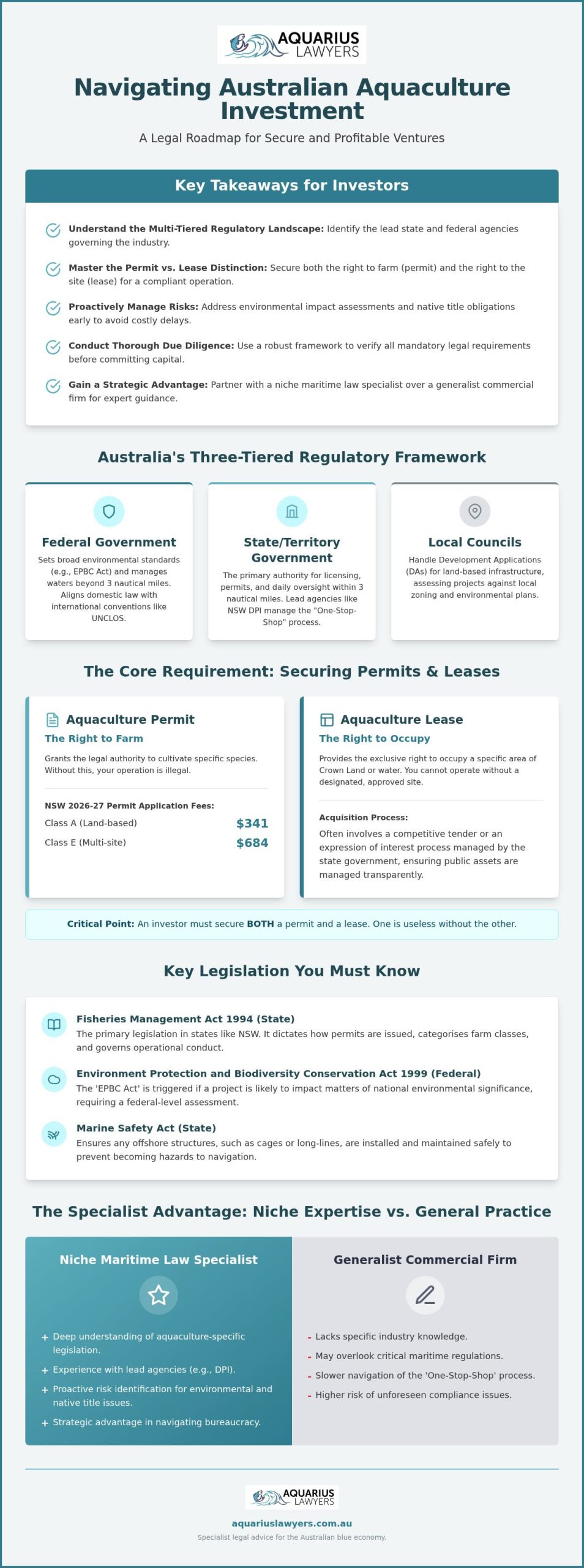
- Identify the multi-tiered regulatory landscape and the lead government agencies responsible for governing the Australian aquaculture industry.
- Master the critical distinction between aquaculture permits and area leases to ensure you hold both the right to farm and the right to the site.
- Protect your investment from costly delays by proactively addressing environmental impact assessments and native title obligations.
- Use a no-nonsense due diligence framework to verify the mandatory legal requirements for aquaculture investment before you commit significant capital.
- Discover how partnering with a niche maritime law specialist provides a strategic advantage over using generalist commercial firms.
Understanding the Australian Aquaculture Regulatory Framework
Investing in Australian aquaculture isn’t just about finding the right site; it’s about mastering a multi-tiered legal system. Success depends on your ability to satisfy three distinct levels of government simultaneously. While the Federal Government sets the broad environmental standards, the heavy lifting of licensing and daily oversight happens at the state level. Local councils also play a part, particularly when land-based infrastructure or zoning changes are involved. Navigating the legal requirements for aquaculture investment requires a clear-eyed understanding of who holds the power in which patch of water.
Lead agencies, such as the NSW Department of Primary Industries (DPI), act as the primary point of contact for investors. To streamline what could easily become a bureaucratic nightmare, several states have adopted a “One-Stop-Shop” assessment process. This model allows the lead agency to coordinate with other departments, such as planning or environment, on your behalf. This efficiency is grounded in the broader Australian Aquaculture Regulatory Framework, which aligns domestic laws with the United Nations Convention on the Law of the Sea (UNCLOS). These international standards ensure Australia maintains sovereign rights over its waters while managing resources sustainably.
State vs. Federal Jurisdiction
The boundary between state and federal control is precise. State jurisdiction typically extends to 3 nautical miles from the coastal baseline. If your project sits within this zone, state laws are your primary concern. Beyond this limit, you enter the Exclusive Economic Zone (EEZ), where Commonwealth authority takes over. This potential for overlap is managed through the Offshore Constitutional Settlement (OCS). The OCS is essentially a legal agreement that allows states to manage certain fisheries or aquaculture activities even when they extend into federal waters, providing much-needed certainty for commercial operators.
Key Legislation You Must Know
The “bible” for most investors in New South Wales is the Fisheries Management Act 1994. It dictates how permits are issued and how the industry must operate. However, you can’t ignore the Environment Protection and Biodiversity Conservation Act 1999 (EPBC Act). This federal powerhouse kicks in if your project is likely to have a significant impact on matters of national environmental significance. Finally, the Marine Safety Act ensures that any offshore structures you install don’t become hazards to navigation. Balancing these acts is a non-negotiable part of your investment strategy. It’s a complex mix, but getting the foundations right is what separates a secure asset from a legal liability.
Essential Licences and Permits for Aquaculture Projects
Distinguishing between your right to farm and your right to the area is the first step in building a compliant operation. An aquaculture permit gives you the legal authority to cultivate specific species. An aquaculture lease, however, provides the exclusive right to occupy a specific patch of Crown Land or water. You cannot have one without the other. This dual-track system is a core component of the legal requirements for aquaculture investment in Australia. It ensures that while you have the freedom to operate, the state maintains control over public assets.
Under the Fisheries Management Act 1994, permits are categorised into classes based on the nature of the farm. For instance, a Class A permit is required for land-based farms using a water supply, while a Class E permit is designed for multi-site operations. According to the 2026-27 fee schedule, the application fee for a Class A permit in New South Wales is $341. Larger, more complex Class E permits attract a fee of $684. Securing a lease on Crown Land often involves a competitive tender or an expression of interest. It is a methodical process that requires precision to avoid administrative delays. These are the Essential Licences and Permits for Aquaculture Projects that form the backbone of your business plan.
The Development Approval (DA) Process
If your project is land-based, your first hurdle is often the local council. They assess your Development Application (DA) against local zoning and environmental plans. For larger projects that meet certain capital investment thresholds, the State Significant Development (SSD) trigger may apply. This means the state government, rather than the council, becomes the consent authority. In NSW, the Integrated Development concept allows you to bundle your DA with other necessary approvals, such as those from the EPA. This streamlines the pathway but requires a comprehensive initial submission to succeed.
Water Access and Quality Rights
Land-based systems rely heavily on Water Access Licences (WAL). These licences define how much water you can take and from which source. Simultaneously, if your farm discharges water back into the environment, you will likely need an Environmental Protection Licence (EPL). This licence sets strict limits on waste and nutrient levels to protect local ecosystems. Biosecurity protocols are also a mandatory legal requirement. You must have a Management and Environmental Monitoring Plan (MEMP) that proves you can prevent disease outbreaks. If you’re feeling overwhelmed by these overlapping rules, consulting an aquaculture law specialist can help you map out the most efficient route to compliance.
Managing Environmental Compliance and Native Title Risks
Project shutdown is the ultimate nightmare for any investor. In the aquaculture sector, this risk usually stems from a failure to meet environmental standards or a clash with existing land rights. Navigating the legal requirements for aquaculture investment means looking beyond the water’s surface to the rights and responsibilities beneath it. For high-risk projects, an Environmental Impact Statement (EIS) is a mandatory shield. It identifies potential harm to ecosystems before a single cage is submerged. International standards and global perspectives, such as those provided in Legal Due Diligence: A Framework for Savvy Investors, underscore the necessity of a rigorous environmental approach to maintain long-term viability.
Climate-driven events, such as the recent algal blooms in South Australia that prompted government fee relief, highlight the legal instability environmental shifts can cause. These events aren’t just biological issues; they are investment risks that require proactive legal management. This is where the “Fish Lawyer” adds value. By integrating traditional maritime expertise with a tech-savvy understanding of environmental monitoring, we help you build a “no-nonsense” compliance strategy. A robust legal framework acts as a buffer against both regulatory scrutiny and the unpredictable nature of the marine environment.
Native Title and Aboriginal Land Rights
Native Title claims are a significant hurdle that generic investment guides often overlook. These claims can affect both inland sites and coastal waters, extending well into the inter-tidal zone. To secure your investment, you must often negotiate an Indigenous Land Use Agreement (ILUA). This is a voluntary but legally binding agreement between you and the Traditional Owners. Our strategy is simple: early engagement equals reduced litigation. By consulting with Native Title holders at the project’s inception, you move from a position of conflict to one of cooperation. This proactive step is essential for ensuring your lease remains unchallenged and your social licence to operate is secure.
Biodiversity and Protected Species
The EPBC Act sets a high bar for projects located near “Matters of National Environmental Significance”. If your sea-cages are near migratory paths for whales or nesting grounds for protected birds, the legal stakes are high. Non-compliance doesn’t just result in fines; it can lead to permanent injunctions. You must implement specific protections for marine mammals and follow strict waste management protocols to avoid nutrient loading. The equation for success is clear: rigorous monitoring plus strict adherence to environmental conditions equals a protected investment. We ensure your operational plans are legally sound, protecting you from the costly delays that follow a breach of biodiversity laws.
Legal Due Diligence: A Framework for Savvy Investors
Scrutinising a target’s regulatory standing is the most critical step before you sign any term sheet. Many investors focus heavily on biomass forecasts and market prices while ignoring the ticking clock of a lease renewal. Understanding the legal requirements for aquaculture investment is only half the battle; the other half is verifying that the target company actually meets them. A rigorous audit isn’t just a chore. It’s a shield that protects your capital from unforeseen liabilities and administrative dead ends.
Your “No-Nonsense” due diligence checklist must include a deep dive into the following areas:
- Licence and Lease Validity: Confirm the remaining term of all existing aquaculture permits and leases. A lease with only two years remaining and no clear right of renewal is a significant risk.
- Compliance History: Audit the company’s track record with the EPA and state fisheries departments. Have there been any prosecutions, warnings, or clean-up notices? A history of non-compliance suggests systemic operational issues.
- Commercial Contracts: Review supply chain agreements and export contracts. Ensure they are legally enforceable and contain appropriate “force majeure” clauses that account for marine-specific disruptions.
- Intellectual Property: If the farm uses proprietary tech or specialised breeding techniques, verify that the IP is properly registered and protected within Australian jurisdiction.
Evaluating Operational Risk and Liability
The strength of a project’s “Social Licence to Operate” is a tangible legal asset. If the local community or environmental groups are hostile, the risk of litigation or permit appeals increases exponentially. You must also review employment law compliance. Specialised maritime staff often fall under specific industrial awards or enterprise agreements. Failing to get this right can lead to costly back-pay claims and reputational damage. Finally, ensure the insurance coverage is fit for purpose. Standard commercial policies often exclude marine-specific risks like storm damage to sea-cages or mass mortality events caused by disease.
Structuring the Investment
How you structure the deal depends on your long-term goals and tax position. Outright acquisition offers total control but also total liability. Joint Ventures (JVs) can share the risk but require meticulously drafted shareholder agreements with clear dispute resolution clauses. If you are an international investor, you must also navigate Foreign Investment Review Board (FIRB) requirements. These rules can be strict for agricultural land and water assets. The reality is that a poorly structured deal can sink even the most promising farm. To ensure your project is built on a solid foundation, you should partner with an aquaculture law specialist who understands the nuances of the Australian maritime sector.
Partnering with an Aquaculture Law Specialist
Generalist commercial lawyers are often brilliant at standard business structures, but they frequently miss the niche maritime nuances that define the blue economy. The ocean operates under a distinct set of rules where property law meets international maritime conventions. Successfully managing the legal requirements for aquaculture investment requires more than just a legal degree; it requires a deep, practical understanding of the water. Relying on a generalist for a complex aquaculture project is like using a road map to navigate the Bass Strait. It simply doesn’t provide the level of detail necessary to avoid the rocks.
At Aquarius Lawyers, we take the role of an “innovative veteran.” Led by Katherine Hawes, known globally as “The Fish Lawyer,” our firm provides a unique blend of traditional expertise and forward-thinking strategy. We don’t just look at the law in isolation. We look at how it impacts your daily operations, from the initial property law aspects of a site to the complexities of international export agreements. Our approach is grounded in a no-nonsense attitude that values tangible results over legal ceremony. We provide the intellectual versatility needed to move between Fisheries Law, Commercial Law, and Litigation with ease.
Strategic Legal Oversight
The most successful investors don’t wait for a crisis to call their lawyer. Ongoing compliance management is a strategic necessity, not an optional extra. We offer retainer-based support that provides a consistent pathway for proactive advice. This steady guidance is what prevents catastrophic outcomes like vessel arrest or immediate site shutdowns due to regulatory breaches. By having a trusted advisor who understands your specific project goals, you can resolve issues before they escalate into costly litigation. We invite you to discuss your project with us to see how strategic oversight can protect your bottom line.
Taking the Next Step
Engaging our expertise starts with a comprehensive review of your project’s legal standing. Whether you’re looking at a new acquisition or need to audit an existing operation, we provide a clear roadmap for compliance and growth. Our firm handles everything from debt recovery and employment law to complex mediation and fisheries disputes. We maintain a down-to-earth pragmatism that ensures our advice is always actionable and relevant to the Australian market. Secure your investment by working with a team that knows the industry inside and out.
Securing Your Future in the Blue Economy
Navigating the Australian aquaculture sector requires more than just capital; it demands a precise understanding of the overlapping jurisdictions that govern our waters. By mastering the legal requirements for aquaculture investment, you turn regulatory red tape into a competitive advantage. You’ve seen how the distinction between permits and leases, the rigour of environmental assessments, and the necessity of early Native Title engagement form the pillars of a secure project. These aren’t just administrative hurdles. They are the safeguards that ensure your operation remains viable for decades to come.
Don’t let complex legislation stall your progress or put your capital at risk. Katherine Hawes, known globally as “The Fish Lawyer,” brings over 20 years of maritime expertise to your project. With specialised knowledge in NSW and Commonwealth fisheries regulations, Aquarius Lawyers provides the strategic oversight needed to keep your investment on course. Whether you’re conducting due diligence or facing a compliance challenge, we offer the “no-nonsense” guidance you need to succeed. Secure your aquaculture investment with expert legal counsel from Aquarius Lawyers and move forward with the confidence that your project is built on a rock-solid legal foundation. We’re ready to help you turn your vision into a sustainable reality.
Frequently Asked Questions
What is the most common legal mistake made by aquaculture investors in Australia?
The most common legal mistake is failing to conduct thorough due diligence on the remaining term and renewal rights of existing leases. Investors often assume a lease is a permanent asset, but without a clear, documented pathway for renewal, the investment value can drop significantly as the expiry date approaches. Another frequent error is ignoring the “Social Licence to Operate,” which can lead to local community opposition that stalls projects indefinitely.
Do I need a different licence for land-based vs. sea-cage aquaculture?
Yes, you require specific permit classes depending on your farming method. In New South Wales, land-based operations typically fall under Class A or B, while marine-based sea-cages require Class E, H, or other specific categories. Each class has distinct fee structures, as seen in the 2026-27 schedule, and unique environmental monitoring requirements. It’s vital to match your permit class exactly to your operational model to remain compliant with state fisheries regulations.
How long does it typically take to get aquaculture development approval in NSW?
Obtaining aquaculture development approval in NSW typically takes between six and twelve months for standard applications. However, if your project is designated as State Significant Development (SSD), the process can extend beyond eighteen months due to the complexity of the required Environmental Impact Statement. Early consultation with the Department of Primary Industries can help identify potential bottlenecks and streamline the submission phase before you commit significant capital.
Can international companies own aquaculture leases in Australian waters?
International companies can own aquaculture leases in Australian waters, provided they comply with Foreign Investment Review Board (FIRB) requirements. The Australian Government scrutinises foreign investment in agricultural land and water assets to ensure they align with the national interest. You must also establish an Australian-registered entity to hold the permits and manage local tax, biosecurity, and employment obligations effectively within the local legal framework.
What role does the EPBC Act play in aquaculture investment?
The EPBC Act acts as a federal trigger for any aquaculture project that might impact matters of national environmental significance. This includes activities near World Heritage sites or those affecting migratory species and marine mammals. If your project triggers the Act, you must obtain federal approval in addition to state permits, which adds another layer to the legal requirements for aquaculture investment in Australia. Failing to account for this can lead to permanent project injunctions.
How does Native Title affect aquaculture projects in coastal areas?
Native Title can significantly affect coastal aquaculture because many claims extend into the inter-tidal zone and coastal waters. Investors must check the Register of Native Title Claims before selecting a site to avoid future litigation. If a claim exists, you will likely need to negotiate an Indigenous Land Use Agreement (ILUA). This proactive engagement ensures your project respects traditional rights while securing your legal right to occupy the area without constant legal challenges.
Are there government grants available for aquaculture investment in 2026?
Several government grants and financial assistance programs are available in 2026 to support sustainable aquaculture development. The Clean Energy Finance Corporation provides backing for energy-efficient farming tech, while specific state programs focus on regional growth and Indigenous-owned enterprises. Additionally, South Australia is currently offering fee relief for certain licence holders until 30 June 2027 to assist with recent environmental challenges, showing that government support often shifts to meet industry needs.
Why should I hire a specialist fisheries lawyer instead of a general commercial solicitor?
Hiring a specialist fisheries lawyer is essential because generalist solicitors often lack the niche maritime knowledge required to navigate complex water rights and international conventions. Katherine Hawes, known as “The Fish Lawyer,” provides over 20 years of experience in this specific field. A specialist understands the intersection of property law, international maritime rules, and state-specific fisheries acts, ensuring your investment is protected by a professional who speaks the industry’s language and understands the practicalities of the water.
Disclaimer
Please note that legal rules change and this is not a substitute nor construed as legal advice. It is general information only.