
What if the simple act of adding a family member to your property deed triggered a tax bill larger than your annual mortgage? It’s a scenario many face when they realise that a transfer of property title nsw is no longer just a matter of signing a piece of paper at the kitchen table. You likely feel that the process has become a maze of digital lodgements and shifting regulations, and the fear of getting caught in the gears of the PEXA system or Revenue NSW is completely understandable.
We believe that complex legal transitions should be handled with a blend of traditional expertise and modern efficiency. This guide is designed to help you master the legal requirements, digital lodgement processes, and cost-saving exemptions for transferring property ownership in 2026. We will explore the latest Transfer Duty thresholds, explain the mandatory PEXA fees effective from 1 July 2026, and detail the impacts of the Conveyancing (General) Regulation 2026. By combining strategic tax positioning with certified digital oversight, you can achieve a smooth, legally compliant transfer while protecting your assets for the years ahead.
Key Takeaways
- Modern property transfers are now almost entirely digital via the PEXA system. Learn how to navigate this mandatory platform to ensure near-instant title updates and secure fund transfers.
- Mastering a transfer of property title nsw requires a precise understanding of the 2026 Revenue NSW thresholds and the “market value” rule to avoid unexpected tax liabilities.
- Discover how specific Transfer Duty exemptions, such as those for transfers between spouses or de facto partners, can be leveraged to minimise your costs during a title change.
- Identify the essential documents and procedural steps needed to satisfy the NSW Land Registry Services, moving from initial assessment to final electronic lodgement.
- Understand the strategic benefit of aligning your property transfer with your broader wills and estates planning to protect your assets and legacy against future legal complications.
Understanding Property Title Transfers in New South Wales
A transfer of property title nsw is the formal legal mechanism used to record a change of ownership on the state’s official Land Titles Register. Think of it as a digital handshake that the government witnesses and guarantees. Unlike older systems that relied on a complex chain of physical deeds, NSW operates under the Torrens Title system. This framework, a cornerstone of Australian property law, provides a state-guaranteed title. If your name is on that digital register, you’re the owner. It’s that simple, yet that absolute.
By 2026, the transition to a paperless environment is complete. Physical Certificates of Title are now historical relics. You don’t “hold the deeds” anymore; you hold a digital record. This shift makes a formal transfer necessary during several common life events:
- Distributing assets after a death (inheritance).
- Formalising property splits during a divorce or separation.
- Gifting a family home or land to the next generation.
- Moving assets into a trust or company for business restructuring.
The Shift to 100% Digital Land Dealings
The “e-Conveyancing” mandate has fundamentally changed how we handle property. The NSW Land Registry Services (LRS) no longer accepts paper lodgements for standard dealings. Instead, everything happens through secure electronic channels. In this digital-first world, the old paper title has been replaced by the Control of the Right to Deal (CoRD). This is a digital “consent” mechanism. It ensures that only the person with the legal right to transfer the property can actually do so. It’s a high-tech shield against fraud that works silently in the background.
Key Parties Involved in the Transfer Process
Every transfer involves a few critical players. First, there’s the Transferor, who is the person giving or selling the property, and the Transferee, who is the person receiving it. Revenue NSW also enters the frame. They’re the authority that assesses the transaction for Transfer Duty, which many people still refer to as stamp duty. Finally, because the system is entirely electronic, a PEXA-certified solicitor is essential. We act as the bridge between you and the Land Registry. We verify your identity and ensure the digital lodgement meets every strict legal requirement. This professional oversight is your best defence against costly administrative errors or delays.
The PEXA Era: Navigating Digital Lodgement in 2026
In 2026, the days of physically attending a settlement with a briefcase of bank cheques are long gone. PEXA (Property Exchange Australia) has become the mandatory standard for nearly all property dealings in Sydney and across the state. This digital platform facilitates the exchange of value and the legal transfer of property title nsw with a level of precision that paper could never match. By digitising the workflow, PEXA ensures that funds are cleared and titles are updated almost simultaneously, removing the “gap risk” that used to plague the industry. The PEXA fee for a single title transfer is currently $146.30 (including GST) for the 2026/2027 financial year. While this is a mandatory cost, the efficiency it buys is invaluable.
Beyond the technical lodgement, PEXA integrates directly with government bodies to streamline compliance. The system calculates and facilitates the payment of Revenue NSW transfer duty during the settlement process. This automation reduces the risk of manual miscalculations or late payments. For those who value certainty, our team at Aquarius Lawyers acts as your steady guide through this digital landscape, ensuring every box is ticked correctly. Manual errors at the Land Registry Services (LRS) have been slashed because the system pre-validates data before lodgement. This means your transfer won’t be rejected for a simple typo or a missing signature.
The Verification of Identity (VOI) Standard
To protect against sophisticated property fraud, the VOI standard is non-negotiable. You must prove you are who you say you are before any digital signature is applied to a transfer document. Modern digital identity tools allow this to happen via your smartphone, using biometric scans to match you to your passport or driver’s licence. Parties located overseas or interstate might still require a face-to-face meeting with a consular official or a notary public to satisfy these requirements. This rigorous check is the primary reason why property fraud has plummeted since the e-conveyancing mandate took effect.
Electronic Settlement vs. Traditional Paper Dealings
Traditional paper dealings are now a rarity, reserved only for specific exemptions where the digital system cannot accommodate a niche legal structure. The speed advantage of the electronic model is undeniable. Where a paper transfer might take weeks to be registered by the LRS, a digital transfer is often completed within hours of settlement. PEXA uses bank-grade encryption and multi-factor authentication to protect your transaction, making it significantly more secure than a physical document that could be lost, stolen, or forged in transit.
Common Transfer Scenarios: Gifting, Selling, and Family Law
Every transfer of property title nsw follows a unique narrative. While many people associate a title change with a traditional sale, life often demands a different approach. You might be gifting the family home to a child, restructuring assets for a business venture, or resolving property matters after a relationship breakdown. Each of these paths requires a specific legal strategy to satisfy the Land Registry Services and Revenue NSW. For instance, when a relationship ends, a transfer to a spouse or de facto partner often qualifies for an exemption under Section 68 of the Duties Act 1997. This allows for a smoother transition of assets during a stressful time, provided the correct legal paperwork is lodged via PEXA.
Gifting property to children is another frequent scenario, but it comes with a common trap. Many owners believe that if no money changes hands, no tax is due. This is a mistake. Revenue NSW applies the “market value” rule. Even for a gift, they’ll calculate Transfer Duty based on what the property is worth on the open market. In the 2026/2027 financial year, for a property valued at $1,200,000, the duty would be $11,602 plus $4.50 for every $100 over $387,000. For deceased estates, the process changes again. We use a “Transmission Application” to move the title from the deceased to the executor or beneficiary. This ensures the chain of ownership remains unbroken and legally sound.
Transfer Duty (Stamp Duty) and Exemptions
Revenue NSW is rigorous about valuations. They calculate duty based on the higher of the purchase price or the market value. If you’re transferring property between related parties, a formal valuation from a registered valuer is essential. You can’t simply guess the price. While exemptions exist for deceased estates and certain family farm transfers, most transactions will trigger a bill. Proactive planning with an experienced accounting firm like Brown Hamilton Partners helps you identify these costs early so they don’t derail your broader financial goals.
Sydney’s iconic waterfront properties introduce another layer of complexity. If your title includes maritime permissions, such as a private jetty or a mooring, you aren’t just dealing with standard land law. These often involve Crown Land leases or specific permissions from Transport for NSW. Transferring these titles requires deep marine law expertise to ensure the maritime rights move seamlessly with the land. We verify that all jetty licences are current and that the transfer won’t trigger a default in your maritime agreements. It’s a niche area where traditional property law meets specialised maritime regulation.
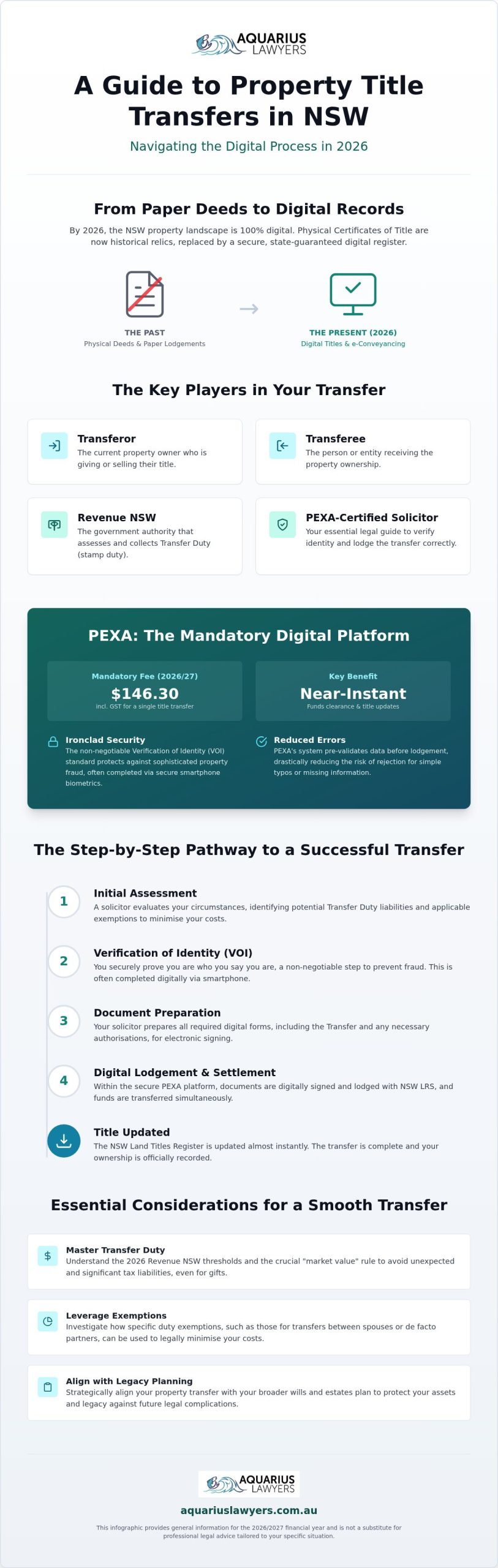
The Step-by-Step Pathway to a Successful Title Transfer
Achieving a seamless transfer of property title nsw involves more than just a signature on a page. It’s a methodical sequence of legal and financial checkpoints that must be cleared with precision. We begin with a comprehensive assessment of the transfer type. Whether it’s a gift between family members or a commercial restructuring, the initial strategy dictates the entire workflow. This phase identifies potential hurdles, such as existing mortgages or caveats, before they can stall your progress. A clear roadmap at the start prevents expensive detours later.
Document Preparation and Legal Review
Drafting the Transfer (Form 01T) requires absolute accuracy; even a minor discrepancy in name spelling can lead to a registry rejection. We also prepare the Notice of Sale (NOS). This is the digital link that ensures local councils and water authorities are notified of the change. To facilitate digital signing, you’ll need to execute a Client Authorisation form. This document empowers your solicitor to act on your behalf within the PEXA workspace. It’s a modern solution that blends convenience with strict legal oversight, ensuring your interests are protected without the need for physical paperwork.
Finalising the Transaction with Revenue NSW
Once the documents are ready, we lodge the transfer for duty assessment through the Electronic Duties Portal. This is a critical junction. You must complete a Purchaser Declaration and an Identity of Parties form to satisfy anti-money laundering and tax requirements. Revenue NSW generally requires the payment of Transfer Duty within three months of the transaction date. If you miss this 90-day deadline, you’ll face interest charges and potential penalties. We manage this timeline closely to ensure your funds are cleared and the duty is paid well before the registry deadline.
The final stage is the digital settlement via PEXA. Once all parties have signed and the duty is verified, the system executes the lodgement. The Land Registry Services then updates the digital register, often within hours. While the Notice of Sale usually triggers automatic updates for council rates and water bills, we conduct a final check to ensure these authorities have correctly recorded your details. This proactive follow-up prevents administrative headaches months down the track. If you’re ready to begin your journey, contact our property law team to secure a fixed-fee assessment today.
Navigating Complex Property Transfers with Aquarius Lawyers
At Aquarius Lawyers, we position ourselves as the steady guide you need in an increasingly automated legal world. A transfer of property title nsw is rarely an isolated event; it’s a strategic move that often intersects with your broader financial and personal goals. We lean into our role as an “innovative veteran” by blending deep, traditional credentials with a mastery of contemporary tools. This approach simplifies the PEXA digital process, turning what could be a source of frustration into a streamlined, transparent experience. We value results over ceremony. This means we focus on getting your title updated correctly and quickly while you focus on your future.
Our firm provides a level of intellectual versatility that standard conveyancing services often lack. For our commercial clients in Sydney, we offer strategic advice that aligns property holdings with business structures to optimise liability and tax outcomes. We also understand that your home is your greatest asset. Integrating property transfers with wills and estates planning ensures that your legacy is protected for the next generation. We offer fixed-fee transparency for standard transfers, so you’ll never have to worry about hidden costs or administrative surprises.
A Holistic Approach to Asset Protection
Protecting your legacy through smart property restructuring is about more than just changing a name on a register. It’s the first step in a broader legal strategy designed to shield your assets from future risks. Whether you’re moving property into a family trust or transferring ownership between partners, we look at the big picture. While we focus on NSW, we understand that property management often spans borders; for those with assets in Adelaide, Fawcett Plumbing offers the professional gas and electrical services needed to keep a property compliant. Our presence in both Sydney and Shellharbour allows us to serve clients across all of New South Wales with a blend of metropolitan expertise and down-to-earth pragmatism. We believe that every client deserves a pathway to resolution that is both legally robust and practically sound.
Starting your journey with us is straightforward. For your initial consultation, please bring your identification for the VOI process, a recent council rates notice, and any existing trust deeds or valuation reports if you’re gifting the property. A typical family transfer in 2026 takes approximately four to six weeks from the initial assessment to final lodgement, depending on the complexity of the duty assessment. Principal Katherine Hawes and our dedicated property law team are ready to provide the clarity and confidence you need. Contact us today for a fixed-fee quote and take the first step towards securing your property assets.
Securing Your Property Assets for the Future
Managing a transfer of property title nsw in 2026 requires a sharp focus on digital precision and strategic tax planning. As we’ve navigated through the PEXA era, it’s clear that the synergy between modern technology and traditional legal expertise is your greatest asset. By understanding the latest Revenue NSW thresholds and the mandatory electronic lodgement protocols, you can bypass common pitfalls like administrative delays and unexpected duty bills. A successful transfer isn’t just about changing a name; it’s about fortifying your legacy and ensuring your assets are legally sound for the years ahead.
Principal Solicitor Katherine Hawes leads our team of PEXA-certified digital settlement experts to provide you with a clear, fixed-fee pathway to resolution. We believe that professional oversight shouldn’t be a source of stress, but a foundation for confidence. Whether you’re gifting a family home or restructuring a commercial portfolio, our no-nonsense approach ensures every detail is handled with care. Secure your property legacy with our fixed-fee transfer services. Contact Aquarius Lawyers today. We look forward to helping you move forward with certainty.
Frequently Asked Questions
Do I still need a physical Certificate of Title in NSW?
No, physical Certificates of Title were abolished in New South Wales and no longer have any legal effect. The state has moved to a 100% digital Land Titles Register managed by the NSW Land Registry Services. Ownership is now verified through a digital record. This shift eliminates the risk of losing paper deeds. Instead, a digital “Control of the Right to Deal” mechanism ensures only authorised parties can initiate a transfer of property title nsw.
Can I transfer property to my child as a gift without paying Stamp Duty?
Gifting property to a child typically triggers Transfer Duty based on the property’s current market value. Revenue NSW doesn’t allow you to avoid tax simply because no money changed hands. You’ll need a formal valuation from a registered valuer to determine the dutiable amount. While some exemptions exist for primary production land, most residential gifts require the payment of duty within 90 days of the transaction to avoid interest penalties and legal complications.
What is the cost of a property title transfer in NSW?
The total cost includes several mandatory government and platform fees. For the 2026/2027 financial year, the PEXA fee for a single title transfer is $146.30. You must also account for the NSW Land Registry Services lodgement fee and the Transfer Duty assessed by Revenue NSW. Duty is calculated on a sliding scale. For example, properties valued between $387,000 and $1,290,000 incur a base rate of $11,602 plus $4.50 for every $100 over $387,000.
How long does the title transfer process take in 2026?
A standard family transfer usually takes between four and six weeks from the initial consultation to final settlement. While the digital update on the Land Titles Register happens almost instantly through PEXA, the preparation phase takes time. We must verify your identity, obtain formal valuations, and wait for Revenue NSW to assess the duty. Once these steps are complete, the electronic lodgement provides immediate certainty of ownership, which is a vast improvement over old paper systems.
Do I need a solicitor to transfer property between family members?
Yes, a solicitor is practically mandatory because 99% of transactions in NSW must be lodged through PEXA. Only certified legal practitioners and financial institutions have access to this secure digital environment. Even for a simple gift between family members, a professional is required to verify identities, witness digital signatures, and ensure the transfer of property title nsw complies with the Conveyancing (General) Regulation 2026. This oversight protects both parties from future legal disputes or registry rejections.
What happens to the mortgage when I transfer a property title?
You cannot transfer a title without addressing any existing mortgage. The bank holds a digital interest that prevents the transfer until the debt is settled or they formally consent to the change. Usually, this involves a discharge of mortgage or a variation of the loan agreement. Your lender must be invited into the PEXA workspace to release their interest simultaneously with the title update. Coordinating this requires early communication with your financial institution to avoid settlement delays.
Is Transfer Duty the same as Stamp Duty in NSW?
Yes, Transfer Duty is the modern name for what many Australians still call Stamp Duty. Revenue NSW officially uses the term Transfer Duty to describe the tax paid when acquiring property or certain other assets. The rates are updated annually on 1 July. For 2026, the general land tax threshold is $1,075,000. Understanding this terminology is vital when calculating your total transaction costs, as duty remains one of the largest expenses in any property transfer across the state.
What is a Notice of Sale (NOS) and why is it important?
The Notice of Sale is a mandatory digital form that notifies government authorities about a change in property ownership. When we lodge your transfer through PEXA, the NOS automatically alerts the local council, water authorities, and the Valuer General. This ensures that future rate notices and water bills are sent to the correct person. Without a properly filed NOS, you might remain liable for the rates on a property you no longer own, leading to administrative headaches.