
A search for a shareholders agreement lawyer often starts with a practical question: what happens if a co-shareholder wants to sell, contribute more capital or blocks a major business decision? These situations can strain even a strong working relationship. A generic template may not answer the questions that matter to your company’s ownership and future plans.
It’s sensible to seek clarity before a disagreement arises. A shareholders agreement is a private contract between its signatories, so its terms should reflect who owns the company, how decisions are made and what happens when a shareholder wants to leave. It also needs to work alongside the company’s constitution and applicable Australian law.
This guide explains what a shareholders agreement can do and how to identify provisions that matter to your business, including decision-making, dispute resolution and share transfers. You’ll also learn what information to prepare before seeking legal advice from Aquarius Lawyers, and why a template may not fit your company’s circumstances. Tailored drafting and review can help align the agreement with your ownership structure and commercial objectives.
Key Takeaways
- Map your ownership structure, business objectives and shareholder roles before drafting agreement terms.
- Identify which decisions need shareholder approval and consider how the agreement can handle disagreement or deadlock.
- Check that provisions for share transfers and shareholder exits reflect the outcomes your company wants to plan for.
- Don’t assume a downloaded template fits your company; review its wording against your circumstances and other company documents.
- Choose a commercial-law lawyer who can explain their drafting approach and the information they’ll need from you.
What does a shareholders agreement do for an Australian company?
A shareholders agreement sets out rules agreed by some or all of a company’s shareholders. It can record how owners intend to make decisions, manage disagreements and respond to changes in ownership or business direction. Written expectations can reduce uncertainty, but they’re useful only when the terms reflect how the company operates and what its owners want to achieve.
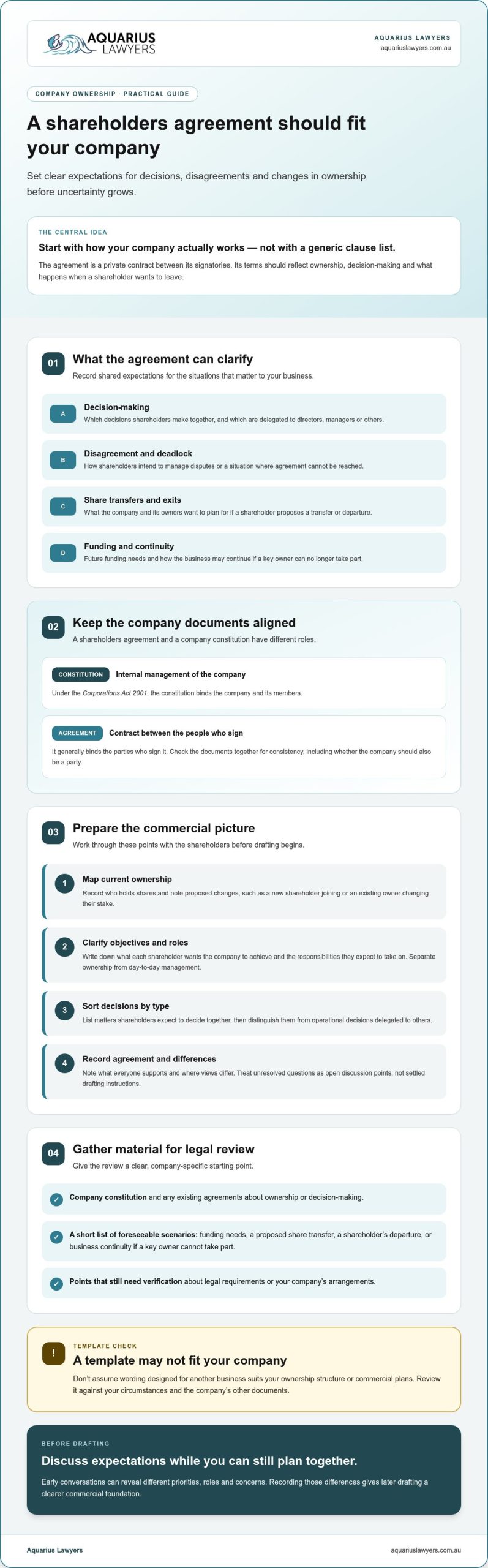
The agreement has a different role from the company constitution. A constitution governs the company’s internal management and, under the Corporations Act 2001, binds the company and its members. A shareholders agreement is a contract that generally binds the parties who sign it. Check the documents together for consistency, and consider whether the company should also be a party to the agreement. For a general overview of common topics, see Shareholders’ agreement.
There’s no universal clause list that suits every business. The right approach depends on your ownership structure, commercial objectives and the situations you want to address. Legal advice can help align the agreement with your company’s arrangements and priorities.
When should shareholders consider an agreement?
Consider an agreement when forming a company, when ownership changes or when the business takes a significant new direction. Discuss expectations before a disagreement develops. For example, two owners of a small business might clarify how they’ll approach major spending or what steps to take if one wants to leave. This is a prompt for discussion, not a rule that applies to every company.
Who should be involved in the discussion?
Start with the shareholders who may be parties to the agreement. Directors should also understand proposed arrangements that affect company decisions or their responsibilities, even if they aren’t shareholders. Discuss each person’s priorities, role and concerns early. If interests differ, individual legal advice may help each shareholder understand the proposed terms and their implications.
Practical preparation starts with candid conversations. Identify what you want the business to achieve, which expectations need to be recorded and where views don’t yet align. Resolving those questions early gives later drafting a clearer commercial foundation.
How to prepare a shareholders agreement around your company
Good drafting starts with clear instructions, not a downloaded template. Before speaking with a lawyer, gather the facts about your ownership and discuss what the business needs the document to address. This gives the review a practical starting point and helps identify decisions shareholders still need to resolve.
Map ownership, roles and decision-making
Work through these steps with the shareholders:
- Map current ownership. Record who holds shares and the current shareholding structure. Note proposed changes, such as a new shareholder joining or an existing owner changing their stake.
- Clarify objectives and roles. Write down what each shareholder wants the company to achieve and the responsibilities they expect to take on. Distinguish ownership from day-to-day management.
- Sort decisions by type. List matters shareholders expect to decide together, then separate them from operational decisions delegated to directors, managers or others. Be specific about decisions that could affect the company’s direction.
- Record points of agreement and disagreement. Note what everyone supports and where views differ. Don’t treat unresolved questions as settled instructions for drafting.
This shared picture matters. For example, shareholders may agree on growth but differ on whether the company should take on a new business activity. Recording that difference helps focus discussion on the decision and the process for reaching it.
Prepare instructions for legal review
Collect the company’s constitution and any existing agreements that relate to ownership or decision-making. Ask the lawyer to check how proposed terms fit with those documents and identify legal or company-specific details that need verification. Don’t assume wording designed for another business will suit your ownership structure or commercial plans.
Next, prepare a short list of foreseeable scenarios. Consider whether shareholders may need to address:
- future funding needs and how shareholders expect to approach them
- a proposed share transfer or a shareholder’s departure
- business continuity if a key owner can no longer take part
- decisions or disagreements that remain unresolved.
Bring your questions, relevant documents and any differing shareholder views to the initial discussion. Ask what further company-specific information is needed before drafting can proceed. Clear instructions help a lawyer assess how the proposed terms can reflect your company’s structure and commercial objectives. If you also need support getting your company’s bookkeeping and administrative records in order ahead of commercial planning, check out Business Wise.
Which shareholders agreement clauses address decisions, disputes and exits?
The clauses that matter depend on the situations your company wants to plan for. Focus on how a decision gets made, what happens if shareholders can’t agree and how ownership may change. A clause can set an agreed process, but it can’t guarantee that conflict will be avoided or a particular outcome achieved.
Decision-making, reserved matters and deadlock
Reserved matters are decisions shareholders agree to treat differently from routine operations. They might include a major change to the business or another decision shareholders want to approve together. Specify which decisions are reserved, who must approve them and how approval is recorded. Keep day-to-day operational choices distinct so the agreement doesn’t make ordinary management unnecessarily difficult.
A deadlock process sets out steps to follow when shareholders can’t resolve a specified issue. It might require further discussion or a dispute-resolution step before other agreed options are considered. The process should be practical for your ownership structure. Ask a commercial-law adviser how the proposed wording fits your company and its constitution.
| Provision | Purpose | Question to discuss |
|---|---|---|
| Decision-making | Sets who decides and how approval is reached. | Which matters need shareholder agreement rather than routine management? |
| Dispute or deadlock process | Sets steps for handling an unresolved disagreement. | What happens if discussion doesn’t resolve the issue? |
Share transfers, departures and future ownership
Transfer provisions can set a process for a proposed sale or other change in ownership. Depending on the company’s needs, shareholders might discuss whether other owners have an opportunity to consider the shares before an outside transfer and what steps apply if a shareholder wants to leave.
Plan for more than a voluntary sale. Consider retirement, incapacity, a shareholder’s departure and the effect of a change in ownership on business continuity. If a departing shareholder’s interest may need to be valued, the agreement can address the valuation method and process. There’s no single formula that suits every company, so define the approach in light of your circumstances.
Before signing, check the proposed terms against the constitution and applicable law. A shareholders agreement is a contract between its parties, while the constitution governs the company’s internal management. Conflicting or unclear documents can create uncertainty about how a decision or transfer should work. Have the relevant documents reviewed together and resolve inconsistencies before relying on the arrangements.
How to review a shareholders agreement before signing
Before signing, check that the draft reflects your company’s objectives and that each shareholder understands what they’re agreeing to. A downloaded template can help you identify questions, but it may not account for your ownership structure, commercial arrangements or other company documents.
Use this review sequence to identify issues before they become binding terms:
- Revisit your objectives. Check that the agreement supports the company’s plans and reflects what shareholders have agreed about their roles and priorities.
- Read each clause for practical meaning. Identify who must act, what triggers the process, what steps follow and whether any terms are unclear. Ask for plain-English explanations of obligations you don’t understand.
- Test realistic scenarios. Consider what the draft says if shareholders disagree on a major decision, an owner wants to leave or ownership changes. Check whether each situation has a clear process, a responsible person and a next step.
- Look for gaps. Note foreseeable governance or ownership changes the draft doesn’t address. Don’t assume silence means everyone shares the same understanding.
- Compare related documents. Review the agreement alongside the company constitution and other relevant company documents. Ask a lawyer to explain any inconsistency or uncertainty about how the documents interact.
- Record agreed revisions. Resolve questions with the relevant shareholders, then make sure agreed changes appear in the final version before anyone signs.
Test the draft against realistic business scenarios
Follow the wording step by step. If a major decision can’t be agreed, does the document explain what happens next? If a shareholder wants to leave, does it set out a process for the proposed ownership change? If the answer depends on an undefined term or assumption, raise it for review. A clause can guide the response, but it can’t guarantee agreement or prevent a dispute.
Check consistency and obtain legal advice
The constitution and shareholders agreement have different roles, so check that their terms work together rather than leave uncertainty about company decisions or ownership arrangements. Ask a commercial-law adviser to explain the wording, its practical implications and how the documents interact. Resolve unclear terms with the shareholders and record agreed revisions before signing.
For guidance on your commercial-law needs, discuss your circumstances with Aquarius Lawyers.
Choosing a shareholders agreement lawyer and planning your next steps
Legal support should connect the agreement to your company’s ownership structure and commercial objectives. Look for a lawyer with commercial-law experience who takes time to understand the business, explains drafting choices clearly and can outline practical trade-offs between different approaches. For companies managing ongoing commercial arrangements, boutique practices such as MAR Legal illustrate how tailored corporate legal support helps align business operations with strategic governance. The document is only useful if you understand how its terms may affect the company and each shareholder.
Questions to ask before engaging a lawyer
Use an initial discussion to understand how the lawyer will approach the work. Ask questions such as:
- How will you learn about our company, ownership structure and each shareholder’s priorities?
- How will you compare the proposed agreement with our constitution and other relevant company documents?
- How will you explain unresolved choices, including the practical implications of different options?
- What is included in the work, who needs to provide instructions and what information should we prepare?
Clear answers help you understand the proposed scope and each person’s responsibilities before work begins. If shareholders have different interests, ask how those differences will be identified and handled. You may also need to consider whether individual legal advice is appropriate for a shareholder.
Take a proactive step with legal guidance
Before making contact, prepare a brief summary of who owns shares, what the company aims to achieve and which concerns need attention. Have the constitution, existing agreements and a list of priority questions ready. Note any decisions the shareholders haven’t resolved, such as how to approach a future ownership change. This gives the discussion a practical focus without requiring you to settle every issue in advance.
A search for a shareholders agreement lawyer sydney can help you compare potential advisers. Check their commercial-law experience and ask whether they can assist with the type of agreement work your company needs. Aquarius Lawyers is an Australian law firm that provides commercial law services. Confirm the scope of any proposed assistance directly with the firm.
To discuss your commercial-law needs, contact Aquarius Lawyers and ask what information they’ll need to assess your situation.
Set your company up for clearer decisions
A useful shareholders agreement turns shared expectations into written processes for decisions, disputes and ownership changes. The right terms depend on your company’s structure and commercial objectives, so don’t assume a generic template will cover the situations that matter to your shareholders.
Before seeking advice, organise your ownership details, constitution and existing agreements. List your priorities and unresolved questions, then check that the proposed terms work alongside the company’s other documents. These steps give you a clearer basis for assessing the draft and discussing trade-offs.
If you’re searching for a shareholders agreement lawyer sydney, focus on commercial-law experience and advice that explains your options in practical terms. Aquarius Lawyers provides commercial law services to individuals and businesses across Australia.
Contact Aquarius Lawyers to discuss your commercial-law needs and ask what information the firm needs to assess your situation. Clear priorities and practical guidance can help you take the next step with greater confidence.
Frequently Asked Questions
What is a shareholders agreement in Australia?
A shareholders agreement records arrangements between some or all shareholders about matters such as company governance, decision-making and ownership changes. Its terms should reflect the company’s circumstances and the parties’ intentions, rather than rely on a generic checklist. It isn’t a substitute for checking the company constitution or applicable legal requirements. Before relying on a draft, ask a lawyer to explain how the agreement and other company documents work together.
Is a shareholders agreement legally binding in Australia?
Whether a shareholders agreement is binding depends on its wording, how it was made and the relevant circumstances. A formal title or signature page alone doesn’t confirm that the document will have the intended effect. Ask a lawyer to review the terms, signing process and relationship with other company documents before relying on it. Legal requirements can change, so confirm current Australian law before acting on specific legal advice.
Does a shareholders agreement replace a company constitution?
No, don’t assume a shareholders agreement replaces the company constitution. The two documents can serve different roles, and their terms may need to be considered together. If they’re inconsistent, you may face uncertainty about how a decision or process should work. Ask a lawyer to compare the documents, identify any conflicts and explain what steps may be needed to align them with the company’s arrangements and the shareholders’ intentions.
What clauses should a shareholders agreement include?
The relevant provisions depend on your company and its shareholders. Topics to discuss may include decision-making, dispute resolution, deadlock processes, share transfers and what happens when a shareholder leaves. If you search for a shareholders agreement lawyer sydney, assess whether the lawyer will connect each proposed clause to your ownership structure and business plans. A tailored discussion is more useful than copying a generic list that may not address your circumstances.
Can a shareholders agreement help resolve a deadlock?
A shareholders agreement can set out a process shareholders agree to follow if they can’t resolve a decision, but it can’t guarantee agreement or a particular result. Check what triggers the deadlock process, which steps follow and who is responsible for them. The process should be clear and workable for your company. Ask a lawyer to review how the clause fits with the rest of the agreement and other company documents.
Do all shareholders need to sign a shareholders agreement?
Who should sign depends on the proposed arrangement, the agreement’s wording and the company’s circumstances. Clarify who the parties will be and consider how the agreement is intended to operate if ownership changes. Don’t assume it automatically binds someone who hasn’t agreed to it. Ask a lawyer to explain the implications of the proposed parties and signing process, including whether the company itself should be a party to the agreement.
Can a shareholders agreement restrict the transfer of shares?
A shareholders agreement may include terms about proposed share transfers, but their effect depends on the wording and applicable legal and company-document requirements. Discuss which situations you want to address, such as a proposed sale or a shareholder’s departure, and what process should apply. Ask a lawyer to compare the transfer provisions with the constitution and explain the practical steps required. Don’t rely on a template clause without checking its fit.
Disclaimer
Please note that legal rules change and this is not a substitute nor construed as legal advice. It is general information only.