
If your company may be unable to pay its debts, acting too late or taking the wrong step can increase your personal legal risk. The safe harbour provisions for directors Australia provide eligible directors with a potential defence to insolvent trading liability while they pursue a course of action reasonably likely to deliver a better outcome for the company than immediate administration or liquidation.
Safe harbour is not automatic. Directors must meet specific conditions and be able to show they were actively developing and pursuing a genuine restructuring course.
This guide explains when safe harbour may apply under section 588GA of the Corporations Act 2001 (Cth), what it does not protect, and practical steps to take if insolvency is a concern. Current financial records, careful monitoring, a documented plan and tailored legal advice can help you assess your options and make informed decisions.
Key Takeaways
- The safe harbour provisions for directors australia are a conditional pathway under section 588GA, not automatic immunity from director liability.
- Assess whether a proposed course of action is reasonably likely to achieve a better outcome for the company than immediate administration or liquidation.
- If insolvency is a concern, review the company’s financial position promptly and keep clear records of decisions and advice.
- Prepare current financial records, key decisions and concerns for legal advice so you can assess risks and possible pathways.
What are the safe harbour provisions for directors in Australia?
Financial distress can leave you weighing whether to keep trading, restructure or appoint an administrator. Section 588GA of the Corporations Act 2001 (Cth) provides a conditional safe harbour from insolvent trading liability while a director pursues a course of action reasonably likely to lead to a better outcome for the company than immediate administration or liquidation. A better outcome may involve restructuring or an orderly sale. It does not necessarily mean the company survives.
Safe harbour is a limited statutory protection for eligible directors pursuing a qualifying course of action, not a blanket exemption from director duties or every form of liability. This is the central idea behind the safe harbour provisions for directors australia.
How safe harbour relates to insolvent trading
In plain English, insolvent trading concerns a company incurring a debt when it cannot pay its debts as they fall due. A director may face personal exposure for certain company debts if the legal requirements for insolvent trading are met. Safe harbour may provide a defence in relation to debts incurred in connection with a qualifying course of action. For background on the underlying concept, see Insolvent Trading and Director Liability. Whether the protection applies depends on the circumstances and statutory requirements.
Who may need to understand the provisions?
Directors and business owners should understand the framework when cash flow pressure, unpaid obligations or creditor concerns raise questions about solvency. These warning signs do not, on their own, establish that a company is insolvent, but they call for prompt attention to its financial position. You do not need to wait for formal administration to seek advice. Early advice can help you assess the company’s position and options before decisions become more urgent.
Does safe harbour protect directors automatically?
No. The safe harbour provisions for directors in Australia are conditional, and they do not remove every director duty or liability. Under section 588GA of the Corporations Act 2001 (Cth), the key test is whether, after suspecting the company may be insolvent, a director begins developing and pursuing a course of action reasonably likely to lead to a better outcome for the company than immediate administration or liquidation.
Eligibility depends on the company’s circumstances, the proposed course of action and what the director actually does, not simply on having a restructuring plan. The ASIC guidance on safe harbour provisions explains the statutory framework and factors relevant to assessing a director’s conduct.
What does a “better outcome” mean?
The comparison is between the likely result of pursuing the proposed course and the result of immediately appointing an administrator or liquidator. A better outcome does not necessarily mean saving the company. Depending on the facts, a sale or structured wind-down may be relevant. No single restructuring option suits every business. Directors need a reasonable basis for the proposed course and should keep assessing whether it remains likely to produce a better outcome as circumstances change.
What safe harbour does not do
Safe harbour is a potential defence to insolvent trading liability for qualifying debts connected with the course of action. It is not a general release from directors’ other obligations, protection from every claim, or a guarantee that a turnaround will succeed. Statutory requirements also apply: the company must meet applicable obligations to pay employee entitlements when due and lodge required taxation documents. These requirements concern payment and lodgement respectively. Unpaid tax debt is not the same as a failure to lodge.
Get advice on the facts before relying on the protection. To discuss your circumstances and assess the relevant legal framework, you can speak with Aquarius Lawyers.
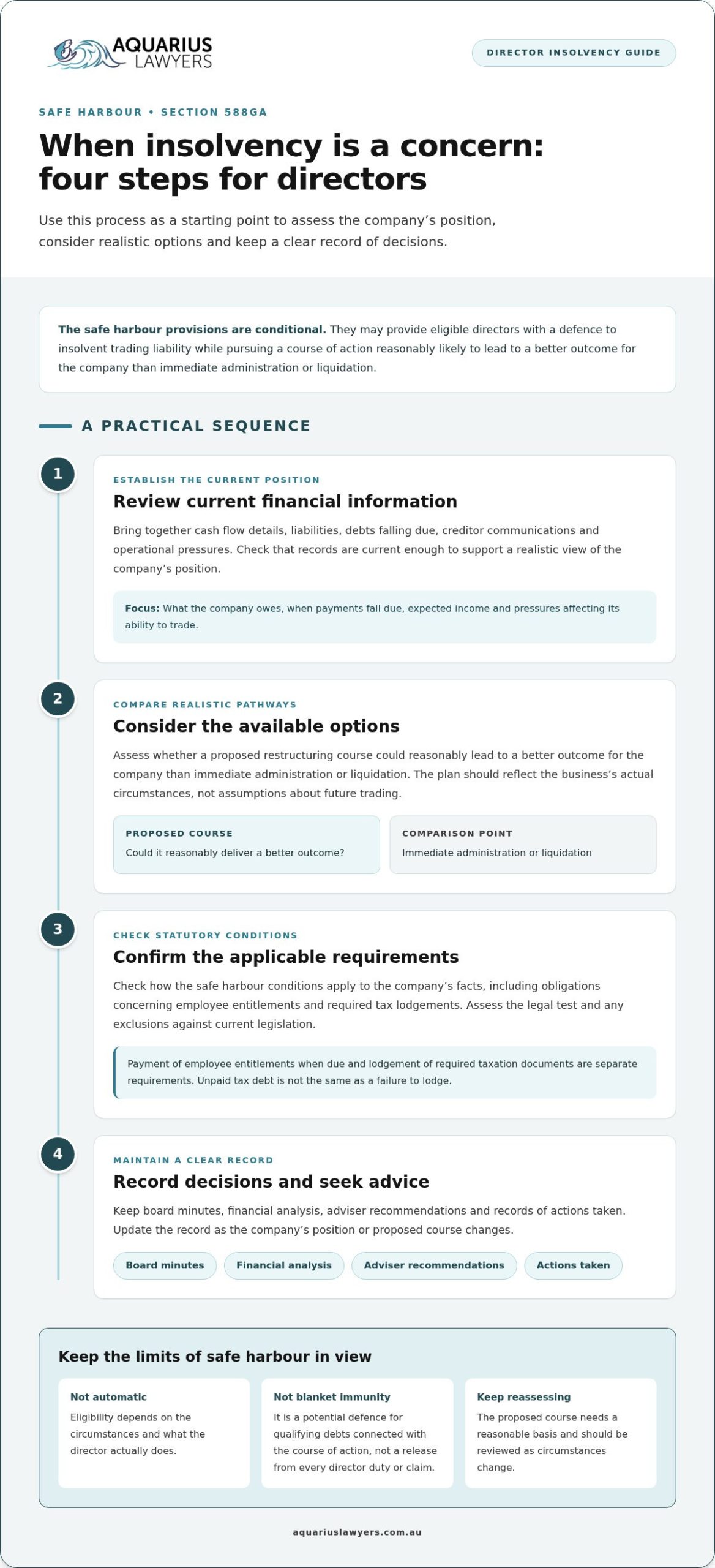
What should directors do when insolvency becomes a concern?
Act promptly, but do not treat a general guide as a guaranteed legal checklist. The right response depends on the company’s position, decisions already made and the current requirements of section 588GA. For directors considering the safe harbour provisions for directors australia, timely assessment, reliable records and informed decisions can help clarify options and explain the steps taken.
Use this process as a starting point, then get advice tailored to your circumstances:
- Review current financial information. Bring together cash flow details, liabilities, debts falling due, creditor communications and operational pressures. Check that the records are current enough to support a realistic view of the company’s position.
- Consider the available pathways. Assess whether a proposed restructuring course could reasonably lead to a better outcome for the company than immediate administration or liquidation. The plan should reflect the business’s actual circumstances, not assumptions about future trading.
- Check statutory requirements. Confirm how the safe harbour conditions apply, including obligations concerning employee entitlements and required tax lodgements. Assess the legal test and any exclusions against current legislation and the company’s facts.
- Record decisions and seek advice. Keep board minutes, financial analysis, adviser recommendations and records of actions taken. Update the record as the company’s position or proposed course changes.
Assess the company’s position and available options
Look beyond a single cash balance. Consider what the company owes, when payments fall due, what income is expected and whether operational pressures affect its ability to trade. Use these records to test assumptions and compare realistic pathways. No universal metric or fixed timeframe in this general process determines eligibility.
Keep records and seek advice early
Clear records help show what information directors considered, why they made decisions and what advice they received. Legal advice can help you understand director duties, safe harbour conditions and potential risks before the position becomes more difficult. Aquarius Lawyers provides commercial legal services to businesses assessing legal and governance issues. Discuss your company’s restructuring options with Aquarius Lawyers.
How can legal advice help directors assess safe harbour options?
Legal advice can help you connect the company’s financial position with the statutory requirements and your responsibilities as a director. Safe harbour involves fact-specific questions, so advice should assess the records, decisions and proposed course of action rather than assume protection applies.
Questions to address with a legal adviser
Use the discussion to clarify what needs attention and which options are open. Ask whether the company’s circumstances may raise insolvent trading concerns, which director duties require attention, and how the current safe harbour conditions and exclusions apply. You can also discuss what evidence may support the decisions made and whether the proposed course remains appropriate as the company’s position changes.
Advice can help you compare practical pathways and understand their potential implications for the company and its directors. It cannot predict the outcome or guarantee that a particular restructuring approach will succeed. The aim is to make decisions with a clearer understanding of the relevant legal framework and risks.
Prepare for a focused discussion
Organise current financial records alongside relevant governance materials, such as board minutes, adviser communications and restructuring proposals. Prepare a timeline of key decisions and actions. Note what steps have already been taken, what information informed them and where uncertainty remains. Raise gaps or unanswered questions directly.
Aquarius Lawyers provides commercial law services and advises businesses on governance and compliance, including developing governance and compliance frameworks. This experience supports practical discussion of oversight and legal options, but a framework alone does not establish safe harbour eligibility.
Take the next step before uncertainty delays informed action. Discuss your director duties and legal options with Aquarius Lawyers.
Make your next decision with a clear view of the risks
Urgency does not mean you need to decide without understanding the consequences. Clarify what the company can realistically pursue, what information is missing and how your responsibilities as a director may be affected. A timely assessment can help you approach the safe harbour provisions for directors australia with the right questions, rather than assumptions about whether protection will apply.
Katherine Hawes brings over two decades of legal and commercial experience to business matters. Tailored legal advice can help you assess your position and consider available pathways without promising a particular outcome. The aim is to ground your next decision in the company’s circumstances.
Discuss your director duties and legal options with Aquarius Lawyers. A considered conversation can help you move forward with greater clarity.
Frequently Asked Questions
Does safe harbour protect a director from all personal liability?
No. Safe harbour is not general personal-liability protection. It may provide a defence to insolvent trading liability for qualifying debts, but it does not automatically remove liability under a personal guarantee or for separate conduct or claims. A guarantee given to a lender, for example, is a distinct commitment. Assess each potential source of liability on its own facts.
When should a director seek advice about safe harbour?
Seek advice as soon as information raises a credible concern about the company’s ability to meet debts, rather than waiting for a formal appointment or creditor action. For example, repeated payment deferrals or an unexpected loss of revenue may prompt a director to consider whether solvency concerns or director duties need attention. Advice can help clarify which decisions need urgent review and what information to gather.
What records should directors keep when considering safe harbour?
Keep source documents that show how the company’s position and decisions developed. These may include cash-flow forecasts and their assumptions, creditor correspondence, payment records, board papers, meeting minutes and written adviser communications. Preserve updates as well as earlier versions, so the record shows what directors knew at each decision point. A clear timeline can help explain why actions were taken.
Can a director rely on safe harbour if the company later enters liquidation?
Liquidation does not, by itself, determine whether safe harbour was available. The director may still need to establish that the statutory requirements applied to the relevant debts and that the course of action was pursued as required. The company’s eventual failure neither guarantees protection nor proves it was unavailable. A liquidator’s review makes contemporaneous records and tailored legal advice especially relevant.
Disclaimer
Please note that legal rules change and this is not a substitute nor construed as legal advice. It is general information only.