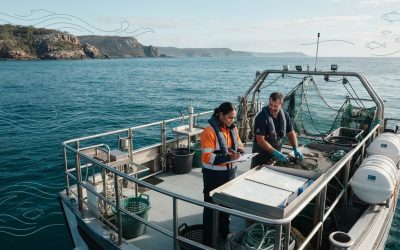
Treating fisheries compliance as routine paperwork is the fastest way to lose your livelihood at sea. If you operate a commercial fishing vessel or hold quota units, you already know the intense pressure of navigating shifting rules. With the 2026 Total Allowable Commercial Catch set at 731.5 tonnes alongside rapid sub-block closures, staying ahead of the abalone fishing regulations Tasmania enforces is no longer just an administrative task. It is a critical legal defence of your enterprise.
The fear of accidental non-compliance is real, especially when simple dockside reporting oversights or boundary crossings can trigger severe licence impacts, vessel seizures, or criminal proceedings. You shouldn’t have to risk your maritime assets because of technical ambiguities or complex data management requirements. In this guide, you will master the legal framework governing the 2026 fishery so you can protect your entitlements and ensure long-term operational success. We examine the updated quota allocations, mandatory GPS and depth logger rules, and practical compliance strategies to keep your business fully protected.
Key Takeaways
- Understand how the Living Marine Resources Management Act and new statutory updates shape the abalone fishing regulations Tasmania enforces across all commercial zones.
- Protect your commercial assets by conducting precise legal due diligence before completing fishing quota transfers or purchasing a commercial fishing vessel.
- Learn how to avoid compliance traps that escalate beyond minor infractions into serious commercial criminal proceedings and costly licence suspension.
- Establish practical deck-level routines to meet mandatory GPS tracking rules and electronic data management requirements without disrupting your catch.
- Discover how pairing more than 20 years of marine law experience with modern technology safeguards your maritime assets against regulatory action.
Understanding the 2026 Abalone Legal Framework
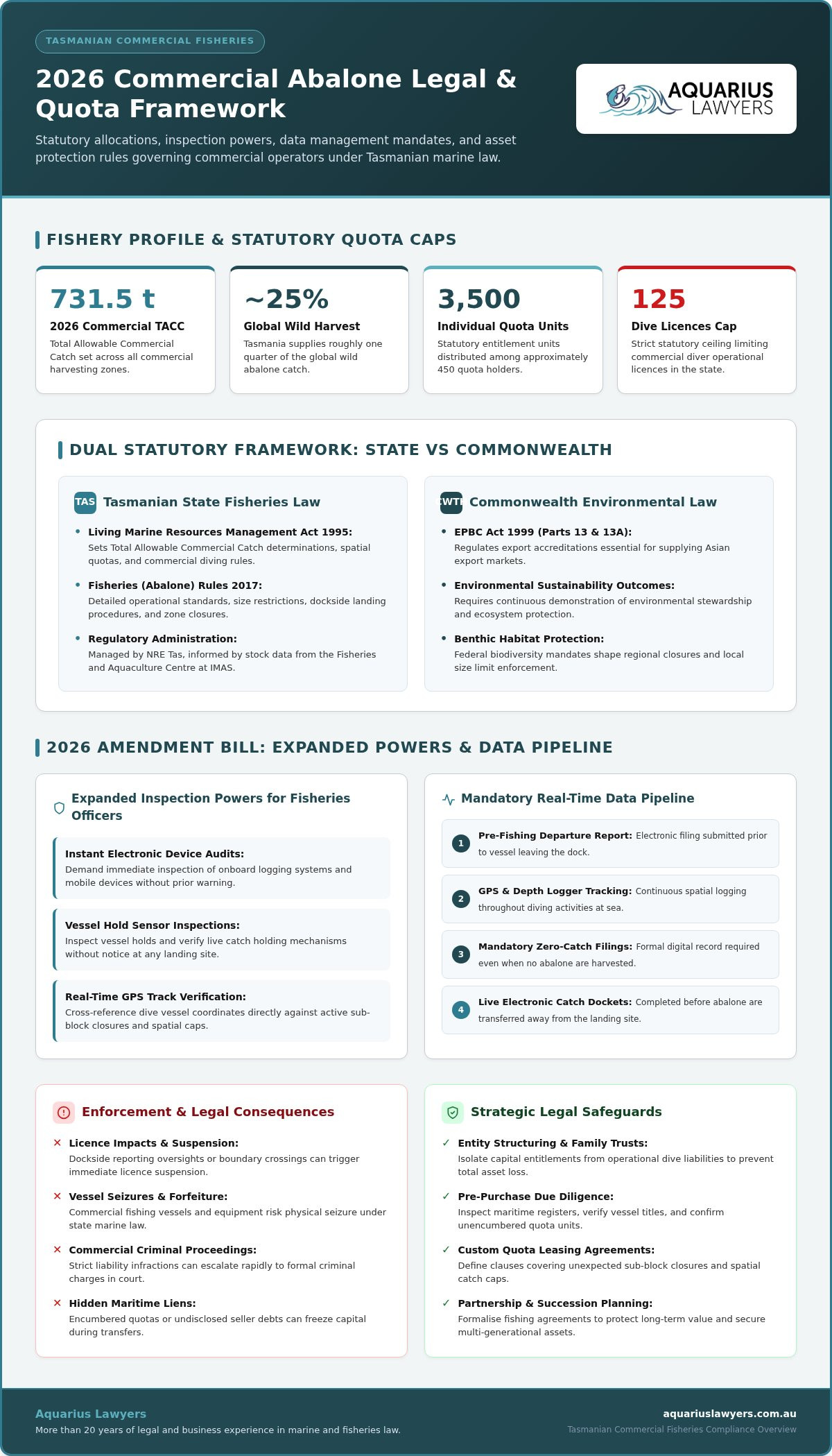
Commercial harvesting operates under a rigorous statutory structure where operational mistakes trigger severe administrative penalties. At the core of the abalone fishing regulations Tasmania enforces is the Living Marine Resources Management Act 1995. This statute establishes total allowable catch determinations, quota management, and licensing rules, supported by subordinate rules including the Fisheries (Abalone) Rules 2017. Management is administered directly by the Department of Natural Resources and Environment Tasmania (NRE Tas), guided by stock assessments from the Fisheries and Aquaculture Centre at IMAS. Because the state supplies roughly 25% of the global wild abalone harvest, legislative oversight remains exceptionally strict.
A critical divide exists between commercial operators and recreational fishers. Recreational participants face individual possession limits and seasonal controls enforced through recreational fishing fines. In contrast, commercial diving is an asset-heavy commercial trade. Commercial operators face statutory quota units, mandatory loggers, electronic reporting, and commercial criminal liability under state marine law.
Key Changes in the 2026 Amendment Bill
The 2026 Fisheries Management Amendment Bill significantly expands inspection powers for fisheries officers. Officers can now demand immediate electronic device audits, inspect vessel hold sensors without notice, and cross-reference real-time GPS tracks against sub-block catch limits. Submissions under statutory data management requirements now require instantaneous pre-fishing reports, zero-catch filings, and live electronic catch dockets before abalone leave the landing site.
In 2026, compliance demands verifiable, real-time data integrity from the moment your vessel leaves the dock until catch handover is finalised.
Environmental Protection and Biodiversity Conservation Act
State fisheries rules do not operate in a vacuum. The Commonwealth Environment Protection and Biodiversity Conservation Act 1999 intersects directly with state controls by regulating export accreditations under Parts 13 and 13A. To export abalone to key Asian markets, commercial operators must demonstrate continuous environmental stewardship and satisfy strict environmental sustainability outcomes. Federal biodiversity conservation mandates directly influence regional catch closures and local size restrictions, ensuring commercial fishing activities protect sensitive benthic habitats and maintain ecological balance across diverse fishing blocks.
Commercial Abalone Fishery: Quotas, Licences, and Transfers
In Tasmania’s abalone sector, harvesting rights represent significant commercial assets. Operating successfully under the abalone fishing regulations Tasmania enforces requires separating diving activity from capital entitlement ownership. The statutory framework divides access sharply: exactly 3,500 individual quota units are distributed among roughly 450 quota holders, while a statutory cap restricts the fishery to 125 commercial dive licences. Whether you are drafting commercial fishing partnership agreements or buying a commercial fishing vessel, securing your financial position demands rigorous contractual due diligence before deploying funds.
Fishing Quota Management and Legal Transfers
Official commercial abalone fishery management guidelines specify how unit allocations function across dynamic regional zones. When executing fishing quota transfers or structuring quota leasing agreements, poorly defined clauses create immense risk. Your contracts must clearly address unexpected sub-block catch closures, spatial caps, and statutory default scenarios under the Living Marine Resources Management Act 1995. Take time to inspect vessel title and maritime registers. Hidden maritime liens against a seller’s vessel or encumbered quota rights can halt transfers immediately, freezing your capital.
Licence Impacts and Business Continuity
Operational oversights lead directly to severe commercial loss. A single documentation mistake or boundary transgression can trigger licence suspension and vessel forfeiture. Because dive licences and quota rights generate substantial value, you cannot afford to hold them under unshielded personal names. Establishing tailored corporate entities and family trusts separates your enterprise liabilities from your core operational entitlements. Reviewing your business structure with Asset Protection Legal Services provides a practical safeguard for your licences against future regulatory disputes.
Succession Planning for Fishing Businesses
Maritime enterprises require specialised exit planning. Transferring quota units, vessel assets, and licence entitlements to the next generation involves navigating complex statutory transfer approvals alongside taxation requirements. Coordinated estate planning ensures that unexpected events do not result in contested probate proceedings or administrative deadlock. Implementing structured estate services guarantees that your fishing assets and hard-won entitlements remain protected for your family well into the future.
Common Legal Pitfalls and Fisheries Prosecution Risks
Most fisheries prosecutions do not stem from intentional poaching. Instead, they arise from administrative oversights, minor navigational errors across block boundaries, or misunderstandings of legal minimum shell lengths. Under the strict abalone fishing regulations Tasmania enforces, offences such as harvesting undersized abalone, failing to file an electronic pre-fishing report, or shucking catch aboard a vessel are treated as strict liability offences. This means prosecutors do not need to prove you intended to break the law. Under the Fisheries (Abalone) Rules 2017, the physical act itself establishes liability.
While amateur divers typically settle matters through on-the-spot recreational fishing fines, commercial divers and quota holders face far higher stakes. Commercial violations trigger formal criminal proceedings in the Magistrates Court, leading to potential vessel forfeiture and permanent licence disqualification. Similarly, any malicious damage to benthic marine habitat, research stations, or monitoring equipment draws aggressive state prosecution.
Navigating Criminal Proceedings in Fisheries Law
When fisheries officers suspect a non-compliance event, they will serve a formal brief of evidence on you. This brief contains logged GPS tracks, electronic weigh-in dockets, officer witness statements, and dive logger depth profiles. State prosecutors rely on this technical data to establish a breach beyond reasonable doubt. Navigating these charges requires an immediate review of the brief. Engaging an experienced Criminal Law Service ensures every piece of technical proof is scrutinised, allowing you to identify procedural errors and cross-examine officer claims effectively.
Licence Suspension and Appeal Processes
If you receive a formal notice of licence suspension from the department, you must act swiftly. You have a narrow statutory window to lodge an administrative appeal or request an urgent stay of proceedings to protect your fishing operations. Marine evidence is rarely infallible. In complex enforcement actions, challenging unreliable police evidence, such as improperly calibrated depth sensors or drifting GPS coordinates across sub-block lines, can dismantle the prosecution’s case. Successfully contesting flawed data eliminates catastrophic licence impacts and keeps your commercial crew working on the water.
Best Practices for Compliance and Evidence Management
Precision on deck prevents disaster in court. To maintain standing under the abalone fishing regulations Tasmania enforces, commercial operators must integrate compliance checks into everyday vessel operations. Routine inspections and sudden boardings by fisheries officers leave no room for guesswork. When officers board your vessel, remain professional, provide mandatory documentation promptly, and ensure your crew members understand their statutory rights. Independent catch verification, such as logging secondary weights before leaving the landing zone, creates a crucial cross-reference if discrepancies emerge during official weigh-ins.
Step-by-Step Compliance Audit
Run through this operational audit prior to starting your engines on every harvest trip:
- Gear and Vessels: Confirm all callipers, measuring gauges, and commercial fishing vessel markings align with Tasmanian gear codes.
- Licence and Quota: Check that your dive licence is active and your target quota unit balance is officially assigned before lines are dropped.
- System Telemetry: Verify that your mandated depth loggers, vessel tracking units, and reporting portals are fully calibrated and transmitting live data.
Managing Evidence for Your Defence
Modern compliance relies entirely on technical proof. If fisheries authorities allege you entered a closed sub-block, your electronic telemetry serves as your primary line of defence. Retain uncorrupted backups of all GPS tracks, depth logger records, and date-stamped deck footage. If fisheries officers challenge body-worn camera footage, establish a documented chain of custody showing the raw files remain unaltered. Contemporaneous written notes recorded in a bound vessel logbook immediately after an event carry immense evidentiary weight in court proceedings, often rebutting ambiguous recall from enforcement officers.
Environmental Stewardship as a Legal Shield
Demonstrating active environmental stewardship strengthens your defence against regulatory scrutiny. Under federal guidelines, evidencing positive environmental sustainability outcomes can serve as mitigating evidence if administrative penalties are considered. Operators who incorporate insights from the International Fisheries Observer and Monitoring Conference into their standard operating practices showcase measurable commitment to stock health. Documenting your adherence to benthic protection protocols proves your enterprise prioritises sustainability alongside commercial yield. Protect your enterprise today by securing experienced advice through Aquarius Lawyers maritime legal counsel.
Strategic Legal Support for Tasmanian Abalone Operators
Operating under the abalone fishing regulations Tasmania mandates requires proactive legal protection. Waiting until fisheries officers serve a court attendance notice or issue an administrative suspension is a dangerous gamble with your commercial livelihood. A routine legal audit of your vessel contracts, quota leases, and telemetry workflows is far more cost-effective than mounting a courtroom defence against a fisheries prosecution. When compliance issues arise on the water, you need an advocate who understands maritime operations and regulatory mechanics.
Led by Katherine Hawes, widely recognised across Australia as “The Fish Lawyer”, Aquarius Lawyers brings specialised industry acumen to your commercial operations. With more than 20 years of legal and business experience, Katherine provides decisive counsel to protect your quota entitlements, vessel investments, and operational rights. Engaging our team through dedicated seafood and marine legal services ensures your enterprise stays resilient against regulatory shifts.
The Aquarius Lawyers Methodology
Our operational equation delivers direct practical results: Our expertise + Ai = Reduced legal costs! We combine two decades of maritime legal practice with modern analytical technology to streamline compliance reviews and contract management. This approach produces rapid, cost-effective solutions for your commercial marine business.
We routinely resolve commercial marine business disputes, partnership splits, and quota leasing breaches. When complex boat ownership disputes threaten to tie up your commercial fishing vessel at the dock, we step in immediately to clarify equity, negotiate clear settlements, and protect your commercial assets.
Protecting Your Future in the Fishery
Securing an abalone business in 2026 means eliminating legal exposure before it triggers a formal investigation. We build custom legal solutions for today’s issues, ensuring your dive arrangements, logger data systems, and asset structures withstand rigorous regulatory scrutiny.
Do not wait for a compliance audit or an unexpected charge to jeopardise your investment. The Time is Now to audit your enterprise, safeguard your licences, and protect your maritime assets for the long haul.
Safeguard Your Catch and Your Commercial Licence
Operating a profitable maritime enterprise requires equal parts seamanship and regulatory discipline. Complying with the abalone fishing regulations Tasmania enforces is ultimately about asset protection, from verifiable digital logger records to watertight quota lease agreements. When you establish strict deck-level protocols and separate commercial liabilities from your personal assets, you eliminate the legal vulnerabilities that threaten your livelihood.
You don’t have to navigate these statutory shifts alone. Led by Katherine Hawes, widely known as “The Fish Lawyer”, the team at Aquarius Lawyers draws on more than 20 years of specialised marine and fisheries law experience. As trusted specialists in licence impact management, we provide the practical legal shielding your commercial operations require. Take control of your maritime enterprise before the season tests your compliance. Secure your fishery business with Aquarius Lawyers and set a confident, profitable course for the years ahead.
Frequently Asked Questions
What are the current recreational bag limits for abalone in Tasmania for 2026?
Recreational fishers in Tasmania are subject to strict daily bag limits and total possession caps per person. Under the abalone fishing regulations Tasmania sets for non-commercial divers, you must hold a valid recreational abalone licence before taking any abalone. Bagged catch cannot be sold, traded, or used for commercial gain. Divers must measure every abalone immediately using an approved measuring gauge before removing it from the reef substrate.
Can I lose my commercial fishing licence for a minor reporting error?
Yes, repeated or critical reporting errors can lead to immediate licence suspension. Tasmanian fisheries legislation classifies electronic logbook filings, pre-fishing notifications, and landing declarations as mandatory statutory conditions. Failing to submit an electronic pre-fishing report or misreporting catch weights undermines the quota management system. Continued non-compliance quickly triggers formal show-cause notices from the department, potentially resulting in the cancellation of your commercial diving entitlements.
How does the 2026 Fisheries Management Amendment Bill affect my quota?
The 2026 legislation strengthens regulatory oversight around real-time quota tracking and spatial allocations rather than changing underlying ownership units. While your assigned unit share of the 731.5-tonne commercial catch remains defined by your quota licence, the amendment bill grants fisheries officers heightened inspection powers. This means instantaneous verification of electronic dockets and depth logger data directly affects your ability to fish against your allocated quota during rapid sub-block closures.
What should I do if a fisheries officer seizes my commercial fishing vessel?
Seek immediate legal counsel before making voluntary statements to investigating officers. When fisheries authorities seize a commercial fishing vessel, they execute statutory forfeiture powers under marine resources legislation. Request a formal inventory of all seized property, including vessel logs, electronic sounders, and catch. Your legal representative can apply urgently to the court for an order to release the vessel, minimising downtime and operational disruption while charges are tested.
Is it possible to appeal a recreational fishing fine in Tasmania?
Yes, you can elect to dispute an infringement notice in court or seek an internal administrative review. If you receive recreational fishing fines for alleged undersized catch or gear violations, you must lodge your dispute within the statutory timeframe noted on the notice. Presenting objective evidence, such as photographic documentation, instrument calibration records, or proof of defective measuring callipers, can convince prosecutors or a magistrate to withdraw the penalty.
What are the legal requirements for transferring an abalone quota?
A valid quota transfer requires formal departmental approval alongside a legally binding commercial contract. You must submit statutory transfer applications to the department to reassign abalone quota units under your licence. Beyond administrative forms, sound legal practice requires verifying clear title, ensuring the units are free from maritime liens or financier security charges, and drafting clear default clauses covering unexpected fishery closures under the abalone fishing regulations Tasmania maintains.
How can I protect my personal assets from business risks in the fishing industry?
Structure your commercial operations through corporate entities and discretionary family trusts rather than sole proprietorships. Holding high-value maritime assets, quota units, and vessel titles in separate proprietary limited companies shields personal assets like your family home from commercial liabilities. This corporate barrier safeguards your wealth if your business encounters contractual disputes, operational vessel losses, or administrative penalties stemming from strict liability fishing offences.
What is the difference between blacklip and greenlip abalone regulations?
Blacklip and greenlip abalone are governed by distinct regional size limits, sub-block catch allocations, and biological management plans. Greenlip abalone typically carry larger legal minimum shell lengths and are managed under a separate total catch allocation, currently set at 98 tonnes across state waters. In contrast, blacklip abalone quotas are divided into distinct western, eastern, northern, and Bass Strait zones, each subject to separate seasonal closures and depth monitoring rules.
Disclaimer
Please note that legal rules change and this is not a substitute nor construed as legal advice. It is general information only.