
In the complex and high-stakes world of commercial fishing, your licence and quota are more than just permits—they are the core assets of your business. Navigating the intricate regulations set by the Australian Fisheries Management Authority (AFMA) is a constant challenge. A minor administrative error or an unintentional breach can escalate quickly, threatening your livelihood with heavy fines, vessel forfeiture, or the loss of your quota. This is where strategic legal guidance becomes your most valuable tool.
Master the complexities of Australian Fisheries Management Authority regulations with expert legal guidance to protect your commercial fishing licence and quotas. Compliance isn’t just about avoiding penalties; it’s about proactively managing risk to secure the long-term viability of your fishing enterprise. An expert AFMA compliance lawyer can translate dense regulations into practical, on-deck actions, ensuring your operations remain secure and profitable for years to come.
What is AFMA and Why Does Your Business Need a Specialist Lawyer?
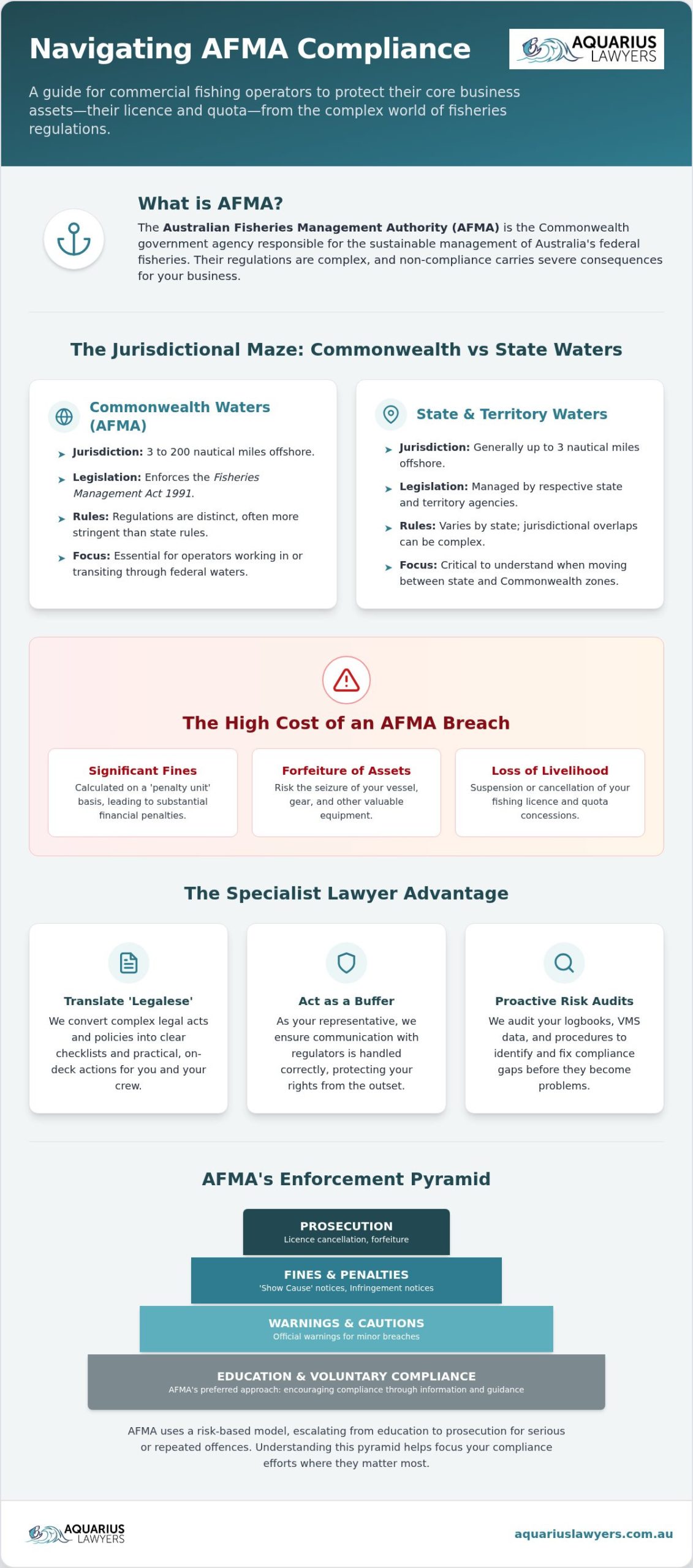
The Australian Fisheries Management Authority (AFMA) is the Commonwealth government agency responsible for the sustainable management and use of Australia’s federal fisheries resources. Its jurisdiction covers waters from 3 to 200 nautical miles offshore, managing everything from policy and enforcement to data collection and research. However, understanding where AFMA’s authority begins and ends is a common source of confusion for many operators.
This is a critical distinction. Many people searching for an “AFMA compliance lawyer” might be confused by the acronym’s other use for the Australian Financial Markets Association. To be clear, this article addresses the fisheries regulator, the government body with the power to investigate, penalise, and prosecute commercial fishing operations.
- Definition and Jurisdiction: AFMA enforces the Fisheries Management Act 1991 and other related legislation in Commonwealth waters. Its role is to ensure ecological sustainability while maximising the net economic returns to the Australian community.
- Commonwealth vs. State Fisheries: State and Territory agencies manage fisheries within their respective coastal waters (generally up to 3 nautical miles offshore). An AFMA compliance lawyer is essential for operators who work in or transit through Commonwealth waters, as the rules are distinct and often more stringent.
- The Specialist Advantage: A general commercial lawyer may understand contract law but lack the deep, industry-specific knowledge of quota systems, VMS data interpretation, bycatch regulations, and the unique ‘strict liability’ nature of many fisheries offences. A specialist understands the operational realities of your business.
- The High Stakes of Non-Compliance: The consequences of an AFMA breach are severe. They range from significant financial penalties calculated on a ‘penalty unit’ basis to the seizure of your vessel and equipment (forfeiture) and the suspension or cancellation of your valuable fishing concessions.
Commonwealth vs State Jurisdiction
Understanding which set of rules applies to your operation is the first step in compliance. Many fishing trips can involve moving between state and Commonwealth waters, creating complex jurisdictional overlaps. An AFMA compliance lawyer helps you navigate these boundaries effectively.
- Identifying Your Waters: A specialist can help you map out your typical operations and clarify which regulations apply at each stage of your journey, from leaving port to returning with your catch.
- The Role of the Fisheries Management Act 1991: This is the primary legislation governing all Commonwealth fisheries. A lawyer specialising in this Act can interpret its requirements for your specific fishery, from gear restrictions to reporting obligations.
- Navigating Cross-Jurisdictional Issues: Complications arise when catch is taken in one jurisdiction but landed in another, or when state-based licences have conditions that interact with Commonwealth rules. Expert legal advice prevents these issues from becoming costly legal problems.
The Role of a Specialist Fisheries Solicitor
An AFMA compliance lawyer acts as more than just a defender in court; they are a strategic partner in your business. Their role is to empower you by demystifying the law and implementing robust systems to protect your assets.
- Translating ‘Legalese’ into Practical Steps: We convert complex legal text from the Act and subordinate policies into a clear checklist of actions you and your crew need to take on the water every day.
- Acting as a Buffer: When dealing with regulators, having a legal professional as your representative ensures communication is handled correctly and your rights are protected from the outset.
- Proactive Risk Auditing: The best way to handle an AFMA investigation is to prevent it from ever happening. A specialist can audit your logbooks, VMS data, and operational procedures to identify and fix potential compliance gaps before they draw regulatory attention.
If your business challenges extend beyond fisheries into broader corporate regulatory issues, you may also wish to check out JZ Law for specialised counsel.
Decoding the AFMA National Compliance and Enforcement Policy
AFMA’s National Compliance and Enforcement Policy is the rulebook that dictates how they monitor the industry and respond to suspected breaches. While the document is publicly available, its dense, bureaucratic language makes it difficult for operators to understand what it means for their business. An AFMA compliance lawyer can decode this policy, revealing the strategic thinking behind the regulator’s actions.
- The ‘Voluntary vs Enforced’ Compliance Model: AFMA’s approach is based on a pyramid of enforcement. They prefer to educate and encourage voluntary compliance at the base, but they will escalate to warnings, fines, and prosecution for more serious or repeated offences.
- How AFMA Prioritises Enforcement in 2026: The agency uses a risk-based model, focusing its resources on threats that pose the greatest risk to fish stocks, protected species, or the integrity of the quota management system. Understanding these priorities helps you focus your compliance efforts where they matter most.
- The ‘Show Cause’ Notice: This is a critical document. If you receive a ‘Show Cause’ notice, it means AFMA has formed a preliminary view that a breach has occurred and is considering taking administrative action (like suspending a licence). Your written response, ideally drafted with legal assistance, is your opportunity to present your case and avoid a negative outcome.
- Key Reporting Obligations: Failure to meet reporting requirements is one of the most common triggers for enforcement action. This includes accurate and timely submission of Vessel Monitoring System (VMS) data, catch logs (e-logs or paper), and other e-monitoring information.
The Enforcement Pyramid
AFMA’s response to non-compliance is not random. It follows a structured ‘enforcement pyramid’, and your position on it is determined by the severity of the offence and your compliance history.
- From Warnings to Prosecution: At the bottom of the pyramid are education and warnings. Further up are directions, cautions, and administrative penalties. At the very top sits civil and criminal prosecution.
- How Your History Matters: A history of good compliance can mean the difference between receiving a warning for a minor error and facing a formal investigation. AFMA’s decisions are heavily influenced by an operator’s past conduct.
- Strategies to Move Down the Pyramid: If a breach is identified, taking immediate and effective remedial action can demonstrate your commitment to compliance. A lawyer can help you communicate these actions to AFMA, often resulting in a less severe penalty.
Modern Monitoring Technologies
Technology is central to AFMA’s compliance strategy. VMS, e-logs, and on-board cameras generate vast amounts of data that can be used as evidence in a prosecution.
- Legal Implications of VMS Data: Your Vessel Monitoring System provides AFMA with real-time location data. This is often used to determine if a vessel has operated in a closed area. A lawyer can scrutinise this data for inaccuracies or technical faults that could form part of a defence.
- Avoiding Accidental Breaches: A malfunctioning VMS unit or a corrupted e-log file can be deemed a breach, even if it’s a technical fault. We can advise on best-practice procedures to ensure your tech setup is compliant and you have records to prove it; for expert assistance with your broader IT infrastructure, AA Network Technologies offers specialised cyber security and managed services.
– Privacy and Data Usage: While monitoring is a condition of your licence, there are legal principles governing how this data can be collected and used. Understanding your rights is crucial.
Common Compliance Pitfalls and How to Avoid Them
While AFMA’s rulebook is vast, a handful of common mistakes are responsible for the majority of enforcement actions. Focusing on these key areas is a pragmatic way to reduce your risk profile significantly. An experienced AFMA compliance lawyer sees the same patterns repeatedly and can help you build systems to avoid them.
- Inaccurate Logbook Entries: This is the most frequent pitfall. The debate often centres on whether an error was an honest mistake or a deliberate attempt to mislead. The onus is on you to ensure every entry is accurate.
- Bycatch and Protected Species Interactions: Failing to report interactions with Threatened, Endangered, and Protected (TEP) species is treated very seriously. Accurate and immediate reporting is non-negotiable.
- Quota Overruns: Exceeding your allocated quota, even by a small amount, is a strict liability offence. Understanding the legal mechanics of ‘balancing’ or reconciling your catch is vital for avoiding penalties.
- Gear Restrictions and Closed Areas: Using non-compliant gear or fishing in a zone that is seasonally or permanently closed are high-priority offences for AFMA, often detected via VMS data and aerial surveillance.
The Danger of Administrative Errors
It’s a common objection: “Why do I need a lawyer for a simple typo?” In fisheries law, there is often no such thing. A seemingly minor administrative error can be interpreted by the regulator as the starting point of a serious investigation.
- Why a Typo Can Trigger an Investigation: An incorrect date, a misidentified species code, or a wrong location grid can create discrepancies when cross-referenced with VMS data or catch disposal records. This flags your operation for closer scrutiny.
- Best Practices for Record-Keeping: Implement a ‘check and double-check’ system for all logbook entries before submission. Ensure your crew is trained on the importance of accuracy.
- How to Correct an Error: If you identify a mistake in a submitted report, there is a correct procedure for notifying AFMA and lodging an amended record. A proactive correction, guided by legal advice, is viewed far more favourably than waiting for the regulator to find it.
Managing Quotas and Licences
Your fishing concessions (licences, permits, and quotas) are valuable commercial assets. Managing them correctly is not just a matter of compliance, but of sound financial management.
- Legal Pitfalls in Leasing or Transferring Quota: The agreements for leasing or transferring quota must be structured correctly to be legally enforceable and to avoid regulatory breaches. We can advise on and draft these critical commercial agreements.
- Keeping Your Boat Licence Current: Ensuring your Commonwealth Fishing Boat Licence and any associated permits are renewed on time and that all conditions are met is fundamental. An oversight can render your entire operation illegal.
- Understanding ‘Deemed Value’: If you are found to have taken fish over your quota, AFMA can impose a penalty based on the ‘deemed value’ of the excess catch, which can be a substantial financial blow on top of any other fines.
What to Do if You Face an AFMA Investigation or Prosecution
The moment an AFMA officer boards your vessel or contacts you for a formal interview is a critical juncture. How you respond in these initial hours can significantly impact the final outcome. It is essential to know your rights and obligations *before* an investigation begins.
AFMA’s own documentation details their extensive powers to search and seize evidence. However, it does not detail your right to silence or your right to legal counsel. A proactive AFMA compliance lawyer ensures you are prepared to handle this pressure professionally and protect your legal position.
- Immediate Steps on Inspection: When an officer boards your vessel, your first step is to be cooperative and professional. However, you should also state clearly that you wish to contact your lawyer before answering any detailed questions.
- Rights During a Formal Interview: You have the right to have a lawyer present during any formal interview. You also have the right to remain silent to avoid self-incrimination. It is almost always advisable to exercise these rights and seek legal advice before proceeding.
- Handling a ‘Notice to Produce’: If you receive a legal notice requiring you to produce documents, logbooks, or digital data, you must comply. A lawyer can ensure you provide exactly what is required by the notice—no more, no less—and that you retain copies of everything.
- The Federal Court Process: If the matter proceeds to prosecution, it will likely be heard in the Federal Court of Australia. This is a complex legal environment requiring a defence team with specific experience in Commonwealth fisheries law.
Handling On-Water Inspections
An on-water inspection is a stressful and intimidating experience. A clear plan helps you and your crew manage the situation effectively.
- Remain Professional, Protect Your Interests: Instruct your crew to be courteous but to refer all questions about the trip, the catch, or past activities to you, the skipper. You can then refer them to your lawyer.
- What You Must Provide: You are generally required to provide your name, address, and identification, as well as facilitate the inspection of the vessel, gear, and catch.
- Recording Your Own Version: As soon as it is safe and practical, make your own detailed notes of the inspection. Record the time, the officers’ names, what was said, what was inspected, and what was seized. This can be invaluable evidence later.
The Legal Defence Strategy
A robust defence against a fisheries prosecution involves meticulous analysis of the evidence and a deep understanding of the law.
- Analysing the Evidence: We scrutinise every piece of the prosecution’s evidence, from the accuracy of VMS polling data to the chain of custody for seized catch and the legality of how witness statements were obtained.
- Challenging ‘Strict Liability’: Many fisheries offences are ‘strict liability’, meaning the prosecution doesn’t have to prove you intended to commit the offence. However, a defence of ‘honest and reasonable mistake of fact’ may be available, and we can assess if the circumstances of your case fit this narrow exception.
- Negotiating Administrative Resolutions: Not every matter needs to end in a full court hearing. We can often negotiate with AFMA’s legal team to have a matter resolved through an administrative penalty or other agreement, saving you the time, cost, and stress of a trial.
Your Expert in AFMA Compliance: Meet Katherine Hawes
In the face of complex regulations and the constant threat of enforcement, you need more than just a lawyer; you need a specialist who lives and breathes maritime and fisheries law. You need a trusted partner who understands the industry from the wharf up.
Aquarius Lawyers, led by Principal Solicitor Katherine Hawes, is that partner. Known throughout the industry as ‘The Fish Lawyer’, Katherine has dedicated her career to providing pragmatic, no-nonsense legal advice to the commercial fishing and aquaculture sectors. She combines decades of specialised legal experience with a modern, technology-driven approach to deliver cost-effective solutions that protect your assets and your future.
Our approach is built on a simple equation: Deep Industry Knowledge + Strategic Legal Expertise = Commercial Security.
- The ‘Fish Lawyer’ Advantage: We speak your language. Our advice is grounded in the operational realities of running a commercial fishing business, not just theoretical legal principles.
- Bespoke Compliance Audits: We can ‘AFMA-proof’ your business by conducting a thorough audit of your operations, identifying potential risks, and implementing robust systems to ensure ongoing compliance.
- Powerful Representation: From responding to a ‘Show Cause’ notice to negotiating with regulators or defending you in the Federal Court, we provide tenacious and strategic representation at every stage.
- Strategic Advice for Quota Owners: We provide high-level advice on structuring your business to protect valuable fishing assets and navigate the legalities of quota transactions and aquaculture investments.
A Trusted Partner in Fisheries Law
Don’t wait for an infringement notice to appear. Proactive management of your AFMA compliance is one of the smartest investments you can make in your business. Secure your livelihood with a lawyer who knows the industry and is dedicated to protecting your interests.
To discuss your compliance needs or an urgent legal matter, contact Katherine Hawes and the Aquarius Lawyers team today.
Contact Aquarius Lawyers:
- Sydney Office: Level 13, 135 King Street, Sydney NSW 2000
- Shellharbour Office: Suite 1, 1-5 Memorial Drive, Shellharbour NSW 2529
- Phone: (02) 4295 2296
Organise a consultation with Aquarius Lawyers today and safeguard the future of your commercial fishing business.
Frequently Asked Questions (FAQs)
What is the difference between AFMA and State fisheries agencies?
AFMA manages and enforces fishing regulations in Commonwealth waters, which generally extend from 3 to 200 nautical miles off the Australian coast. State and Northern Territory fisheries agencies are responsible for managing fisheries within their coastal waters, typically up to the 3 nautical mile limit. The rules, species managed, and licensing requirements are different for each jurisdiction.
Can I be prosecuted for an accidental error in my fishing logbook?
Yes. Many fisheries offences, including those related to inaccurate reporting, are ‘strict liability’. This means the prosecution does not need to prove you intended to make the error, only that the error occurred. While an honest and reasonable mistake can sometimes be used as a defence, it is a high bar to meet, which is why meticulous record-keeping is so critical.
What powers do AFMA officers have when boarding my vessel?
AFMA officers have extensive powers under the Fisheries Management Act 1991. They can board and search your vessel, inspect your gear and catch, seize items they believe are evidence of an offence (including your vessel), and require you to answer questions related to your identity and the vessel’s activities. However, you have the right to legal counsel and the right to silence regarding questions that may incriminate you.
Do I need a lawyer for a ‘Show Cause’ notice from AFMA?
It is highly recommended. A ‘Show Cause’ notice is a formal step in the enforcement process where AFMA outlines a suspected breach and invites you to explain why they should not take action (e.g., suspend your licence). Your written response is a critical piece of evidence. A lawyer can help you draft a compelling, legally sound response that protects your interests and maximises your chances of a favourable outcome.
How much are the fines for Commonwealth fisheries offences in 2026?
Fines are calculated using ‘penalty units’, a standard value set by the Commonwealth government that increases with inflation. As of mid-2023, the value of one penalty unit was $313. This value is indexed annually, so it is expected to be higher by 2026. A single offence can attract a penalty of hundreds of units, potentially leading to fines in the tens or hundreds of thousands of dollars.
Can AFMA seize my boat or fishing gear during an investigation?
Yes. If an AFMA officer reasonably believes that your vessel, gear, or catch has been used in the commission of a serious fisheries offence, they have the power to seize it. If you are subsequently convicted, the court can order that the seized property be forfeited to the Commonwealth.
How does the ‘strict liability’ rule apply to fisheries law?
‘Strict liability’ means that the intention of the person committing the act is not a necessary element for an offence to be proven. For example, if you are found fishing in a closed zone, the prosecution only needs to prove that your vessel was in that zone and was engaged in fishing. They do not need to prove that you knew it was a closed zone or that you intended to fish there.
Is it possible to appeal an AFMA decision regarding my fishing licence?
Yes. Many administrative decisions made by AFMA, such as a decision to suspend or cancel a licence, can be appealed. The appeal is typically heard by the Administrative Appeals Tribunal (AAT). The AAT will conduct a merits review, effectively stepping into AFMA’s shoes to remake the decision. Legal representation is essential for a successful AAT appeal.
Disclaimer
Please note that legal rules change and this is not a substitute nor construed as legal advice. It is general information only.