
What if the biggest threat to your career isn’t the fine itself, but the confusion between NSW road laws and maritime regulations? Facing a BUI charge is incredibly stressful, and it’s natural to fear that a Sydney Local Court appearance will result in a lost licence and immediate unemployment. You need more than just a general practitioner; you need a strategic boating under the influence lawyer nsw who understands that specialised maritime knowledge plus robust criminal defence equals a strategic pathway to protecting your future. We recognise the pressure you’re under and believe that a pragmatic, “no-nonsense” approach is the most effective way to restore your peace of mind.
This guide provides a strategic, common-sense legal pathway to protect your licence and livelihood. We’ll explain how 2026 regulations differ between the road and the water, specifically regarding the mandatory Interlock program and PCA limits. You will discover how we aim for outcomes like a Section 10 dismissal to avoid a criminal conviction and how to secure the minimum disqualification period possible. By layering deep industry expertise with modern legal methodology, we provide the clarity and confidence you need to resolve these charges efficiently.
Key Takeaways
- Understand the specific PCA categories in NSW, from novice to high range, and how they dictate the severity of your maritime offence.
- Navigate the Sydney Local Court process with confidence by understanding how the Police Fact Sheet influences your first mention at centres like Downing Centre or Parramatta.
- Learn why the 2026 road-based Interlock requirements differ from boating penalties and how to manage the financial impact of potential fines.
- Secure a strategic advantage by consulting a boating under the influence lawyer nsw to utilise mitigation tools like the Traffic Offender Intervention Program (TOIP).
- Discover how a “no-nonsense” defence strategy can help you aim for a Section 10 dismissal, protecting both your professional licence and your livelihood.
Understanding PCA and Boating Under the Influence (BUI) in NSW
In New South Wales, the law treats the safety of our waterways with the same level of scrutiny as our roads. Prescribed Concentration of Alcohol (PCA) refers to the level of alcohol in your system, measured through breath or blood analysis. While the legal framework for the water is found under the Marine Safety Act 1998, it mirrors the tiered system used for road vehicles. If you’re stopped by NSW Maritime or the Police on Sydney Harbour or Pittwater, you’re subject to Random Breath Testing (RBT) just as you would be on the M5. Understanding these limits is the first step toward a strategic defence, and consulting a boating under the influence lawyer nsw ensures you aren’t blindsided by the technical overlap between these jurisdictions.
When a PCA offence occurs, the Police may issue an immediate suspension. This means your right to operate a vessel is revoked on the spot, often lasting until your matter is heard in the Sydney Local Court. It’s a pragmatic “safety first” measure from the authorities, but it can be devastating for those whose livelihood depends on being on the water.
The PCA Tier System in New South Wales
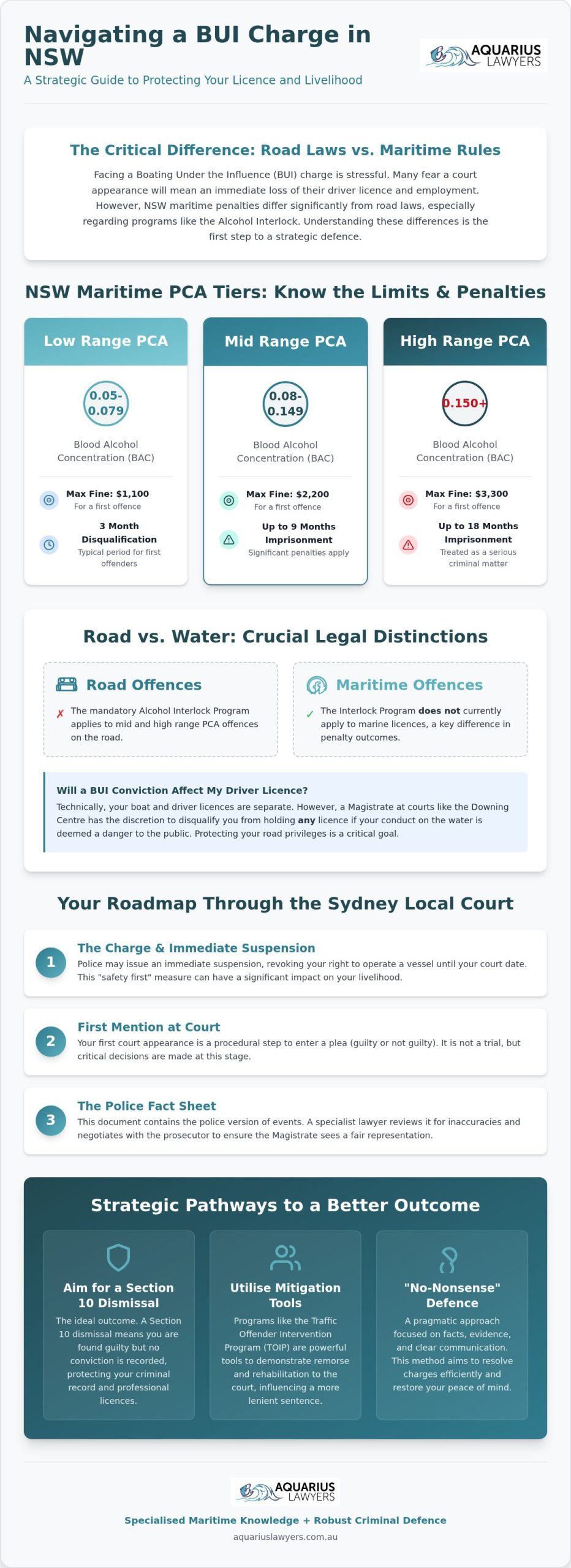
The penalties you face are determined by your blood alcohol concentration (BAC) at the time of testing. New South Wales uses a strict hierarchy to categorise these offences:
- Low Range PCA (0.05 to 0.079): For a first offence, you face a maximum fine of $1,100 and a 3-month licence disqualification. It’s often seen as a “lapse in judgment,” but it still results in a criminal record without a proper legal strategy.
- Mid Range PCA (0.08 to 0.149): This tier carries a maximum fine of $2,200 and potential imprisonment for 9 months. While the mandatory Alcohol Interlock Program is a staple for road offences in 2026, it currently does not apply to marine licences, though magistrates still impose significant disqualification periods.
- High Range PCA (0.150+): This is treated as a high-level criminal matter. With fines up to $3,300 for a first offence and the risk of 18 months in prison, the court’s priority shifts from education to heavy punishment.
Drink Driving on the Water: Sydney Harbour BUI Laws
Sydney Harbour and Pittwater are high-patrol zones where authorities are particularly vigilant. The legal standards here are part of the broader Drunk Driving Laws in Australia, which hold skippers to a high standard of care. A common question is whether a BUI conviction will automatically cancel your car driver licence. Technically, your boat licence and your driver licence are separate. However, a Magistrate at the Downing Centre or Waverley Local Court has the discretion to consider your overall character. If they believe your conduct on the water proves you’re a danger to the public, they may seek to disqualify you from holding any licence. This is where a boating under the influence lawyer nsw becomes essential to ensure your road privileges remain protected while we resolve your maritime charges.
The Sydney Local Court Process: A Pragmatic Roadmap
The first time you step into a Sydney Local Court for a BUI charge can be overwhelming. Whether your case is listed at the Downing Centre, Parramatta, or Waverley, the process follows a strict, methodical sequence. Your first appearance is known as a “First Mention.” This isn’t a trial; it’s a procedural step where you or your boating under the influence lawyer nsw will inform the Magistrate whether you intend to plead guilty or not guilty. It’s a high-pressure environment, but having a grounded, steady guide by your side ensures you don’t make critical errors during this initial phase.
The most critical document in the room is the Police Fact Sheet. This is the version of events the police provide to the Magistrate. It covers everything from the weather conditions on the harbour to your level of cooperation during the breath test. If the facts are overstated or inaccurate, your lawyer must negotiate these details with the Police Prosecutor before the Magistrate ever sees them. We operate on a simple but effective formula: Preparation + Presentation = Outcome. By refining the facts and preparing your subjective material early, we control the narrative from the outset.
Your Day in Court: Step-by-Step
Arrive at least 30 minutes early. Locate your name on the court lists, usually displayed on digital screens in the foyer. Once you find your courtroom, check in with the court officer. While you wait, your solicitor will often engage in “bar table” negotiations with the Police Prosecutor. This is where the heavy lifting happens. When your name is called, stand when the Magistrate addresses you and remain respectful. Avoid long-winded excuses. Instead, let your legal representative present a concise, evidence-based argument for leniency.
Key Sydney Jurisdictions for Traffic Matters
Different courts have different “atmospheres,” and local knowledge is a significant asset in maritime defence.
- Downing Centre Local Court: Located in the CBD, this is the busiest hub for maritime matters originating from Sydney Harbour.
- Parramatta Local Court: This centre handles a high volume of traffic and PCA cases for Western Sydney residents.
- Regional Representation: If your incident occurred further south, matters are often heard in Shellharbour or Wollongong, where the court’s focus may shift toward local safety issues.
Securing a favourable result requires a lawyer who understands the nuances of these specific benches and can navigate the list efficiently. You can organise a fixed-fee consultation to discuss how these local court dynamics might affect your specific case and your pathway forward.
Penalties, Disqualifications, and the 2026 Interlock Program
A PCA conviction in NSW carries more than just immediate court costs; it initiates a ripple effect that touches your insurance premiums, international travel prospects, and future employment. Understanding the distinction between mandatory and discretionary disqualifications is vital. While a Magistrate has the discretion to reduce a disqualification period in certain circumstances, many offences carry a “floor” or minimum period that cannot be bypassed without a Section 10 dismissal. Navigating these brackets requires a boating under the influence lawyer nsw who can map out a specific pathway to resolution based on your unique PCA tier and personal circumstances.
The long-term impact of a criminal record is often the most stressful part of the process. A conviction can result in being barred from certain countries or losing professional accreditation. We view legal defence as a formula where proactive evidence plus a clear statement of remorse equals a significantly better sentencing outcome. By addressing the “why” behind the incident early, we aim to minimise the “what” in terms of penalties.
The Mandatory Alcohol Interlock Program (MAIP)
In 2026, the NSW Alcohol Interlock Program remains a central pillar of road-based PCA sentencing. It’s important to clarify a common point of confusion: currently, the interlock program does not apply to boating licences or marine offences. However, many clients facing BUI charges also find themselves under scrutiny for road-based drink driving. For road offences, the program is mandatory for mid-range, high-range, and repeat offenders. From 1 August 2026, the technical requirements are updating to a “BlowThenHum” pattern, and the financial commitment is significant. Participants should expect to pay approximately A$2,270 for a 12-month program or A$4,190 for 24 months. Avoiding this device requires a strict exemption order, which courts only grant under very narrow, documented hardship criteria.
Fines and Community Correction Orders (CCO)
The financial toll of a BUI offence is structured around the PCA tier system. For a first-time low-range offence, the maximum fine is A$1,100. This climbs sharply to A$3,300 for a first-time high-range offence, and can reach A$5,500 for subsequent serious breaches. Beyond fines, the court may impose a Community Correction Order (CCO). A CCO is a pragmatic, community-based sentencing alternative to imprisonment, often involving supervision and specific conditions like alcohol rehabilitation. Our primary objective for many clients is a Section 10 dismissal. This outcome means the court finds you guilty but chooses not to record a conviction. It is the ultimate “clean slate” solution that protects your criminal record and allows you to move forward without the weight of a permanent mark on your history.
Strategic Defence: Mitigation and Evidence for NSW Courts
Magistrates in the Sydney Local Court hear dozens of PCA matters every week. They are experts at spotting hollow excuses. A successful defence relies on a pragmatic shift from “why it happened” to “what I am doing to ensure it never happens again.” Accountability is the cornerstone of leniency. When you stand before the bench, the court is looking for genuine insight into your actions. Engaging a boating under the influence lawyer nsw allows you to build a brief of evidence that focuses on proactive mitigation rather than deflection. This “no-nonsense” approach creates a clear pathway for the Magistrate to consider a more lenient sentence, such as a Section 10 dismissal.
Proving your “need for a licence” is another critical component. If a disqualification will result in the loss of your employment or prevent you from meeting family obligations, this must be documented with precision. We use a logical equation: Verifiable Hardship + Demonstrated Remorse = Judicial Leniency. This requires more than just a verbal claim; it needs pay slips, contracts, or medical schedules that prove your vehicle or vessel is essential to your livelihood.
The Traffic Offender Intervention Program (TOIP)
Completing an accredited TOIP is one of the most effective ways to demonstrate remorse. These programs, offered by providers like PCYC or Road Sense Australia across Sydney and regional NSW, educate offenders on the risks of drink driving and boating. Strategic timing is essential. You should aim to complete the course before your final sentencing date so your solicitor can present the certificate of completion as evidence of your rehabilitation. This proactive step shows the court you’ve taken the initiative to correct your behaviour without being ordered to do so.
Drafting Powerful Character References
Quality always beats quantity when it comes to references. A Magistrate is more likely to be moved by a single, well-structured letter from a long-term employer than three generic notes from friends. To be effective, a reference must follow the “Three Pillars” of courtroom evidence:
- Acknowledgement: The referee must state they are aware of the specific PCA or BUI charge you are facing.
- Remorse: They should describe your reaction to the offence, such as your visible distress or your efforts to seek help.
- Consequences: They must explain how a conviction or licence loss would specifically impact your role or the community.
Avoid references that claim you “would never do this,” as the court has already established that you did. Instead, focus on your general good character and the out-of-character nature of the incident. You can contact our Sydney defence team to receive a structured template that ensures your referees provide the exact information the court requires.
Why Aquarius Lawyers is Your Trusted Sydney Defence
Choosing the right legal representative is a strategic decision where niche expertise plus local court experience equals the best possible outcome. Katherine Hawes, widely known as “The Fish Lawyer,” provides a level of maritime authority that generalist firms simply cannot match. When you’re searching for a boating under the influence lawyer nsw, you need someone who understands the specific currents of Sydney Harbour as well as the technicalities of the Marine Safety Act. We don’t believe in cold, detached formality. Instead, our team prioritises a down-to-earth pragmatism that values results over legal ceremony.
This “no-nonsense” attitude is backed by innovative, tech-integrated case management. We use contemporary tools to streamline the preparation of your brief of evidence, ensuring that every character reference and TOIP certificate is organised for maximum impact. This efficiency doesn’t just improve your chances in court; it also keeps our services cost-effective. Legal stress is often compounded by financial uncertainty, which is why we offer transparent, fixed-fee options for traffic and BUI matters. You’ll know exactly what your defence will cost from the outset, allowing you to focus on the pathway to resolution rather than worrying about billable hours.
Expertise Across Road and Water
The “Fish Lawyer” perspective is vital because BUI matters often involve complex intersections of maritime regulation and criminal law. We serve as a steady, common-sense guide through a system that can feel exclusionary. Beyond the water, we also provide robust representation for road-based offences, ensuring that a single mistake doesn’t dismantle your entire professional life. You can explore our Criminal Lawyer Sydney services to see how we apply this same strategic rigour to all Local Court matters.
Your Pathway to Resolution
Moving from a foundation of expertise to a tangible court result requires direct access to senior counsel who value efficiency. We don’t hand your future off to junior clerks; you deal directly with experienced advisors who understand how to protect your livelihood. Whether we’re aiming for a Section 10 dismissal or seeking to avoid the ripple effects of a conviction, our methodology is always solution-oriented and grounded in relatable, everyday wisdom. We move easily between high-level strategy and the practical realities of the Sydney Local Court list. Contact Aquarius Lawyers today for a confidential consultation and take the first proactive step toward securing your licence and your future.
Securing Your Future and Protecting Your Livelihood
Resolving a BUI charge requires a strategic transition from panic to proactive preparation. We’ve explored how a clear understanding of PCA tiers and the Sydney Local Court process can demystify what feels like an overwhelming situation. By focusing on accountability through tools like the Traffic Offender Intervention Program and high-quality evidence, you move closer to outcomes like a Section 10 dismissal. Protecting your criminal record isn’t just about avoiding a fine; it’s about safeguarding your professional reputation and your daily freedom.
Partnering with a dedicated boating under the influence lawyer nsw ensures that your defence is built on a foundation of maritime authority and criminal law expertise. Principal Katherine Hawes is a recognised expert in the unique intersection of Sydney road and water laws, providing a steady, common-sense guide through every mention and hearing. Our fixed-fee arrangements provide financial clarity, ensuring you can move forward with confidence and optimism. You don’t have to face the Magistrate alone.
Secure your future and your licence—contact Aquarius Lawyers for a no-nonsense defence strategy.
Frequently Asked Questions
Can I keep my licence if I am charged with a mid-range PCA in Sydney?
You can keep your licence if the court grants a Section 10 dismissal or a conditional release order without conviction. While mid-range PCA offences usually trigger a mandatory disqualification period, a magistrate has the power to avoid this if they are persuaded by a strong mitigation case. Success depends on proving the offence was out of character and showing that losing your licence would cause exceptional hardship to your family or employer.
What is a Section 10 dismissal and how do I get one for drink driving?
A Section 10 dismissal is an order where the court finds you guilty but chooses not to record a criminal conviction. It is the most favourable result because it means you avoid a criminal record and keep your licence. To secure this, you must present a brief of evidence that highlights your good character, your need for a licence, and the specific circumstances that made the offence an isolated incident.
Will a drink driving conviction in NSW stop me from travelling overseas?
A conviction can complicate entry into countries with strict visa requirements, such as the United States or Canada. While a single drink driving offence is not always a barrier to travel, you are often required to disclose it on visa applications. Avoiding a permanent criminal record through a non-conviction order is the most effective way to ensure your international travel and employment prospects remain completely unaffected by the incident.
How much does a drink driving lawyer cost in Sydney?
Legal fees depend on the complexity of your matter and whether you intend to plead guilty or challenge the police evidence. Aquarius Lawyers provides fixed-fee arrangements for traffic and PCA matters to remove financial uncertainty. This means you know the total cost of your defence before your first court appearance. Our focus is on providing cost-effective, high-level representation that prioritises your outcome over complicated hourly billing structures.
What happens if I refuse a breath test in NSW?
Refusing a breath test is a serious criminal offence that often carries the same maximum penalties as a high-range PCA charge. The law assumes a high level of intoxication if you refuse to cooperate with police. You face an immediate licence suspension, heavy fines, and potential imprisonment. It is vital to consult a boating under the influence lawyer nsw immediately to manage the significant legal consequences and prepare a defence for the Local Court.
Can I drive while waiting for my drink driving court date?
Your ability to drive depends on whether the police issued an immediate licence suspension at the time of your breath test. If you received a suspension notice, you cannot drive until a magistrate hears your case or a successful suspension appeal is lodged. Driving while suspended is a separate offence that carries a risk of imprisonment. If no immediate suspension was issued, you can drive until the court determines your final disqualification period.
Does a boating drink driving offence affect my car licence?
A boating conviction does not automatically result in the loss of your car driver licence, as they are managed under different regulations. However, a magistrate has the discretionary power to disqualify you from holding any licence if they believe your behaviour on the water proves you are a risk to public safety. A boating under the influence lawyer nsw can help argue that your road privileges should remain intact while resolving your maritime charges.
Is it worth fighting a drink driving charge if the breathalyser was positive?
It is always worth seeking legal advice because “fighting” a charge includes negotiating the facts or pursuing a non-conviction outcome. Even with a positive reading, there may be technical issues with the testing procedure or significant mitigating factors that can reduce your penalty. Strategic legal intervention can be the difference between a permanent criminal record and a Section 10 dismissal, regardless of the blood alcohol concentration recorded at the time.
Disclaimer
Please note that legal rules change and this is not a substitute nor construed as legal advice. It is general information only.