
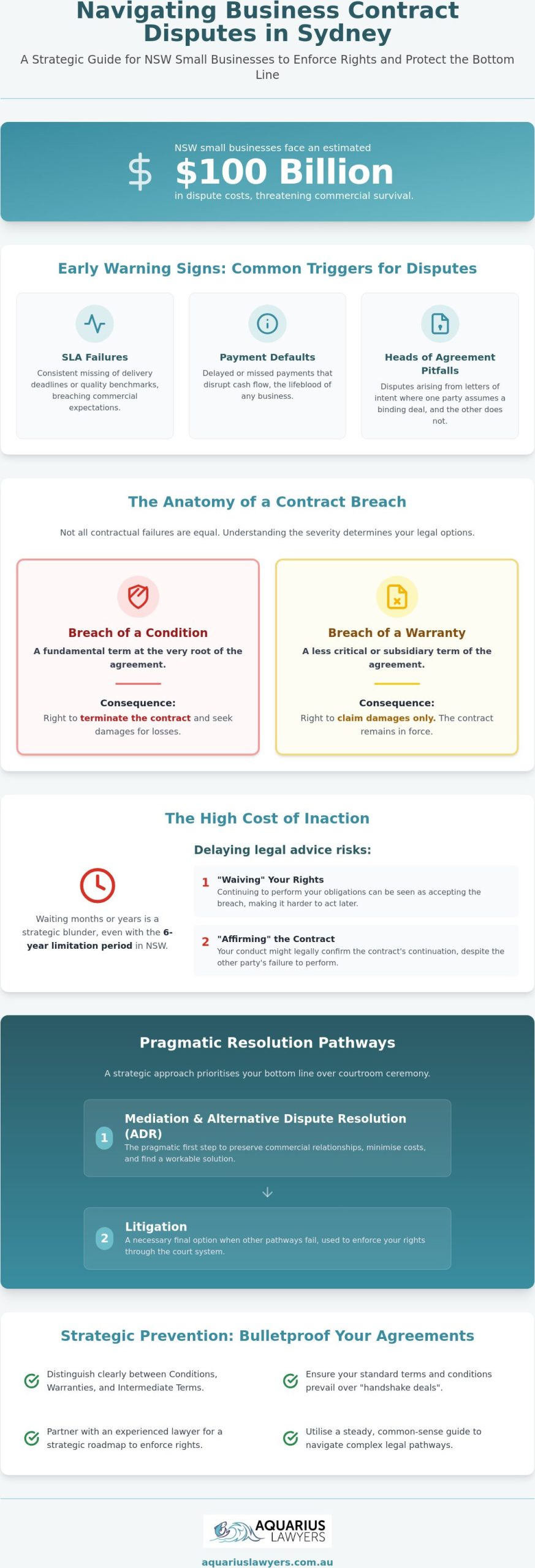
With NSW small businesses currently facing an estimated $100 billion in dispute costs, a single breached agreement isn’t just a legal headache; it’s a direct threat to your commercial survival. Engaging a business contract dispute lawyer sydney shouldn’t mean signing a blank cheque for endless litigation that stalls your operations and drains your resources. You’ve worked hard to build your brand, and it’s frustrating to see that progress threatened by a partner who won’t honour their word or a contract that lacks clarity.
We understand that you need a results-driven approach that prioritises your bottom line over courtroom ceremony. This article will show you how to navigate complex commercial conflicts using a pragmatic strategy designed to protect your interests in the 2026 legal environment. We’ll preview the most effective pathways for enforcing your contractual rights and minimising operational downtime. From leveraging the latest updates in the Unfair Trading Practices Bill to mastering early intervention techniques, you’ll learn how to resolve disputes efficiently without letting legal costs outweigh the value of your claim.
Key Takeaways
- Learn to distinguish between conditions, warranties, and intermediate terms to determine if a contract breach allows you to terminate the agreement or simply claim damages.
- Discover why mediation and Alternative Dispute Resolution (ADR) are the pragmatic first steps in the NSW court hierarchy for preserving commercial relationships and minimising costs.
- Protect your bottom line by identifying the risks of “handshake deals” and ensuring your standard terms and conditions prevail in the 2026 Sydney market.
- Partnering with an experienced business contract dispute lawyer sydney provides a strategic roadmap for enforcing your rights while avoiding the high fees and disruption of protracted litigation.
- Understand how a “steady, common-sense guide” can help you navigate the complex synergy between traditional legal rigour and modern, tech-forward resolution pathways.
Navigating Business Contract Disputes in the Sydney Commercial Landscape
Sydney is the engine room of the Australian economy, but the sheer velocity of trade in the CBD and Greater Sydney often outpaces the clarity of the agreements that underpin it. Friction isn’t just a possibility; it’s a statistical reality for most growing enterprises. When a partnership sours, the difference between a minor operational hiccup and a catastrophic financial loss depends on how quickly you identify the friction point. A seasoned business contract dispute lawyer sydney understands that early intervention is the most effective way to protect your “fair go” under Australian Consumer Law. Acting decisively ensures you don’t inadvertently accept substandard performance as the new status quo.
Identifying early warning signs is a critical skill for any director. You might notice a sudden breakdown in communication, frequent requests to “re-negotiate” previously settled terms, or a consistent failure to meet minor milestones. These are rarely isolated incidents. They are often precursors to a formal Understanding Breach of Contract. In the 2026 market, where margins are tight and regulatory scrutiny is high, ignoring these red flags can lead to a total breakdown of your supply chain or service delivery.
Common Triggers for Sydney Business Disputes
- Service Level Agreement (SLA) Failures: When a provider consistently misses delivery deadlines or quality benchmarks, it’s more than an inconvenience; it’s a breach of your commercial expectations.
- Payment Defaults: Cash flow is the lifeblood of Sydney commerce. Payment delays often bridge the gap between commercial law and debt recovery, requiring a strategy that secures your funds without burning valuable bridges.
- Heads of Agreement Pitfalls: Many disputes arise from “Heads of Agreement” or letters of intent where one party believes they have a binding deal while the other views it as a non-binding proposal.
The Cost of Inaction: Why Delaying Legal Advice Is Risky
In New South Wales, the Limitation Act 1969 generally provides a six-year window to bring a claim for breach of contract. However, waiting years, or even months, is a strategic blunder. If you continue to perform your side of the agreement while the other party is in breach, you risk “waiving” your rights or “affirming” the contract. This makes it significantly harder to terminate the deal or claim full damages later. Under NSW precedents, a material breach occurs when a party’s failure to perform goes to the very root of the agreement, substantially depriving the innocent party of the benefit they were intended to receive. If this happens, your window to act is narrow. Professional guidance ensures you take protective steps immediately, rather than reacting once the damage to your bottom line is irreversible.
The Anatomy of a Contract Breach: Understanding Your Legal Position
Understanding the legal architecture of your agreement is the first step toward a resolution that doesn’t sink your business. Not all contractual failures are equal. In the Australian legal system, we categorise breaches based on their severity and the intent behind the terms. A “condition” is a fundamental pillar of your deal; if it’s broken, the contract’s purpose is essentially destroyed, giving you the right to terminate and seek damages. Conversely, a “warranty” is a less critical term. Breaking it might be frustrating, but it usually only allows you to claim compensation while the contract continues. Identifying where your dispute sits on this spectrum is a task for a seasoned business contract dispute lawyer sydney who can weigh the technical breach against the commercial reality of your operations.
Your conduct after a breach occurs is just as vital as the breach itself. If you continue to accept late deliveries or pay invoices despite a failure in service, you might inadvertently “affirm” the contract, making it harder to take decisive action later. Australian commercial agreements also carry “implied terms” that exist even if they aren’t written in black and white. These include the duty to act in good faith and the statutory guarantees provided by the Australian Consumer Law. When assessing these pathways, professional bodies like the Resolution Institute provide the framework for accredited experts who help determine if a breach is remediable through structured negotiation rather than a courtroom battle.
Types of Breaches and Their Remedies
An actual breach happens when a party fails to perform their obligations on time. An anticipatory breach occurs when one party makes it clear they won’t be meeting their future obligations. If you’re facing either, you have a strict “duty to mitigate” your loss. This means you must take reasonable steps to keep your financial damage as low as possible. You can’t simply let the bills pile up and expect the other side to pay for everything. Remedies often include liquidated damages or, in rarer cases, specific performance where the court orders the party to fulfill their promise. If you are unsure where your agreement stands, seeking a preliminary review of your commercial law position can prevent a minor friction point from becoming a major liability.
Industry-Specific Nuances: Marine and Fisheries Contracts
For those in the maritime or aquaculture sectors, contract disputes often involve a complex overlay of niche regulations. Standard commercial principles still apply, but they are viewed through the lens of maritime law and NSW fisheries compliance. Whether it’s a dispute over vessel charters or aquaculture lease agreements, the triggers are often highly technical. A generalist might miss the regulatory nuances that Katherine Hawes, “The Fish Lawyer,” identifies as critical. In these sectors, a breach isn’t just about a missed payment; it’s often about maintaining the licenses and quotas that allow your business to function. You need a strategy that understands both the law of the sea and the law of the land.
Resolution Pathways: Mediation, Arbitration, or Litigation?
The NSW court system isn’t designed to be your first port of call. Under the Civil Procedure Act 2005, the “overriding purpose” of the rules is to facilitate the just, quick, and cheap resolution of the real issues in the dispute. This means judges expect you to have made a genuine attempt at Alternative Dispute Resolution (ADR) before you ever step foot in a courtroom. For most directors, a business contract dispute lawyer sydney acts as a strategic gatekeeper, helping you decide which pathway offers the highest probability of success with the lowest operational drag. We use a simple but effective logic: (Potential Recovery – Legal Spend) / Time = Commercial Viability. If the equation doesn’t balance in your favour, we find a different route.
Mediation is often the most pragmatic choice for Sydney SMEs. It’s a confidential process where a neutral third party helps both sides reach a voluntary agreement. It’s faster than a trial and keeps the details of your dispute out of the public record. Arbitration, on the other hand, is more formal and results in a binding decision. It’s frequently used in international trade or high-stakes construction contracts where you need a specialist “judge” rather than a generalist. While litigation is sometimes unavoidable to enforce your rights, it’s a blunt instrument. We treat it as a tactical tool, not a default setting.
The Sydney Court Hierarchy for Commercial Matters
Understanding where your case sits is vital for managing your budget. The Local Court (Small Claims Division) handles matters up to $20,000, offering a streamlined process that’s relatively cost-effective. The District Court of NSW manages claims between $20,000 and $750,000, while the Supreme Court handles the most complex, high-value litigation. For specific commercial friction points, such as retail lease disagreements, the NSW Civil and Administrative Tribunal (NCAT) provides a specialized forum that often bypasses the traditional court delays. Each venue has its own “scale of costs,” and we ensure your strategy aligns with the specific rules of the jurisdiction.
The Aquarius Lawyers Method: Strategic Pragmatism
We don’t believe in billable hours for the sake of it. As “innovative veterans,” we blend traditional legal rigour with tech-integrated research to get to the heart of your matter quickly. Our approach is to prepare every case as if it’s going to trial, which paradoxically is the best way to secure an early settlement. By drafting a “Statement of Claim” that is legally bulletproof and factually dense, we signal to the other side that we’re ready for the distance. This often encourages a more reasonable tone during negotiations. We are firm on your rights but fair in our dealings, ensuring that your reputation remains intact while your interests are protected.
Strategic Prevention: How to Bulletproof Your Sydney Business Agreements
The most effective way to manage a dispute is to prevent it from ever reaching a courtroom. While we’ve discussed the pathways to resolution, the smartest Sydney directors focus on building bulletproof agreements before the first invoice is even sent. In a fast-paced market like the CBD, the “Battle of the Forms” is a common trap. This occurs when two businesses exchange their own standard terms and conditions during a transaction. Usually, the last person to send their document before performance begins wins the legal argument. If you aren’t prioritising whose terms prevail, you’re essentially gambling with your liability and payment security.
Handshake deals or casual email chains might feel efficient in the moment, but they’re a massive liability in the 2026 Sydney market. Memory is a poor substitute for a written record. Without a formalised agreement, you’re left at the mercy of the court’s interpretation of your implied intentions. Regular contract audits are a proactive investment. By reviewing your standard agreements every twelve months, you can identify outdated clauses that no longer align with current NSW regulations or your evolving risk profile. This small step can save you thousands in future legal spend by closing loopholes before a partner can exploit them.
The Essential Contract Checklist
Don’t leave your commercial safety to chance. Every robust Sydney agreement needs a clear, multi-tiered dispute resolution clause that mandates negotiation and mediation before any litigation can commence. Limitation of liability and indemnity clauses must be tailored specifically to your industry risk; a generic template won’t protect you if things go pear-shaped. You also need to distinguish between termination for convenience, which allows a clean break, and termination for cause, which triggers specific remedies for a breach. These “checkpoints” ensure that if a relationship sours, you have a pre-defined exit strategy that protects your assets.
Modern Tools for Contract Management
Efficiency is about more than just speed; it’s about creating an undeniable evidentiary trail. Using digital signatures and timestamped communications provides a clear record of when terms were agreed upon and by whom. For ongoing service contracts, integrating automated compliance checks ensures that service level agreements (SLAs) are being met in real-time. Precise and unambiguous definitions serve as the structural anchor of a contract, leaving no room for the creative interpretations that often fuel costly litigation. If your current agreements feel like they’re built on shaky ground, it’s time to consult a business contract dispute lawyer sydney to fortify your commercial foundations and ensure your contractual rights are fully enforceable.
Why Sydney Businesses Partner with Aquarius Lawyers for Dispute Resolution
Choosing a business contract dispute lawyer sydney is a decision that impacts your mental health as much as your bank balance. Most firms treat commercial friction as a purely academic exercise, but we understand that for a Sydney business owner, it’s a personal disruption. Katherine Hawes, widely recognised as “The Fish Lawyer,” brings a unique perspective to the table. Her deep expertise in the highly regulated marine and fisheries sectors has forged a legal methodology that is both rigorous and incredibly pragmatic. If we can navigate the complex international and domestic regulations of the aquaculture industry, we can certainly deconstruct and resolve your commercial contract friction.
Our presence at 135 King Street in the Sydney CBD ensures that high-level legal expertise is accessible when you need it most. We don’t hide behind layers of junior associates or detached formality. Instead, we offer a “steady, common-sense guide” through the stress of litigation and mediation. We value results over legal ceremony. This means we won’t recommend a course of action just because it’s traditional; we recommend it because it’s the most efficient pathway to protecting your interests. We blend the credentials of an “innovative veteran” with a no-nonsense attitude that gets straight to the heart of the matter.
A Personalised, Cost-Effective Approach
We’ve moved away from the unpredictable billing models that often make the legal process more stressful than the dispute itself. By offering transparent pricing and fixed-fee options for specific stages of the resolution process, we provide the cost certainty you need to manage your business’s cash flow. You get direct access to senior counsel who understands the synergy between niche industry insights and broad commercial law. Our commitment to “modern optimism” means we focus on finding a resolution pathway that allows you to move forward, rather than getting bogged down in historical grievances. We use tech-integrated research to keep our processes lean, ensuring your billable hours are spent on strategy, not administration.
Next Steps: Securing Your Business Future
Resolving a dispute begins with a clear assessment of your standing. To make the most of an initial consultation, we recommend organising your documentation early. Having a clean copy of the signed agreement, a timeline of the breach, and all relevant correspondence ready will significantly speed up our ability to provide a strategic roadmap. Don’t let a failing agreement dictate your business’s future. Whether you are facing a payment default or a complex service level disagreement, we are here to provide the clarity and confidence you need to reach a resolution. Protect your business and resolve your dispute with Aquarius Lawyers today.
Securing Your Commercial Future in 2026
Commercial success in Sydney requires more than just a good product; it demands resilient legal foundations. We’ve explored how identifying a material breach early and choosing the right resolution pathway can save your business from unnecessary disruption. Whether you’re navigating the NSW court hierarchy or seeking a confidential mediation, the goal is always a pragmatic outcome that protects your bottom line. Strategic prevention remains the ultimate legal equation: Clear Agreements + Proactive Audits = Minimised Litigation Risk.
Led by Katherine Hawes, Principal Solicitor, our team combines specialist knowledge in marine and fisheries sectors with broad commercial expertise to provide a “no-nonsense” guide for your business. Located in the heart of Sydney at 135 King Street, we’re ready to help you turn a stressful conflict into a resolved milestone. Partnering with a dedicated business contract dispute lawyer sydney ensures your rights are enforced without sacrificing your operational focus. Don’t let uncertainty stall your progress.
Contact our Sydney CBD office for a strategic contract dispute consultation.
Your business has the potential to thrive even after a dispute; let’s find the pathway forward together.
Frequently Asked Questions
How much does a contract dispute lawyer cost in Sydney?
Legal fees in Sydney depend on the complexity of the matter and the seniority of the practitioner. Research indicates that junior lawyers often charge between $200 and $400 per hour, while senior partners can range from $500 to over $900 per hour. Many firms now offer fixed-fee arrangements for specific stages like drafting a letter of demand. Always request a written costs agreement to ensure transparency before any work begins.
Can I resolve a business contract dispute without going to court?
Yes, the vast majority of commercial disputes are settled through Alternative Dispute Resolution (ADR) methods like mediation or structured negotiation. Courts in NSW actually mandate that parties attempt to resolve their issues before a trial date is set. A business contract dispute lawyer sydney can help you reach a confidential settlement that preserves your commercial relationships and avoids the public nature and high costs of a courtroom.
What is the first step I should take if someone breaches a contract with my business?
Your first step should be to review the agreement’s dispute resolution clause and document the breach in writing immediately. Collate all relevant emails, invoices, and timestamped communications to build a clear evidence trail. Avoid making casual admissions or agreeing to new terms over the phone, as this could inadvertently waive your existing rights. Professional advice at this early stage prevents you from taking steps that might weaken your legal standing.
How long does commercial litigation typically take in the NSW Supreme Court?
Timelines vary, but complex commercial litigation in the Supreme Court often takes between 12 to 18 months to reach a final hearing. This duration depends on the volume of evidence, the number of witnesses, and the court’s current caseload. Early intervention and strategic mediation can frequently resolve the matter much sooner, often within a few months, which significantly reduces the impact on your daily business operations.
Is an oral agreement legally binding for a Sydney business?
Oral agreements are generally legally binding in NSW, provided they meet the requirements of offer, acceptance, consideration, and an intention to create legal relations. However, proving the specific terms of a “handshake deal” is notoriously difficult and expensive in a court setting. We always recommend formalising agreements in writing. This creates an undeniable record that prevents costly evidentiary disputes and ensures both parties understand their specific obligations.
What is the difference between a material breach and a minor breach?
A material breach is a serious failure that goes to the root of the contract, substantially depriving you of the benefit you were promised. This level of breach often gives you the legal right to terminate the agreement and claim damages. A minor breach, often called a breach of warranty, is less severe. It typically allows you to claim compensation for the specific loss but doesn’t usually permit you to end the contract.
Can I recover my legal costs if I win a contract dispute in NSW?
In NSW litigation, the court usually orders the unsuccessful party to pay the winner’s legal costs. However, you rarely recover the full amount spent on your representation. Costs are typically awarded on a “party and party” basis, which often covers between 60% and 75% of your actual expenses. In specific cases involving unreasonable conduct or “Calderbank” offers, the court might award indemnity costs, which provide a significantly higher recovery rate.
How does maritime or fisheries law affect a standard commercial contract?
Maritime law introduces specific federal regulations and international conventions that overlay standard commercial terms. In the fisheries sector, your contractual rights are often tied to statutory quotas and licenses issued by the NSW Department of Primary Industries. A business contract dispute lawyer sydney ensures these niche regulatory requirements are integrated into your strategy. This prevents a standard agreement from becoming unenforceable or non-compliant due to industry-specific legal triggers that generalists might overlook.
Disclaimer
Please note that legal rules change and this is not a substitute nor construed as legal advice. It is general information only.