
A caveat on your property title is more than just a legal hurdle; it’s a high-stakes handbrake that can stall your settlement and jeopardise your financial plans. You’ve likely spent hours worrying about whether your sale will fall through or how much the caveat removal nsw cost will actually set you back. It’s a common frustration to feel buried under complex jargon like lapsing notices while the clock ticks toward your completion date. We understand that you need clarity and a practical way forward, not more confusion.
This guide provides a definitive breakdown of the total costs and the most efficient pathways to clear your title in 2026. You’ll discover how the $167.58 statutory fees interact with professional service costs and why a precision-first approach is your best defence against a failed settlement. We will walk you through the strategic choice between voluntary withdrawal and the 21-day lapsing process. In our view, strategic preparation plus rapid action equals settlement certainty. Our goal is to provide you with a clear roadmap to a clean title, ensuring that your property transaction stays on track through a combination of traditional expertise and modern efficiency.
Key Takeaways
- Understand why a caveat acts as a title “freeze” and why formal legal action under the Real Property Act 1900 is essential for its removal.
- Identify the total caveat removal nsw cost by breaking down mandatory statutory filing fees and separate electronic lodgement charges.
- Compare the three primary resolution pathways, withdrawal, lapsing, or court order, to find the most efficient route for your specific situation.
- Minimise the risk of a failed settlement by learning why technical precision in legal drafting and PEXA integration is non-negotiable.
- Discover how a pragmatic, pathway-focused legal strategy can streamline your resolution and protect your property transaction.
What is a Caveat and Why Does it Cost to Remove One?
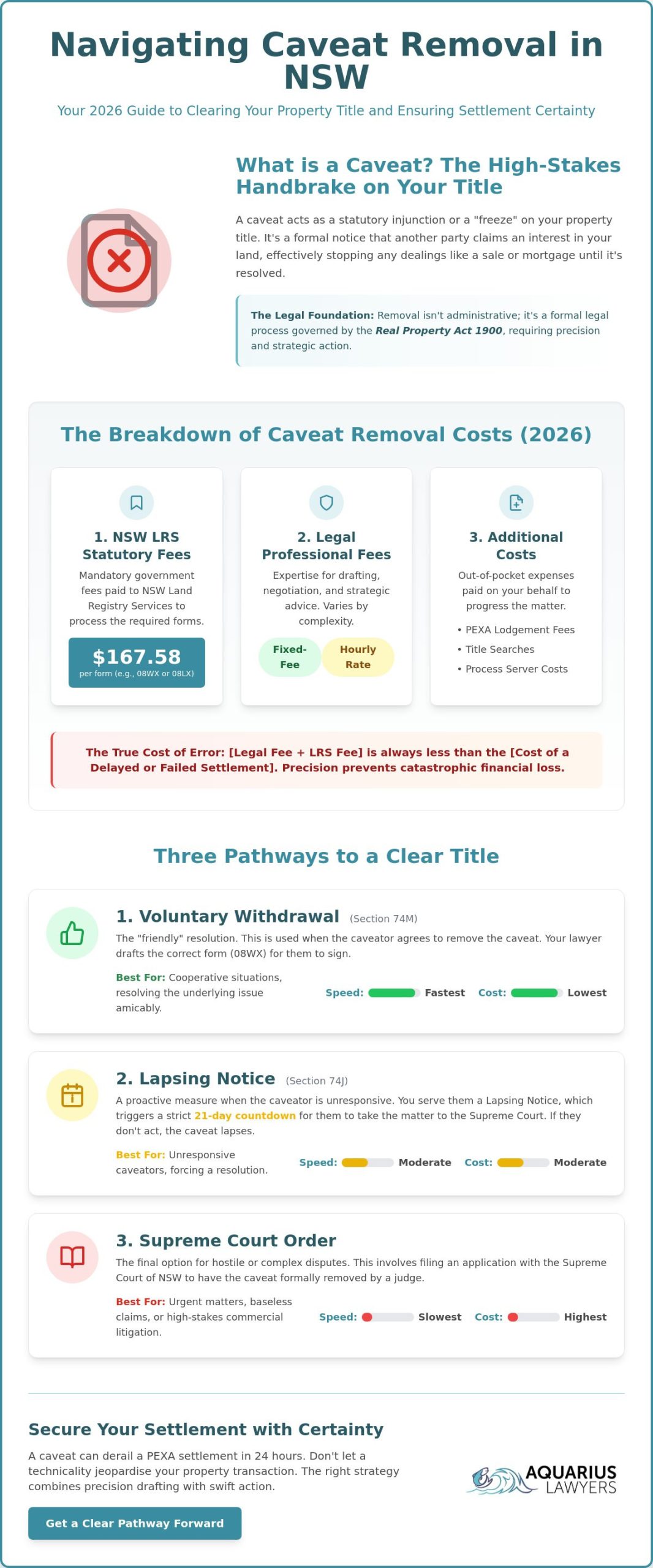
A caveat is a statutory injunction that requires a precise legal pathway to unlock. It acts as a “freeze” on your property title, serving as a formal notice to the world that another party claims an interest in your land. Think of it as a legal red light. It stops any further dealings, such as a sale or a mortgage, from being registered until the claim is resolved. Understanding What is a Caveat is the first step in realising why you cannot simply ignore it. Removal is not an automatic administrative process; it requires formal legal action under the Real Property Act 1900.
The total caveat removal nsw cost is generally comprised of three distinct areas. You will encounter mandatory government filing fees paid to NSW Land Registry Services, legal professional fees for strategic drafting, and potential court costs if the matter escalates. The formula for a successful resolution is simple: Correct drafting + swift service = title clearance. Precision is your best tool for cost control. A single error on a technical form can lead to a rejection, which doubles your filing fees and wastes precious time while your settlement date looms.
The Legal Basis for Caveat Removal in NSW
The Real Property Act 1900 provides the specific machinery for clearing your title. Section 74M governs the voluntary withdrawal process, which is the most cost-effective “friendly” resolution. If the caveator refuses to budge, Section 74J outlines the lapsing notice procedure. This triggers a strict 21-day countdown for the caveator to prove their claim in the Supreme Court. Legal precision is the most important factor here. If a notice is served incorrectly, the 21-day clock never starts, leaving you with mounting legal bills and a stalled transaction.
Why Do Caveats Appear During Settlements?
Caveats often appear at the eleventh hour, triggered by unpaid debts, commercial disagreements, or family law disputes. In the modern property market, a caveat can derail a PEXA settlement in 24 hours. Because the PEXA platform requires a “clear” title to complete a transaction, an unexpected caveat creates an immediate roadblock. This creates a significant emotional and financial burden. A blocked title often leads to penalty interest, lost deposits, and the potential collapse of a property chain. Strategic action is the only way to restore your momentum and protect your equity.
The Breakdown of Caveat Removal Costs in 2026
Calculating the total caveat removal nsw cost requires looking at the sum of several distinct parts. It isn’t just about the cheque you write to the government; it’s about the professional strategy that ensures the “freeze” on your title is lifted before your settlement deadline. Think of this as a strategic equation where [Legal Fee + LRS Fee] is always significantly less than the [Cost of a Delayed or Failed Settlement]. If your sale falls through because of a filing error, the real cost is far higher than the initial fee. Precision in the early stages prevents catastrophic financial losses later.
NSW Land Registry Services (LRS) Statutory Fees
Every property owner in NSW should be aware that land registry fees are updated annually on 1 July. Effective from 1 July 2026, the mandatory fee for a “Withdrawal of Caveat” (Form 08WX) or an “Application for Cancellation of Caveat” is $167.58. These are the official NSW government fees paid directly to the Land Registry Services to process the paperwork. If you are issuing a Lapsing Notice (Form 08LX) to force a caveator to prove their claim, you will encounter similar statutory costs. These figures are regulated and represent the baseline for any title clearance.
Legal Professional Fees: Fixed vs. Hourly
Professional fees vary based on the complexity of your situation. For a straightforward, “friendly” withdrawal where the other party agrees to sign the paperwork, many property lawyers offer fixed-fee arrangements. This provides you with cost certainty from the outset. However, if the caveator is hostile or refuses to move, the matter may shift into commercial litigation territory. In these cases, fees are typically billed at an hourly rate to reflect the time spent on complex negotiations or Supreme Court applications.
You should also account for disbursements. These are out-of-pocket expenses your lawyer pays on your behalf, such as title searches and the service of documents by a professional process server. With the shift toward electronic lodgement, you will also see PEXA fees on your statement. For a withdrawal of caveat with financial settlement, PEXA fees in 2026 typically range between $37.95 and $58.63. To avoid surprises, always ask for a transparent costs agreement that outlines these variables before work begins. If you are facing an urgent settlement deadline, seeking a tailored legal strategy is the most effective way to manage these costs while securing your property’s future.
Comparing Removal Strategies: Lapsing vs. Withdrawal vs. Court Order
Choosing the right strategy is about more than just filling out forms; it’s a tactical exercise in risk management. If the caveator is reasonable, a voluntary Withdrawal of Caveat is your gold standard. It’s the cleanest, most efficient way to clear your title without escalating tensions. However, when negotiations stall, you need an assertive approach to keep your settlement alive. The total caveat removal nsw cost is often dictated by how quickly you move from soft negotiation to formal action. Strategic Pathway + Timing = Financial Protection.
The Lapsing Notice (S74J) Pathway
The Lapsing Notice is the most common tool for property owners facing a stubborn caveator. Once you lodge this notice under Section 74J of the Real Property Act 1900, a strict 21-day countdown begins. The caveator must then decide: do they spend thousands on a Supreme Court application to extend the caveat, or do they let it lapse? This is a highly effective way to call a bluff. Many caveators lodge “nuisance” claims without the intention or the funds to back them up in a courtroom. The primary risk is the 21-day timeframe. If your settlement is scheduled for next week, this clock simply doesn’t tick fast enough, making the wait a costly gamble.
Urgent Court Applications for Removal
When a settlement is only days away and the caveator is being unreasonable, the Supreme Court becomes the necessary “nuclear option.” This pathway is for urgent, high-stakes removals where you cannot afford to wait for a 21-day lapsing period. To succeed, your legal team must satisfy two critical tests: the “prima facie case” and the “balance of convenience.” You must prove the caveat is likely invalid and that the financial damage of a failed settlement far outweighs the caveator’s interest. While court action involves higher upfront legal fees, it offers the fastest resolution. Additionally, the court can issue costs orders against the caveator. If they’re found to have lodged the caveat without reasonable cause, they may be ordered to reimburse your legal expenses.
Don’t let a caveator hold your equity hostage because you’re unsure of the next step. Every day of delay adds to the caveat removal nsw cost through mounting penalty interest or the potential collapse of your property chain. Moving quickly with a precise legal strategy is the only way to ensure your title is clear for settlement. Prioritising your completion date over long-winded disputes is almost always the most cost-effective decision you can make.
Avoiding Costly Delays: The Role of Precision in NSW Land Dealings
Precision is the difference between a smooth property settlement and a legal quagmire. In the 2026 e-conveyancing environment, the PEXA platform requires every digital “cog” to align perfectly. If your paperwork contains even a slight discrepancy, the system will reject the lodgement, causing your caveat removal nsw cost to spiral. This isn’t just about the extra $167.58 filing fee. It’s about the mounting penalty interest and the potential loss of your buyer. A minor clerical error in a lapsing notice can reset the 21-day clock.
Common Pitfalls That Blow Out Costs
Many property owners try to handle negotiations themselves to save money, only to find that “cheap” advice is often the most expensive. A common mistake is incorrectly describing the “Caveatable Interest” when responding to a caveator. If your legal response doesn’t precisely address the specific interest claimed, your application may be dismissed. Another frequent error is failing to serve the notice at the caveator’s registered address for service. If service isn’t performed strictly according to the rules, the 21-day period never legally begins.
Negotiations that drag on without a firm legal deadline are a recipe for financial disaster. Without a “no-nonsense” approach that sets clear boundaries, a hostile caveator can hold your settlement hostage for weeks. We’ve seen cases where simple disagreements turn into month-long delays because the owner didn’t issue a formal notice early enough. Every day of uncertainty adds to your total bill and increases the risk of a failed transaction.
The Innovative Veteran’s Approach to Efficiency
We combine traditional legal expertise with modern technology to ensure your title is cleared as quickly as possible. By using real-time tracking for LRS lodgments, we can see exactly when a document is processed, allowing us to update the PEXA workspace instantly. This proactive stance is what we call the “innovative veteran” approach. It involves moving beyond simple threats and focusing on pragmatic solutions that save you money. For example, we often use debt recovery or mediation strategies alongside property law to resolve the underlying dispute. This prevents the need for expensive, long-term litigation.
This synergy of commercial strategy and legal precision is the most effective way to manage your total caveat removal nsw cost. It’s about being academics in the law but pragmatists in the field. We understand that your priority is the settlement date, not a long-winded legal battle. If you need a rapid resolution to clear your title, contact our property law team to secure your settlement today.
How Aquarius Lawyers Streamlines Your Caveat Resolution
Aquarius Lawyers provides the pragmatic, results-oriented legal counsel you need when a property transaction is on the line. Led by Principal Katherine Hawes, our team focuses on pathways rather than just processes. We understand that your settlement date is the most critical variable in the equation. Our role is to act as a trusted advisor, stripping away the stress and legal jargon to provide a clear, rapid resolution. We believe that professional expertise plus down-to-earth communication equals client confidence.
While the statutory caveat removal nsw cost is a known quantity, the strategy used to manage it determines your final financial outcome. We offer authoritative representation in the Supreme Court of NSW for those high-stakes situations where a caveat must be removed immediately to prevent a total settlement failure. Our approach is grounded in common sense and a no-nonsense attitude that prioritises your financial security. We don’t just react to issues; we anticipate them to keep your property dealings moving forward.
Why Our Niche Expertise Matters
Our firm brings a unique perspective to property law that most standard conveyancers simply cannot match. We apply the same strategic rigour used in maritime and fisheries law to complex property disputes. This “innovative veteran” perspective is vital when a caveat stems from an unusual commercial agreement or a professional debt. Katherine Hawes and her team possess the intellectual versatility to move easily between different areas of focus, ensuring that no technicality is overlooked.
Experience with complex commercial caveats is one of our core strengths. Many caveats are lodged improperly or without a true caveatable interest, and we have the expertise to identify these weaknesses quickly. We provide direct, honest advice on the most cost-effective path forward, whether that involves a 21-day lapsing notice or urgent litigation. By combining traditional credentials with a tech-savvy perspective on PEXA and LRS systems, we ensure your caveat removal nsw cost remains as low as possible while achieving the desired result.
Take the Proactive Step Toward a Clear Title
Resolving a caveat starts with a comprehensive title review and a dedicated strategy session. By identifying the caveator’s true leverage early, we can often bypass lengthy and expensive disputes. This proactive stance gives you the peace of mind that comes with having a trusted advisor in your corner. We don’t just file paperwork; we build a solution that protects your equity and ensures your property transaction completes on time. Our methodology is designed to get to the heart of the matter quickly, layering information to build a foundation of trust and progress.
Don’t let a caveat sink your settlement or cause unnecessary financial strain. Every day you wait is a day that your property title remains frozen and your financial plans are on hold. Seeking professional guidance early is the best way to maintain control over the situation. Contact Aquarius Lawyers today for a strategic pathway to resolution and let us help you clear your title with confidence and precision.
Clear Your Title and Secure Your Settlement Today
Clearing a caveat is a strategic necessity, not just a paperwork exercise. We’ve explored how the total caveat removal nsw cost is influenced by both mandatory statutory fees and the technical precision of your legal strategy. Whether you’re navigating a voluntary withdrawal or a contested lapsing notice, timing is your most valuable asset. Fixed-fee options for standard title dealings provide the cost certainty you need, while authoritative NSW Supreme Court representation ensures you’re protected if a dispute escalates at the eleventh hour. This synergy of traditional expertise and modern efficiency is what keeps your property transaction on track.
Principal Katherine Hawes, known as The Fish Lawyer & Property Strategist, brings a unique rigour to property law that standard conveyancers often miss. This innovative veteran approach ensures your settlement remains the primary focus. By combining traditional credentials with a no-nonsense, pathway-focused methodology, we help you remove title roadblocks before they become financial disasters. You don’t have to face these complex property disputes alone. With a trusted advisor by your side, you can resolve title issues quickly and move forward with confidence.
Secure your property settlement—talk to our caveat removal specialists. Take the proactive step toward a clear title today and protect your financial future.
Frequently Asked Questions
How much are the NSW LRS filing fees for caveat removal in 2026?
Statutory filing fees for a Withdrawal of Caveat or an Application for Cancellation of Caveat are $167.58, effective from 1 July 2026. These fees are regulated by NSW Land Registry Services and are subject to annual updates at the start of each financial year. You should also account for PEXA electronic lodgement fees, which typically range between $37.95 and $58.63 depending on the transaction type.
Can I remove a caveat myself to save on costs?
While you can technically lodge your own paperwork, it’s rarely a pragmatic choice when a property settlement is at risk. A single clerical error in the description of the caveatable interest can lead to a rejected form or a reset of the legal clock. Professional oversight ensures your caveat removal nsw cost doesn’t blow out due to preventable mistakes or incorrect service procedures that delay your sale.
How long does the lapsing notice process take in NSW?
The lapsing notice process takes exactly 21 days from the date the notice is formally served on the caveator. If the caveator doesn’t obtain a Supreme Court order to extend their claim within this window, the caveat will lapse and be removed from your title. It’s vital to ensure service is performed correctly at the registered address, as any procedural flaw can stall the 21-day countdown.
What happens if the caveator refuses to sign a withdrawal of caveat?
If a caveator refuses to sign a voluntary withdrawal, your primary recourse is to issue a lapsing notice under Section 74J of the Real Property Act 1900. This forces the caveator to either prove their claim in the Supreme Court or let the caveat lapse. For urgent settlements where you can’t wait 21 days, you may need to seek an immediate court order for removal.
Will I have to go to court to remove a caveat from my property?
Most caveats are resolved through voluntary withdrawal or the lapsing notice process without ever reaching a courtroom. Court intervention is typically reserved for contested cases where the caveator actively seeks an extension or where a settlement is only days away. A strategic legal approach prioritises a commercial resolution to avoid the higher costs and time commitment associated with a full Supreme Court hearing.
Can I claim my legal costs back from the person who lodged the caveat?
You can seek compensation if a caveat was lodged “without reasonable cause” under Section 74P of the Real Property Act 1900. If the court finds the caveator acted improperly, they may be ordered to pay for your financial losses, including legal fees and penalty interest. Proving a lack of reasonable cause requires specific evidence and authoritative representation to ensure the court understands the impact on your settlement.
Does a caveat expire automatically in New South Wales?
Caveats don’t expire automatically in New South Wales; they remain as a “freeze” on your title until formal action is taken. While some specific caveats have internal expiry conditions, the vast majority stay active until a Withdrawal of Caveat or a Lapsing Notice is lodged. Leaving an old, inactive caveat on your title can create unexpected hurdles when you eventually decide to sell or refinance your property.
What is the difference between a withdrawal of caveat and a lapsing notice?
A withdrawal is a voluntary agreement where the caveator signs a form to remove their claim, making it the fastest resolution. A lapsing notice is a forced legal procedure triggered by the owner to clear the title when the caveator is uncooperative. Choosing the right pathway is a major factor in your total caveat removal nsw cost, as it determines whether you face a friendly settlement or a contested 21-day countdown.
Disclaimer
Please note that legal rules change and this is not a substitute nor construed as legal advice. It is general information only.