If your vessel hits a reef or a crew member is injured, is your family home anchored to the fallout? In the high-stakes world of Australian waters, a generic company setup is often little more than a leaky bucket. Most operators spend years perfecting their fleet’s horsepower while leaving their legal framework exposed to the elements. You already know that the marine environment is inherently risky. Between the AMSA National Compliance Plan 2026-27 and complex state-based fisheries regulations, selecting the right maritime business legal structure is the only way to ensure your personal assets don’t go down with the ship.
This guide provides a clear pathway to securing your livelihood. We believe that a smart structure + proactive compliance = long-term asset security. We combine traditional legal expertise with modern strategy to create a “legal hull” designed for the specific pressures of the 2026 maritime landscape. You’ll learn how to isolate vessel-related liabilities, protect valuable fisheries quotas, and organise a tax-efficient operation that scales with your ambitions. It’s time to turn regulatory compliance from a burden into your greatest competitive advantage.
Key Takeaways
- Understand why maritime law operates differently to land-based commercial law and why your business needs a specialised “legal hull” to withstand unique marine liabilities.
- Discover how a Proprietary Limited (Pty Ltd) structure can shield your personal assets from an “Action in Rem” or the sudden operational threat of vessel arrest.
- Learn how your chosen maritime business legal structure directly impacts your eligibility for NSW fisheries licences and your ability to meet 2026 AMSA compliance standards.
- Identify strategic methods to isolate high-risk vessel operations from valuable fisheries quotas to ensure long-term business resilience and asset protection.
- Explore the “innovative veteran” approach to structuring that combines traditional legal credentials with modern marine technology for a scalable, investment-ready operation.
Why Maritime Businesses Require a Bespoke Legal Structure
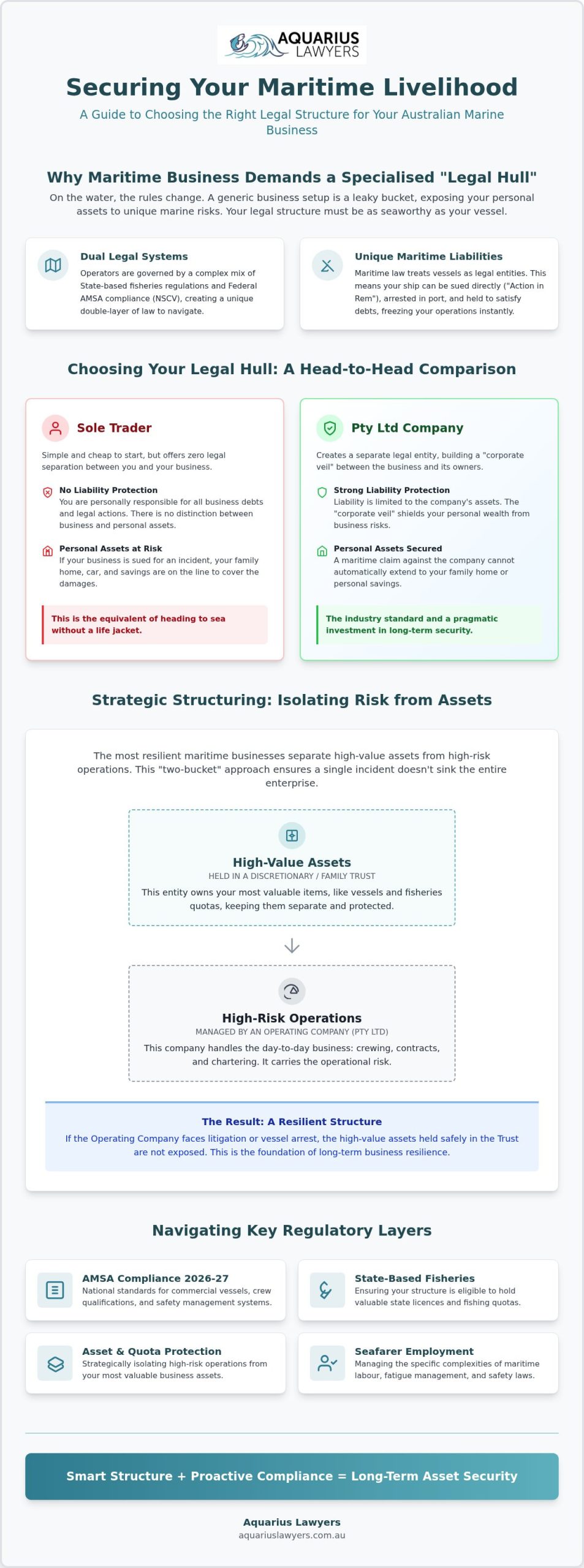
Setting up a business on land is relatively straightforward. You get an ABN, find a premises, and start trading. On the water, the rules of engagement change completely. Maritime law is a distinct legal system that predates many land-based commercial codes. It treats vessels as unique legal entities that can be sued in their own right. A generic ABN registration might suffice for a local cafe, but for a commercial marine operation, it’s like heading to sea without a life jacket. Your maritime business legal structure is your “legal hull.” It must be built to withstand the specific pressures of the 2026 regulatory environment, including vessel arrest and complex liability claims.
The Interplay of State and Federal Jurisdictions
Marine operators in Australia deal with a unique double-layer of regulation. While your daily operations might happen in NSW state waters, you are simultaneously governed by Commonwealth legislation. The Australian Maritime Safety Authority (AMSA) oversees the National Standard for Commercial Vessels (NSCV); this dictates everything from crew qualifications to vessel construction. If your structure doesn’t account for both state fisheries requirements and federal safety standards, you risk falling through the cracks. Effective structuring ensures your business interfaces seamlessly with these authorities, protecting your ability to hold licences and operate legally across borders. It’s about ensuring your paperwork is as seaworthy as your fleet.
High-Risk Profiles in the Marine Industry
Charter boats, commercial fishers, and shipwrights face liability profiles that land-based contractors rarely encounter. A single mechanical failure or environmental incident can trigger claims that exceed the value of the vessel. In the marine world, there is a “last to be paid” reality for many contractors. If a vessel owner goes bust, maritime liens and secured debts often swallow the remaining assets before you see a cent. A bespoke structure helps you manage these risks through:
- Asset Isolation: Separating your fleet from your personal property and other business interests.
- Debt Recovery Strategy: Using specific entities to improve your position in the payment queue during litigation.
- Environmental Safeguards: Protecting the parent company from heavy pollution penalties and biofouling reporting breaches.
- Employment Clarity: Dealing with the specific complexities of seafarer rights, fatigue management, and safety.
A shop doesn’t drift into international waters. A boat does. Because your primary asset is mobile, it can be arrested in different jurisdictions to satisfy debts. A bespoke structure prevents a disaster on one vessel from sinking your entire commercial portfolio.
Core Australian Business Structures for the Marine Industry
While there are several Core Australian business structures available, your choice must align with your specific risk profile. A shipwright has different needs than a multi-vessel fleet owner. Selecting the right maritime business legal structure is about balancing setup costs with long-term survival. You need a framework that supports growth while keeping your personal assets safely behind a seaworthy legal barrier.
Sole Traders vs. Pty Ltd Companies on the Water
Sole trader status is simple. It’s often the go-to for independent shipwrights or small contractors because it’s inexpensive to start. However, it offers zero protection. If a client sues you for a faulty repair that leads to a vessel sinking, your personal house is on the line. Conversely, a Proprietary Limited (Pty Ltd) company creates a corporate veil. This separates the person from the boat. For vessel owners, this is the industry standard. It limits liability to the company’s assets, ensuring a maritime claim doesn’t sink your family’s future. The higher setup fees are a pragmatic investment in peace of mind.
The Role of Trusts in Maritime Asset Protection
Discretionary or family trusts are powerful tools for holding high-value assets like commercial fishing quotas or the vessels themselves. By separating ownership from operation, you create an extra layer of security. If the operating company faces litigation, the assets held in the trust remain out of reach. Trusts also offer significant tax flexibility. You can distribute income among family members to manage tax brackets effectively. To better manage these complexities and optimise your financial performance, you can discover KHT Accounting & Wealth for specialised advice. The administrative burden is higher; you’ll need a corporate trustee and meticulous record-keeping. For many family-owned fisheries, this complexity is a small price for the resulting asset protection.
Aquaculture projects often require massive capital. Joint Ventures (JVs) allow multiple parties to pool resources for new farm developments or large-vessel acquisitions. These aren’t just handshakes. You need a formal agreement to manage shared risks, profits, and exit strategies. Legal protections are vital when multiple parties invest in a single vessel to ensure one partner’s debt doesn’t lead to a total fleet arrest. If you are looking to scale your operations through a partnership, getting the foundational commercial law advice early prevents expensive disputes later. We help you build these agreements to be as robust as the vessels they fund.
Mitigating Risk: Liability, Vessel Arrest, and Asset Protection
In the maritime world, your boat is more than just a piece of equipment; it’s a legal person. Under the principle of “Action in Rem,” a claimant can sue the vessel itself for debts or damages. This means that even if you aren’t personally named in a lawsuit, your primary income-earning asset can be arrested and held by the court. Choosing the right maritime business legal structure is the only way to ensure a single incident doesn’t trigger a total fleet collapse. Strategy + structure = security.
The Action in Rem and Your Business Entity
The threat of vessel arrest is a unique hazard under the Admiralty Act 1988. If a supplier, salvor, or crew member has a maritime lien, they can apply to the Federal Court to have the vessel detained. To manage this, many savvy operators use a “single-ship company” model. By placing each vessel into its own proprietary limited company, you effectively isolate the risk. If Vessel A is arrested for a claim, the assets of Vessel B and the parent company remain untouched. While this increases the administrative need to maintain separate records on the Australian general shipping register, the protection it offers against a total business shutdown is invaluable.
Protecting Personal Assets from Maritime Debts
Simply having a company isn’t a “get out of jail free” card. Courts can “pierce the corporate veil” if they find the business was a sham or if directors were grossly negligent. To prevent your family home from being pulled into a business dispute, you must treat your company as a truly separate entity. This includes having formal, written loan agreements if you’ve injected personal cash into the business. Without these documents, your personal funds might be treated as company equity, making them fair game for creditors during a liquidation.
Federal laws, such as the Limitation of Liability for Maritime Claims Act 1989, allow owners to cap their financial exposure based on the vessel’s tonnage. However, these protections are technical and require a robust corporate foundation to be effective. We view insurance as a partner to, not a replacement for, this legal framework. While insurance pays the bill, your legal structure protects the ownership. It’s about building layers of defence so that no single wave can swamp your entire livelihood.
Navigating Regulatory Layers: AMSA, Fisheries, and State Compliance
Operating a commercial vessel in Australian waters is a regulatory balancing act. Your maritime business legal structure isn’t just a vehicle for tax; it’s the foundation that determines your eligibility for specific licences and your ability to meet federal safety standards. While an Australian Business Number (ABN) and Australian Company Number (ACN) are the starting points, they are merely the entry ticket. In 2026, staying compliant means reporting to both ASIC and the Australian Maritime Safety Authority (AMSA) while adhering to the National Standard for Commercial Vessels (NSCV). Failure to align your corporate structure with these layers can result in grounded fleets and heavy fines.
Fisheries Quota and Licence Ownership
In the commercial fishing sector, your most valuable asset is often your “Right to Fish.” Holding commercial fishing quotas and licences requires a structure that is both secure and flexible. Katherine Hawes, known as “The Fish Lawyer,” emphasises that your structure must protect these intangible assets from operational liabilities. In NSW, transferring licences between entities is a common pitfall. If the receiving entity doesn’t meet specific state criteria, the transfer can be blocked, leaving your operations in limbo. We recommend structures that separate the ownership of the quota from the high-risk vessel operations. This ensures that if a vessel is involved in a maritime incident, your underlying fishing rights remain protected and productive. For expert guidance on these complex transfers, consult a fisheries law specialist to secure your livelihood.
Aquaculture Development and Environmental Compliance
Aquaculture ventures face an even tighter regulatory net. To operate in NSW, you must provide a comprehensive aquaculture business plan that satisfies both commercial and environmental standards. Your legal structure must clearly define who is responsible for environmental breaches, such as spills or biofouling reporting failures. As of June 18, 2026, new biofouling rules require strict reporting for all commercial arrivals. A robust structure ensures that environmental liability is contained within a specific entity, protecting the broader organisation from catastrophic penalties. Navigating development approvals (DA) for land-based or marine farms also requires a structure that can hold property rights and long-term leases while managing the risks of the development phase.
Compliance is a moving target. The AMSA National Compliance Plan 2026-27, effective from July 1, 2026, focuses heavily on seafarer welfare and electrical safety. Your business structure must allow for clear lines of reporting and fatigue management to meet these updated expectations. For businesses managing broader regulatory frameworks, Trancher offers a comprehensive platform to streamline AML/CTF obligations. By organising your business into clear, compliant units, you satisfy both the tax office and the maritime regulators, creating a seamless pathway for future growth and investment.
Building a successful operation on the water takes more than just grit and a good hull. It requires a maritime business legal structure that acts as a fortress for your assets. At Aquarius Lawyers, we don’t just provide generic advice. We blend high-level professional expertise with a down-to-earth pragmatism that only comes from years in the wheelhouse. Our approach is built on a simple but powerful formula: deep industry knowledge + strategic commercial foresight = a business that survives the storm. We ensure your legal framework is as robust as the vessels you operate.
The Aquarius Methodology: Audit, Strategise, Implement
We believe that clarity is the best defence against risk. Our process begins with a comprehensive “Legal Audit” of your current maritime operations. We look at your vessel registrations, existing contracts, and how your fisheries licences are held. From there, we develop a bespoke structure that balances tax efficiency with maximum asset protection. We don’t just hand you a folder and walk away. We implement the strategy, ensuring every ACN is correctly linked to the right maritime assets. For many clients, our retainer-based oversight provides ongoing peace of mind, acting as a steady guide through the shifting tides of 2026 regulations.
Why Katherine Hawes, “The Fish Lawyer”, is Your Best Ally
General commercial lawyers often struggle with the “peculiar realm” of the sea. They might understand a lease, but they don’t understand the nuances of a maritime lien or the complexities of the Admiralty Act. Katherine Hawes, known across the industry as “The Fish Lawyer,” brings a niche authority to your table. Whether you are navigating a dispute over a charter agreement or need to learn more about our Fisheries Law expertise, Katherine offers a no-nonsense approach that values results over ceremony. With offices in Sydney and Shellharbour, we are positioned to protect maritime livelihoods across NSW and beyond.
Your maritime legacy also deserves protection. Beyond the immediate setup, we integrate succession planning into your business structure. By utilising our expertise in Wills and Estates, we ensure that your hard-earned fishing quotas and vessel permits transition smoothly to the next generation. Don’t leave your family’s future to chance in an unpredictable environment. It’s time to move from a generic, high-risk setup to a tailored solution that secures your place in the industry. Organise a consultation with Aquarius Lawyers today and let’s get your legal house in order.
Charting a Course for Commercial Resilience
Operating on Australian waters in 2026 requires more than just a sturdy vessel; it demands a business foundation that can withstand the unique pressures of maritime law. We’ve explored how a generic setup leaves you exposed to the threat of vessel arrest and why isolating high-value assets like fisheries quotas is a non-negotiable strategy for long-term survival. Your maritime business legal structure is the ultimate safeguard for your livelihood, ensuring that one mechanical failure or regulatory shift doesn’t sink your entire commercial portfolio.
Don’t let complex AMSA requirements or overlapping state regulations hold your business back. By combining traditional legal credentials with modern strategic thinking, we help you build a framework that’s both compliant and scalable. Led by “The Fish Lawyer” Katherine Hawes, our team provides the niche expertise in fisheries and aquaculture law that generalist firms simply can’t match. We focus on strategic, cost-effective solutions that protect your assets today and secure your legacy for tomorrow.
Secure your maritime future with a strategic legal structure from Aquarius Lawyers. It’s time to trade uncertainty for clarity and ensure your business is ready for whatever the tide brings in.
Frequently Asked Questions
Can I use a standard Australian company structure for a maritime business?
Yes, you can, but a generic setup often fails to account for maritime-specific risks like vessel arrest or “action in rem.” While a standard Pty Ltd provides basic protection, a specialised maritime business legal structure isolates high-risk assets from your other operations. This prevents a single marine incident from jeopardising your entire commercial portfolio. You need a setup that interfaces correctly with AMSA and state fisheries departments to ensure full compliance.
What is the most tax-efficient structure for a commercial fishing operation?
A discretionary trust with a corporate trustee is often the most tax-efficient choice for family-owned fisheries. This allows you to distribute income among beneficiaries to manage tax brackets effectively. However, the operating entity should remain a separate Pty Ltd company to handle high-risk daily activities. This dual structure balances tax flexibility with the robust asset protection required for vessel operations and quota holding, keeping your “Right to Fish” secure.
Do I need a separate company for every vessel I own?
It’s a strategic move to place each high-value vessel in its own “single-ship company.” This isolation ensures that if one vessel is arrested for a maritime claim or debt, your other assets remain untouched. While this increases administrative costs and ASIC reporting, the protection it offers against a total business shutdown is significant. It prevents a domino effect where one accident or mechanical failure sinks your entire fleet and livelihood.
How does a business structure protect me from vessel arrest?
A robust structure prevents a vessel arrest from affecting your personal assets or other business interests. Under maritime law, a vessel can be sued and arrested as a legal entity in its own right. By using a single-ship company, the arrest is confined to that specific entity’s assets. This ensures your family home and non-marine investments aren’t dragged into the litigation, keeping your personal life safely separated from the boat’s legal troubles.
Can a family trust own a commercial fishing licence in NSW?
Yes, a family trust can hold a licence, but the structure must be carefully managed to meet NSW regulatory requirements. The trust usually holds the quota or licence as a long-term asset, while a separate company operates the vessel. This separation protects your valuable fishing rights from operational liabilities. It’s essential to ensure the trust deed is specifically drafted to allow for maritime-specific activities and meets all state-based eligibility criteria.
What happens to my maritime business structure if I want to sell the vessel?
Selling a vessel usually involves either a share sale of the company or an asset sale of the boat itself. If the vessel is the only asset in a single-ship company, selling the company shares can be a clean way to transfer ownership and existing AMSA certifications. However, you must account for capital gains tax and ensure all maritime liens are cleared before the transfer. Proper documentation is vital for a smooth, legally sound handover.
Are there specific director duties for maritime companies under AMSA?
Directors of maritime companies must comply with the National Standard for Commercial Vessels (NSCV) alongside general Corporations Act duties. AMSA focuses heavily on safety management systems and seafarer welfare. As a director, you’re responsible for ensuring the vessel is seaworthy and crew fatigue is managed correctly. Failure to meet these safety obligations can lead to personal liability, especially if gross negligence is proven, making a robust corporate structure even more critical.
How much does it cost to set up a maritime Pty Ltd company in Australia?
Setup costs include ASIC registration fees and professional legal advice to tailor the structure to maritime risks. While a basic company registration has a fixed government fee, a bespoke maritime business legal structure requires drafting specific shareholder agreements and asset protection strategies. These costs vary based on complexity, such as whether you’re integrating trusts or multiple vessel entities. It’s a pragmatic investment compared to the catastrophic cost of a single vessel arrest.
Disclaimer
Please note that legal rules change and this is not a substitute nor construed as legal advice. It is general information only.