
Would you gamble $50 million on the “fine print” in your standard service agreement? With the February 2026 updates to Unfair Contract Terms legislation, that’s exactly the risk you’re taking if your documents haven’t been reviewed recently. Many Australian directors still treat legal paperwork as a “set and forget” administrative chore, but common commercial contract mistakes are now more than just a litigation risk; they’re a direct threat to your company’s solvency.
It’s understandable to feel frustrated by the constant stream of regulatory shifts, especially when the definition of a “small business” now covers entities with up to 100 employees or $10 million in turnover. You want to focus on growth, not deciphering the latest Australian Consumer Law amendments. We’ll show you how to move past the fear of hidden clauses and high-cost disputes. This guide dismantles five dangerous myths that leave local businesses vulnerable, providing you with a pragmatic roadmap to secure bulletproof agreements. You’ll gain a clear understanding of your liability and a strategy for cost-effective legal protection that turns your contracts into a strategic roadmap for growth.
Key Takeaways
- Understand why verbal agreements often fail in the NSW legal system and how to avoid the evidentiary burden of “he-said, she-said” disputes.
- Learn to spot the “State of Delaware” trap in generic online templates that lack essential Australian GST and ABN clauses.
- Identify commercial contract mistakes related to unfair terms that could trigger heavy ACCC scrutiny under the strict 2026 regulatory regime.
- Discover how to use your agreements as operational manuals by integrating KPIs that define exactly how your business partnerships should function.
- Realise why a proactive, fixed-fee legal review serves as a strategic insurance policy against the high cost of future litigation.
Myth #1: ‘A Handshake Agreement is Just as Binding as a Written Contract’
The “she’ll be right” approach to business is a classic Australian trait, but in a courtroom, it is a recipe for disaster. While verbal contracts are technically legal in many circumstances, they are notoriously difficult to enforce. One of the most frequent commercial contract mistakes involves the misplaced belief that a verbal agreement holds the same weight as a formal document in the NSW court system. When a dispute arises, you are stuck in the “he-said, she-said” trap. The evidentiary burden of proof rests on the person claiming the contract exists, and without a signature, that burden is often too heavy to carry.
In 2026, the reality of business communication adds a layer of complexity. You might have a string of emails, WhatsApp messages, or Slack pings that seem to confirm a deal. However, these digital trails are rarely a substitute for a formal deed or a well-drafted agreement. They often lack the clarity needed to define specific obligations, leading a court to “imply” terms into your deal. These implied terms are based on industry standards or what a judge deems reasonable, which might be the exact opposite of what you actually intended. It is a gamble with your business solvency that you simply do not need to take.
The Essential Elements of an Enforceable Australian Contract
To be legally binding, an agreement must satisfy several core requirements under Australian contract law. This includes a clear offer and an unequivocal acceptance. Crucially, there must also be “consideration,” which is essentially the price paid for the promise. Beyond these basics, there must be a clear intention to create legal relations. A casual chat about a future partnership doesn’t count. Finally, there must be “certainty of terms.” Vague promises like “I’ll look after you on the price” or “we’ll figure out the delivery dates later” are usually unenforceable because they lack the precision required for a court to act.
Why ‘Gentleman’s Agreements’ Fail in Marine and Commercial Industries
In the high-stakes world of fisheries and maritime operations, the risks are magnified. Relying on a handshake for a vessel charter or a quota leasing arrangement is particularly dangerous. If equipment fails or a catch is lost, the lack of a written contract makes debt recovery or litigation nearly impossible. A simple “Heads of Agreement” can often bridge the gap between a verbal deal and a full commercial contract, providing a basic framework that protects all parties. Engaging a Sydney solicitor to formalise these understandings ensures that your commercial contract mistakes are caught before they become expensive legal nightmares. Clarity is your best defence against the high cost of a “gentleman’s agreement” gone wrong.
Myth #2: ‘A Generic Online Template is Sufficient for Local Compliance’
Downloading a free template from a US or UK website is one of the most common commercial contract mistakes made by Australian startups and small businesses. These documents often fall into the “State of Delaware” trap. They reference foreign laws, court systems, and statutes that have zero standing in New South Wales. If your agreement says disputes will be settled according to the laws of California, you’ve essentially handed your counterparty a “get out of jail free” card when a breach occurs on Australian soil.
Beyond jurisdiction, generic templates often miss critical Australian tax obligations. Every local commercial agreement needs robust clauses regarding Goods and Services Tax (GST) and the provision of an Australian Business Number (ABN). Without these, you may find yourself in a messy dispute with the ATO or unable to recover the 10% GST component from a client because the contract was silent on the matter. Similarly, the term “work for hire” is a staple of American intellectual property law but doesn’t exist in the same way here. In Australia, unless you have a specific written assignment of intellectual property, a contractor might still own the rights to the work you paid for, creating a massive liability for your brand.
Botched templates lead to expensive consequences that far outweigh the initial “savings” of a free download. Trying to “fix” an unenforceable or vague clause in the Federal Court costs tens of thousands of dollars in legal fees. It is far more efficient to have a commercial law specialist review your documents before you sign them. Proactive legal protection is a strategy, not just a cost.
The Danger of ‘Copy-Paste’ Legal Clauses
Indemnity and liability clauses are the “safety belts” of your contract. If they are copied from a foreign template, they often conflict with the Australian Consumer Law (ACL) or local negligence statutes. A governing law clause must point specifically to the state where the work is performed, such as New South Wales or Queensland. Ensuring your contract is anchored in the local jurisdiction where your business operates is the only way to guarantee the law will actually stand behind you when things go south.
Customising for Your Specific Industry
A standard “Sale of Goods” agreement is frequently useless for a complex aquaculture operation or a commercial fishing venture. Your contracts must reflect specific NSW environmental regulations, biosecurity requirements, and industry-specific commercial contract mistakes that generalist templates ignore. The Aquarius approach combines decades of veteran legal experience with a modern, tech-savvy methodology to ensure your documents are fit for purpose. We move away from generic paperwork, focusing instead on pragmatic solutions that protect your unique business interests in the marine and commercial sectors.
Myth #3: ‘If a Term is in the Signed Contract, it is Automatically Enforceable’
Many business owners believe that a signature on the dotted line provides absolute legal immunity. This is a dangerous misconception. In the current Australian regulatory environment, a signature does not grant you permission to bypass fairness. Under the Australian Consumer Law (ACL), the “Unfair Contract Terms” (UCT) regime ensures that one-sided clauses in standard form contracts are not just frowned upon; they are legally void. Relying on “take it or leave it” agreements is one of the most common commercial contract mistakes that can lead to a direct confrontation with the ACCC.
The distinction between a “void” clause and an “illegal” one is critical for your risk profile. A void term is treated as if it never existed, which can leave a massive hole in your liability protection. However, as of February 2026, the law has moved beyond simply ignoring these terms. Proposing, using, or relying on an unfair contract term is now a contravention of the law that carries massive financial penalties. For corporations, these fines can reach $50 million, while individuals can face penalties of $2.5 million. A signature + an unfair term = a potentially business-ending liability.
Identifying Unfair Contract Terms (UCT) in 2026
The ACCC’s enforcement priorities for 2025-2026 are laser-focused on harmful cancellation terms and automatic renewals. If your contract allows you to terminate without cause but denies the other party the same right, it is likely unbalanced. Similarly, “evergreen” clauses that renew a subscription or service without sufficient notice are now under heavy scrutiny. Remember that these rules apply to any standard form contract where one party has fewer than 100 employees or an annual turnover of less than $10 million. The previous contract value thresholds have been removed, meaning even your smallest service agreements must comply with these strict standards.
The ‘Good Faith’ Requirement in Australian Commercial Law
Australian courts increasingly recognise an implied duty of good faith in commercial dealings, especially when one party holds significantly more bargaining power. You cannot use a contractual right in a way that is opportunistic or capricious. The NSW Small Business Commissioner provides a framework for these interactions, emphasizing that “fairness” in drafting is the best way to ensure long-term enforceability. When you draft for balance, you are not just being a “good corporate citizen”; you are actively protecting your agreement from being dismantled in court. A fair contract is a robust contract that stands up to the pressure of commercial contract mistakes and regulatory audits.
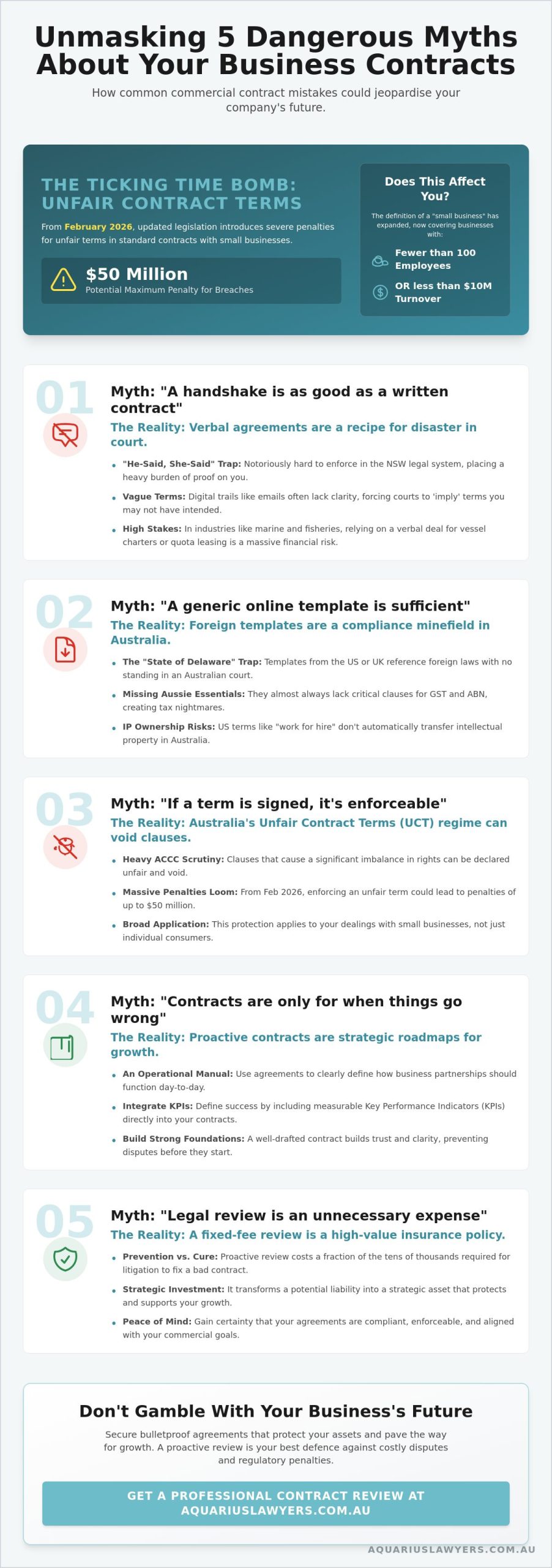
Myth #4: ‘Contracts are Only Relevant When Things Go Wrong’
Many directors view their legal documents as a “break glass in case of emergency” tool. This reactive mindset is one of the most persistent commercial contract mistakes in the Australian market. Instead of viewing an agreement as a defensive shield against litigation, you should treat it as a proactive operational manual. A high-performing contract defines the “Who, What, When, and How” of your daily business life. It sets the rhythm for your team and your partners, ensuring that everyone is moving toward the same objective without the friction of ambiguity.
Integrating Key Performance Indicators (KPIs) directly into your agreements transforms them from static paperwork into a driver of commercial value. When you link payment or renewal terms to specific, measurable outcomes, the contract becomes a tool for growth rather than a hurdle. Furthermore, clear dispute resolution clauses are not an admission of future failure; they are a sophisticated method of prevention. By establishing a structured “pathway” to resolution, such as mandatory mediation in Sydney before any court action, you significantly reduce the risk of an expensive, public legal battle. You are choosing a solution-oriented approach that prioritises business continuity over conflict.
Streamlining Operations Through Better Drafting
Precision in your payment milestones is the most effective way to avoid the stress of debt recovery. By clearly articulating exactly when an invoice is triggered and the consequences of delay, you maintain healthy cash flow. If a client still fails to pay despite clear contractual terms, engaging a debt recovery lawyer NSW businesses trust can help you pursue unpaid invoices efficiently through the correct court jurisdiction. Managing scope creep is equally vital. A robust variation clause allows your business to adapt to changing project requirements without losing profit margins to unbilled work. A well-drafted contract serves as a dynamic business roadmap that aligns daily operations with long-term strategic goals while mitigating unforeseen risks.
Building Trust with Clients and Suppliers
A professional, balanced contract signals to the market that you are “investment ready.” It shows potential partners and investors that you have a mature understanding of risk and a disciplined approach to management. This “innovative veteran” perspective involves using contemporary tools to track contract milestones and expiry dates, ensuring you never miss an opportunity to renegotiate or renew. Transparency in your terms builds a foundation of trust that leads to more resilient, long-term commercial relationships. If you are ready to turn your paperwork into a strategic asset, consult with our team for a comprehensive commercial law review to ensure you are avoiding the commercial contract mistakes that derail growth.
Myth #5: ‘Legal Review is an Unnecessary Expense for Small Businesses’
Viewing legal advice as a sunk cost is a fundamental misunderstanding of business strategy. Sophisticated operators adopt an “Insurance Policy” mindset. You wouldn’t launch a commercial trawler without hull insurance; you shouldn’t launch a business partnership without a contract review. Avoiding commercial contract mistakes is significantly cheaper than attempting to fix them during a crisis. A proactive review identifies the “landmines” we have discussed, such as jurisdictional traps or unfair terms, before they are detonated by a dispute. It is an investment in your company’s resilience.
Aquarius Lawyers integrates modern technology with veteran expertise to keep our advice efficient and cost-effective. We prioritise results over ceremony, offering transparency through fixed-fee commercial reviews. Our “Fish Lawyer” advantage means we already understand the unique regulatory pressures of the aquaculture and marine sectors. You don’t pay us to learn your industry. You pay for a “no-nonsense” perspective that gets straight to the heart of the matter. This synergy of traditional credentials and forward-thinking methodology ensures your agreements are bulletproof without the bloated costs often associated with big-city firms.
The Real Cost of Commercial Litigation in Australia
Breach of contract claims in the NSW District Court are notoriously expensive. Beyond the legal fees, which can quickly climb into the tens of thousands, there is a significant emotional and time toll on business owners. A legal battle distracts you from your core operations and stunts your growth. Mediation serves as a highly effective, cost-conscious alternative to “fighting it out” in court. It allows for a controlled, private resolution that preserves your reputation and your bottom line. Choosing a strategic review now is simply a smarter way to manage your future cash flow.
Your Next Steps: A Proactive Contract Health Check
The legal landscape in 2026 demands that your existing agreements are audited for compliance with the latest ACL updates and privacy regulations. A “quick look” from a specialised solicitor can often prevent a catastrophic commercial contract mistakes from going unnoticed. Don’t wait for a letter of demand to find out your paperwork is outdated. Secure your business with a pragmatic assessment of your current risks. Contact Aquarius Lawyers today for a strategic commercial review.
Turning Legal Risks into Strategic Assets
The legal landscape in 2026 demands more than just a signed piece of paper. It requires a strategic alignment of your operations with the latest Australian Consumer Law standards. By moving away from handshake deals and generic templates, you protect your business from the “he-said, she-said” traps and jurisdictional nightmares that derail growth. A robust agreement isn’t just a defensive shield; it’s a roadmap for your commercial success. Avoiding common commercial contract mistakes now ensures you aren’t paying for them later in the Federal Court.
With over 20 years of experience serving NSW businesses, Principal Solicitor Katherine Hawes provides the niche expertise in commercial and marine law needed to navigate these complexities. We offer fixed-fee options to ensure your legal budgeting remains transparent and predictable. It’s time to trade uncertainty for clarity. Secure your business with a professional contract review from Aquarius Lawyers and build a foundation for sustainable expansion. You’ve worked hard to build your business; let’s ensure your paperwork works just as hard to protect it.
Frequently Asked Questions
What are the most common commercial contract mistakes in Australia?
The most frequent commercial contract mistakes include relying on verbal “handshake” deals, using generic overseas templates, and failing to account for the 2026 Unfair Contract Terms (UCT) regime. Many businesses also neglect to include clear KPIs or dispute resolution pathways. These omissions turn simple operational disagreements into high-cost litigation that could have been avoided with a pragmatic, locally-compliant document.
Is an email exchange considered a legally binding contract in NSW?
Yes, an email exchange can be a legally binding contract in NSW if it satisfies the core elements of formation: offer, acceptance, consideration, and an intention to create legal relations. However, relying on emails is inherently risky. They often lack the “certainty of terms” found in a formal deed, leaving your business vulnerable to implied terms that a court may impose if a dispute arises.
How often should I update my standard business terms and conditions?
You should review your standard business terms at least once a year or immediately following major regulatory shifts. For example, the February 2026 penalty increases for unfair terms and the December 2026 Privacy Act updates regarding automated decision-making require urgent document audits. Regular updates ensure your agreements remain a strategic roadmap for growth rather than a hidden liability.
Can I use a US-based contract for my Sydney-based business?
Using a US-based contract is a significant risk because it usually references foreign jurisdictions and misses essential Australian requirements like GST clauses and ABN disclosures. These templates also use foreign terminology like “work for hire,” which doesn’t carry the same legal weight in the Australian intellectual property framework. A local contract ensures your business is anchored in the correct jurisdiction.
What happens if a contract doesn’t have a termination clause?
If your agreement lacks a termination clause, the law generally implies a right to terminate on “reasonable notice.” The difficulty is that “reasonable” is not a fixed number; it depends on your industry, the length of the relationship, and the nature of the services. This ambiguity is a frequent trigger for litigation as parties struggle to agree on what a fair notice period looks like.
Are digital signatures legally valid for commercial contracts in Australia?
Digital signatures are legally valid and enforceable for the vast majority of commercial contracts in Australia under the Electronic Transactions Act. Using secure digital platforms is a proactive step that creates a clear audit trail of when and where the document was signed. It is an efficient, modern way to formalise agreements while maintaining high levels of security and compliance.
What is the difference between a ‘breach of contract’ and an ‘unfair term’?
A breach of contract occurs when one party fails to meet their agreed obligations, such as missing a payment milestone. An unfair term is a clause that is inherently unbalanced and void under the Australian Consumer Law. While a breach leads to a claim for damages, using or relying on an unfair term in 2026 can result in massive ACCC penalties of up to $50 million.
How much does a commercial lawyer cost to review a contract in Sydney?
Legal costs for a contract review in Sydney vary depending on the complexity of the document and the specific needs of your industry. Many modern firms now offer fixed-fee arrangements for standard commercial reviews to provide businesses with complete budget certainty. This transparency allows you to treat legal advice as a predictable business investment rather than an open-ended administrative expense.
Disclaimer
Please note that legal rules change and this is not a substitute nor construed as legal advice. It is general information only.