
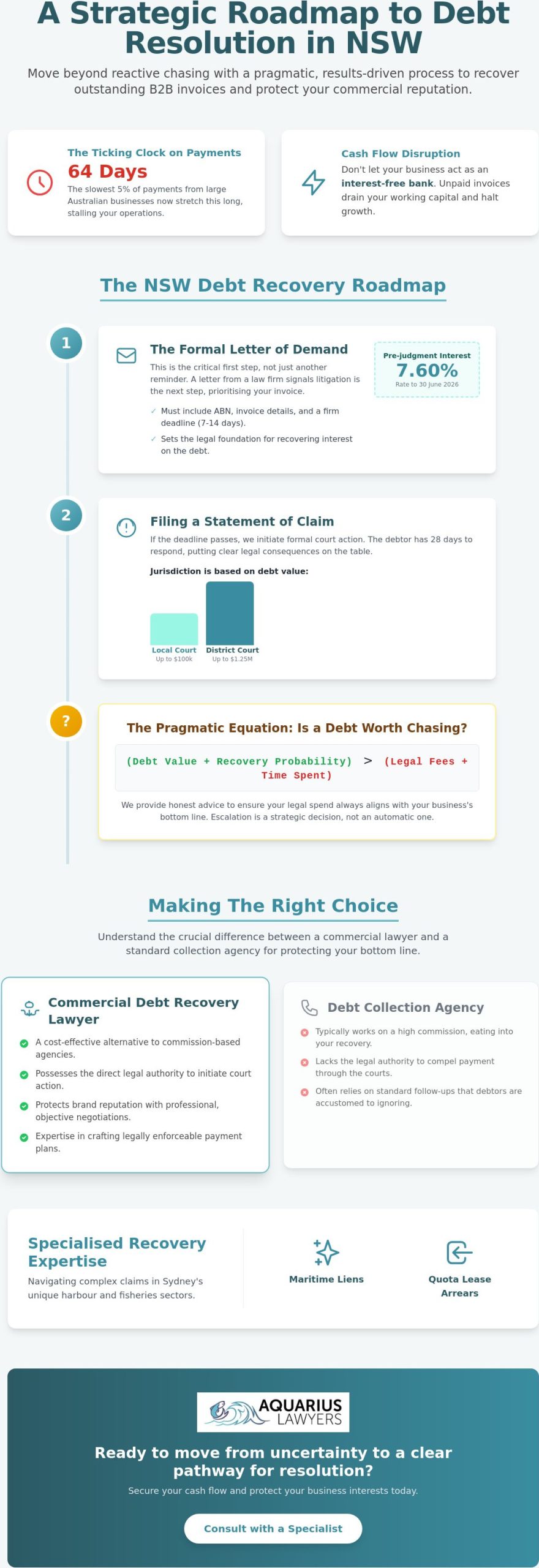
With the slowest 5% of payments from large Australian businesses now stretching to 64 days, your firm shouldn’t have to act as an interest-free bank for delinquent debtors. It’s exhausting to watch cash flow bottlenecks stall your operations while standard follow-ups are ignored. You likely worry that the cost and stress of the NSW court system will eventually outweigh the value of the debt itself. Partnering with a commercial debt recovery lawyer in Sydney changes that equation. It replaces reactive chasing with a pragmatic, results-driven strategy designed to protect your commercial reputation.
We believe that legal action should be a surgical tool, not a blunt instrument. This article will show you how to recover your principal debt plus the current 7.60% pre-judgment interest through a streamlined, low-stress process. You’ll gain a clear understanding of the thresholds for statutory demands and receive honest advice on whether a debt is actually worth chasing. It’s time to move from uncertainty to a clear pathway for resolution.
Key Takeaways
- Understand why a formal Letter of Demand is the critical first step in the NSW recovery roadmap to ensure your B2B invoices are prioritised.
- Discover how a commercial debt recovery lawyer in Sydney offers a more cost-effective alternative to commission-based agencies by providing the direct legal authority to initiate court action.
- Learn how to navigate complex specialised claims, such as maritime liens and quota lease arrears, to protect your interests in the Sydney harbour and fisheries sectors.
- Identify the strategic framework used to determine when a debt is worth chasing, ensuring your legal spend always aligns with your business’s bottom line.
- Master the art of crafting enforceable payment plans that secure your cash flow without damaging vital commercial relationships.
Commercial Debt Recovery in Sydney: A Strategic Business Necessity
Commercial debt recovery is far more than a series of polite reminders. It’s a structured legal process designed to reclaim unpaid B2B invoices through established NSW legal frameworks. For small and medium enterprises (SMEs) in Sydney, maintaining liquidity is a constant challenge. The city’s high-cost regulatory environment means that even a single significant unpaid invoice can create a dangerous cash flow bottleneck. When debtors stall, they aren’t just holding your money; they’re effectively using your business as an interest-free credit facility. This drains your working capital and prevents you from reinvesting in your own growth.
Success in this area relies on what we call the Pragmatic Equation. You must assess if the total debt value, combined with the probability of recovery, outweighs the projected legal fees and the time your team spends chasing it. A debt collection practices overview shows that recovery rates drop significantly as a debt ages. Engaging a commercial debt recovery lawyer in Sydney early in the piece signals professional intent. It moves you to the top of the debtor’s payment list because they realise you’re no longer willing to accept excuses. This proactive stance often resolves matters before they ever reach a courtroom.
The Tipping Point: When to Hire a Sydney Debt Recovery Solicitor
Knowing when to escalate is critical. Red flags include a debtor who suddenly goes silent, breaks multiple payment arrangements, or requests documentation they already have. While your internal accounts team is excellent for day-to-day management, they lack the legal leverage to force a resolution. Relying on internal staff for too long can actually jeopardise your standing if you eventually need to prove you’ve taken reasonable steps to mitigate losses. There is a psychological shift when a debtor receives a letter on a law firm’s letterhead. It replaces the “ignore” option with a clear legal consequence.
Protecting Your Brand Reputation During Recovery
Recovering funds shouldn’t mean burning bridges. Many business relationships are built over decades, and a heavy-handed approach can cause lasting market friction. We use “without prejudice” negotiations to find a middle ground, allowing for frank discussions that can’t be used against you in court later if a settlement isn’t reached. This allows you to maintain leverage while exploring enforceable payment plans. A commercial debt recovery lawyer in Sydney ensures the process remains objective and professional. A commercial litigator is a strategic advisor who secures funds while minimising market friction.
The Debt Recovery Process in NSW: A Roadmap to Resolution
Resolving a debt in New South Wales requires more than persistence; it requires a methodical adherence to court rules and strategic timing. While every case has its nuances, the path from an unpaid invoice to recovered funds follows a predictable legal roadmap. By following this sequence, you ensure that your claim is legally sound and that you’re positioned to recover not just the principal, but also interest and costs where applicable. Moving through these stages with precision prevents debtors from exploiting procedural loopholes to delay payment.
Step 1: The Letter of Demand
The first pillar of any successful recovery is the formal Letter of Demand. This isn’t a standard “overdue” notice. It must contain your ABN, specific invoice references, and a firm deadline for payment, usually seven or 14 days. A letter drafted by a commercial debt recovery lawyer in Sydney carries significant weight because it signals that litigation is the immediate next step. This letter also sets the stage for interest recovery under the Civil Procedure Act 2005. For the period ending 30 June 2026, the pre-judgment interest rate in the NSW Local Court is 7.60%. Ensuring your demand aligns with the ACCC debt collection guidelines protects you from claims of harassment while maintaining maximum pressure on the debtor.
Step 2: Filing the Statement of Claim
If the deadline passes without payment or a viable settlement offer, we move to filing a Statement of Claim. The jurisdiction depends on the debt value. The NSW Local Court handles matters up to $100,000, while the District Court can determine disputes up to $1,250,000. Once served, the debtor has a 28-day response window to either pay or file a defence. We use modern legal technology to fast-track these filings, avoiding the common bottlenecks found in the Sydney court registry. If you’re unsure which court is appropriate for your specific situation, seeking a professional legal assessment can save months of jurisdictional delays.
Judgment and Enforcement
Obtaining a judgment is a legal victory, but the ultimate goal is the actual transfer of funds. If a debtor still refuses to pay after a court order, enforcement is the final phase. This might involve an Examination Order to uncover the debtor’s assets, which carries a filing fee of approximately A$109 for individuals or A$218 for corporations. Other tools include garnishee orders on bank accounts or writs for the levy of property. A strategic recovery plan ensures that you don’t just win on paper, but actually see the money back in your business account where it belongs.
Lawyer vs. Debt Collection Agency: Making the Right Choice
Choosing between a debt collection agency and a commercial debt recovery lawyer in Sydney is a decision that directly dictates your net recovery. Many businesses fall into the “Commission Trap” without realising the long-term cost. Agencies typically charge a percentage of the recovered amount, which often ranges from 10% to 25%. On a high-value commercial invoice of A$50,000, you could lose A$12,500 just in fees. A law firm’s fixed-fee model ensures you keep the lion’s share of your principal. Beyond the mathematics, there is the matter of legal authority. An agency is a facilitator; a solicitor is an officer of the court. Agencies can call and send letters, but they cannot initiate court proceedings or provide the protection of solicitor-client privilege during sensitive disputes.
Why Fixed-Fee Legal Support Wins
Transparency in billing is the foundation of a professional recovery strategy. With a fixed-fee model, you know your exact costs before the first letter is sent. This prevents the “fee creep” that often plagues commission-based arrangements. We also provide integrated advice. We don’t just look at the unpaid invoice; we examine the contract that caused the debt. This identifies potential cross-claims or weaknesses in your terms of trade that an agency would simply overlook. It is a simple equation: Legal Foresight + Fixed Costs = Higher Net Recovery.
The Power of Court Enforcement
When a debtor remains stubborn, an agency reaches a dead end. They must eventually refer the matter to a lawyer anyway, which adds unnecessary layers of cost and delay. A commercial debt recovery lawyer in Sydney can move straight to powerful enforcement tools that agencies simply cannot access. These include:
- Garnishee Orders: Taking funds directly from the debtor’s bank account or third-party payments.
- Statutory Demands: For undisputed corporate debts over A$4,000, this creates a 21-day window for payment before a presumption of insolvency is triggered.
- Writs of Execution: Directing the Sheriff to seize and sell assets to satisfy the debt.
- Examination Orders: Forcing the debtor to attend court and disclose their financial position under oath.
Using the threat of liquidation or bankruptcy is a powerful recovery tool. Agencies lack the standing to initiate these high-stakes procedures, often leaving you with nothing but a “closed file” and a lost debt. By engaging a solicitor from the outset, you bypass the middleman and go straight to the tools that get results.
Specialised Recovery: Maritime, Fisheries, and Aquaculture Debts
Generic debt recovery firms often struggle when an unpaid invoice involves a commercial vessel or a fisheries quota. These aren’t standard commercial disputes. They require a deep understanding of the Admiralty Act 1988 and the Fisheries Management Act 1994. Whether you’re dealing with unpaid fuel bills in Sydney Harbour or aquaculture supply chain debts involving hatcheries and feed suppliers, the legal pathways are highly specialised. Engaging a commercial debt recovery lawyer in Sydney who understands these niche primary industries is the difference between a stalled claim and a successful recovery. We leverage our “Fish Lawyer” expertise to navigate these specific regulatory waters, ensuring your business doesn’t sink due to someone else’s bad debt.
Maritime Liens and Vessel Arrests
In maritime law, a debt for “necessaries” like fuel, vessel repairs, or crew wages can actually attach to the vessel itself through a maritime lien. This is a unique power that doesn’t exist in standard land-based commerce. If a shipowner refuses to pay, you can apply to the Federal Court to arrest the vessel while it’s in Australian waters. This effectively holds the asset as security for the debt. It’s a high-stakes move that requires surgical precision. One jurisdictional error can lead to significant damages for “wrongful arrest,” which is why having an experienced commercial debt recovery lawyer in Sydney is mandatory for shipping disputes.
Fisheries Compliance and Debt
The commercial fishing industry operates on a complex system of licences and quotas. Quota lease arrears can quickly escalate, threatening your commercial interests and NSW licences. We frequently manage disputes between co-owners of commercial fishing licences or recovery actions for unpaid levies and lease fees. For primary producers facing non-payment from wholesalers, the strategy must account for the perishability of the product and the long-term viability of the trading relationship. Our approach focuses on:
- Recovering unpaid levies and lease fees within the NSW fisheries framework.
- Resolving co-owner disputes regarding licence usage and revenue sharing.
- Providing strategic advice for primary producers facing insolvency or non-payment from wholesalers.
If you’re facing a niche industry dispute that standard agencies can’t handle, you can consult with our specialised maritime and fisheries team to discuss a tailored recovery plan that protects your commercial licences.
Why Choose Aquarius Lawyers for Your Sydney Debt Recovery?
Aquarius Lawyers isn’t your typical legal practice. We operate as an “innovative veteran” in the legal space, combining over 20 years of traditional experience with modern technology to create a recovery process that is both robust and rapid. When you engage a commercial debt recovery lawyer in Sydney from our team, you aren’t passed off to a junior clerk. You receive a principal-led strategy. Katherine Hawes personally oversees high-stakes commercial matters, ensuring that your business benefits from senior-level expertise and a “no-nonsense” attitude. We focus on the fastest pathway to your money, serving the Sydney CBD and regional NSW from our Shellharbour base with a grounded, down-to-earth approach.
Tech-Driven Efficiency
Efficiency is the core of our methodology. We use digital document management systems to reduce billable hours and accelerate court filings. This tech-driven approach allows us to conduct high-level legal research and manage complex claims without the bloated overheads often associated with traditional firms. You receive transparent communication and regular updates throughout the process. We believe you should never be left in the dark about the status of your funds. Our cost-effective solutions are designed to be a protective step for your business, providing a clear narrative of progress from the first consultation to the final resolution.
Choosing the right commercial debt recovery lawyer in Sydney means finding an advisor who values results over ceremony. We understand the commercial reality of debt. Before we recommend litigation, we assess whether a debtor actually has the assets to satisfy a judgment. This intellectual versatility allows us to move easily between standard B2B disputes and the specialised maritime or fisheries claims discussed earlier. We don’t just chase debts; we provide strategic advice that protects your commercial reputation and secures your financial future.
Ready to Resolve Your Dispute?
Don’t let unpaid invoices sink your business cash flow or drain your operational energy. Every day a debt remains outstanding, the statistical likelihood of full recovery decreases. We provide a clear pathway to resolution, managing everything from the initial demand to rigorous court enforcement. Whether you are a Sydney-based SME or a primary producer in the aquaculture sector, your recovery deserves a pragmatic, results-driven strategy. Contact Aquarius Lawyers today for a pragmatic consultation on your debt recovery options.
Reclaim Your Working Capital and Commercial Peace of Mind
Unpaid invoices are more than just missing figures on a ledger; they represent a direct threat to your business’s operational agility. We have explored how a methodical legal roadmap, from solicitor-drafted demands to rigorous court enforcement, ensures you aren’t left at the mercy of non-responsive debtors. By opting for a fixed-fee legal model over commission-based agencies, you retain the maximum value of your principal while gaining access to powerful enforcement tools like garnishee orders and statutory demands. This approach turns debt recovery from a source of stress into a controlled, strategic business function.
Partnering with a commercial debt recovery lawyer in Sydney provides the intellectual versatility required to handle both standard B2B disputes and specialised maritime or fisheries matters. Led by Principal Katherine Hawes, often referred to as “The Fish Lawyer,” our team combines deep industry credentials with modern legal technology to accelerate your recovery. With offices in the Sydney CBD and Shellharbour, we provide accessible, high-level strategy for businesses across regional NSW. Don’t let delinquent payments dictate your firm’s future growth or stability.
Secure your business cash flow with a strategic consultation at Aquarius Lawyers. You have worked hard to earn your revenue; we are here to help you bring it home.
Frequently Asked Questions
How much does it cost to hire a debt recovery lawyer in Sydney?
Costs vary depending on the complexity of the matter and whether you choose a fixed-fee or hourly rate model. A fixed-fee approach is often preferred for straightforward recoveries as it provides transparency from the outset. Unlike agencies that take a percentage of your debt, a commercial debt recovery lawyer in Sydney typically charges for specific legal actions taken. This ensures you keep more of the principal amount once the debt is resolved.
Can I recover my legal fees from the debtor in NSW?
You can often recover a portion of your legal costs if the matter proceeds to court and you are successful. However, the Small Claims Division of the NSW Local Court for debts under $20,000 is generally a “no costs” jurisdiction, meaning parties usually pay their own way. For larger claims in the General or District divisions, the court typically orders the losing party to pay the winner’s costs, which covers some of your expenditure.
How long does the debt recovery process typically take?
The timeframe ranges from a few days to several months depending on the debtor’s response. A Letter of Demand usually gives a seven or 14-day deadline, and many matters settle here. If you must file a Statement of Claim, the debtor has 28 days to respond. While we use digital filing to speed up the process, a defended matter that goes to a full hearing can take significantly longer to reach a final judgment.
What is the difference between a Letter of Demand and a Statement of Claim?
A Letter of Demand is a formal warning sent before legal action begins, while a Statement of Claim is the document that actually starts court proceedings. The letter is a final opportunity for the debtor to pay voluntarily to avoid litigation. The Statement of Claim is a court-filed document that requires a formal response within 28 days. Filing the latter is a serious escalation that signals your intent to seek a court-ordered judgment.
What happens if a debtor ignores a court judgment?
You must move to the enforcement phase if a debtor fails to pay after a court order. This involves using legal tools like garnishee orders to take money directly from their bank account or wages. You might also apply for a Writ for the Levy of Property, which allows the Sheriff to seize and sell the debtor’s assets. For corporate debtors, ignoring a judgment is often the first step toward a statutory demand and potential liquidation.
Can I chase a debt if there is no written contract?
You can still pursue a debt without a formal written contract, provided you have other evidence of the agreement. This includes emails, text messages, purchase orders, or proof that the goods or services were delivered and accepted. While a signed contract makes the process smoother, an oral contract is still legally binding in NSW. We help you gather the necessary secondary evidence to build a compelling case for recovery.
Is there a time limit for starting debt recovery action in Australia?
The limitation period for most commercial debts in NSW is six years from the date the debt became due. This clock restarts if the debtor provides a written acknowledgment of the debt or makes a partial payment. It is critical to act well before this deadline. Engaging a commercial debt recovery lawyer in Sydney early makes it easier to locate debtors and reduces the risk that they will enter insolvency before you secure your funds.
What is a Statutory Demand and when should I use it?
A Statutory Demand is a powerful tool used for undisputed corporate debts exceeding A$4,000. Once served, the company has 21 days to pay or apply to set it aside. Failure to comply creates a legal presumption that the company is insolvent, which allows you to apply to the court to wind them up. This is an effective “nuclear option” that often forces immediate payment from companies that were previously ignoring your follow-ups.
Disclaimer
Please note that legal rules change and this is not a substitute nor construed as legal advice. It is general information only.