A standard family will cannot protect a lifetime spent on the water. When handling commercial fishing business succession planning, relying on off-the-shelf estate documents can jeopardise everything you have built. Lasting succession succeeds through the careful integration of maritime assets, statutory endorsements, and corporate structures, not generic legal paperwork.
You already know the relentless grit it takes to keep a fleet viable and profitable. You also know the quiet anxiety that comes with passing the helm: the dread of family disputes over operational control, vessel compliance snags halting operations at the wharf, or administrative traps that could strip away hard-won quota entitlements. A lifetime of work should not sink under conflicting legal claims or avoidable regulatory missteps.
In this guide, you will learn how to safeguard your quota, commercial fishing vessel, and enterprise value throughout succession. We walk you through the practical, legal pathways that align statutory licensing, business assets, and family expectations for a seamless transition to the next generation of operators.
Key Takeaways
- Master commercial fishing business succession planning by establishing clear legal boundaries between transferable statutory quota and personal skipper authorisations.
- Safeguard vessel compliance and operational continuity by aligning commercial maritime surveys and statutory licence registers well before handover.
- Compare intergenerational transfers, management buyouts, and commercial sales to determine the right commercial pathway for your seafood enterprise.
- Implement structured corporate agreements to resolve family disputes and protect non-operating beneficiaries before ownership transitions occur.
- Bridge the gap between general estate planning and fisheries law through specialist marine legal counsel to prevent costly administrative transfer traps.
What Is Commercial Fishing Business Succession Planning in Australia?
At its core, commercial fishing business succession planning is the structured legal process of transferring operational control, commercial assets, and regulatory authorisations from one generation or owner to the next. Unlike standard brick-and-mortar enterprises, commercial fisheries rely on finite statutory rights and heavily regulated maritime assets. Successful succession secures fishing rights, vessel survey continuity, and corporate ownership stability long before an owner steps away.
Too often, operators conflate at-sea command with executive equity. While corporate governance handles the commercial enterprise, daily fishing relies on endorsed skippers holding valid maritime tickets. Separating operational skippering from corporate ownership prevents devastating operational standstills if an owner suddenly retires or falls ill. In broader commerce, Succession planning establishes clear leadership trajectories; in primary marine production, it protects business continuity under strict fisheries law.
The Core Assets: Vessels, Quota, and Corporate Entities
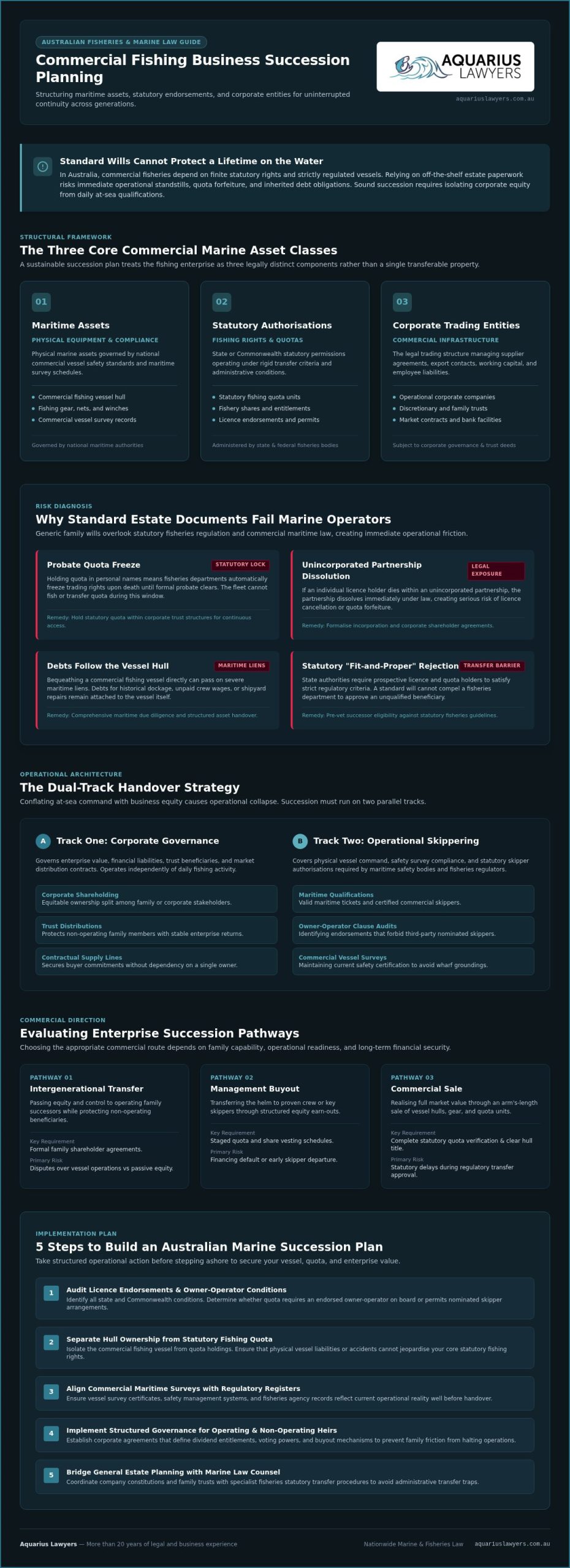
A sound transition demands treating the enterprise as three distinct asset classes:
- Maritime assets: The commercial fishing vessel, fishing gear, and vessel surveys governed by national commercial vessel safety standards.
- Statutory authorisations: Fishing quota units, fishery shares, and endorsements managed by state or Commonwealth fisheries management authorities.
- Corporate trading entities: The operational company, discretionary trusts, or trading partnerships holding market contracts and operational bank facilities.
Quota units operate under separate statutory frameworks with rigid transfer rules. Operating through an unincorporated partnership introduces severe legal exposure. If an individual licence holder dies, the partnership dissolves immediately, risking licence cancellation or quota forfeiture before family members can legally intervene.
Why Off-the-Shelf Wills Threaten Commercial Marine Enterprises
Generic wills assume assets transfer without regulatory friction. That assumption breaks down on the water. Standard estate documents fail to satisfy the statutory fit-and-proper person tests imposed by fisheries departments before a nominated beneficiary can legally hold shares or quota.
Directly bequeathing a commercial fishing vessel creates another blind spot. Under marine law, maritime debts follow the hull. Passing a vessel straight to an unprepared beneficiary can trigger immediate maritime lien liabilities for historical dockage, unpaid crew wages, or shipyard repairs. Working with dedicated estate services ensures testamentary documents align with corporate constitutions, trusts, and statutory licensing frameworks to keep your fleet operating without disruption.
Managing Critical Marine Assets in Fishing Business Succession
Failing to separate transferable commercial assets from personal skipper authorisations is a common mistake in commercial fishing business succession planning. In Australia, a marine licence does not automatically pass down like family land. Fishing rights, vessel surveys, and corporate ownership each sit under separate statutory bodies. If you mismanage these operational boundaries, the business stops generating revenue the day an owner steps ashore.
Every handover requires a dual-track strategy. You must isolate what the corporate trading entity owns from what the individual master holds. When structuring your succession, this approach protects both the business balance sheet and your daily maritime permissions.
Statutory Fishing Rights, Quotas, and Licence Transfers
A rigorous audit of licence endorsements comes first. Many historical state endorsements carry strict owner-operator clauses that forbid third-party nominated skippers. Discovering these conditions during a transfer can instantly trap your chosen successor off the water.
Holding quota units through corporate trusts protects your business against probate freezes. When an individual dies holding quota in their own name, fisheries departments freeze trading rights until probate clears. Structuring your holdings through an appropriate entity ensures your fleet keeps quota accessible in real time. For specialised advice on protecting statutory fishing entitlements, seek out a fisheries lawyer Australia who understands these statutory nuances.
Vessel Titling, AMSA Survey, and Maritime Encumbrances
Passing on a commercial fishing vessel involves far more than exchanging equipment keys. A smooth vessel transfer demands verifying legal title, surveys, and debts through three essential steps:
- Title verification: Check the Australian Register of Ships to confirm legal ownership and verify that all registered mortgages are properly discharged.
- Maritime lien clearance: Conduct comprehensive legal inquiries for secret maritime liens, which attach directly to the hull for historical salvage claims or unpaid crew wages.
- Survey currency: Ensure certificates of survey remain compliant with Australian Maritime Safety Authority standards to prevent sudden detentions.
Undisclosed maritime liens pose an immediate financial threat because they travel with the hull regardless of company ownership changes. If you want to protect your enterprise value and avoid inheriting old liabilities, consult the specialists at Aquarius Lawyers to conduct targeted marine due diligence before signing any transfer agreements.
Evaluating Succession Pathways: Family Transfer vs Management Buyout vs Sale
Selecting an exit route requires balancing commercial realities against personal obligations. In commercial fishing business succession planning, choosing the right pathway depends on who holds the maritime qualifications and how cleanly the enterprise assets can be divided. A transition model that works for an offshore prawn trawling fleet will rarely fit an artisanal estuary net fisher.
Every commercial fisher faces three distinct legal mechanisms when stepping back:
- Intergenerational family transfer: Keeps operational control and fishing history within the family lineage, provided internal conflict is managed proactively.
- Management buyout (MBO): Empowers employed skippers or senior deckhands to buy equity over time, ensuring operational continuity at sea.
- Arm’s length commercial sale: Cashes out enterprise equity entirely to a corporate competitor or external syndicate, requiring clean warranties and deep regulatory due diligence.
Intergenerational Family Handover: Preserving Generational Heritage
Handing the helm to a son or daughter preserves decades of brand equity and local territory knowledge. Unspoken family expectations, however, can quickly sink the business. When only one child works the deck while others pursue non-marine careers, friction follows.
You can safeguard family harmony by drafting formal family governance charters. Use off-water assets such as residential property or external superannuation to equitably balance gifts to non-participating children. To protect operating rights from matrimonial claims, structure ownership through discretionary trusts where a corporate trustee holds the statutory fishing shares. This shields maritime operating rights from relationship breakdowns and ensures non-fishing siblings cannot force the immediate liquidation of the commercial fishing vessel.
Arm’s Length Commercial Disposals and Quota Splits
Selling out entirely requires strategic unbundling. In many state-managed fisheries, Individual Transferable Quota (ITQ) units trade at a distinct commercial premium compared to older vessel hulls. Splitting quota parcels from physical marine assets allows you to sell quota directly to active operators while disposing of the commercial fishing vessel separately on the national register.
A third-party sale demands rigorous vendor due diligence. Buyers now scrutinise regulatory compliance records, Vessel Monitoring System logs, and logbook entries to ensure no unreported historical fisheries offences exist. Establishing proper corporate structures via asset protection legal services isolates trading liabilities prior to drafting vendor warranties, locking in your enterprise value before settlement documents are signed.
How to Build an Australian Fishing Succession Plan in 5 Steps
Rushing an exit twelve months before retirement rarely succeeds in the seafood sector. Effective commercial fishing business succession planning demands a realistic multi-year runway, typically between two to five years. This lead time gives you room to align statutory licence transfers, vessel survey renewals, and corporate reorganisations without disrupting cash flow.
Executing an orderly handover requires moving through five sequential stages, taking your enterprise from an initial legal audit to the final regulatory clearance.
Steps 1 to 3: Commercial Asset Audits and Entity Structuring
The first phase locks down your balance sheet and operational rights:
- Step 1: Execute a commercial asset audit. Collate all statutory fishing entitlements, catch share allocations, logbook records, and your current certificate of survey. Confirm clear legal title on the Australian Register of Ships before initiating any transfer talks.
- Step 2: Construct protective entity structures. Restructure unincorporated partnerships or sole proprietorships into discretionary trusts or proprietary companies. Holding statutory rights within dedicated entities isolates trading liabilities from personal family assets.
- Step 3: Formalise corporate agreements and estate documents. Draft binding shareholder agreements that set out dispute resolution pathways, buyout formulas, and retirement trigger events. Ensure your personal wills, testamentary trusts, and binding death benefit nominations align precisely with these commercial contracts.
Steps 4 to 5: Operational Transition and Regulatory Lodgement
The final phase tests incoming leadership and satisfies government authorities:
- Step 4: Transition daily operations and lodge approvals. Step back from the wheelhouse gradually. Mentor your nominated master on regulatory logbooks, seasonal patterns, and compliance rules while retaining commercial oversight. Submit statutory transfer applications to state or Commonwealth fisheries departments early to absorb mandatory fit-and-proper person checks.
- Step 5: Finalise settlement and transfer clearances. Coordinate with lenders to discharge registered vessel mortgages, update marine hull insurance policies, and transfer digital fisheries reporting portal credentials.
A structured legal pathway prevents operational downtime and protects your enterprise value. Contact Aquarius Lawyers to structure your fishing succession plan and safeguard your commercial maritime operations across Australia.
Protecting Your Commercial Enterprise with Specialist Marine Law Counsel
Commercial fishing occupies a distinct legal space where corporate structuring, estate planning, and marine law intersect. Generalist solicitors and accounting practices frequently misjudge how administrative fisheries acts govern statutory property. Without sector-specific legal guidance, well-meaning corporate agreements can inadvertently breach statutory transfer rules, risking quota forfeiture or stalled operations. Independent marine counsel ensures your commercial agreements align with regulatory realities from day one.
Led by Katherine Hawes, Aquarius Lawyers brings more than 20 years of legal and business experience to the Australian seafood industry. We understand that safeguarding your fleet is not just about drafting contracts; it is about preserving the generational wealth and daily viability of your enterprise. Decisive legal advice prevents bitter boardroom disagreements that disrupt fishing seasons, slash asset valuations, and fracture families.
Bridging Corporate Restructuring with Specialized Marine Regulations
Aligning corporate ownership with fisheries regulations demands meticulous legal drafting. Company constitutions and discretionary trusts must accommodate the operational constraints of state fisheries management acts and Commonwealth waters. When a trust deed clashes with statutory ownership caps, administrative authorities can reject licence transfers altogether.
Our firm works in close coordination with your financial advisors and accountants. This unified approach ensures your corporate restructuring supports your tax position while meeting every compliance threshold set by licensing bodies. You can explore tailored strategic guidance through our seafood and marine legal services team to protect your catch history and commercial entitlements.
Mitigating Partnership Conflicts and Future Estate Disputes
Unresolved disagreements between retiring owners, incoming operators, and non-working siblings often threaten maritime enterprises. Structured legal mediation can de-escalate tensions before they spill over into court proceedings. Formal mediation provides a confidential setting to renegotiate equity shares, buyouts, and operational control without jeopardising goodwill.
Proactive legal drafting also shields your maritime operations against catastrophic licence impacts. An unexpected divorce, a partner exit, or a family provision claim under probate law can lead to court orders that halt vessel operations or compel the urgent sale of quota parcels. By embedding clear exit mechanics and dispute resolution clauses into your partnership and shareholder agreements, you isolate operational licences from private disputes.
A resilient transition protects everything you have built on the water. Engage early with dedicated legal practitioners to execute an actionable commercial fishing business succession planning strategy that secures your fleet for the next generation.
Secure Your Maritime Legacy for the Next Generation
Stepping back from the helm should mark an achievement, not an administrative crisis. For many lifelong operators, transitioning away from commercial pressure opens up time to enjoy recreational freshwater sportfishing at leisure; to explore bait selection and angling tactics, check out Bass Online for dedicated guides. On the commercial side, successful commercial fishing business succession planning protects what matters most: isolating statutory quota units from personal skipper tickets, clearing hidden maritime liens before vessel handover, and putting transparent corporate agreements in place to keep family peace intact.
Aquarius Lawyers brings more than 20 years of legal and business experience directly to commercial fishers nationwide. Known across Australia as dedicated specialists in marine, fisheries, and aquaculture law, our firm delivers clear legal solutions across corporate structuring, marine assets, and estate planning. A well-designed transition keeps your fleet working, protects your statutory entitlements, and provides lasting certainty for the incoming crew.
Don’t leave a lifetime of physical effort and enterprise value to generic paperwork. Protect your fishing enterprise and quota with Aquarius Lawyers and navigate your handover with confidence, knowing your business is set up to thrive for decades to come.
Frequently Asked Questions
Can commercial fishing quota be transferred directly through a standard personal will?
No, statutory quota cannot simply be bequeathed like standard personal property. Statutory fishing quota is governed by fisheries management authorities, not general succession acts. A standard will triggers probate delays, during which fisheries departments may freeze trading rights or require beneficiaries to satisfy fit-and-proper person tests. Holding quota in appropriate corporate or trust structures prevents assets from being trapped in administrative limbo.
What happens to a commercial fishing vessel survey when business ownership changes?
A certificate of survey remains attached to the vessel itself, but operational authorisations require prompt administrative updates. When corporate shareholding transfers, the vessel’s survey status under the National Standard for Commercial Vessels remains valid, provided operations don’t change. If the title transfers on the Australian Register of Ships, incoming owners must update safety management documentation to ensure operations continue legally.
How do maritime liens affect the sale or transfer of a fishing business?
Maritime liens attach directly to the commercial fishing vessel rather than the owner, meaning historical debts survive ownership changes. Unpaid crew wages, towage accounts, or salvage liabilities travel with the hull. In commercial fishing business succession planning, failing to uncover unrecorded maritime liens through specialised legal due diligence leaves an incoming owner personally exposed to sudden vessel arrest at the wharf.
What is the difference between transferring shares in a fishing company and transferring quota?
Transferring company shares changes executive ownership of the legal entity, whereas transferring quota reassigns the underlying statutory fishing entitlement. Company share transfers operate under standard corporate law, keeping supplier agreements, banking facilities, and vessel surveys continuous. Quota transfers require formal registry filings with fisheries bodies. A structured handover aligns corporate share transfers with statutory quota units to prevent operational standstills.
Can non-family members buy into a family-owned commercial fishing business?
Yes, management buyouts and staged equity partnerships allow senior skippers or deckhands to acquire an ownership stake. Bringing experienced crew into the business structure preserves essential maritime knowledge when family members pursue other careers. Clear shareholder agreements with pre-agreed valuation metrics, transfer restrictions, and voting rules protect core enterprise assets while keeping catching operations profitable on the water.
How long does a commercial fishing business succession process typically take in Australia?
A thorough succession transition typically takes between two and five years to execute properly. Commercial fishing business succession planning requires sufficient lead time to audit catch histories, restructure corporate holding entities, and mentor incoming skippers into executive management. Early preparation also accommodates state or Commonwealth fisheries department lodgement timelines, ensuring all regulatory approvals clear before the founder retires.
What happens if a quota holder becomes incapacitated without a succession plan in place?
Operations grind to a halt if a sole quota holder becomes incapacitated without valid corporate authorities established beforehand. Fisheries authorities will not accept licence instructions from unappointed family members. Without tailored enduring powers of attorney and corporate governance documents built for marine law, administrative authorities can freeze quota trading, leaving vessels tied to the jetty during prime fishing seasons.
Disclaimer
Please note that legal rules change and this is not a substitute nor construed as legal advice. It is general information only.