
A commercial lease default notice nsw isn’t just a formal letter; it’s a high-stakes legal lever that can either protect your property asset or trigger the immediate collapse of your business operations. If you’ve received a notice or need to issue one, you’re likely feeling the weight of potential lockouts and the looming shadow of the Supreme Court. It’s a stressful position to be in, especially when the validity of a single document determines your financial future. We understand that you want a resolution that doesn’t involve years of litigation or astronomical legal fees.
This guide cuts through the dense jargon of Section 129 of the Conveyancing Act 1919 to provide a pragmatic roadmap for 2026. You’ll learn how to master the complexities of NSW lease defaults, ensuring every step you take is legally sound and strategically advantageous. We’ll preview the essential requirements for a valid notice, explain the specific protections afforded by the Retail Leases Act 1994, and outline the pathways to retain your lease or terminate it lawfully without unnecessary conflict. Clear advice plus decisive action equals a protected bottom line.
Key Takeaways
- Identify whether a breach is monetary or non-monetary to determine if a formal notice period is legally required before any re-entry occurs.
- Understand how Section 129 of the Conveyancing Act 1919 serves as a critical statutory shield, protecting tenants from immediate eviction.
- Master the precise requirements for drafting and serving a commercial lease default notice nsw to ensure your legal position remains unassailable.
- Implement strategic responses designed to “buy time” for rectification or protect property assets without the need for Supreme Court intervention.
- Leverage specialist expertise for niche commercial sectors, including maritime and fisheries, where unique lease conditions require a tailored legal approach.
Understanding the Commercial Lease Default Notice in NSW
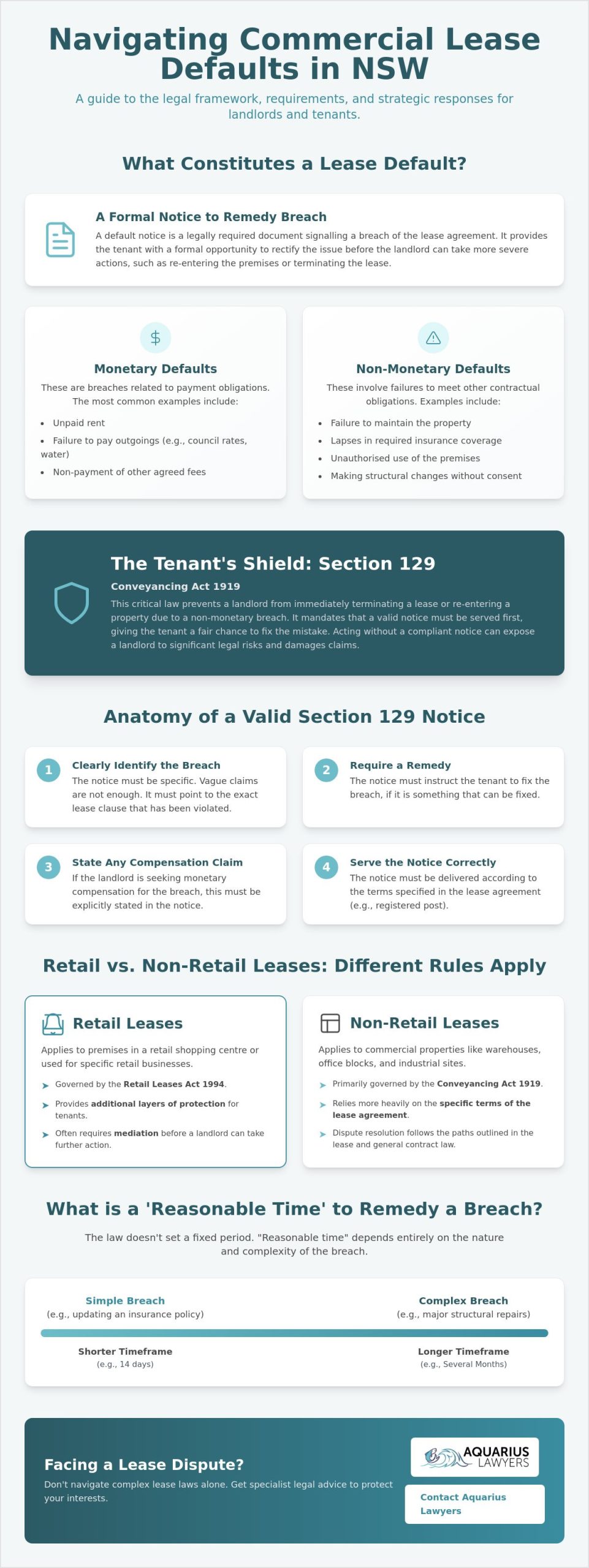
A commercial lease default notice nsw serves as the formal starting gun for any legal dispute between a landlord and a tenant. It isn’t just a courtesy email; it’s a strict legal requirement that signals a breach of contract has occurred. Think of it as a “Notice to Remedy Breach,” providing the tenant with a window of opportunity to fix the issue before the landlord takes more drastic action, such as re-entering the premises or claiming damages. Without this document, most attempts to terminate a lease for non-monetary reasons are legally invalid from the outset.
Your lease agreement is the primary source of truth here. It defines exactly what constitutes a “default.” Most defaults fall into two camps: monetary and non-monetary. Monetary defaults usually involve unpaid rent or outgoings. Non-monetary defaults are often more complex, involving failures to maintain the property, lapses in insurance coverage, or unauthorised use of the space. While rent is often seen as the most urgent issue, a failure to rectify a non-monetary breach can be just as fatal to a tenancy if the notice is handled correctly.
What constitutes a default under NSW Law?
A default is triggered when a party fails to meet an “essential term” of the lease. Common triggers include rent arrears, failure to pay council rates, or making structural changes without the landlord’s written consent. It’s vital to distinguish between a standard default and “abandonment.” Abandonment occurs when a tenant leaves the premises with no intention of returning, whereas a default notice assumes the tenant is still in possession but is failing to perform their obligations. If you’re dealing with a breach of an essential term, the path to resolution starts with a precisely drafted notice that identifies the specific clause being ignored.
Retail vs. Non-Retail: Which rules apply to your notice?
The rules governing Commercial and Retail Leases in Australia differ significantly depending on the nature of the business. If your premises is a retail shop, the Retail Leases Act 1994 adds layers of protection for the tenant, often requiring mediation before a landlord can move toward eviction. Conversely, non-retail commercial leases, such as warehouses or office blocks, rely more heavily on the Conveyancing Act 1919. Identifying your lease category is the first step in ensuring your commercial lease default notice nsw is compliant. Using the wrong format or failing to meet the statutory timeframes for your specific category can lead to a total dismissal of your claim in court.
The Legal Framework: Section 129 of the Conveyancing Act 1919
If the lease agreement is the rulebook, Section 129 of the Conveyancing Act 1919 is the referee. This statutory provision acts as a powerful shield for tenants, ensuring they aren’t evicted without a fair chance to fix their mistakes. In NSW, a landlord cannot simply re-enter a property or forfeit a lease because of a non-monetary breach without first serving a compliant notice. If they do, they risk committing a repudiatory breach themselves, which could lead to significant damages claims from the tenant. This legal barrier exists to prevent the catastrophic loss of a business over a minor or easily rectifiable oversight.
A critical component of any commercial lease default notice nsw is the “reasonable time” requirement. The law doesn’t define this as a set number of days. Instead, what is “reasonable” depends entirely on the nature of the breach. While 14 days might be sufficient to update an insurance policy, it would likely be considered insufficient for major structural repairs that require council permits. If a landlord demands the impossible within a 48-hour window, the notice will likely fail the court’s scrutiny. Getting this timing wrong is one of the fastest ways to turn a legitimate grievance into a legal nightmare for the landlord.
Mandatory requirements for a valid Section 129 Notice
For a notice to be legally enforceable, it must meet three strict criteria. First, it must specifically identify the breach. Vague references to “violating lease terms” won’t cut it; you must point to the exact clause being ignored. Second, the notice must require the tenant to remedy the breach if it’s capable of being fixed. Third, if the landlord is seeking monetary compensation for the breach, this must be explicitly stated in the document. Finally, the service of the notice must be impeccable. If your lease specifies service via registered post to a particular address, any other method, like a casual email, could render the entire commercial lease default notice nsw invalid. Ensuring every technicality is met requires a sharp eye. If you’re unsure about the wording of your document, seeking advice from a property law expert can prevent a costly legal backfire.
Common pitfalls that invalidate a default notice
Many landlords fall into the trap of using overly aggressive or vague language. If a tenant cannot understand exactly what they need to do to fix the problem, the notice fails the “clarity test.” Another common pitfall is failing to account for the service provisions hidden in the fine print of the lease. Some older leases have very specific requirements for how legal documents must be delivered. If you ignore these, the “rectification clock” never actually starts ticking. Lastly, demanding compensation for things not allowed under the lease can also jeopardise the notice’s validity, making it look like an attempt to “shake down” the tenant rather than a legitimate legal step.
Strategic Responses: Landlord vs. Tenant Perspectives
When a breach occurs, the law provides the framework, but strategy dictates the outcome. Issuing or receiving a commercial lease default notice nsw is often the first move in a high-stakes game of commercial leverage. For landlords, the goal is often a return to steady cash flow or the recovery of a valuable asset. For tenants, it’s about survival and protecting the goodwill they’ve built over years of operation. Success in these situations requires a “no-nonsense” assessment of your position before the legal clock runs out.
Landlords must weigh the desire for a perfect tenant against the harsh reality of the current market. With Sydney A-Grade office vacancy rates sitting at 16.6% in early 2026, a vacant premises can be a financial black hole. Sometimes, a structured repayment plan is more profitable than a lockout. Conversely, tenants possess a powerful legal weapon known as “Relief Against Forfeiture.” Under the Conveyancing Act 1919 (NSW), courts are generally reluctant to see a lease terminated if the tenant can prove they are capable of fixing the breach and paying the landlord’s costs. This doctrine often provides the breathing room needed to move away from the brink of eviction and toward a mediated settlement.
Landlord moves: Issuing the notice with precision
Precision is your best protection. Before serving a notice, assess the tenant’s financial viability. If they’re genuinely insolvent, a notice might simply trigger a liquidation that leaves you with an empty shell and no recovery. You must also avoid the “waiver trap.” If you accept rent after becoming aware of a non-monetary breach, you may be seen as “waiving” your right to terminate for that specific issue. Always issue a commercial lease default notice nsw with a clear, documented path to termination, while keeping the door open for a commercial “win-win” if the tenant shows a genuine willingness to rectify.
Tenant rights: Responding to a Notice to Remedy Breach
If you receive a notice, the first 48 hours are critical. Don’t ignore it; silence is often interpreted as a lack of intent to comply. Your first step should be to verify the notice’s validity against the strict requirements of Section 129. If the landlord’s demands are unreasonable or the notice is technically flawed, you can apply for an urgent injunction in the Supreme Court to prevent a lockout. Simultaneously, prepare a “Without Prejudice” offer. This allows you to propose a settlement or a rectification timeline without admitting liability, keeping your legal options open while you work toward a pragmatic resolution.
Step-by-Step: Managing the Breach and Rectification Period
Moving from legal theory to tactical execution requires a disciplined approach. Once you’ve identified a violation of the lease terms, you must cross-reference the specific clause with current NSW legislation to confirm the breach is actionable. This isn’t the time for guesswork. A minor administrative error in your commercial lease default notice nsw can result in a court-ordered injunction against the landlord, potentially costing thousands in wasted legal fees and lost momentum. Every step must be documented with the expectation that a judge might eventually review your “paper trail.”
The process follows a logical sequence: identify, draft, serve, and monitor. After your solicitor drafts the Section 129 notice, service becomes the priority. Casually handing a notice to a staff member at the premises is rarely sufficient. You must follow the service provisions outlined in your lease, which often mandate registered post or personal service to a specific registered office. Once served, the “rectification clock” begins. During this window, landlords must resist the urge to interfere with the tenant’s business, while tenants must provide regular, documented updates on their progress toward fixing the breach.
Calculating the “Reasonable Time” for rectification
While 14 days is often cited as the industry standard for a rectification period, it is not a universal rule. The law requires the period to be “reasonable” based on the specific circumstances of the breach. For simple matters like unpaid outgoings or renewing an insurance policy, 14 days is usually plenty. However, if the breach involves complex structural repairs or obtaining a specific government licence, the courts may expect a much longer window. Under the Conveyancing Act 1919 (NSW), “reasonable time” refers to the period objectively necessary for a tenant to remedy a breach, which typically ranges from 14 days for monetary defaults to several months for complex structural or regulatory rectifications.
Documenting the process for potential litigation
Winning a lease dispute often comes down to who has the better folder of evidence. Landlords should maintain a “Schedule of Breaches,” which is a living document that tracks every violation, the date it was identified, and all subsequent communications. If you’re a tenant, keep every receipt, email, and photograph that proves you’re making a “good faith” effort to rectify the issue. All site visits or inspections during this period must be conducted lawfully, adhering strictly to the notice requirements in the lease. If you need to organise a Section 129 notice or defend against one, having this evidence ready is your greatest strategic advantage. Only after the notice period has expired and the breach remains unrectified should you proceed with the final steps of re-entry or lease termination.
Beyond the Notice: Resolving Disputes with Aquarius Lawyers
When a commercial lease default notice nsw leads to a legal stalemate, you need more than just a solicitor; you need a strategist who values results over ceremony. Aquarius Lawyers operates as an innovative veteran in the NSW property sector, blending decades of traditional credentials with a tech-savvy, forward-thinking methodology. We understand that for most landlords and tenants, the ideal outcome isn’t a three-year battle in the Supreme Court; it’s a legally valid resolution that protects the bottom line. Our approach is grounded in the belief that clarity plus strategy equals a faster path to resolution.
Moving from conflict to resolution requires a nuanced understanding of when to push and when to negotiate. While we are formidable in litigation, we prioritise cost-effective strategies that resolve breaches before they escalate into catastrophic financial losses. This pragmatic perspective is particularly valuable when dealing with the high-pressure environment of lease defaults, where every day of uncertainty costs money. We act as a steady, common-sense guide, helping you navigate the emotional and financial stress of potential evictions or property losses.
Mediation and the NSW Small Business Commissioner
For retail shop leases, mediation through the NSW Small Business Commissioner is often a mandatory hurdle before any court proceedings can commence. We don’t view this as a mere formality. Instead, our solicitors prepare you for these sessions by identifying the core commercial drivers of the dispute and drafting settlement terms that provide long-term certainty. The benefits of a structured settlement are clear: you retain control over the outcome, avoid the unpredictability of a judge’s decision, and bypass the exhausting costs of a full trial.
Tailored support for niche commercial premises
One of our distinct strengths lies in managing defaults for niche commercial premises that generalist firms often overlook. Whether you’re dealing with marina berths, waterfront processing facilities, or aquaculture sites, these leases carry unique regulatory burdens and default triggers. Navigating the intersection of maritime law and commercial property requires a specialist eye. We ensure that your default notice or response accounts for specific industry compliance, protecting your rights in sectors where the “Fish Lawyer” advantage provides a critical edge. You can explore our full range of services on our Commercial Law page to see how we tailor our expertise to your specific industry needs.
Securing Your Commercial Future in NSW
Mastering the technicalities of a commercial lease default notice nsw requires a blend of legislative knowledge and commercial foresight. Success in these high-stakes situations isn’t just about following Section 129; it’s about knowing when to leverage the law and when to negotiate a pragmatic settlement. By prioritising precise documentation and exploring mediation early, you can protect your business goodwill or property assets without the exhausting drain of the Supreme Court. Precision in your initial response plus a proactive strategy equals a significantly better outcome for your bottom line.
At Aquarius Lawyers, we provide the “innovative veteran” perspective needed to resolve complex property disputes. Led by Principal Katherine Hawes, widely known as “The Fish Lawyer,” our team offers decades of experience in maritime and commercial litigation across Sydney and regional NSW. We value results over ceremony, ensuring you have a steady, common-sense guide through every stage of the default process. Don’t leave your lease to chance when expert strategy is available.
Book a consultation with our NSW Commercial Law specialists today to clarify your rights and secure your commercial interests. With the right legal partner by your side, a clear path toward resolution is always within reach.
Frequently Asked Questions
What happens if I ignore a commercial lease default notice in NSW?
Ignoring a notice typically leads to the landlord exercising their right to terminate the lease and re-enter the premises. Once the rectification period expires, you lose your legal protection against eviction, and the landlord can claim damages for the breach. This often results in the immediate loss of business premises and potential liability for the landlord’s legal costs. Prompt action is the only way to prevent a permanent lockout.
Can a landlord lock me out without a court order in NSW?
Yes, a landlord can generally exercise “peaceable re-entry” without a court order if the lease allows it and they have followed the correct notice procedures. However, for non-monetary breaches, they must first serve a valid commercial lease default notice nsw and allow a reasonable time for rectification. If the breach is non-payment of rent, many leases allow for re-entry without a Section 129 notice, provided the grace period in the contract has passed.
How much time do I have to fix a breach of a commercial lease?
You have what the law considers a “reasonable time” to fix the breach, which depends entirely on the complexity of the issue. While 14 days is a common industry standard for simple matters like insurance renewals, more complex repairs or regulatory compliance might require several months. The specific timeframe should be clearly stated in the notice you receive, and it must be objectively sufficient for the task at hand.
Is a default notice valid if it was sent via email?
A default notice is only valid via email if your lease agreement explicitly permits service by electronic communication. Most traditional commercial leases require service by hand or registered post to a specific registered office or the premises itself. If the landlord fails to follow the service requirements set out in the lease, the notice may be legally invalid regardless of whether you actually read the email.
What is “Relief Against Forfeiture” and can it save my business?
Relief against forfeiture is a court order that stops a landlord from terminating a lease and allows a tenant to stay in the premises. It acts as a final legal safety net for tenants who can prove they have the means to fix the breach and compensate the landlord for any losses. Courts are often inclined to grant this relief to protect the goodwill of a business, provided the tenant acts quickly.
Can I stop paying rent if the landlord refuses to do repairs?
No, you generally cannot withhold rent even if the landlord is failing to meet their repair obligations. In NSW, the obligation to pay rent is usually seen as independent of the landlord’s duties under the lease. Withholding rent will likely trigger a commercial lease default notice nsw against you, which puts your entire business at risk of eviction while the original repair issue remains unresolved.
What are the costs involved in issuing a Section 129 Notice?
The costs involve professional solicitor fees for drafting the notice and the administrative expenses associated with formal service. While specific legal fees vary, landlords should view this as a necessary strategic investment to protect their property asset. Most commercial leases contain clauses that allow the landlord to recover these reasonable legal costs from the tenant once the breach has been identified and the notice served.
Does the Retail Leases Act 1994 protect me differently than a standard lease?
Yes, the Retail Leases Act 1994 provides significantly stronger protections, including mandatory mediation through the Small Business Commissioner before most disputes can move to a tribunal or court. It also imposes stricter disclosure requirements on landlords and limits certain types of outgoings. If your business falls under this Act, the landlord must navigate additional procedural hurdles before they can lawfully terminate your lease for a default.
Disclaimer
Please note that legal rules change and this is not a substitute nor construed as legal advice. It is general information only.