
A sudden lockout notice or an aggressive “make good” demand can feel like a direct assault on everything you’ve built. Finding effective commercial lease dispute resolution Sydney wide often feels like a high-stakes race against the clock where the rules seem stacked in the landlord’s favour. We know it’s incredibly stressful to face the threat of eviction while trying to decipher whether the Retail Leases Act or standard commercial terms apply to your specific situation.
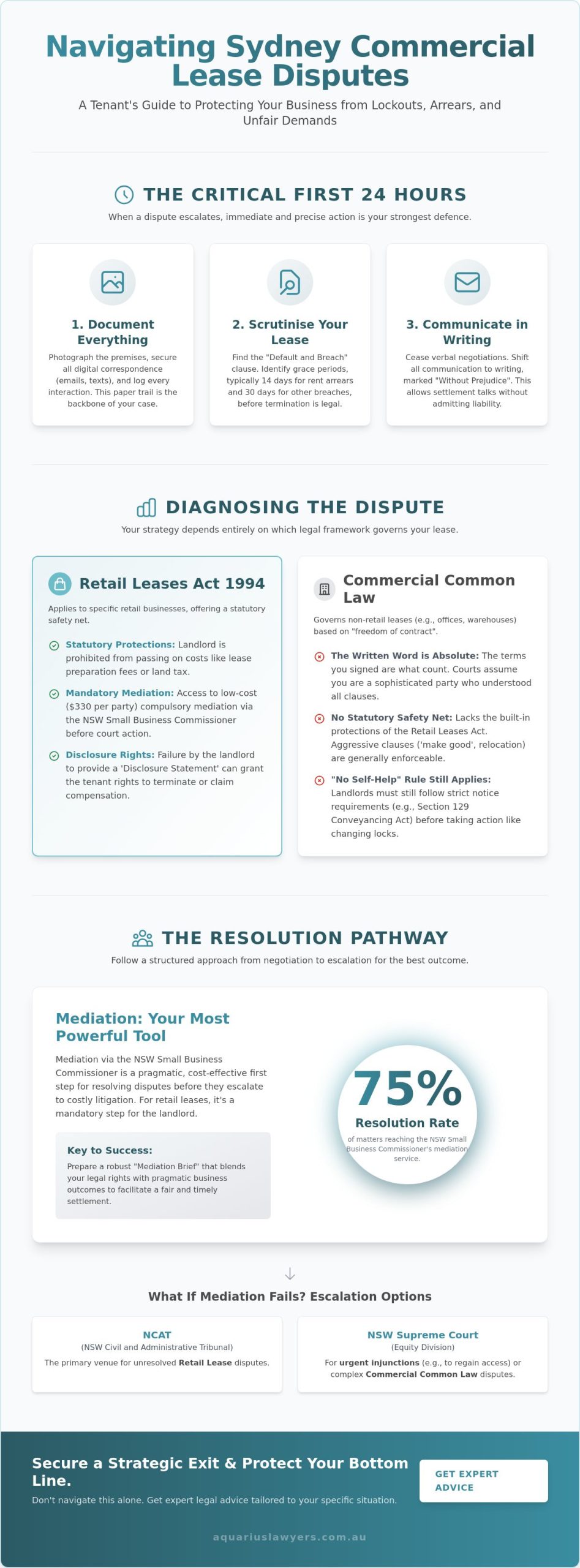
You shouldn’t have to choose between a toxic lease and financial ruin. This guide provides the exact steps to navigate Sydney lease disputes, from the initial mediation process through to NCAT. We’ll show you why a strategy of precise evidence combined with early mediation equals a cost-effective outcome, noting that the NSW Small Business Commissioner’s mediation service resolves around 75% of the matters that reach it. You’ll learn how to regain access to your premises, negotiate fair settlements on arrears, and secure a clear exit strategy that protects your commercial interests and your bottom line.
Key Takeaways
- Act immediately within the first 24 hours of a conflict by documenting all interactions and identifying the specific grace periods hidden in your “Default and Breach” clauses.
- Identify whether your tenancy qualifies for the statutory protections of the Retail Leases Act 1994 (NSW) or is governed by more rigid commercial common law terms.
- Leverage mediation through the NSW Small Business Commissioner as a pragmatic, cost-effective tool for commercial lease dispute resolution sydney before committing to formal litigation.
- Prepare a robust “Mediation Brief” that blends traditional legal rights with pragmatic business outcomes to facilitate a fair and timely settlement.
- Understand the pathways for escalating unresolved matters to NCAT or the NSW Supreme Court to protect your access to premises and secure a strategic exit.
Immediate Action: What to Do When a Sydney Lease Dispute Escalates
The moment a landlord threatens action, the clock starts ticking. The first 24 hours are the most critical for evidence gathering. If you’re facing a conflict, your priority is to document every interaction, photograph the state of the premises, and secure all digital correspondence. This initial paper trail forms the backbone of any successful commercial lease dispute resolution sydney strategy. Don’t rely on memory or handshake agreements made in the past; if it isn’t in writing, it effectively didn’t happen.
Next, pull out your contract and scrutinise the “Default and Breach” clause. You need to identify your specific grace periods. Most leases provide a window, often 14 days for rent arrears and 30 days for other breaches, before a landlord can legally terminate. Understanding the legal framework of a lease is essential here, as it dictates the timeline of your response. In NSW, the “No-Self-Help” rule generally prevents landlords from simply changing the locks without following strict notice requirements. If they bypass these steps, they may be acting unlawfully.
Stop all verbal negotiations immediately. Phone calls and face-to-face meetings are too easily misconstrued. Shift every communication to written “Without Prejudice” correspondence. This label allows you to explore settlement options without those offers being used against you as an admission of liability in court later. It’s about creating a controlled environment where facts, not emotions, dictate the outcome.
Handling Urgent Lockouts and Evictions
If you find yourself locked out, verify if the “Notice to Remedy Breach” was served correctly under Section 129 of the Conveyancing Act 1919 (NSW). A notice that fails to specify the breach or give a reasonable time for remedy is often invalid. You must identify if the alleged breach concerns an “essential term” of the lease. If the eviction is clearly unlawful or the notice is defective, you may need to seek an urgent injunction in the NSW Supreme Court to regain access and protect your business assets.
Managing Arrears and Financial Pressure
When cash flow is the issue, you need a clear “Rent Equation”: calculate your total arrears versus any disputed outgoings or landlord failures. In a NSW commercial context, rent is the base payment for occupation, while outgoings are the tenant’s share of the building’s operating expenses such as rates, insurance, and land tax. Proposing a “Good Faith” payment plan, even if it’s only a partial payment of the undisputed amount, can often stall immediate termination while you seek a more permanent commercial lease dispute resolution sydney path.
Diagnosing the Dispute: Retail Leases Act vs. Commercial Common Law
You can’t solve a problem until you know which rulebook you’re playing by. In the world of commercial lease dispute resolution sydney, your strategy hinges entirely on whether your tenancy falls under the Retail Leases Act 1994 (NSW) or is governed by commercial common law. This classification isn’t just a legal technicality. It’s the difference between having a statutory safety net and being left to the mercy of a “freedom of contract” environment where the written word is absolute.
Retail leases are prescriptive. The law steps in to balance the scales between small business owners and powerful landlords. Conversely, non-retail commercial leases, often used for offices or warehouses, are far more brutal. If you signed a lease with an aggressive “make good” clause or a punishing relocation term, common law assumes you are a sophisticated party who knew exactly what you were doing. Diagnosing your lease type is the first step in identifying your “Path to Resolution,” a logical equation where Lease Classification + Specific Breach = Strategic Leverage.
Retail Lease Protections in NSW
If your business qualifies as retail, you gain immediate tactical advantages. For instance, the landlord is generally prohibited from passing on their legal costs for lease preparation or land tax. More importantly, you have access to compulsory mediation through the NSW Small Business Commissioner for a fixed fee of $330 per party. This is a mandatory hurdle the landlord must clear before they can escalate the matter to a tribunal or court. We often find the “Disclosure Statement” is a landlord’s Achilles heel; if they failed to provide this document at least seven days before the lease commenced, you may have significant rights to terminate the agreement or claim damages.
Industrial and Specialised Commercial Leases
Disputes involving industrial sites, marine berths, or aquaculture facilities require a different lens. These aren’t standard “cookie-cutter” tenancies. In these environments, “fixtures vs. fittings” arguments often dominate. Does an expensive tank system or a specialised crane remain with the property or can it be removed? If the contract is silent, common law rules apply, and the distinction determines whether you’re facing a massive “make good” bill or walking away with your equipment. For these complex scenarios, seeking specialised legal advice early can prevent a minor disagreement from becoming a ruinous litigation battle. We recommend drafting a “Dispute Diagnosis” to map out your strongest leverage points, ensuring your commercial lease dispute resolution sydney plan is built on facts rather than desperation.
The Mediation Pathway: Resolving Conflicts via the NSW Small Business Commissioner
Choosing mediation isn’t a sign of a weak legal position; it’s the hallmark of an innovative veteran who values results over ceremony. In the landscape of commercial lease dispute resolution sydney, mediation through the NSW Small Business Commissioner acts as a strategic circuit breaker. It’s a pragmatic venue where business owners can bypass the rigid formality of a courtroom to find a solution that actually works for their bottom line. Because the Commissioner’s service resolves around 75% of the matters that reach it, this pathway is statistically your best shot at a quick, cost-effective exit or a fair reset of your tenancy terms.
Success at the table requires a “Mediation Brief” that merges traditional legal rights with cold, hard business reality. You aren’t just presenting a list of grievances. You’re pitching a logical settlement. The mediator is a facilitator, not a judge, which means they won’t hand down a verdict. Use this to your advantage by framing your position as a way to mitigate the landlord’s risk of a vacant premises or a protracted legal battle. When both parties reach an agreement, it’s formalised into a binding “Terms of Settlement,” a document that holds the same weight as a court order once signed.
Strategic Evidence Gathering
Modern disputes require modern evidence. We recommend using technology like 3D spatial scans or high-resolution digital logs to document the exact state of your premises during a “make good” conflict. Organise your financial records into a clear ledger to immediately counter claims of unpaid outgoings or “hidden” administration fees. A comprehensive Schedule of Condition serves as the definitive baseline for assessing alleged property damage, effectively neutralising subjective “make good” claims. Having this data ready transforms a “he-said, she-said” argument into a factual discussion that’s hard to ignore.
The Settlement Equation
Every dispute can be distilled into a simple formula: Litigation Cost + Operational Disruption > Cost of Compromise. We help clients calculate the “Litigation Gap” to determine if a rent abatement or an early lease surrender is actually the more profitable path. During the session, you must remain approachable yet authoritative. This balance shows the landlord you’re willing to talk, but you’re also fully prepared to escalate if the offer on the table isn’t fair. This strategy ensures you don’t just settle; you settle on terms that protect your business’s future.
Escalating to NCAT or the NSW Supreme Court
If mediation doesn’t yield a result, your strategy must pivot from dialogue to formal litigation. This transition isn’t about being aggressive for the sake of it; it’s about using the law to compel a resolution that negotiation couldn’t reach. In the landscape of commercial lease dispute resolution sydney, the venue for your battle is determined by the lease type and the financial stakes involved. For most retail tenancies, the NSW Civil and Administrative Tribunal (NCAT) is the primary forum. However, if your claim involves a non-retail commercial lease or the value of the dispute exceeds NCAT’s $750,000 jurisdictional limit, the matter will likely move to the Supreme Court of NSW.
Taking a “no-nonsense” approach to court means focusing on the core breach rather than getting bogged down in procedural delays. Whether it’s a dispute over a marine berth or a city storefront, the goal remains the same: a clear, enforceable judgment. If you find yourself at this crossroads, it is vital to secure expert litigation support to ensure your evidence is presented with clinical precision.
Navigating the NCAT Process
The process begins with filing a “Points of Claim.” This document must clearly articulate the alleged breach, the relevant lease clauses, and the specific remedy you are seeking. On your first day at the Tribunal, you’ll typically enter a “Conciliation and Hearing” model. A Tribunal Member will often encourage one last attempt at conciliation before moving to a formal hearing. You need to decide early whether you are seeking “Specific Performance,” such as forcing the landlord to repair a leaking roof, or “Damages,” which is a monetary payout to compensate for your business losses.
Enforcement of Orders
Winning a case is only half the battle; you also need the other party to comply. If a landlord or tenant ignores a Tribunal order, you must take steps to enforce it. This involves registering the NCAT order as a judgment in the Local or District Court, which then allows for enforcement actions like a writ for the levy of property or a garnishee order. Regarding legal costs, NCAT is generally a “jurisdiction where each party pays their own costs,” but there are exceptions. If one party has acted unreasonably or the lease specifically allows for the recovery of costs, the “loser pays” rule may be applied by the Tribunal or Court.
- Points of Claim: Your roadmap for the legal argument.
- Jurisdictional Limit: $750,000 for retail lease matters in NCAT.
- Registration: The essential step to turn a Tribunal order into an enforceable court judgment.
Strategic Dispute Resolution with Aquarius Lawyers
Aquarius Lawyers isn’t your typical law firm. We’ve earned the “Fish Lawyer” reputation through deep work in marine, fisheries, and aquaculture law, which gives us a unique edge in commercial property disputes involving complex infrastructure. Whether your business is a high-rise CBD office or a regional NSW maritime facility, we provide a level of specialised insight that standard firms often miss. Our approach to commercial lease dispute resolution sydney is built on a simple equation: Traditional Legal Authority + Modern Strategic Pragmatism = Sustainable Business Outcomes.
We operate as a “Steady Guide,” balancing the need for aggressive advocacy with the common-sense requirement for a settlement that doesn’t bankrupt your operation. We value results over ceremony. This means we won’t waste your time with archaic jargon or unnecessary procedural posturing. Instead, we use tech-integrated support systems to streamline evidence gathering and communication, which directly reduces billable hours and increases the efficiency of your case. By leveraging the digital tools mentioned earlier in this guide, we ensure your evidence is as robust as your legal argument.
Why Sydney Businesses Trust Aquarius
Our team moves easily between the high-pressure environment of the Sydney CBD and the practical realities of regional NSW maritime hubs. We understand that for most tenants, the goal isn’t just to win a legal argument; it’s to ensure the business’s survival. This “results over ceremony” attitude is why we offer fixed-fee options for specific dispute resolution stages, such as mediation or NCAT filings. This ensures you have complete cost transparency from day one. It’s about proactive protection, helping you transition from the heat of a conflict into a long-term lease management strategy that prevents future friction.
Next Steps: Securing Your Business Future
The path to resolution starts with a clear diagnosis of where you stand. We invite you to book an initial consultation where we’ll assess your lease “health score” and identify your strongest points of leverage. From there, we’ll develop a customised 30-day “Resolution Roadmap” designed to move your specific conflict toward a final settlement or a successful tribunal hearing. Don’t let a lease dispute paralyse your operations or threaten your livelihood. You can organise a strategy session with our Sydney commercial lease specialists today to take back control of your premises and your business future.
- Marine & Commercial Synergy: Expertise in complex property and infrastructure disputes.
- Fixed-Fee Transparency: Clear costs for mediation and tribunal stages.
- 30-Day Roadmap: A brisk, solution-oriented plan for every client.
Take Control of Your Tenancy Conflict
Resolving a tenancy conflict doesn’t have to be a battle of attrition that drains your resources. Success relies on a clear equation: early documentation plus a precise understanding of your lease classification leads to a controlled outcome. Whether you’re navigating a mandatory mediation or escalating a matter to the Tribunal, having a steady guide who values results over ceremony is your greatest asset. You’ve built your business through hard work, and you deserve a legal strategy that respects your bottom line.
At Aquarius Lawyers, Principal Katherine Hawes brings her recognised expertise in niche commercial and marine law to every case. We’ve built a proven track record in both NCAT and Supreme Court litigation, ensuring our clients aren’t just heard, but protected. We prioritise efficiency through a transparent, strategic approach to legal fees, so you always know where you stand. If you’re ready to move toward a definitive commercial lease dispute resolution sydney, our team is here to facilitate that pathway.
Protect your business today—contact our Sydney commercial lease lawyers. You’ve worked too hard to let a lease dispute derail your vision. Let’s secure your business future together.
Frequently Asked Questions
Can a landlord lock me out of my commercial shop in Sydney without notice?
Generally, a landlord cannot legally lock you out without first serving a formal “Notice to Remedy Breach” under Section 129 of the Conveyancing Act 1919 (NSW). This notice must clearly identify the breach and provide a reasonable timeframe for you to fix the issue. If they bypass this step, they may be acting unlawfully. You should seek immediate advice to determine if an urgent injunction is necessary to regain access to your premises.
What is the difference between a retail lease and a commercial lease in NSW?
Retail leases are governed by the Retail Leases Act 1994 (NSW) and cover businesses like shops, cafes, and specific service providers. These tenants receive extra protections, such as mandatory disclosure statements and restrictions on landlords passing on land tax costs. Standard commercial leases for offices or warehouses rely more heavily on the specific contract terms. Understanding this distinction is vital for effective commercial lease dispute resolution sydney.
How much does it cost to go to NCAT for a lease dispute?
As of July 2025, the standard application fee for commercial proceedings in the NCAT Consumer and Commercial Division is $124 for corporations and $62 for individuals. A reduced fee of $16 applies for eligible concession card holders. While the filing fee is relatively low, you should also account for the cost of preparing your evidence and any professional representation required to argue your case effectively before the Tribunal Member.
Do I have to keep paying rent if the landlord refuses to do repairs?
Yes, you must continue paying rent even if the landlord is failing to meet their repair obligations. In NSW law, the obligation to pay rent and the landlord’s duty to repair are usually seen as independent covenants. If you stop paying, you risk being in breach of the lease, which can lead to termination and eviction. It is better to pay “under protest” while seeking a formal rent abatement through mediation.
How long does the mediation process take with the NSW Small Business Commissioner?
A standard mediation session typically lasts up to four hours. While the session itself is efficient, the lead-up involves filing an application and waiting for a date, which depends on the Commissioner’s current caseload. The process is designed to be brisk and solution-oriented. Because around 75% of these matters are resolved during this session, it remains the fastest way to reach a binding settlement without lengthy court delays.
What does “make good” actually mean at the end of a Sydney lease?
The “make good” clause requires you to return the premises to the condition it was in at the start of the lease, excluding “fair wear and tear.” This often involves removing your fit-out, repairing any damage caused during removal, and repainting the walls. Disputes frequently arise over what constitutes “fair wear and tear,” which is why having a digital condition report from the start of your tenancy is a powerful defensive tool.
Can I terminate my commercial lease early if my business is struggling?
You cannot simply walk away from a lease because of financial hardship unless the contract contains a specific “break clause.” To exit early, you generally need to negotiate a “Surrender of Lease” with the landlord or find a new tenant to take over through an “Assignment of Lease.” Landlords are not usually obliged to agree to an early exit, so offering a financial settlement or a “surrender fee” is often part of the negotiation.
What happens to my bond if there is a dispute over damages?
If a dispute arises, the landlord may attempt to claim the bond or draw down on your bank guarantee to cover the costs of alleged repairs. You can contest this by refusing to sign the bond release or by seeking an order from NCAT to prevent the bank guarantee from being accessed. Mediation is the preferred path here to determine a fair cost for any actual damage, ensuring your security deposit isn’t used for general property upgrades.
Disclaimer
Please note that legal rules change and this is not a substitute nor construed as legal advice. It is general information only.