
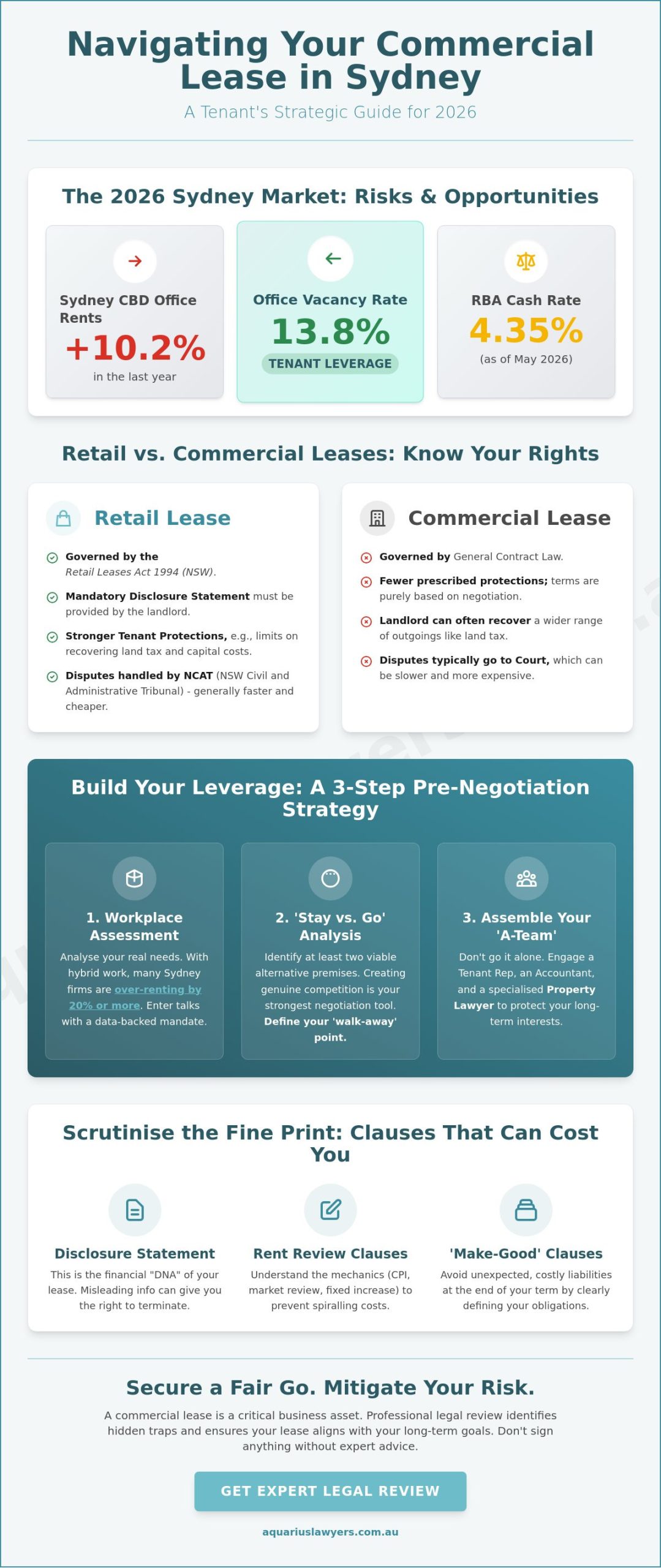
With Sydney CBD office rents climbing 10.2% in the last year and the RBA cash rate hitting 4.35% in May 2026, is your current lease actually working for your bottom line? Most Australian business owners feel like they are walking into a trap of high rent and complex legal jargon that limits their future growth. You aren’t alone in worrying about hidden outgoings or a lack of flexibility if you need to exit your premises. It is a stressful position, but market data suggests that tenants currently hold more leverage than they realise.
This guide provides practical commercial lease negotiation tips to help you secure a fair deal and mitigate long-term risks. We will show you how to leverage current market conditions, such as the 13.8% vacancy rate in Sydney, to gain better incentives and favourable terms. You will learn how to navigate the recent amendments to the NSW Retail Leases Act 1994 and transform a dense legal document into a strategic asset. We cover everything from rent reduction strategies to the essential clauses that protect your commercial interests in a shifting economy.
Key Takeaways
- Understand the critical legal distinctions between retail and commercial tenancies to leverage the specific protections available under Australian law.
- Apply these commercial lease negotiation tips to build a “stay vs. go” strategy that creates genuine leverage before you even reach the bargaining table.
- Master the mechanics of rent reviews and “make-good” clauses to prevent spiralling costs and unexpected liabilities at the end of your term.
- Learn how to draft a robust Heads of Agreement (HOA) that sets a clear pathway for finalising your lease without losing your competitive edge.
- Discover how specialised property law expertise identifies hidden traps and ensures your lease aligns with the long-term goals of your business.
Understanding the Australian Commercial Leasing Landscape in 2026
A commercial lease is far more than a simple rental agreement for a set of keys. It is a high-stakes, binding business contract that dictates your company’s financial health and operational agility for years to come. Many tenants fall into the trap of viewing these documents as “standard” or non-negotiable. This is a dangerous myth. In the Sydney market, a “standard lease” is simply the landlord’s preferred starting position. Every clause is a variable that can be adjusted to better suit your business goals.
The current economic climate demands a strategic approach. As of May 2026, the Reserve Bank of Australia has held the cash rate at 4.35% following recent hikes. While Sydney CBD office rents grew by 10.2% over the last year, the overall vacancy rate remains high at 13.8%. This creates a “quality bifurcation” in the market. Landlords with premium space are holding firm, but those with secondary stock are increasingly flexible. Using effective commercial lease negotiation tips involves understanding these market shifts and using them as leverage to secure better incentives or lower base rents.
Retail vs. Commercial: Why the Distinction Matters
In New South Wales, the legal framework changes significantly depending on whether your lease is classified as “retail” or “general commercial.” If your business involves selling goods or services to the public, you likely fall under the Retail Leases Act 1994 (NSW). This legislation provides a layer of protection that general commercial tenancies do not enjoy, such as limits on how a landlord can recover land tax or certain capital costs. Understanding commercial lease basics starts with identifying your classification. If a dispute arises, retail tenants can access the NSW Civil and Administrative Tribunal (NCAT), which is generally faster and less expensive than traditional litigation in the courts.
The Role of the Disclosure Statement
The Disclosure Statement is your most important pre-signing document. It acts as a summary of the lease’s financial “DNA,” detailing everything from estimated outgoings to the landlord’s planned contributions for your fit-out. You must verify these estimates against historical data. Under the 2025 amendments to the Act, the disclosure process has been streamlined, but the legal weight remains the same. If a landlord provides misleading or incomplete information in this statement, you may have the right to terminate the lease or claim damages. It is the first place a specialized property lawyer looks to identify “hidden” costs that could cripple your cash flow.
Preparing Your Strategy: Building Leverage Before the First Meeting
Leverage in a property deal is rarely found; it is meticulously built. Before you even step into a boardroom or reply to a landlord’s email, you must understand your own operational requirements better than they do. A common mistake is entering discussions based on the space you currently have rather than the space your business actually needs. With hybrid work models now standard, many Sydney firms find they are over-renting by 20% or more. Conducting a workplace strategy assessment allows you to enter negotiations with a clear, data-backed mandate. It transforms your position from a passive tenant into a strategic occupier.
One of the most effective commercial lease negotiation tips is to develop a credible “Stay vs. Go” analysis. If a landlord believes you have no intention of moving, your bargaining power evaporates. You need to identify at least two alternative premises that could realistically house your business. This creates a genuine competitive environment. Combined with strict financial due diligence, this strategy helps you define a “walk-away” point. You must know your maximum total occupancy cost, including outgoings and any potential increases, before the first meeting begins. This prevents emotional decision-making when a landlord pushes back on your terms.
No business owner should do this alone. Assembling an “A-Team” is the most efficient way to protect your interests. This typically involves a tenant representative to source sites, an accountant to model the long-term tax implications, and a property law expert to handle the legal due diligence. While a broker focuses on the deal, your solicitor ensures the fine print doesn’t contain “ticking time bombs” that could explode years later.
Timing Your Negotiation for Maximum Impact
Timing is your greatest ally. You should ideally start the process 6 to 12 months before your current lease expires. This window provides the necessary runway to conduct a full market search and, if necessary, execute a relocation. If you leave it until the final three months, the landlord knows you are under pressure. Use the “Heads of Agreement” (HOA) phase to lock in your core commercial lease negotiation tips early. A well-drafted HOA ensures the landlord is committed to the big-picture terms before you spend thousands on formal legal documentation.
Gathering Market Intelligence
Knowledge is power in the Sydney market. Don’t rely on “face rents” listed on marketing brochures; these are vanity metrics. You need to uncover the “effective rent,” which accounts for rent-free periods or fit-out contributions. With the Sydney CBD vacancy rate sitting at 13.8%, certain “zombie” buildings with high vacancy are under immense pressure to secure tenants. Identifying these assets allows you to push for significantly higher incentives. Understand the landlord’s motivator: a private owner might value consistent cash flow, while an institutional fund might be more focused on maintaining the building’s capital value through a higher face rent.
Essential Clauses to Negotiate: Protecting Your Business Interests
Negotiating the lease document is where your strategy meets the reality of property law. While many owners focus solely on the base rent, the true cost of a tenancy is often hidden in the mechanics of the fine print. One of the most critical commercial lease negotiation tips is to scrutinise the rent review mechanism. In a climate where the RBA cash rate remains at 4.35%, choosing between a fixed 4% increase or a CPI-linked review can result in a massive variance over a five-year term. You want financial certainty, not a surprise bill that outpaces your revenue growth.
The “make-good” provision is perhaps the most overlooked liability in Australian leasing. Landlords frequently demand that the premises be returned to a “base building” shell at the end of the term. This can cost tens of thousands of dollars in demolition and restoration. You should negotiate to limit this to “fair wear and tear” or agree on a fixed financial contribution instead of a physical reinstatement. Additionally, consider how you receive your incentives. While a fit-out contribution helps with upfront costs, a rent-free period often provides better immediate cash flow relief during the critical early months of a new location.
Liquidity is the lifeblood of your business. Landlords usually require a bank guarantee or security deposit, often equivalent to 3 to 6 months of rent. This is significant capital that stays locked away and unproductive. Negotiate for a “bank guarantee burn-down” clause, where the required security amount reduces annually if you meet your rent obligations. It rewards your reliability and returns cash to your business as the landlord’s risk diminishes.
Operational Flexibility and Exit Strategies
Your business today might not be the same business in four years. Securing “Options to Renew” protects your location long-term, but you also need a way out if things change. Ensure you have the right to assign the lease or sublease the space if you decide to sell your company or need to downsize. Your “permitted use” clause must also be broad. A narrow definition can prevent you from adding new service lines or pivoting your model to meet changing Sydney market demands. It is about creating a pathway for growth, not a legal cage.
Hidden Costs: Outgoings and Maintenance
Outgoings can be a black hole for your monthly budget. You must insist on excluding capital improvements, such as structural repairs or the replacement of a building-wide air conditioning system, from your costs. These are the landlord’s responsibility as the asset owner. Capping annual increases in operating expenses to a specific percentage provides a safety net against building management inefficiencies. Always reserve the right to audit the landlord’s outgoings statements to ensure you are only paying for legitimate, agreed-upon services.
The Step-by-Step Negotiation Process for NSW Tenants
Negotiation is a methodical progression where clarity beats speed every time. Once you have identified a premises in Sydney or regional NSW, the first move is drafting the Heads of Agreement (HOA). Think of the HOA as a non-binding blueprint. It outlines the “big ticket” items like rent, term length, and incentives. One of the most vital commercial lease negotiation tips is to ensure this document is as detailed as possible. If a term isn’t in the HOA, the landlord’s solicitor will likely exclude it from the formal lease, leading to friction and higher legal costs later.
Expect a back-and-forth period. Landlords will often counter-offer on rent reviews or security amounts. This is where your market intelligence pays off. If you know the building has a high vacancy rate, you can remain firm on your requirements. Once the HOA is signed, the process moves to the formal Lease Agreement. This is where the devil lives. Your solicitor will review the fine print to ensure the legal reality matches the commercial promises made during the handshake stage. Finally, before you take possession, conduct a thorough inspection. Ensure the fit-out period is clearly defined, giving you rent-free access to renovate before your business officially opens for trade.
From Heads of Agreement to Binding Contract
A handshake is not a contract. Your HOA must explicitly state it is “Subject to Contract” to prevent it from becoming legally binding prematurely. This protects you if you find a major issue during legal due diligence. Every verbal promise made by an agent must find its way into the written lease. If they promised a new air conditioning unit, get it in writing. Additionally, negotiate a fit-out period that allows for at least 4 to 8 weeks of rent-free access. This ensures you aren’t paying A$1,000s in rent while the floors are still being laid.
Managing the Relationship with the Landlord’s Agent
Remember that the leasing agent is a professional negotiator hired to maximise the landlord’s return. They are not your advisor. Keep all communication professional, firm, and strictly in writing. This creates a paper trail that is invaluable if a dispute reaches the NSW Civil and Administrative Tribunal. If negotiations stall or the agent becomes difficult, it may be time to have your solicitor speak directly to the landlord’s legal team. For expert assistance in finalising these complex documents, contact a specialist commercial law solicitor to ensure your interests are fully protected.
Securing a Fair Go: Why Professional Legal Review Mitigates Risk
Signing a lease without a professional legal eye is like sailing into a storm without a chart. While the commercial lease negotiation tips provided so far help you build leverage, the formal review is where you secure the win. A specialised commercial solicitor identifies legal traps that a generalist might miss. These include aggressive indemnity clauses that shift the landlord’s insurance risks onto your business or default provisions that allow for immediate termination without a fair period to remedy the breach. One oversight in a 60-page document can lead to a liability exceeding A$100,000 over the life of the tenancy.
The cost-benefit analysis of professional advice is clear. Paying for a fixed-fee lease review is a proactive step that prevents catastrophic financial leaks. It is a strategic investment in risk mitigation. We focus on ensuring the “handshake deal” you made during the Heads of Agreement phase actually translates into the final contract. Without this verification, you may find that promised incentives or maintenance caps have mysteriously vanished from the final draft. Our role is to act as a steady, common-sense guide to ensure you aren’t left exposed to the landlord’s legal team.
Beyond the Standard Clause
General property law often fails to address the specific needs of niche industries. If you operate in the marine, aquaculture, or fisheries sectors, your premises requirements are unique. You must ensure your lease accounts for specialised aquaculture storage, marine workshops, or specific wharfage access. These tenancies must also remain compliant with complex environmental and maritime regulations that don’t apply to a standard retail shop. Aquarius Lawyers merges traditional expertise with modern efficiency to provide a steady, common-sense guide through these complexities. We tailor every clause to fit the operational reality of your specific trade, ensuring your lease is a facilitator of growth rather than a legal hurdle.
Final Checklist Before You Sign
Never rush the final signature. Take a breath and verify the details one last time. It is vital to confirm that every agreed incentive, including rent-free periods and fit-out contributions, is clearly documented in the final version. You must also verify the plan of premises. Ensure the diagram attached to the lease accurately reflects the square metres you are paying for, including any car spaces, loading docks, or storage cages. Small discrepancies in the plan can lead to significant disputes over outgoings later. Don’t leave your business’s future to chance.
Organise a fixed-fee lease review with Aquarius Lawyers today.
Taking Control of Your Commercial Future
Securing a fair deal in a complex property market requires more than just a signature. By applying these commercial lease negotiation tips, you have the tools to transform a dense legal document into a strategic business asset. You now understand how to balance operational flexibility with financial certainty, ensuring your premises support your growth rather than hindering it. Whether you are managing a standard office or a specialised marine facility, the goal remains the same: protecting your bottom line from avoidable risks.
Principal Katherine Hawes is a renowned expert in commercial and marine law. She provides strategic advice that focuses on cost-effective outcomes for small businesses. We offer fixed-fee arrangements for property transactions to ensure you have total price transparency from the outset. Don’t leave your most significant business contract to chance. Secure your business future; contact Aquarius Lawyers for a no-nonsense lease review and move forward with the confidence that your interests are fully protected.
Frequently Asked Questions
Can I negotiate the rent once I have already signed the Heads of Agreement?
You can technically negotiate terms until the formal lease is executed, especially if the Heads of Agreement (HOA) is marked “subject to contract.” However, attempting to lower the rent at this late stage is risky. It can damage the relationship with the landlord or lead them to withdraw the offer entirely. It is far more effective to use your commercial lease negotiation tips during the initial HOA phase to lock in the best possible rate before legal drafting begins.
What is a “standard” rent-free period for a new commercial lease in Sydney?
There is no single “standard,” as incentives fluctuate based on vacancy rates and building quality. In the current Sydney CBD market, where vacancy sits at 13.8%, tenants often secure incentives ranging from 15% to 30% of the total lease value. This is typically structured as a combination of rent-free months and a fit-out contribution. Secondary or “B-grade” buildings generally offer more generous periods than premium office towers to attract stable tenants.
How does a bank guarantee differ from a cash security deposit in Australia?
A bank guarantee is a promise from your financial institution to pay the landlord if you default, whereas a cash deposit is money you pay directly to the landlord to hold in trust. Most Australian landlords prefer bank guarantees because they provide security without the administrative burden of managing trust accounts. For the tenant, a bank guarantee is often better for cash flow, though the bank will usually require “cash backing” or a charge over assets to issue it.
What happens if my business grows and I need to move before the lease ends?
You are legally bound to pay rent until the lease expiry unless you have negotiated an exit strategy. Your primary options are assigning the lease to a new tenant or subleasing the excess space. If your lease does not permit these actions, you may have to negotiate a “surrender of lease” with the landlord. This usually involves paying a significant surrender fee, often equivalent to several months of rent and the remaining value of any incentives you received.
Are outgoings always paid by the tenant in a commercial lease?
Payment of outgoings depends on whether you sign a “net” or “gross” lease. In a net lease, you pay a base rent plus your share of the building’s operating expenses, such as council rates, insurance, and cleaning. In a gross lease, these costs are included in the base rent. Under the Retail Leases Act 1994 (NSW), landlords are prohibited from recovering certain outgoings, like land tax, from retail tenants, which is a critical distinction to check during your review.
Is a solicitor really necessary for a small commercial lease negotiation?
A specialist solicitor is essential because the legal liabilities in a small lease are often identical to those in a large one. Small business owners are frequently more vulnerable to “hidden” costs like structural repairs or aggressive make-good clauses. A professional review ensures that the contract is fair and that you aren’t signing away your right to relocate or sell the business. It is a small upfront cost to prevent a dispute that could cost tens of thousands of dollars later.
What is a “make-good” provision and why is it so expensive?
A make-good provision requires you to remove your fit-out and return the premises to the exact condition they were in when you arrived. This is expensive because it involves demolition, capping off plumbing and electricals, and repainting the entire shell. Costs can spiral if the landlord demands “base building” condition. You should always attach a detailed condition report to your lease to limit your obligations to “fair wear and tear” only.
Can the landlord refuse my request to sublease part of my office?
Landlords generally cannot “unreasonably” withhold consent to a sublease if your contract includes a standard assignment and subletting clause. However, they can refuse if the proposed sub-tenant has a poor financial history or if their business type conflicts with other tenants in the building. It is vital to ensure the lease specifies that the landlord’s consent must be granted within a reasonable timeframe, such as 21 days, to prevent them from stalling your deal.
Disclaimer
Please note that legal rules change and this is not a substitute nor construed as legal advice. It is general information only.