
What if the most expensive mistake in your business isn’t a bad hire or a failed marketing campaign, but the fine print in your 2026 rental agreement? Your lease is a legal anchor that can either steady your enterprise or drag it under. Most Australian business owners feel outmatched by sophisticated landlords, but mastering a few commercial lease negotiation tips can shift the power back into your hands. Expert Insight + Tactical Preparation = Sustainable Growth. It’s time to stop viewing your premises as a fixed cost and start seeing it as a strategic asset.
We understand the stress of facing unpredictable outgoings and onerous make-good clauses that threaten your bottom line. You deserve a workspace that fosters success rather than stifling your cash flow. This article will show you how to reduce costs, mitigate risks, and secure terms that actually work for your specific industry. We will explore the essential steps to lower your rent, negotiate better incentives, and ensure your legal obligations are transparent and fair for the long haul.
Key Takeaways
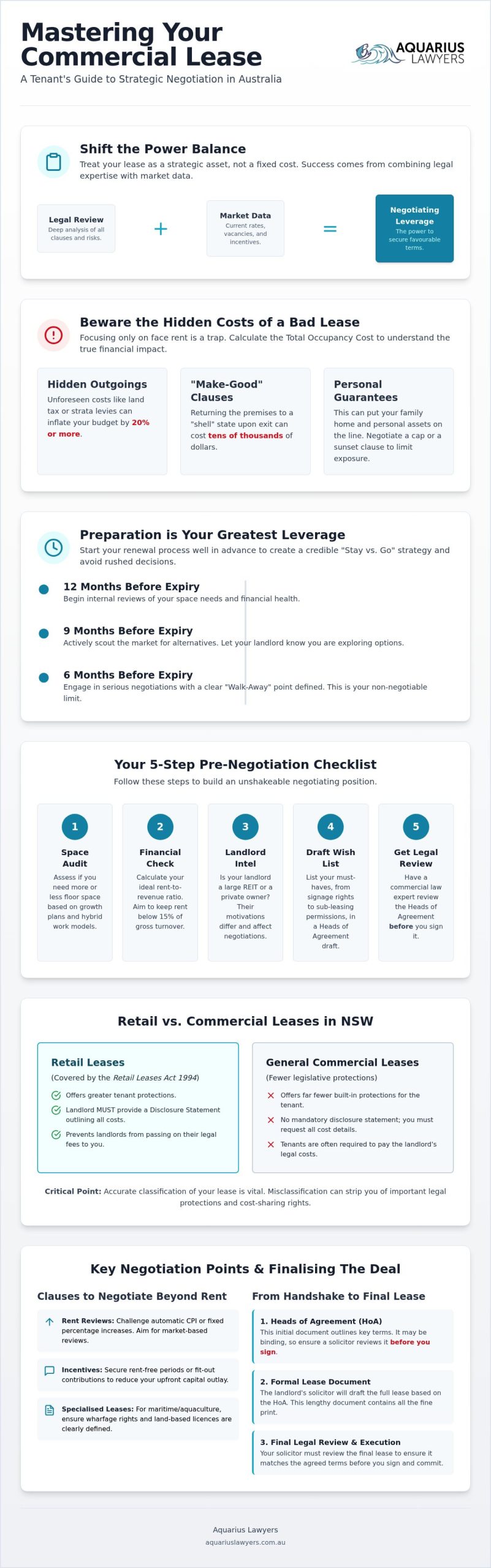
- Shift the power balance by treating your lease as a strategic asset and starting your preparation at least nine months before expiry.
- Apply practical commercial lease negotiation tips to secure flexible rent review terms and valuable incentives like rent-free periods or fit-out contributions.
- Identify your “walk-away” point early to maintain control during discussions and avoid committing to a contract that risks your business future.
- Navigate the unique complexities of maritime and aquaculture leasing, including wharfage rights and land-based licence requirements.
- Protect your interests by ensuring a solicitor reviews every document, from the initial Heads of Agreement to the final formal lease.
The Power Imbalance: Why You Must Negotiate Your Lease
Landlords aren’t your mates. They use sophisticated templates designed to maximise their yield and minimise their risk. If you sign a “standard” lease without pushback, you’re essentially agreeing to their terms on their turf. In the commercial world, “standard” is a myth. Every clause is a variable that can be tweaked, traded, or tossed out entirely. Thinking that a lease is just a monthly bill is a mistake that limits your growth. We view it differently. To us, a lease is a strategic asset that should be engineered to support your long term goals.
To secure a win, you need more than just a gut feeling. We use a specific formula to help our clients succeed: Legal Review + Market Data = Negotiating Leverage. By combining deep legal expertise with current market trends, you transform a passive expense into a powerful tool for business stability. One of the most effective commercial lease negotiation tips is to remember that everything is up for grabs until the ink is dry.
The Real Cost of a Bad Lease
Many business owners focus solely on the face rent. This is a trap. You must calculate the “Total Occupancy Cost” over the life of the agreement. Hidden outgoings, such as land tax or strata levies, can balloon your budget by 20% or more without warning. Then there’s the “make-good” clause. Leaving a space can cost tens of thousands of dollars if you’re required to return it to a “shell and core” state. Finally, watch for personal guarantees. These put your family home on the line. We often negotiate a “sunset clause” or a financial cap on these guarantees to limit your personal exposure and protect your private assets.
The Retail Leases Act vs. General Commercial Leases
In NSW, the Retail Leases Act 1994 provides a safety net, but only if your business qualifies. Retail leases require landlords to provide a Disclosure Statement at least seven days before the lease begins. This document is your shield. It outlines all anticipated outgoings and prevents the landlord from surprising you with unlisted costs. General commercial leases, however, offer far fewer protections. If you’re a wholesaler or a back-office operation misclassified as retail, or vice versa, you might lose vital cost-sharing rights. Getting this classification right is the difference between a protected partnership and an expensive legal headache. Accurate classification ensures you aren’t paying for the landlord’s legal fees, which is generally prohibited under retail legislation but common in commercial contracts.
Preparation Strategies to Create Immediate Leverage
Leverage isn’t found; it’s engineered. In the high-stakes commercial environment of 2026, the most effective commercial lease negotiation tips start with the calendar. You need a lead time of at least nine to twelve months. This window allows you to execute a “Stay vs. Go” strategy. By actively scouting the market in Sydney or regional NSW—where you can discover The Agency Coffs Coast to find competitive local options—while simultaneously talking to your current landlord, you create a credible threat of departure. Landlords are far more flexible when they know you have genuine options. Before you even pick up the phone, you must define your “Walk-Away” point. This is the absolute limit on rent, outgoings, or terms that your business can sustain. Without it, you’re just hoping for the best.
Success in this arena requires Mastering the Art of Lease Negotiation, which involves deep market research and a clear understanding of your own operational needs. Use the formula: Preparation + Market Intelligence = Negotiating Power. If you don’t know the current “per square metre” rates for comparable buildings in your area, you’re flying blind.
- Step 1: Space Audit. Don’t pay for empty desks. Assess if you need more floor space for growth or less due to hybrid work models.
- Step 2: Financial Health Check. Calculate your ideal rent-to-revenue ratio. If your rent exceeds 15% of gross turnover, your margins are likely at risk; for expert assistance with your business’s financial strategy, check out The Sphere Group.
- Step 3: Landlord Intel. Is your landlord a major REIT focused on capital growth or a private owner needing steady cash flow to cover high interest rates?
- Step 4: HoA Wish List. Draft your must-haves, from signage rights to sub-leasing permissions.
- Step 5: Legal Guardrails. Engage a commercial law expert to review your Heads of Agreement before you sign anything.
Understanding Landlord Motivators in 2026
Landlords have different priorities. Some prioritise high “face” rents to keep their property valuations up for refinancing. Others just want a tenant who pays on time and doesn’t cause trouble. In areas like the Sydney CBD, your value as a stable, long-term tenant is your biggest bargaining chip. Use this to secure better incentives, such as comprehensive fit-out contributions or extended rent-free periods. A vacant lot is a liability. A reliable tenant is a protected asset. With the Federal Funds Rate sitting between 3.50% and 3.75% in mid-2026, many landlords are feeling the squeeze and may be more open to negotiation than they let on.
Key Clauses You Must Negotiate Beyond the Rent
Don’t get tunnel vision on the monthly rent figure. A low base rent with aggressive annual increases is a slow-motion disaster for your cash flow. One of the most critical commercial lease negotiation tips is to look at the hidden levers that dictate your total liability. These include rent review structures, renewal options, and the eventual exit costs. If you ignore these details, you aren’t just renting a space; you’re signing a blank cheque for the landlord’s future capital gains. We treat these clauses as tactical pivot points that can either protect your margins or erode them over time.
Rent reviews are the heartbeat of your lease. Typically, you’ll choose between a fixed percentage increase, the Consumer Price Index (CPI), or a market review. With annual inflation sitting at 3.4% as of July 2026, a fixed 3% increase might actually be a tactical win. Market reviews are more volatile. They allow the landlord to reset the rent to what others are paying in the area. To stay safe, ensure these reviews include a “cap and collar” to prevent sudden, unmanageable spikes that outpace your revenue growth.
Options to renew are your insurance policy for business continuity. If your brand is tied to your location, a “3+3+3” year structure offers more flexibility than a flat 9-year term. However, the exit is where many Australian business owners get stung. The “make-good” clause often requires you to strip the premises back to a base building state. We recommend negotiating this down to a “broom clean” standard or ensuring the landlord accepts the fit-out for the next tenant’s use. This single move can save you $50,000 or more in demolition costs at the end of your tenure.
The Danger of Ratchet Clauses
A ratchet clause ensures the rent can only stay the same or go up; it “ratchets” in the landlord’s favour regardless of the economy. In NSW retail leases, these are generally illegal; rent must be able to go down if a market review shows a decline. For general commercial leases, you must fight for this right. Don’t let a landlord lock you into peak-market rates if the local economy cools. We push for “mirror” clauses that allow for downward adjustments to reflect true market conditions.
Fit-out and Capital Works
Who owns the assets you install? Unless specified, items like air conditioning units or specialised lighting often become the landlord’s property. When negotiating, prioritise a fit-out contribution over a simple rent-free period. This preserves your capital for operational needs. Ensure your rent-free period is long enough to cover the actual construction phase. If the fit-out takes three months but your rent-free period is only two, you’re paying for a space you can’t even use yet.
Industry-Specific Leasing: Maritime and Fisheries
Standard commercial lease negotiation tips often run aground when they reach the water’s edge. If your business operates on a wharf, jetty, or waterfront site, you aren’t just dealing with four walls and a roof. You’re managing a complex intersection of property law, maritime regulations, and environmental obligations. In NSW, many of these sites involve Crown Land leases, which introduce the government as a silent third party in your negotiations. This requires a specialised “Innovative Veteran” approach that balances traditional property rights with the unique demands of the marine sector. Failure to align your lease with your operational reality can lead to catastrophic disruptions if your access to the water is suddenly restricted.
Recent government actions in 2026 have opened up previously restricted areas to commercial fishing. This has triggered a surge in demand for related onshore facilities and processing centres. In this competitive environment, your lease must do more than provide space; it must protect your right to operate. Whether you are negotiating for a commercial marina or a regional processing plant, the synergy between niche maritime expertise and traditional property law is your greatest asset. For tailored advice on these complex agreements, you can consult our maritime law specialists to ensure your interests are fully protected.
Leasing for Aquaculture and Fisheries
Aquaculture and fisheries businesses face a unique challenge: the leasehold on the land must perfectly mirror the licences or quotas held on the water. If your land-based lease expires or is terminated, your entire operation could be dead in the water. We focus on ensuring that your lease term and renewal options align with the duration of your commercial fishing licences. Environmental compliance is another major hurdle. You must negotiate clear boundaries regarding who is responsible for water quality monitoring and seabed maintenance. Landlords often demand broad access rights for inspections, but on sensitive aquaculture sites, these must be strictly limited to prevent biosecurity breaches that could wipe out your stock.
Zoning and Permitted Use
The “Permitted Use” clause is a common trap for marine businesses. If your lease is too specific, such as “oyster processing only”, you might find yourself legally barred from branching out into retail sales or tourism activities later. We push for broad use descriptions that allow for future business pivots without requiring a formal lease variation. Additionally, you must ensure the zoning of the land supports your intended activities. Negotiating a lease is pointless if the local council won’t grant the necessary Development Application (DA) for your specific marine use. Always make the lease commencement conditional upon receiving all required regulatory approvals from both the council and relevant maritime authorities.
Closing the Deal: From Heads of Agreement to Final Lease
You have successfully applied your commercial lease negotiation tips and reached a verbal agreement. Now, the transition from a handshake to a signed contract begins. This phase is where many deals lose their shine because of poor documentation. The Heads of Agreement (HoA) serves as your blueprint. While usually intended to be non-binding, an HoA can become legally enforceable if the language isn’t carefully qualified with “subject to a formal lease agreement”. We treat the HoA as the skeleton of your deal. If the bones are crooked, the final lease will never stand straight. Never rush this stage; a mistake here can haunt your cash flow for a decade.
Before you commit, you must manage the financial security requirements. Landlords typically demand a bank guarantee or a cash security deposit. In 2026, with interest rates remaining steady above 4%, a bank guarantee is often the smarter play for your business. It keeps your cash in your offset account or working for your operations rather than sitting idle in a landlord’s trust account. Ensure the lease clearly states the conditions for the return of this security. You don’t want your capital held hostage long after you have vacated the premises.
Your final line of defence is the condition report. This document is the only thing standing between you and an inflated “make-good” claim at the end of your term. Take high-resolution photos and videos of every scuff, crack, and stain. Attach these to the lease as a formal record. Accurate Documentation + Professional Review = Long-term Protection. This simple step ensures you aren’t paying to repair damage that existed before you even moved in.
The Role of Your Commercial Solicitor
A solicitor does more than just spot typos. Their job is to translate complex “legalese” into plain-English business risks. They ensure that the formal lease accurately reflects every win you secured in the HoA. If a landlord tries to sneak in a new outgoing or a restrictive access clause, your solicitor is your gatekeeper. They also handle the technical heavy lifting, such as the exchange of documents and the registration of the lease with Land Registry Services. Registration is vital; it protects your leasehold interest if the landlord decides to sell the building during your stay.
Protecting Your Business Long-Term
Signing the lease is the start of the journey, not the end. You must set up a lease management calendar immediately. Mark every critical date, including rent review windows and the deadline for exercising your option to renew. Missing an option deadline by even twenty four hours can result in the loss of your location. Additionally, never rely on “side deals” or verbal promises made by a property manager. If a term changes, document it in a formal Deed of Variation. To ensure your agreement is watertight, secure your business future with a comprehensive commercial lease review today. Protecting your legacy requires a proactive approach to every clause and every deadline.
Secure Your Commercial Foundation for 2026 and Beyond
Your lease is the engine room of your business operations. By shifting from a passive tenant to an active negotiator, you protect your cash flow and your long term stability. Remember that leverage is built through early preparation and a deep understanding of your specific industry needs. Whether you are managing a Sydney office or a regional aquaculture site, these commercial lease negotiation tips ensure you aren’t left vulnerable to standard contracts that only serve the landlord’s interests. A well-engineered agreement is a strategic asset that supports growth rather than a liability that drains your resources.
Principal Katherine Hawes and our team bring decades of experience in commercial and maritime law to your corner. We provide expert advice for Sydney and regional NSW businesses, ensuring every clause aligns with your strategic goals. Don’t leave your business future to chance or complex legalese. Contact Aquarius Lawyers for a Fixed-Fee Lease Review to gain the clarity and confidence you need. We offer transparent, fixed-fee arrangements for property transactions to keep your costs predictable and your risks managed. It’s time to take control of your premises and build a workspace that truly works for you.
Frequently Asked Questions
What is a “make-good” clause in an Australian commercial lease?
A make-good clause is a provision requiring you to return the premises to a specific state when your tenancy ends. This often involves removing fit-outs and repairing any damage caused during your stay. You should negotiate this clause carefully to ensure you aren’t stuck with massive demolition bills. Aiming for a “broom clean” standard or ensuring the landlord accepts your improvements can save your business significant exit costs.
Can I negotiate the outgoings in a commercial lease?
You can certainly negotiate outgoings, as they significantly impact your total occupancy costs. Ask for a cap on annual increases or request the exclusion of specific costs like the landlord’s land tax or structural repairs. In retail settings, the landlord must provide a disclosure statement outlining these expenses. Negotiating these details effectively ensures your business isn’t hit with unpredictable cost spikes that could erode your profit margins over the lease term.
How long should a standard commercial lease term be in Sydney?
Sydney leases typically range from three to five years, often with options to renew for similar periods. There is no legal requirement for a specific length; it depends on your business goals. A shorter term provides flexibility if you are growing quickly, while a longer lease, such as a “5+5+5” year structure, offers stability and more leverage to secure landlord incentives. Balancing your need for security with the ability to pivot is essential.
What is the difference between a gross lease and a net lease?
A gross lease is an all-inclusive agreement where your rent covers both the base space and all outgoings. A net lease separates these, requiring you to pay a base rent plus a share of operating expenses like rates and insurance. While net leases are common in New South Wales, gross leases provide much better budget certainty. Understanding this distinction is vital for accurately calculating the total cost of your business premises.
Do I need a lawyer to negotiate my commercial lease?
Engaging a solicitor is a protective step that ensures your interests are legally watertight. While you might handle the initial commercial discussions, a lawyer identifies hidden risks in the fine print that could lead to future litigation. One of the most important commercial lease negotiation tips is to have a professional review the formal contract before you sign. We provide fixed-fee property services to help Sydney and regional businesses manage their legal obligations without any pricing surprises.
What happens if I need to break my commercial lease early in NSW?
Breaking a lease early in NSW usually makes you liable for the rent until a new tenant is found, plus the landlord’s reasonable re-letting costs. To mitigate this risk, you should negotiate “assignment” or “sub-leasing” rights during the initial contract phase. This allows you to transfer the lease to another party if your circumstances change. Without these exit strategies, you could face a significant financial burden that threatens the future of your enterprise.
Is a Heads of Agreement legally binding in Australia?
A Heads of Agreement can be legally binding if it contains all the essential terms of the deal. To ensure you aren’t locked in prematurely, the document must state it is “subject to a formal lease”. This allows you to negotiate the finer details later with your solicitor. Never treat an HoA as just a “letter of intent”; it is a critical document that sets the foundation for your entire tenancy.
What is a rent-free period and how do I get one?
A rent-free period is an incentive where you don’t pay rent for a specific timeframe, usually at the start of your lease. This is often negotiated to cover your fit-out phase. Using commercial lease negotiation tips like demonstrating your long-term stability can help you secure these windows. Landlords are often willing to trade a few months of rent to secure a reliable tenant, especially in a competitive market like the Sydney CBD.
Disclaimer
Please note that legal rules change and this is not a substitute nor construed as legal advice. It is general information only.