
Could a single moment of heated conflict cost you your career and your reputation? It’s a confronting question, but for many facing common assault charges nsw penalties, it is the reality they face every morning. You’re likely feeling the weight of the unknown, wondering if a Section 10 dismissal is truly achievable or if the Local Court process will leave you with a permanent criminal record. We understand that this isn’t just a legal issue; it’s a direct threat to your livelihood and your peace of mind.
This guide serves as your strategic roadmap through the NSW justice system in 2026. We’ll strip away the confusing jargon to explain exactly what you’re up against, from the $2,200 maximum fine to the risk of a two-year prison sentence. By combining traditional legal expertise with a modern, results-oriented approach, we’ll explore the defences available to you and the specific pathways that lead to a non-conviction. You’ll gain a clear understanding of how to protect your record and move forward with confidence. Strategic preparation plus early action equals the best possible court outcome.
Key Takeaways
- Learn why you can face common assault charges nsw penalties even if no physical contact occurred, as the law focuses on the victim’s fear of immediate violence.
- Understand the “Magistrate’s Equation” used to determine whether your case qualifies for a Conditional Release Order (CRO) without a criminal conviction.
- Identify the specific criteria for a “reasonable” self-defence claim to ensure your side of the story is presented effectively in the Local Court.
- Clear the confusion around 2026 penalty units and how the court calculates financial penalties based on current legislative values.
- Discover how a fixed-fee approach to legal representation provides cost certainty while you focus on protecting your professional future.
Understanding Common Assault Under Section 61 of the Crimes Act 1900
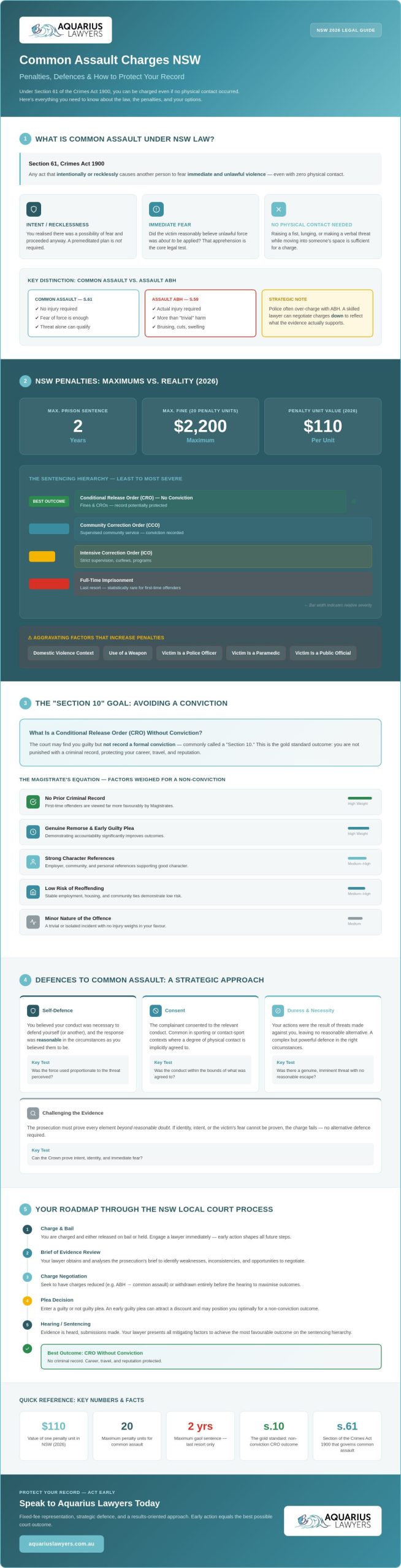
Facing a criminal charge is a heavy burden, but the first step toward resolution is understanding the specific law at play. In New South Wales, common assault is governed by Section 61 of the Crimes Act 1900. Many people are surprised to learn that you don’t actually have to hurt someone to be charged. The law defines common assault as any act that intentionally or recklessly causes another person to fear immediate and unlawful violence. It’s a broad definition that catches many off guard.
There is a technical distinction between “assault” and “battery” that often gets lost in everyday conversation. Traditionally, an assault is the threat of violence, while battery is the actual physical contact. Under the current NSW legal framework, both are prosecuted under the umbrella of common assault. This means that even if you never laid a finger on the other person, you could still be navigating the complexities of common assault charges nsw penalties if they felt an immediate threat of force. Experience shows that the “no injury” rule is one of the most misunderstood aspects of the Local Court system.
Recklessness is another critical pillar. You don’t need a premeditated plan to scare someone to be found guilty. If you acted in a way where you realised there was a possibility the other person would fear immediate violence, but you went ahead anyway, the “recklessness” element is satisfied. It’s about the risk you took, not just your specific intent. Modern legal strategy focuses heavily on disproving this element of recklessness or intent to protect your future.
The Difference Between Common Assault and ABH
It’s vital to distinguish Section 61 from Section 59, which covers Assault Occasioning Actual Bodily Harm (ABH). While common assault can involve no injury at all, ABH requires the victim to have suffered an injury that is “more than merely transient or trifling.” Think of significant bruising, swelling, or a cut that requires stitches. Police often “over-charge” by pushing for an ABH conviction when the evidence only supports common assault. A strategic legal plan often involves negotiating these charges down to reflect the reality of the incident. Lower charges often equal better outcomes.
When “No Touch” Still Counts as Assault
The “No Touch” rule is where many people feel the law is unfair. If you raise a fist, lunge toward someone, or make a verbal threat while moving into their personal space, you’ve crossed the line. The court applies the “Immediate Fear” test: did the victim reasonably believe that unlawful force was about to be applied? The apprehension of force is a core legal pillar of an assault charge. If that fear is immediate and the act was unlawful, the charge can stick without a single scratch being exchanged. Understanding this threshold is essential for building a robust defence.
Common Assault NSW Penalties: Maximums vs. Reality
Under Section 61 of the Crimes Act 1900, the court possesses significant power to penalise. The maximum sentence for a conviction is two years of imprisonment and a fine of 20 penalty units. In 2026, the value of one penalty unit in NSW is $110, which means the maximum financial penalty sits at $2,200. While these figures are confronting, they represent the ceiling for the most serious examples of the offence. For the majority of people, the actual court outcome sits much lower on the sentencing hierarchy. Experience is the difference between facing the maximum and achieving a workable resolution.
The court follows a specific sentencing hierarchy designed to match the penalty to the crime. This includes:
- Fines and Conditional Release Orders (CROs)
- Community Correction Orders (CCOs)
- Intensive Correction Orders (ICOs)
- Full-time imprisonment
Certain factors can “aggravate” the offence, pushing the penalty higher. If the incident occurred in a domestic violence context, involved the use of a weapon, or was directed at a public official like a police officer or paramedic, the Magistrate will view the matter with increased severity. If you’re concerned about how these aggravating factors might influence common assault charges nsw penalties, consulting with experts in criminal law is a proactive step toward protecting your interests.
Will You Actually Go to Gaol?
Gaol is legally a measure of last resort. For a first-time offender, the likelihood of a prison sentence for common assault is statistically low. The Magistrate’s primary focus is often on rehabilitation and community safety. If you have a clean prior record, this serves as a powerful shield. We utilise an “innovative veteran” approach by gathering evidence of good character and proactive rehabilitation early in the process. This strategy demonstrates to the court that the incident was an out-of-character lapse in judgment rather than a pattern of violent behaviour. Preparation equals protection.
The Impact of a Criminal Record in Australia
The true danger of a common assault charge often isn’t the fine, but the permanent record it leaves behind. A conviction can immediately halt your ability to travel to the US or UK, as visa applications require the disclosure of criminal history. It can also jeopardise a Working with Children Check or professional accreditations in healthcare, finance, and law. In NSW, a conviction usually becomes “spent” after ten years of crime-free behaviour, meaning it no longer appears on a standard police check. However, ten years is a long time to wait for a clean slate when a strategic defence plan could have prevented the conviction from being recorded in the first place.
The “Section 10” Goal: Avoiding a Conviction
For decades, “Section 10” was the phrase every defendant hoped to hear in a NSW courtroom. While the legal terminology has evolved, the core objective remains the same: a finding of guilt without the life-altering burden of a criminal record. In the modern legal system, this outcome is primarily achieved through a Conditional Release Order (CRO) without conviction. When you are facing common assault charges nsw penalties, securing this result is rarely a matter of luck. It requires a strategic presentation of what we call the “Magistrate’s Equation.” This logical formula balances the objective seriousness of the incident against your subjective personal circumstances and good character.
Preparation is the engine of a successful non-conviction order. Entering a “guilty plea” at the first available opportunity is a powerful tactical move; it provides a mandatory sentencing discount and demonstrates immediate remorse to the court. We complement this with “Gold Standard” character references. A generic, one-page letter rarely moves a busy Sydney Magistrate. Instead, an effective reference must be highly specific, acknowledging the offence while highlighting your history of positive contributions to the community. An apology letter, drafted with sincerity and a clear understanding of the impact your actions had on the victim, further tilts the scales of justice in your favour.
Conditional Release Orders (CRO) Explained
A CRO without conviction is the legal “holy grail” for those charged with assault. It allows you to maintain a clean criminal record while remaining under the court’s supervision. Standard conditions typically require you to avoid further offences and appear before the court if called upon during the term of the order, which is often 12 months. However, it is a conditional second chance. If you breach these terms, the court can revoke the order and re-sentence you, potentially imposing much harsher common assault charges nsw penalties for the original offence. Protection of your record depends on strict compliance.
Subjective Factors That Influence Sentencing
The “Innovative Veteran” approach relies on presenting a compelling narrative of reform. Your employment status, family responsibilities, and community involvement are not just background noise; they are essential pillars of your defence. If mental health issues contributed to the incident, we may pursue a Section 14 application. This pathway allows the court to dismiss the charge on the condition that you complete a structured mental health treatment plan. We meticulously organise your subjective case to ensure the Magistrate sees a person with a bright future rather than just another case file. A well-presented subjective case is often the difference between a conviction and a fresh start.
Defences to Common Assault: A Strategic Approach
Defending a criminal charge requires more than just a denial; it demands a calculated strategy that leverages both traditional law and modern evidence. When you are facing common assault charges nsw penalties, the right defence can lead to an outright acquittal or the withdrawal of charges before they ever reach a hearing. We don’t just wait for the court date. We actively look for the “strategic gap” in the prosecution’s case. Common legal defences in NSW include:
- Self-Defence: You believed your actions were necessary to defend yourself or another person, and your response was reasonable in the circumstances.
- Duress: You were forced to act because of a direct threat of death or serious injury.
- Necessity: You acted to prevent a greater harm or a “life or death” situation.
- Lawful Correction: A controversial and highly restricted defence relating to parental discipline, which must not involve any force applied to the head or neck of a child.
Our “innovative veteran” approach goes beyond witness statements. In 2026, the digital footprint of an incident is often more reliable than human memory. We utilise CCTV footage, dashcam recordings, and mobile phone metadata to reconstruct the timeline of events. If a complainant claims an assault happened at 9:00 PM, but your GPS metadata places you three kilometres away, the prosecution’s case begins to crumble. This synergy of traditional courtroom grit and modern technology is how we protect your record. If you need an immediate strategy for your case, contact Aquarius Lawyers to discuss your options.
The Onus of Proof in NSW Courts
A common misconception is that you must prove you acted in self-defence. In reality, once you “raise” the issue of self-defence with some evidence, the burden shifts entirely to the prosecution. The police must then prove, beyond reasonable doubt, that you were not acting in self-defence. Many “he said, she said” cases fail at this stage because a skilled cross-examination can highlight inconsistencies that create that necessary doubt. The court applies a strict proportionality test to determine if your use of force was a reasonable response to the perceived threat. If the prosecution cannot disprove your version of events, you must be found not guilty.
Negotiating with Police: Representations for Withdrawal
The most efficient way to handle common assault charges nsw penalties is to ensure the matter never goes to a final hearing. We employ a “no-nonsense” tactic by drafting formal “Representations” to the Police Area Command (PAC). This involves a detailed legal letter that points out the specific flaws, evidentiary gaps, or contradictions in the Brief of Evidence. By highlighting that the prosecution has no reasonable prospect of a conviction early on, we can often negotiate to have the charges dropped or downgraded. Early intervention is the most effective way to safeguard your professional future.
How Aquarius Lawyers Defends Assault Charges in NSW
Securing a result that protects your future requires more than just a presence in court; it demands a synergy of traditional courtroom grit and forward-thinking strategy. At Aquarius Lawyers, we don’t believe in detached formality. Our Principal, Katherine Hawes, is an “innovative veteran” who prioritises tangible results over traditional ceremony. We understand that when you are navigating common assault charges nsw penalties, you need a steady hand and a clear plan. We combine decades of legal credentials with modern investigative tools to ensure every possible advantage is explored.
A unique strength of our practice is the intersection of criminal law with niche areas like Fisheries and Maritime Law. For many of our clients, an assault charge isn’t just a legal hurdle; it’s a direct threat to a commercial fishing licence or a maritime accreditation. A conviction can trigger a “fit and proper person” review that generalist firms might miss. Our deep expertise in these specialised sectors allows us to build a comprehensive defence that protects both your liberty and your professional livelihood. We see the hidden risks and neutralise them early.
Cost certainty is a core part of our pragmatic approach. We offer a “Fixed-Fee” structure for Local Court mentions and hearings. This removes the anxiety of mounting hourly rates and allows you to focus entirely on your case. Clear pricing plus expert strategy equals confidence in the courtroom.
Your Pathway Through the Local Court
The legal process begins at the first “Mention.” This is a procedural date where we handle the essential paperwork, negotiate with the police prosecutor, and formally enter your plea. If the matter proceeds to a Defended Hearing, our approach is methodical. We engage in rigorous witness preparation and evidence analysis to ensure your side of the story is unshakeable. Protect your future—contact Aquarius Lawyers for a confidential consultation today.
Comprehensive Legal Support Across NSW
Our reach extends from the Sydney CBD to regional NSW. We believe that high-level legal counsel should be accessible regardless of your location. We communicate in plain English, stripping away the archaic jargon that often makes the law feel exclusionary. Our role is to be your facilitator of outcomes, providing a direct and efficient pathway to resolution. If you are facing the stress of a police investigation or a court date, don’t wait for the situation to escalate. Speak with a Sydney Criminal Lawyer now.
Protect Your Future with Strategic Legal Action
Facing a court date is a significant challenge, but it is one you don’t have to navigate alone. We have explored how the “no injury” rule can lead to unexpected charges and why understanding common assault charges nsw penalties is essential for managing your expectations. A conviction is not an inevitability. By focusing on the “Magistrate’s Equation” and utilising modern digital evidence, you can shift the narrative from a criminal record to a fresh start. Whether it is a Section 10 dismissal or a withdrawal of charges, the goal is always clear: protecting your reputation and your livelihood.
Principal Katherine Hawes, known as “The Fish Lawyer,” brings an innovative veteran’s perspective to every case across Sydney and regional NSW. Our approach combines traditional courtroom grit with the transparency of fixed-fee options, ensuring you have cost certainty during a stressful time. We value results over ceremony and provide the plain-English guidance you need to move forward. Secure your defence—Book a strategic consultation with Aquarius Lawyers. Your record is worth defending, and the right strategy starts today.
Frequently Asked Questions
Can I get a Section 10 for common assault if it is my first offence?
Yes, first offenders are often the strongest candidates for a non-conviction order, though it is never guaranteed. In the modern NSW system, what was formerly known as a Section 10 is now typically handled as a Conditional Release Order (CRO) without conviction. The court will weigh the trivial nature of the incident and your prior good character to decide if a conviction is necessary for your specific case.
What is the “minimum” penalty for common assault in NSW?
There is no mandatory minimum penalty for common assault under NSW law. The court has the discretion to dismiss the charge entirely without a conviction if the circumstances warrant leniency. At the lowest end of the scale, you may receive a CRO without conviction; at the highest end, you face the maximum common assault charges nsw penalties of two years imprisonment and a $2,200 fine.
Will a common assault charge show up on a National Police Check?
A common assault charge will only appear on a standard National Police Check if the court records a formal conviction against you. If your lawyer successfully secures a non-conviction order, the offence is technically “proven” but not “convicted,” meaning it generally won’t appear on most employment checks. However, it may still be visible on “spent conviction” checks for specific high-security roles or working with children applications.
Do I have to go to court if I plead guilty to common assault?
Yes, you are almost always required to attend the Local Court in person for your sentencing, even if you have entered a guilty plea. While you can sometimes submit a written notice of pleading for the first mention, Magistrates prefer to see the defendant in person before making a final decision. Your physical presence allows your lawyer to demonstrate your remorse and character more effectively to the court.
How much does a criminal lawyer cost for an assault hearing in Sydney?
Legal costs for an assault matter depend on the complexity of the evidence and whether the case goes to a full-day hearing. We provide cost certainty by offering fixed-fee options for Local Court mentions and sentencing hearings. This approach ensures you aren’t blindsided by hourly rates while you focus on protecting your professional record and achieving a non-conviction outcome.
Can I travel to the USA with a common assault conviction from NSW?
A conviction for common assault can create significant hurdles for travel to the USA and other countries with strict entry requirements. US immigration authorities may view assault as a “crime involving moral turpitude,” which can lead to visa refusals or the need for a complex waiver process. This is why a strategic defence aimed at avoiding a conviction is vital for anyone with international travel plans.
What happens if the victim wants to drop the assault charges?
The police have the final say on whether to drop charges, not the victim. Even if a victim expresses a desire to “withdraw” their statement, the NSW Police often continue the prosecution if they believe they have enough independent evidence, such as CCTV or 000 recordings. We can assist by making formal representations to the police to explain why continuing the case is not in the public interest.
Is common assault a “summary” or “indictable” offence in NSW?
Common assault is a summary offence, which means it is dealt with by a Magistrate in the Local Court rather than a Judge and Jury. Because it is a summary offence, the police must generally commence the prosecution within six months of the alleged incident. This classification also means the maximum common assault charges nsw penalties are capped at two years of imprisonment, as opposed to the much higher limits for more serious indictable offences.
Disclaimer
Please note that legal rules change and this is not a substitute nor construed as legal advice. It is general information only.