
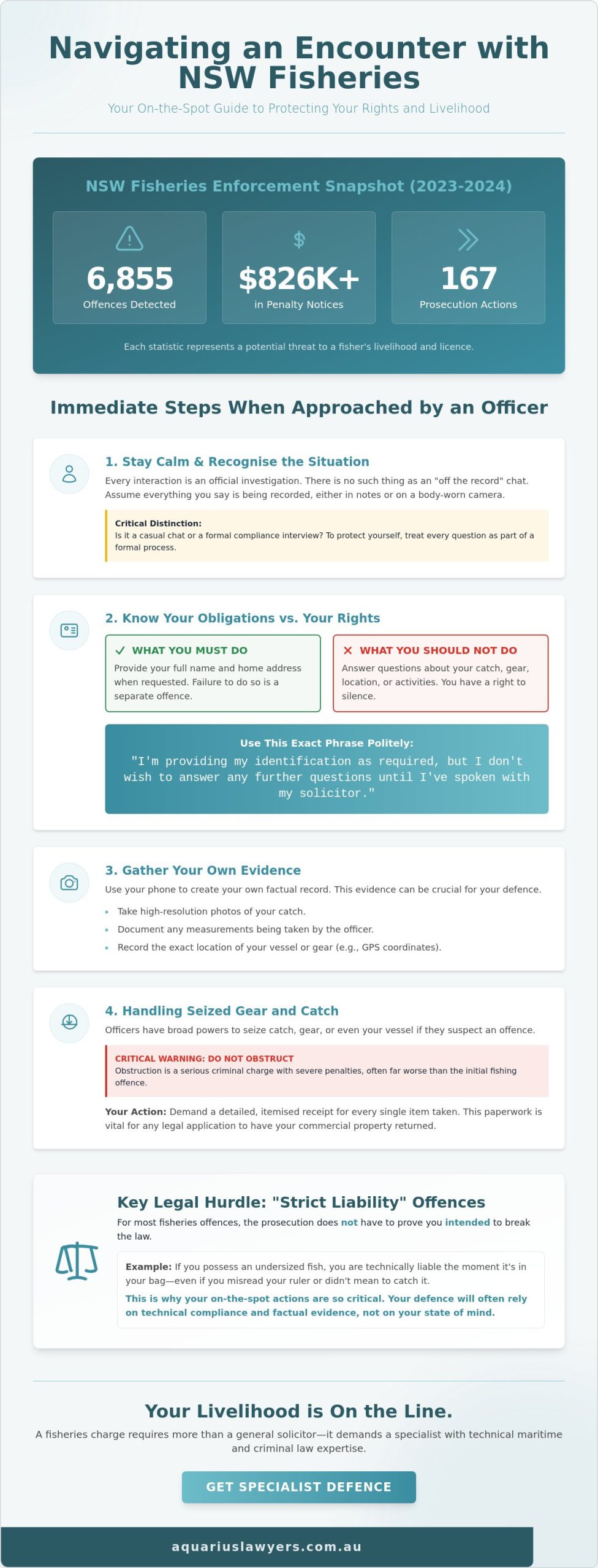
Did you know that in the 2023-2024 period, NSW Fisheries Officers detected 6,855 offences, resulting in 167 prosecution actions and over $826,000 in penalty notices? For a commercial operator, these aren’t just statistics. A single charge under the Fisheries Management Act 1994 can mean the difference between a thriving business and the permanent loss of your commercial fishing licence or quota. When the stakes involve your livelihood and seized gear, defending fisheries charges nsw requires more than just a general solicitor; it demands a technical maritime strategy.
We understand that facing the DPI can feel like an uphill battle against a confusing wall of regulations. You’ve spent years on the water, and the fear of a criminal record or losing your livelihood is a heavy burden to carry. This article provides a clear, pragmatic pathway to protect your future. You’ll learn how to master complex maritime law, identify valid legal defences, and implement expert strategies from ‘The Fish Lawyer’ to aim for a dismissal, a reduced penalty, and the retention of your essential fishing assets.
Key Takeaways
- Learn why distinguishing between an informal chat and a formal compliance interview is critical for protecting your rights on the water.
- Gain a clear understanding of the Fisheries Management Act 1994 and how it applies to both common recreational breaches and complex commercial quota issues.
- Discover the strategic legal pathways for defending fisheries charges nsw, including how to use the ‘Honest and Reasonable Mistake of Fact’ defence effectively.
- Demystify the NSW Local Court process by learning what to expect during your first ‘Mention’ and how to scrutinise the prosecution’s ‘Brief of Evidence’.
- Understand why combining technical maritime knowledge with criminal law creates a more robust defence than relying on a generalist solicitor.
Immediate Steps: What to Do When Approached by NSW Fisheries Officers
Meeting a fisheries officer on the water or at a boat ramp is a high-stakes moment. Your response in those first ten minutes often dictates the success of defending fisheries charges nsw later in the Local Court. It’s vital to stay calm and grounded. While officers are generally professional, their role is to gather evidence for potential prosecution. Every word you say and every action you take is being recorded, either mentally or via body-worn cameras.
Distinguish immediately between a casual “chat” and a formal compliance interview. There is no such thing as an “off the record” conversation with an officer from the NSW Department of Primary Industries. If they are asking questions about your catch, gear, or location, they are conducting an investigation. Use your phone to document the encounter. Take high-resolution photos of your catch, the specific measurements being taken, and the exact location of your vessel or gear. This provides a factual counterpoint to the officer’s notes.
The Power of Silence and Identification
You have a legal obligation to provide your name and home address when requested under the Fisheries Management Act 1994. Failing to do so is a separate offence that can lead to immediate arrest. However, your obligation generally ends with identification. You have a fundamental right to silence regarding the specifics of your activities. Politely state, “I’m providing my identification as required, but I don’t wish to answer any further questions until I’ve spoken with my solicitor.” This isn’t being difficult; it’s a strategic move to protect your interests. Informal admissions made while stressed on a boat ramp are notoriously hard to walk back once a formal charge is laid.
Managing Seized Gear and Catch
If an officer suspects an offence has occurred, they possess broad powers to seize your catch, nets, or even your vessel and trailer. Don’t obstruct them. Obstruction is a serious criminal charge that often carries far heavier penalties than the initial fishing infringement. Instead, focus on the paper trail. Demand a detailed, itemised receipt for every piece of equipment taken. For commercial operators, the equation is simple: No gear equals no income. In these circumstances, we can often utilise specific legal “pathways” to apply for the urgent return of seized commercial equipment. This process usually involves negotiating with the DPI or making an application to the court to ensure you can continue working while your legal matter is being resolved.
Understanding the Charges: The Fisheries Management Act 1994
To effectively approach defending fisheries charges nsw, you need to understand the rulebook the prosecution is using. The NSW Department of Primary Industries (DPI) doesn’t just look at whether you’re a “good person”; they look at whether you’ve complied with the strict letters of the law. Most offences fall under the Fisheries Management Act 1994. This includes common recreational slip-ups like exceeding a bag limit or fishing during a seasonal closure. For commercial fishers, the net is much wider, covering quota mismanagement, incorrect logbook entries, or failing to lodge records on time.
The DPI acts as both the investigator and the prosecutor. They have a specific mandate to protect fish stocks, which means they often take a rigid approach to enforcement. If you’ve received a Court Attendance Notice (CAN), the matter has moved beyond a simple fine and into the criminal justice system. Understanding the technicalities of the Act is the first step in defending fisheries charges nsw when your commercial future is on the line.
Strict Liability vs. Intentional Offences
The biggest hurdle in many fisheries cases is the concept of “strict liability.” In most criminal matters, the police have to prove you intended to commit the crime. Fisheries law is different. For many offences under the Act, the prosecution only needs to prove that the event occurred. For example, if you have undersized fish in your possession, it doesn’t matter if you didn’t mean to catch them or if you misread the ruler. You’re technically guilty the moment the fish is in your bag.
This reality shifts the focus of your defence strategy. Instead of arguing about what you were thinking, we look at technical compliance and factual errors. However, more serious charges, such as trafficking or large-scale commercial fraud, require the prosecution to prove “knowledge” or “intent.” These are high-level battles where the right specialist fisheries law advice can identify weaknesses in the DPI’s evidence.
The Impact on Commercial Licences
For commercial operators, a conviction isn’t just about a fine; it’s a threat to your ability to work. NSW uses a demerit point system for commercial fishers. Accumulating points through multiple offences or a single serious conviction can trigger a suspension or even the permanent cancellation of your licence. You might receive a Penalty Infringement Notice (PIN), which is an on-the-spot fine. While paying it might seem like the easy way out, doing so counts as an admission of guilt and can still result in demerit points. If you receive a CAN, you’re headed to court, where the stakes for your livelihood are at their highest.
Strategic Defences for Fisheries Prosecutions in NSW
A common misconception is that a strict liability charge under the Fisheries Management Act 1994 makes a conviction inevitable. While the prosecution doesn’t have to prove you intended to break the law, they still have to prove every element of the offence beyond a reasonable doubt. Successful strategies for defending fisheries charges nsw often hinge on technicalities that a generalist lawyer might overlook. We look for the “cracks” in the DPI’s case, whether that’s a procedural slip-up or a fundamental misunderstanding of maritime conditions.
Beyond technicalities, certain legal defences can excuse what otherwise looks like an offence. For First Nations fishers, the Native Title Act 1993 (Cth) provides a robust framework for cultural fishing rights, often overriding state-based restrictions. For others, defences like duress or necessity might apply in rare maritime emergencies, such as entering a restricted zone to seek shelter from a sudden, life-threatening storm. The goal is always to find the specific legal pathway that leads to a dismissal or a withdrawal of the charges.
Honest and Reasonable Mistake of Fact
This is the primary defence for strict liability offences in New South Wales. To succeed, you must demonstrate that you held a genuine belief in a set of facts that, if true, would have made your actions legal. It isn’t enough to say “I didn’t know the law.” You must show that your mistake was reasonable. For example, if a commercial operator relies on a DPI-issued map that is demonstrably inaccurate or ambiguous, a court may find their subsequent breach was an honest and reasonable mistake. We test the “reasonableness” of your actions against what a prudent, experienced fisher would have done in the same situation. If the equation shows your belief was grounded in logic, the charge should not stand.
Challenging Technical Evidence
NSW Fisheries Officers rely on tools like scales, measuring tapes, and GPS coordinates to build their case. These tools aren’t infallible. We scrutinise the calibration records of every device used during your inspection. If a scale hasn’t been certified or a measuring tape is worn and inaccurate, the entire basis of the prosecution’s evidence can collapse. Procedural errors are equally critical. If an officer failed to follow the correct protocol for storing seized evidence or didn’t accurately record the time and tide of the alleged offence, we can challenge the reliability of their notes. In complex cases, we engage expert marine biologists or hydrographic surveyors to contest the DPI’s claims about species identification or vessel location. This technical, evidence-led approach turns the prosecution’s own methodology against them.
Navigating the NSW Local Court: The Legal Pathway
The transition from the water to the courtroom is often jarring. When you receive a Court Attendance Notice, the matter is no longer in the hands of a fisheries officer; it’s in the hands of the NSW legal system. Defending fisheries charges nsw requires a methodical approach to the Local Court process. Your first court date is called a ‘Mention’. This is a procedural step where the Magistrate asks how you intend to plead. It’s a common mistake to rush this stage without a clear strategy in place.
You shouldn’t enter a plea of guilty or not guilty at the very first Mention without seeing the ‘Brief of Evidence’. This document contains every statement, photo, and technical report the DPI intends to use against you. Once your solicitor has this brief, we can look for inconsistencies. If the evidence is weak, we enter negotiations. This involves making ‘Case Representations’ to the DPI legal team; essentially, we are arguing why the charges should be withdrawn or downgraded before a single witness is called.
The Mention and Negotiating a Result
Rushing into a plea is a tactical error. By adjourning the first Mention, you buy time to scrutinise the prosecution’s case. Early legal intervention is often the difference between a long hearing and a quiet withdrawal. We use this period to highlight procedural flaws or factual errors discovered during our investigation. If we can demonstrate that the DPI’s case is flawed, we can often negotiate a result that avoids a trial altogether. This proactive strategy protects your reputation and your livelihood.
Sentencing Options and Protecting Your Record
If the matter proceeds to sentencing, the goal shifts to mitigation. A Magistrate considers your prior record, your character, and the specific circumstances of the breach. For commercial fishers, a criminal conviction is a professional disaster. It can impact your licence and even your ability to travel internationally. We often aim for a ‘Section 10’ dismissal. This means the court finds you guilty but chooses not to record a conviction. To achieve this, we prepare a ‘Subjective Brief’ that illustrates your contribution to the industry and the disproportionate impact a conviction would have on your life.
If you’ve been served with a Court Attendance Notice, don’t wait for the first Mention to act. Secure a specialised fisheries law defence today to begin building your case.
The ‘Fish Lawyer’ Advantage: Specialist Defence for NSW Fishers
A generalist criminal lawyer might be a master of the Local Court, but they rarely understand the technical nuances of a commercial fishing operation. Fisheries law is a specialised intersection of criminal law and maritime regulation where technicalities often determine the outcome. If your legal representative doesn’t grasp the difference between a gear measurement error and a quota mismanagement allegation, your defence is already on the back foot. Successfully defending fisheries charges nsw requires a specialist who understands the operational realities of the industry and the specific language of the water.
Katherine Hawes, widely recognised as ‘The Fish Lawyer’, provides this exact advantage. By combining decades of maritime expertise with high-level criminal law strategy, she offers a “no-nonsense” approach that prioritises results over ceremony. We don’t just rely on traditional legal arguments. Instead, we use a blend of deep industry knowledge and modern methodology to scrutinise the DPI’s evidence. Whether it’s questioning the accuracy of GPS tracking data or challenging the biological claims made by prosecution witnesses, our approach is brisk, solution-oriented, and grounded in pragmatism.
Niche Expertise in Fisheries and Aquaculture
Our team understands the specific pressures facing commercial fishers and aquaculture operators in New South Wales. We speak your language, from mesh sizes and net configurations to the complex demerit point system that threatens your licence. We’ve built a reputation for defending complex commercial fisheries matters by identifying the “cracks” in the prosecution’s case that others simply don’t see. This niche authority allows us to act as a steady, common-sense guide through what is often a highly stressful legal process. We move easily between high-level strategic thinking and the everyday wisdom required to navigate a DPI investigation successfully.
Contact Aquarius Lawyers Today
If you’ve been served with a Court Attendance Notice or are facing a compliance interview, early intervention is your best protection. We’re committed to providing result-driven legal representation that is both cost-effective and authoritative. We focus on creating a clear pathway toward a resolution, whether that involves negotiating with the DPI or fighting for a dismissal in court. Don’t leave your commercial future to chance with a generalist who doesn’t understand your industry. Secure your livelihood—contact The Fish Lawyer at Aquarius Lawyers today to book a consultation and protect your right to fish.
Secure Your Future on the Water
Facing a Court Attendance Notice doesn’t have to mean the end of your career or your passion. Successful outcomes depend on a clear-eyed understanding of the Fisheries Management Act 1994 and the ability to challenge technical evidence with precision. Whether you’re navigating the complexities of a Local Court ‘Mention’ or seeking a Section 10 dismissal to protect your record, early intervention is the most powerful tool in your kit. Defending fisheries charges nsw is a high-stakes equation where technical maritime knowledge plus strategic legal expertise equals the best chance of a positive result.
With offices in Sydney and Shellharbour, we provide comprehensive coverage for fishers across regional NSW. Principal Katherine Hawes, known throughout the industry as ‘The Fish Lawyer’, brings a unique blend of traditional experience and modern strategy to every case. Don’t risk your commercial quota or your personal reputation by going it alone. Protect your licence and your livelihood—contact Katherine Hawes, ‘The Fish Lawyer’, today. There is always a pathway forward, and we’re here to help you find it.
Frequently Asked Questions
Can I lose my commercial fishing licence for a first-time offence in NSW?
Yes, you can, though it’s less common for minor first offences. The NSW demerit point system means certain serious breaches, even on a first occasion, can trigger a suspension or cancellation of your commercial fishing licence. It’s the severity of the charge, such as illegal trafficking or large-scale quota fraud, that determines the immediate risk to your livelihood.
What is the difference between a fisheries fine and a court summons?
A fisheries fine, known as a Penalty Infringement Notice (PIN), is an on-the-spot penalty that resolves the matter without a court appearance; a court summons, or Court Attendance Notice (CAN), initiates a formal criminal proceeding. Paying a fine still results in an admission of guilt and can trigger demerit points. A summons requires you to appear before a Magistrate where a criminal record is a potential outcome.
Is Native Title a valid defence for commercial fishing charges?
Native Title can be a valid defence if you’re an Aboriginal person exercising traditional fishing rights under the Native Title Act 1993. However, using this for commercial-scale operations is legally complex. While cultural fishing is protected, the intersection between traditional rights and commercial licensing requires a specific legal strategy to navigate successfully in the NSW courts.
Can NSW Fisheries officers board my vessel without a warrant?
Yes, NSW Fisheries officers have broad powers under the Fisheries Management Act 1994 to board and search vessels without a warrant. They can inspect your catch, gear, and records while you’re on the water or at a boat ramp. You’re legally required to assist them and provide identification. Obstructing an officer is a serious criminal offence that often carries heavier penalties than the initial fishing breach.
What should I do if my boat and gear are seized by DPI officers?
You should immediately request a detailed, itemised receipt for every item taken. Once the gear is in DPI custody, the focus shifts to a legal application for its return. For commercial operators, we often use specific legal pathways to argue for the urgent release of boats and nets to ensure you can continue working while defending fisheries charges nsw.
What is a Section 10 dismissal, and can I get one for a fisheries charge?
A Section 10 dismissal is an order where the court finds you guilty but chooses not to record a criminal conviction. This is a vital outcome for commercial fishers because it prevents the automatic triggering of certain licence sanctions. Achieving this requires demonstrating your good character and the disproportionate impact a conviction would have on your professional life and future employment.
How much does it cost to defend a fisheries prosecution in the Local Court?
The cost of a legal defence varies based on the complexity of the charges and whether the matter proceeds to a full hearing. Factors that influence the total include the volume of the prosecution’s evidence; the need for expert witnesses like marine biologists; and the number of court appearances required. We focus on providing a pragmatic, result-driven service that balances cost against the protection of your livelihood.
Do I need a specialist fisheries lawyer, or will a local solicitor do?
While a local solicitor can handle basic criminal matters, a specialist understands the technical maritime “language” and the specific nuances of the Fisheries Management Act 1994. Defending these charges often requires challenging the calibration of measuring tools or interpreting complex quota regulations. A specialist’s niche authority provides a strategic advantage that a generalist might miss during a high-stakes prosecution.
Disclaimer
Please note that legal rules change and this is not a substitute nor construed as legal advice. It is general information only.