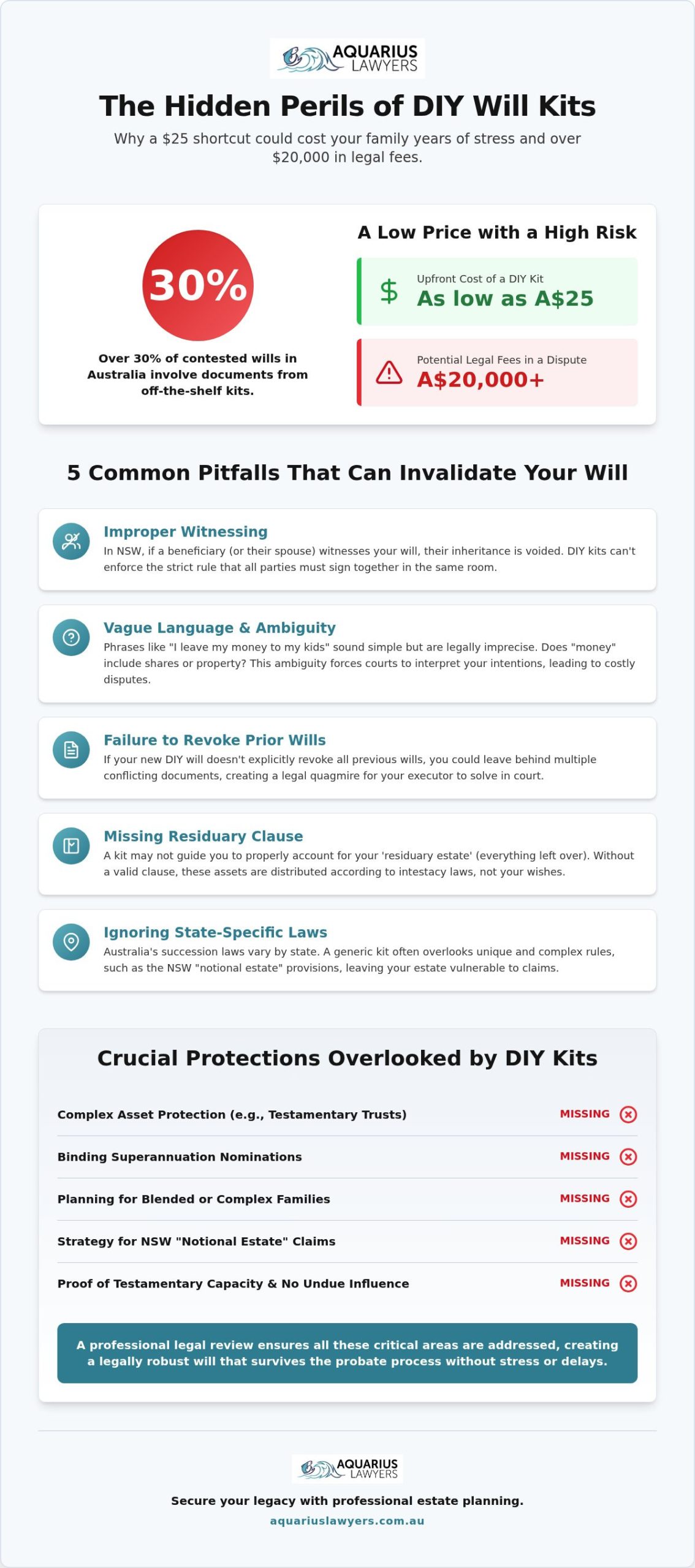
Did you know that over 30% of contested wills in Australia involve documents drafted using off-the-shelf kits? It’s a sobering reality for anyone looking to save a few dollars at the local newsagent or through a quick online download. While the A$25 price tag is tempting, the hidden diy will kit problems australia often creates can lead to the exact outcome you’re trying to avoid: a legacy tied up in the NSW Supreme Court for years.
You probably want a straightforward way to protect your children and assets without the high cost of traditional legal fees. It’s a practical, common-sense goal. This article will show you why these “cheap” alternatives are often a high-stakes gamble that ignores the nuances of modern Australian probate law. We’ll explore the critical pitfalls of DIY kits, from incorrect witnessing to the complexities of NSW “notional estate” rules. You’ll discover how to secure your family’s future with a valid will that survives probate without the stress, ensuring your assets go exactly where you intended and your legacy remains protected in 2026.
Key Takeaways
- Understand the technical execution errors, such as improper witnessing, that frequently lead to diy will kit problems australia and can potentially void your entire estate plan.
- Learn why a small upfront saving on a template can result in A$20,000 or more in legal fees if your family is forced into a probate dispute at the NSW Supreme Court.
- Discover the critical assets that standard post office kits often ignore, including superannuation nominations and tax-effective testamentary trusts.
- Identify how state-specific regulations, such as the unique NSW “notional estate” rules, can override a generic document and leave your loved ones vulnerable.
- Find out how a strategic, professional review ensures your legacy is legally robust and survives the probate process without unnecessary delays or stress.
What is a DIY Will Kit and Why are They Popular in Australia?
A DIY will kit is a pre-printed or digital template designed to help you outline your final wishes without visiting a solicitor. You can pick these up at most Australian newsagents for as little as A$25; alternatively, you can download one from a variety of online platforms for under A$100. They appeal to our sense of pragmatism. They offer a perceived path to security that is fast, cheap, and private.
There is a massive difference between a document that is technically “legal” and one that is “effective” under the Succession Act 2006 (NSW). While a kit might be a recognised legal document, it often lacks the precision required to actually move through the legal system. The rise of digital platforms has unfortunately led to an increase in “informal wills.” These documents frequently fail to meet strict legislative standards, which is a primary driver of the diy will kit problems australia currently faces.
The Appeal of the “Quick Fix” Estate Plan
Many Australians reach for a DIY kit during major life transitions, such as getting married or purchasing their first home. The allure is simple: you want to tick a box on your “to-do” list without spending A$500 or more on professional advice. There is a common misconception that estate planning is merely a matter of filling in the blanks. This approach ignores the emotional weight of inheritance and the complex family dynamics that a rigid template cannot address. A kit doesn’t ask the “what if” questions that protect your children’s future.
If you’re looking for a more robust alternative to standard kits, click here to see how Aiker Wills and Trusts can help secure your legacy.
Legal Validity vs. Probate Success
A document can be legally valid but completely fail the “probate-ready” test. Probate is the process where the Supreme Court of NSW confirms a will is the final, true word of the deceased. If a DIY kit is ambiguous or poorly executed, your executor may face significant delays. The court must be satisfied that the document is authentic and that you had the necessary testamentary capacity. A paper kit cannot testify to your state of mind or confirm that you weren’t under undue influence. Without that professional verification, your family is left to prove these facts in court. This often happens at a cost that dwarfs any initial savings you made at the newsagency.
5 Common Technical Pitfalls That Void Australian DIY Wills
While many believe a signature is enough to secure their legacy, the technicalities of the Succession Act 2006 (NSW) are unforgiving. These diy will kit problems australia often stem from a lack of oversight during the final signing phase. A single missed initials or an incorrectly dated page can be enough for a court to set the entire document aside. It’s a high-stakes gamble where the rules matter more than the intention.
One major oversight is the failure to revoke previous documents. If your DIY kit doesn’t explicitly state that it replaces all prior wills, your executors may find themselves dealing with multiple active documents. This creates a legal quagmire that requires a judge to determine which instructions take precedence. Additionally, many kits lack a robust residuary clause. Without one, any assets not specifically mentioned, such as a surprise inheritance or a forgotten bank account, fall into partial intestacy. This means the law, not you, decides who gets the “rest” of your estate.
The Witnessing Trap
In New South Wales, the “interested witness” rule is a common trap for the unwary. Section 10 of the Act dictates that if a beneficiary or their spouse witnesses the will, any gift to that person is void. You might have a perfectly written document, but if your daughter signs as a witness, she could lose her entire inheritance. All parties must be physically present in the same room at the same time to sign. Digital signatures or remote witnessing via video link are fraught with complex requirements that simple templates rarely explain. This lack of physical oversight is a primary reason why DIY documents fail the probate test.
Ambiguity: The Solicitor’s Worst Nightmare
The “plain English” trap is where everyday language clashes with legal definitions. For example, writing “I leave my money to my kids” sounds clear. However, in court, does “money” mean cash, term deposits, or shares? The Australian Law Reform Commission has highlighted the problems that can arise when templates are used without professional guidance. These vague terms often lead to “construction suits,” where the Supreme Court must interpret your meaning. These disputes can easily cost an estate A$20,000 or more in legal fees, effectively draining the inheritance you worked so hard to build. A quick professional review of your estate plan can identify these linguistic gaps before they become your family’s financial burden.
Ambiguity and the NSW Supreme Court: The Real Cost of “Cheap” Wills
Saving a few hundred dollars today can create a massive financial debt for your heirs tomorrow. A professionally drafted will typically costs between A$500 and A$1,500 for a standard estate. Compare this to a probate dispute, where legal fees often start at A$20,000 and can quickly exceed A$50,000 if the matter is contested. As the NSW Trustee & Guardian warns, the ambiguity found in many templates often forces families into the courtroom. This financial chasm is one of the most significant diy will kit problems australia faces today, as the “cheap” document effectively drains the inheritance it was meant to protect.
When a document fails to meet the strict requirements of the Succession Act 2006 (NSW), it is classified as an “informal testamentary document.” Under Section 8 of the Act, the Supreme Court has the power to validate these documents, but the process is neither quick nor inexpensive. Your executor must prove that you intended that specific piece of paper to be your final will. This requires gathering extensive evidence, filing additional affidavits, and often attending multiple court hearings. Every hour a solicitor spends fixing a DIY mistake is an hour of fees billed directly to your estate.
When the Court Has to Intervene
If a will is flawed, the executor must often provide an “affidavit of due execution.” This involves tracking down the original witnesses, which can be nearly impossible if the will was signed decades ago. The court then uses its discretion to decide if the document is reliable. Judicial discretion is the legal authority granted to a judge to admit an informal document to probate if they are satisfied it represents the deceased person’s genuine testamentary intentions. Relying on a judge’s discretion is a high-stakes gamble that adds months, if not years, to the probate process.
The Executor’s Personal Liability
Being named an executor is a significant legal burden, not just a family honour. If a DIY will is ambiguous, the executor is caught in the middle of disgruntled beneficiaries. They can be held personally liable for “breach of trust” if they distribute assets based on a flawed interpretation of a kit’s vague language. These legal battles frequently last three years or more, causing irreparable damage to family relationships. A professional solicitor acts as a vital shield for your executor. We provide the legal certainty that prevents beneficiaries from questioning the executor’s actions, ensuring the estate is settled with minimal friction and maximum protection.
Estate Planning Essentials: What a Post Office Kit Often Misses
A standard paper template assumes your life fits into a few neat boxes. For most Australians in 2026, wealth is far more interconnected than a simple list of belongings. These documents often fail to address assets that sit outside the legal definition of your “estate,” which is a core part of the diy will kit problems australia presents. It gives a false sense of security while leaving your most valuable holdings in legal limbo. From cryptocurrency to complex trust structures, a one-size-fits-all approach is rarely a solution.
Modern estate planning also needs to account for digital assets. If you own cryptocurrency, social media accounts with commercial value, or online businesses, a newsagency kit is woefully inadequate. Without specific “digital executor” clauses, your family may find themselves locked out of your accounts forever. These assets require technical and legal precision that a generic template cannot provide. We ensure these modern realities are integrated into a strategy that actually protects your legacy.
The Superannuation Oversight
Your superannuation is likely your largest or second-largest asset. However, it’s generally a “non-estate” asset. This means your will cannot automatically distribute your super balance or any associated life insurance. A DIY kit rarely explains the necessity of a Binding Death Benefit Nomination (BDBN). Without a valid, current BDBN, the trustees of your super fund decide who gets your money. This can lead to results you never intended. Learning How to Make a Legal Will in NSW involves synchronising your super nominations with your testamentary wishes to ensure a seamless transfer of wealth across all platforms.
Complex Family Dynamics
Blended families are the modern Australian norm, yet they are the biggest victims of “sideways disinheritance.” This occurs when assets pass to a new spouse, and your children from a previous marriage are accidentally left with nothing. DIY kits lack the sophisticated trust structures, such as Testamentary Trusts, required to protect these vulnerable beneficiaries. These trusts also provide significant tax-saving benefits that a A$25 kit simply cannot build. They act as a protective barrier, keeping assets within your bloodline.
There is also the risk of “Family Provision Claims.” Many people try to “exclude” a relative by writing a blunt sentence in a kit. This often backfires. In the eyes of the NSW Supreme Court, a lack of professional reasoning can make a challenge more likely to succeed. We use specific strategies to minimise these risks, providing a robust defence against future litigation. If you want to ensure your assets are distributed exactly as you wish, book a consultation with our estate specialists to secure your family’s future.
Protecting Your Legacy with Aquarius Lawyers: Expert Estate Strategy
Choosing a solicitor shouldn’t feel like a cold, formal transaction. At Aquarius Lawyers, we bridge the gap between high-level legal expertise and down-to-earth pragmatism. While we’ve discussed the technical diy will kit problems australia often creates, the solution isn’t just a document; it’s a strategy. Our principal, Katherine Hawes, is widely known as the “Fish Lawyer” due to her deep roots in maritime and fisheries law. This unique niche means we aren’t just looking at your house and bank account. We understand the complex commercial structures, property interests, and international assets that standard templates simply ignore.
Efficiency + Expertise = Security. This is the formula we use to move you from a risky DIY document to a robust estate plan. We offer fixed-fee options for standard wills, providing you with professional certainty without the anxiety of the “billable hour.” This transparent approach ensures you know exactly where you stand, allowing you to focus on the peace of mind that comes from knowing your children are protected. Transitioning from a generic template to a professionally drafted document is the most effective way to resolve the diy will kit problems australia creates before they become a burden for your heirs.
Pragmatic Advice for Modern Australians
Katherine Hawes acts as a trusted advisor for families and business owners across Sydney and regional NSW. Whether you are managing a property portfolio or navigating the transition of a family business, our advice remains grounded in the real world. We avoid archaic jargon in favour of clear, no-nonsense communication. We’ve seen how poorly drafted kits can tear families apart; our goal is to act as a steady guide to prevent that outcome. We blend traditional credentials with a tech-savvy perspective to ensure your legacy survives the complexities of 2026 and beyond.
Next Steps: Securing Your Family’s Future
Moving from a generic kit to a legally sound plan is a straightforward process. We offer local accessibility through our multiple NSW locations, including Sydney and Shellharbour. To make your appointment as efficient as possible, please bring a list of your assets, current superannuation statements, and any existing DIY documents you’ve previously prepared. This allows us to quickly identify gaps and build a pathway to a secure legacy. Book a consultation with our Wills and Estates team today to ensure your final wishes are truly protected under NSW law.
Secure Your Family’s Future with Legal Certainty
Leaving your estate to a newsagency template is a gamble that rarely pays off. You’ve seen how strict witnessing rules and the exclusion of non-estate assets like superannuation can create a legal nightmare for your loved ones. These diy will kit problems australia are entirely avoidable with the right strategic oversight. Principal Solicitor Katherine Hawes, often called the “Fish Lawyer,” brings specialist expertise in NSW Succession Law to ensure your assets are protected; this is particularly vital if you hold complex commercial or maritime interests.
By choosing professional drafting over a “cheap” kit, you replace uncertainty with a robust plan designed to survive the probate process. Our fixed-fee estate planning packages provide the clarity you need without the anxiety of hidden costs. It’s time to move beyond the template and build a legacy that actually stands up in the NSW Supreme Court. Secure your legacy with a professional Will review from Aquarius Lawyers. Protecting your family is the most important job you’ll ever do, and we’re here to help you get it right from the start.
Frequently Asked Questions
Is a DIY will kit legally binding in Australia?
Yes, a DIY will kit is legally binding provided it meets the strict execution requirements of the relevant state laws. However, being “binding” is not the same as being “effective.” Many documents that are technically legal fail the probate process because they contain errors that lead to diy will kit problems australia families must then resolve in court. A document is only useful if it can be easily validated by the Supreme Court.
What is the most common reason a DIY will is challenged in NSW?
Ambiguity in language is the leading cause of challenges in New South Wales. When a kit uses vague terms like “my belongings” instead of specific legal definitions, it invites family provision claims under the Succession Act 2006. Disgruntled beneficiaries often argue that the document doesn’t reflect the true intentions of the deceased. This leads to expensive litigation that can quickly drain the estate’s total value.
Can I use a DIY will kit if I have a blended family?
It is highly risky to use a generic kit if you have a blended family. These templates rarely account for the complexities of protecting children from previous marriages while providing for a current spouse. Without sophisticated trust structures, you risk “sideways disinheritance,” where your biological children are accidentally left with nothing. Professional drafting ensures all family members are considered according to your specific wishes and protects against future claims.
Does a DIY will cover my superannuation and life insurance?
Generally, no. Superannuation and life insurance are considered “non-estate” assets and do not automatically fall under the instructions of your will. A standard kit often misses the crucial step of coordinating your will with a Binding Death Benefit Nomination. If these documents aren’t synchronised, your super fund trustees may distribute your death benefits in a way that contradicts your final wishes, regardless of what your will says.
What happens if the witnesses sign the DIY will at different times?
If the witnesses do not sign the document in your presence and in the presence of each other, the will is likely invalid. The law requires a simultaneous act of signing to prevent fraud and ensure authenticity. This technicality is one of the most frequent diy will kit problems australia executors encounter. Fixing this error after your death requires expensive court applications and affidavits from the original witnesses to prove the document is genuine.
How much does it cost to fix a mistake in a DIY will after someone dies?
The cost of remedial legal work starts at several thousand dollars and can exceed A$20,000 if the estate is contested. While a professional will might cost between A$500 and A$1,500, the price of “saving” money upfront is often paid by your heirs. These costs are deducted directly from the inheritance, meaning your family receives significantly less than you intended due to avoidable paperwork errors and court delays.
Should I use an online will platform instead of a paper kit?
Online platforms are typically more advanced than paper kits because they use logic-based questions to guide you. However, they still cannot verify your testamentary capacity or provide the strategic advice needed for complex assets. They are a “tech-first” solution that lacks the “human-first” nuance of a trusted solicitor. For anything beyond a very basic estate, a professional review is the only way to ensure your legacy remains secure.
How often should I update my will with a solicitor?
You should review your estate plan every three to five years or whenever a significant life event occurs. Marriage, divorce, the birth of a child, or the purchase of a new property all change your legal landscape. Relationships and asset values fluctuate; therefore, your will must evolve to remain effective. Regular updates with a solicitor ensure your strategy stays aligned with current NSW legislation and your personal financial circumstances.
Disclaimer
Please note that legal rules change and this is not a substitute nor construed as legal advice. It is general information only.