
Most beneficiaries view the probate process as a legal “black hole” where communication goes to die, but it’s actually the most robust security system protecting your inheritance. It’s natural to feel anxious when months pass without a clear update from an executor. You might be wondering if the delay is a standard procedural requirement or a sign of mismanagement. This guide focuses on explaining probate process to beneficiaries australia, stripping away the complex jargon to provide the clarity you deserve.
We understand that waiting for a legacy to be settled is about more than just money; it’s about closure and respect for a loved one’s wishes. You’ll learn exactly what your rights are, what the current 2026 timelines look like across different states, and how the law safeguards your interests during every stage of administration. We’ll walk through the essential milestones, from the initial court filing to the final distribution. You’ll finish this article knowing precisely which questions to ask the executor and possessing the peace of mind that comes from understanding the path forward.
Key Takeaways
- Probate serves as the Supreme Court’s official validation of a Will, providing a legal framework that prevents executors from acting outside of their defined authority.
- Standard timelines for estate administration generally span 6 to 12 months, involving specific milestones like the mandatory 14-day notice of intent before a grant is issued.
- Beneficiaries have a fundamental legal right to be kept informed, underpinned by the executor’s fiduciary duty to manage assets with total honesty and transparency.
- By explaining probate process to beneficiaries australia, we empower you to identify common delays early, such as those involving complex commercial interests or maritime assets.
- Engaging a firm that blends traditional expertise with modern technology ensures you have a steady, common-sense guide to resolve disputes and secure your inheritance efficiently.
What is Probate? A Beneficiary’s Perspective on the Australian Process
To many beneficiaries, the term “probate” sounds like a hurdle designed to slow down their inheritance. In reality, it’s the most powerful protection you have. What is Probate? At its core, it’s the Supreme Court’s official recognition that a Will is legally valid and the executor has the authority to manage the deceased’s affairs. For you, this process ensures the estate is handled according to the law, not just the executor’s personal preferences or whims. It’s the legal “green light” that allows the transition of assets to begin safely.
Think of probate as a transparency framework. When we focus on explaining probate process to beneficiaries australia, we emphasize that it provides a “clean slate.” The law requires all of the deceased’s debts, including taxes and funeral costs, to be settled before you receive your share. This protects you from future claims against the assets you inherit. Without a Grant of Probate, most Australian banks and land titles offices won’t release significant assets, as they need the court’s assurance that they’re dealing with the rightful legal representative.
When is Probate Required in Australia?
Not every estate requires a full court application. If the deceased held only a small amount of cash in a bank account, typically under A$20,000 or A$50,000 depending on the specific bank’s policy, probate might be avoided. However, real estate almost always triggers the requirement. If property was held solely by the deceased or as “tenants in common,” probate is mandatory to transfer the title. This differs from “joint tenants,” where the property usually passes automatically to the survivor. If there’s no Will, the process changes to “Letters of Administration,” which follows similar court-supervised steps to ensure fairness when no written instructions exist.
How the Supreme Court Protects Your Interests
The Supreme Court acts as a rigorous gatekeeper. Their role is to verify the “last Will and testament,” ensuring that outdated or fraudulent documents aren’t used to distribute assets. They also confirm the executor is a fit and proper person to handle the responsibility. This oversight is vital for explaining probate process to beneficiaries australia because it creates a public record. You can actually verify if an application has been lodged by checking the online probate registry in your state. This level of visibility prevents executors from operating in the shadows and gives you the confidence that the process is moving forward correctly under judicial supervision.
The Probate Timeline: From Application to Distribution
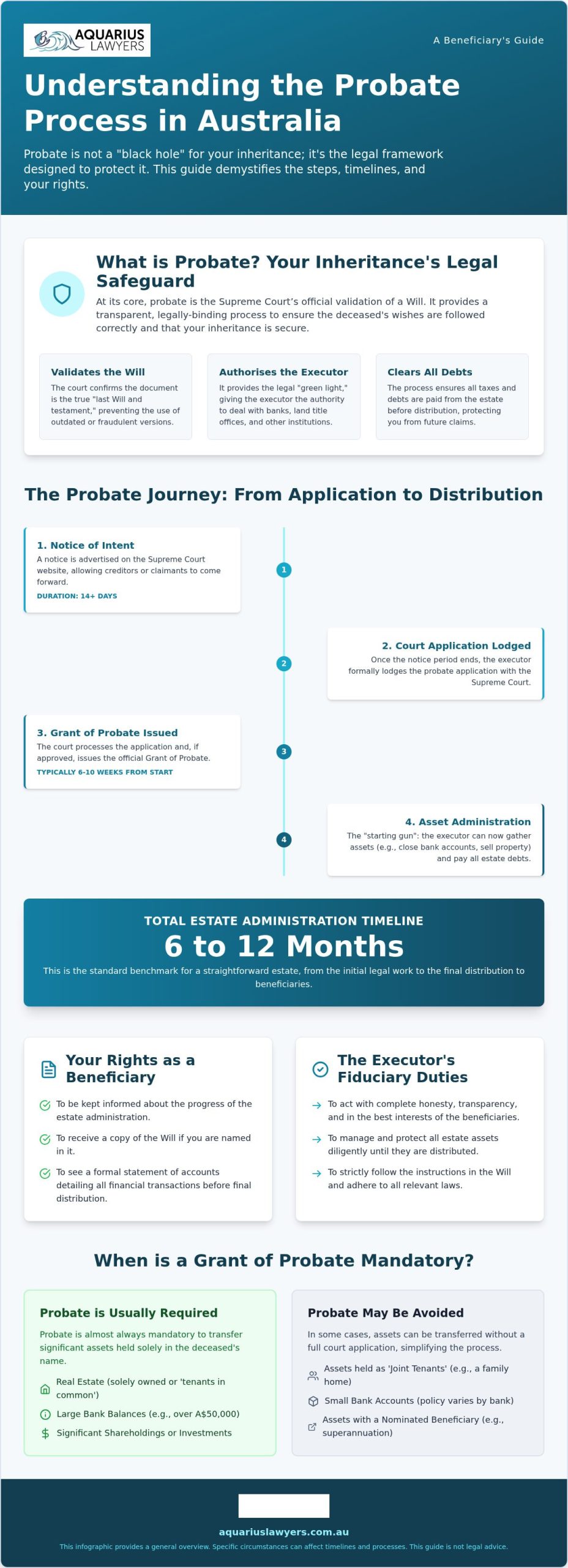
The journey from a loved one’s passing to the final distribution of assets follows a structured legal sequence. For beneficiaries, understanding these milestones is the best way to reduce anxiety during what can feel like a long period of silence. The first formal step involves advertising a Notice of Intent to apply for Probate on the Supreme Court website, which must stay live for at least 14 days. This allows potential creditors or anyone contesting the Will to come forward. Once this period expires, the executor lodges the formal application. As of mid-2026, the Supreme Court of NSW probate process typically sees routine applications processed within 2 to 4 weeks of filing.
When explaining probate process to beneficiaries australia, we look at the total timeline. From the moment you engage a solicitor to receiving the Grant of Probate, you should expect a window of 6 to 10 weeks. However, the Grant is not the finish line; it is the starting gun for the executor to begin the work of realising assets. This involves closing bank accounts, selling property, and settling any outstanding debts. The final stage is the distribution to beneficiaries, which should always be accompanied by a formal statement of accounts detailing every dollar that entered and exited the estate.
Managing Expectations: How Long Does it Really Take?
While the Grant itself is relatively fast, the entire estate administration typically spans 6 to 12 months. In regional NSW and Sydney, this duration remains a standard benchmark for straightforward estates. Several factors can influence this pace, including the complexity of the assets and the efficiency of the legal team involved. Using modern, tech-integrated solutions helps streamline the paperwork, but some statutory waiting periods are non-negotiable. If you feel the process is stalling, seeking expert Wills and Estates advice can help clarify whether the delay is procedural or problematic.
The Notice of Intended Distribution
Beneficiaries often wonder why executors wait so long to distribute funds after the Grant of Probate is received. This is usually due to the “6-month rule.” In New South Wales, executors are encouraged to wait at least six months from the date of death before distributing assets. This period allows creditors to make claims and protects the executor from personal liability for any of the deceased’s unknown debts. The Notice of Intended Distribution is a legal safeguard for the estate’s integrity, ensuring that all financial obligations are met before the final inheritance is paid. In 2026, the cost to place this notice on the Supreme Court website remains A$57, a small price for the security it provides to both the executor and the beneficiaries.
Beneficiary Rights vs Executor Duties: A Comparison
The relationship between an executor and a beneficiary is often misunderstood as a hierarchy of power. In reality, the law frames it as a relationship of service and accountability. While the executor holds the legal authority to manage assets, they owe you a “fiduciary duty.” This means every decision they make must prioritise the estate’s interests over their own. When we focus on explaining probate process to beneficiaries australia, the most vital point to understand is that you aren’t a passive observer. You possess specific legal entitlements designed to ensure the executor acts with total honesty and transparency.
Your primary rights include:
- Right to Information: You must be kept informed about the progress of the estate administration.
- Access to the Will: Once probate is granted, the Will becomes a public document. However, in most Australian jurisdictions, you have a right to request a copy even before this stage if you’re a named beneficiary or a close relative.
- Right to Timeliness: If an executor is dragging their feet without a valid reason, you can seek a court order to compel them to provide an update or even remove them in extreme cases.
The Right to an Accounting
Before the final distribution occurs, you have a right to see a “Statement of Accounts.” This document is essentially a financial ledger of the estate. It should clearly show all assets collected, debts paid, and any expenses incurred, such as funeral costs or professional legal fees. If an executor is claiming a “commission” for their time, this must be authorised by the Will or approved by the court. If you suspect funds are being mismanaged or fees are being charged unfairly, this is the time to raise a formal objection. Transparency isn’t optional; it’s a legal requirement.
The Executor’s Year: Understanding the Grace Period
It’s important to recognise the “Executor’s Year.” In Australian law, executors generally have 12 months from the date of death to wind up an estate before they’re considered “slow” by the courts. This grace period acknowledges that complex matters, like selling property or settling tax, take time. However, if the 12-month mark passes and you’ve had no meaningful communication, the delay may be deemed legally unreasonable. Aquarius Lawyers helps beneficiaries navigate these tensions by providing a steady, common-sense guide to communication. We ensure you know exactly what to ask to get the process moving again without unnecessarily escalating conflict.
Common Probate Delays and How to Resolve Them
While the court’s approval might arrive in weeks, the practical administration of an estate can face several roadblocks. Understanding these hurdles is a core part of explaining probate process to beneficiaries australia. Delays often stem from the complexity of the assets involved. If the deceased held overseas property, specialized Fisheries Law assets like commercial licences, or intricate aquaculture interests, the valuation and transfer process takes significantly longer than a standard residential home. Similarly, if the original Will is missing or beneficiaries are difficult to locate, the executor must undertake “due diligence” before the court will allow the process to proceed.
Taxation is another frequent culprit. An executor can be held personally liable for any unpaid tax of the deceased if they distribute assets before settling all debts with the Australian Taxation Office (ATO). Consequently, many executors will wait for a final tax clearance before releasing funds to you. This isn’t the executor being difficult; it’s them protecting the estate’s integrity and their own legal standing. If the deceased had complex commercial interests or multiple years of unfiled returns, this stage can easily add several months to the timeline.
Handling a Family Provision Claim
A significant delay occurs when a person feels they’ve been unfairly left out or inadequately provided for in the Will. In Australia, these “Family Provision” claims can halt the distribution of assets for months. When a claim is lodged, the executor cannot safely distribute the estate until the matter is resolved. Fortunately, the modern legal approach prioritizes mediation. This process allows parties to reach a settlement without a long, expensive court battle, preserving the estate’s value for everyone involved. If you’re a beneficiary caught in this crossfire, staying informed about the mediation timeline is your best defence against uncertainty.
Proactive Steps for Beneficiaries
You don’t have to sit in silence while the months tick by. If you feel the communication has dried up, you can take proactive steps to regain clarity. Start by requesting a formal written update from the solicitor handling the estate. It’s also wise to keep your own records of all correspondence with the executor. If the delay seems unreasonable or you suspect the executor isn’t acting in your best interests, it may be time to seek independent Wills and Estates advice. Protecting your share of the assets often requires moving from a passive observer to an informed participant.
When dealing with estates across different states, it is often beneficial to consult with professionals who understand the specific nuances of local registries. If you are navigating an inheritance in Victoria, you might learn more about Mohan Yildiz & Associates to ensure your rights are being upheld according to state-specific probate requirements.
Why Expert Legal Guidance Matters for Beneficiaries
Securing your inheritance shouldn’t feel like a battle against a complex legal system. While the executor typically has their own solicitor, that professional represents the estate’s interests, not necessarily your personal rights as a beneficiary. Our firm excels at explaining probate process to beneficiaries australia, ensuring you aren’t left guessing while assets are being managed. We provide a steady, common-sense guide through what can often be a high-pressure environment, focusing on resolution rather than prolonged litigation.
Many estates involve more than just a family home and a bank account. If your inheritance includes complex commercial interests, fisheries licences, or aquaculture assets, you need a legal partner who understands these niche sectors. Aquarius Lawyers leverages deep expertise in Commercial Law and maritime matters to ensure these unique assets are valued and transferred correctly. Our goal is to get your inheritance to you as quickly as the law allows, removing the friction that often arises from poor communication or administrative delays.
Similarly, for beneficiaries dealing with assets located in the United States, seeking out dedicated probate administration services from The Probate & Estate Planning Co. ensures that the specific requirements of American probate courts are handled with professional care.
The Aquarius Lawyers Difference
Principal Katherine Hawes is a known “innovative veteran” in Australian law, blending traditional credentials with a forward-thinking methodology. This approach means we don’t just rely on archaic paper trails. We integrate modern technology to speed up the probate verification process and keep communication lines open. To provide peace of mind regarding costs, we offer fixed-fee options for many estate matters, ensuring you aren’t surprised by hidden legal bills. Whether you’re in the heart of the Sydney CBD or require support from our regional NSW office in Shellharbour, we provide accessible, down-to-earth advice that prioritises your outcome over ceremony.
Next Steps: Securing Your Inheritance
If the 12-month “executor’s year” is approaching or if you’ve been met with a wall of silence, it’s time to take a proactive step. We can act as a professional bridge between you and a difficult executor, requesting the necessary “Statement of Accounts” and ensuring the distribution stays on track. You don’t have to wait until the final cheque is written to understand your position. By reviewing the Will and the estate’s progress now, you can protect your share from mismanagement or unreasonable delays. Organise a consultation with Aquarius Lawyers to discuss your rights today.
Securing Your Legacy with Clarity and Confidence
Probate shouldn’t be a source of constant stress; it’s the legal framework ensuring your loved one’s wishes are honoured exactly as written. You now understand that while the process involves necessary statutory waiting periods, your rights to transparency and a full accounting remain absolute. We’ve focused on explaining probate process to beneficiaries australia so you can move from a state of uncertainty to one of informed action.
If you’re dealing with a silent executor or an estate involving complex maritime or commercial assets, you don’t have to navigate the path alone. Principal Katherine Hawes, widely known as “The Fish Lawyer,” brings a unique blend of “innovative veteran” experience to every estate matter. With offices in Sydney and Shellharbour, our team provides the down-to-earth, pragmatic advice you need to resolve delays and secure your rightful inheritance. Don’t let legal jargon or long timelines keep you in the dark. Taking a proactive step today ensures the estate’s integrity is maintained and your interests are protected.
Speak with a Wills and Estates Specialist at Aquarius Lawyers to gain the clarity you deserve. Your peace of mind is just a conversation away.
Frequently Asked Questions
How long does probate usually take in Australia?
Obtaining a Grant of Probate generally takes between 1 and 3 months from the date of death. Once the court issues the grant, the total estate administration typically spans 6 to 12 months. Routine NSW applications are often processed in 2 to 4 weeks once filed. However, complex assets like commercial fisheries licences or international property can extend these timeframes significantly beyond the standard benchmarks.
Can an executor change the Will after someone dies?
No, an executor has no legal authority to alter the terms of a Will. Their role is strictly to carry out the deceased person’s instructions as written. While they have discretion over administrative matters, such as choosing which real estate agent to use for a property sale, they cannot change who inherits what. Any attempt to deviate from the Will’s instructions without a court order is a breach of their fiduciary duty.
What happens if the executor is not communicating with the beneficiaries?
Beneficiaries have a legal right to be informed about the estate’s progress. If an executor remains silent, you should first send a formal written request for an update. If the lack of communication continues, you can apply to the Supreme Court for an order compelling them to provide an account of the estate. Professional legal advice is crucial here to act as a bridge and resolve the deadlock without escalating to litigation.
Do I have to pay tax on my inheritance in Australia?
Australia does not have a “death tax” or inheritance tax, but certain assets may trigger other tax obligations. For instance, you might be liable for Capital Gains Tax (CGT) if you sell an inherited property later. Additionally, superannuation death benefits paid to non-dependants, such as adult children, are often taxed at up to 17% or 32% depending on the insurance components. Always verify your specific tax position with a specialist advisor.
Can I see the Will before probate is granted?
Yes, certain individuals have a statutory right to inspect the Will before probate is granted. In New South Wales, this includes anyone named in the Will, surviving spouses, children, and creditors. If the person holding the Will refuses to provide a copy, legal intervention can compel its production. This transparency is a key part of explaining probate process to beneficiaries australia, ensuring everyone knows their legal standing early in the piece.
What is the “6-month rule” for estate distribution in NSW?
The “6-month rule” refers to the period executors are encouraged to wait before distributing assets to protect themselves from personal liability. By waiting six months from the date of death, the executor allows enough time for creditors or claimants to come forward. If they distribute the estate earlier and a debt is later discovered, the executor might have to pay that debt out of their own pocket. This rule ensures the estate’s integrity.
What happens if there is no Will (Intestacy)?
If there is no Will, the estate is distributed according to the rules of intestacy, which vary by state. In NSW, a surviving spouse or de facto partner is generally the primary beneficiary. For 2026, the statutory legacy for a spouse in an intestate estate is A$603,091.72 plus half of the remaining estate. An administrator must apply for Letters of Administration to manage the process instead of a standard Grant of Probate.
Can a beneficiary remove an executor who is doing a bad job?
Yes, but removing an executor requires a Supreme Court order and proof of serious misconduct. Courts are generally reluctant to override the deceased’s choice of executor unless there is evidence of fraud, significant delays, or a total conflict of interest. If the executor’s actions are jeopardising the estate’s assets, a beneficiary can apply to have them removed. This is often a last resort when explaining probate process to beneficiaries australia who are facing mismanagement.
Disclaimer
Please note that legal rules change and this is not a substitute nor construed as legal advice. It is general information only.