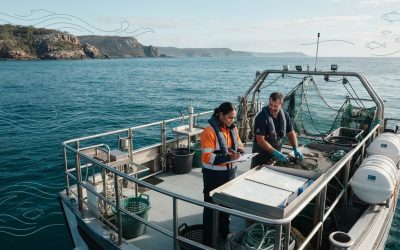
Imagine the sun hasn’t even touched the horizon when an AFMA patrol boat pulls alongside your vessel for an unannounced boarding. In the high-stakes climate of 2026, where a serious breach can lead to a $165,000 fine, the pressure to “just cooperate” is immense. You’ve spent decades building your quota, and the fear of losing a multi-generational legacy over a misunderstanding of fisheries investigation legal rights australia is a heavy burden to carry. It’s completely understandable to feel stressed when facing the “Big Reset” regulations or the new NSW enforcement powers that have shifted the goalposts for every commercial operator.
This guide provides the clarity you need to master your legal rights, ensuring you can protect your commercial licence and livelihood from regulatory overreach. We’ll explore the critical strategy for handling inspections, the reality of Commonwealth versus State jurisdiction, and how to exercise your right to silence without escalating the situation. By the end of this guide, you’ll have the confidence to deal with AFMA or NSW Fisheries officers using a professional, informed approach that prioritises your business’s survival.
Key Takeaways
- Learn to distinguish between routine gear inspections and formal investigations to identify exactly when your legal risk profile shifts.
- Understand how to balance your duty to provide assistance with your right to silence to safeguard your fisheries investigation legal rights australia during high-stress boardings.
- Navigate the jurisdictional maze by identifying whether Commonwealth or State laws apply to your vessel based on the three-nautical-mile rule.
- Implement a professional response strategy that prioritises requesting a ‘Notice of Investigation’ while maintaining a calm, documented record of the interaction.
- Discover why engaging a specialised maritime legal expert provides a strategic advantage over generalist advice when defending your commercial quota and livelihood.
What is a Fisheries Investigation? Understanding the Regulatory Scope in 2026
A fisheries investigation isn’t a social call or a routine gear check. It is a formal, evidence-gathering inquiry triggered by a suspected breach of the Fisheries Management Act 1991 or relevant state legislation. In the current regulatory climate, these investigations have become increasingly sophisticated. Authorities no longer rely solely on what they see over the gunwale. They use an intelligence-led model that combines data analytics with physical surveillance. What you do and say during the first 24 hours of this process often dictates the final legal outcome. This window is when the most critical evidence is gathered, and it’s where your knowledge of fisheries investigation legal rights australia becomes your most valuable asset.
It’s vital to distinguish between a routine inspection and a targeted investigation. An inspection is a compliance check to ensure your gear, catch, and logbooks meet standard requirements. An investigation, however, starts when an officer suspects an offence has occurred. This shift is often subtle but changes the legal landscape entirely. Common triggers for a full investigation in 2026 include:
- VMS Anomalies: Real-time Vessel Monitoring System data suggesting you’ve entered a closed bioregion or marine park.
- Logbook Discrepancies: Inconsistencies between digital catch records and actual landed weight discovered during a dockside audit.
- Anonymous Tip-offs: Information provided via “Fishwatch” or similar reporting hotlines.
- Historical Track Logs: Analysis of your vessel’s movement patterns over several months to identify suspicious activity.
Who Regulates Your Catch? AFMA vs State Authorities
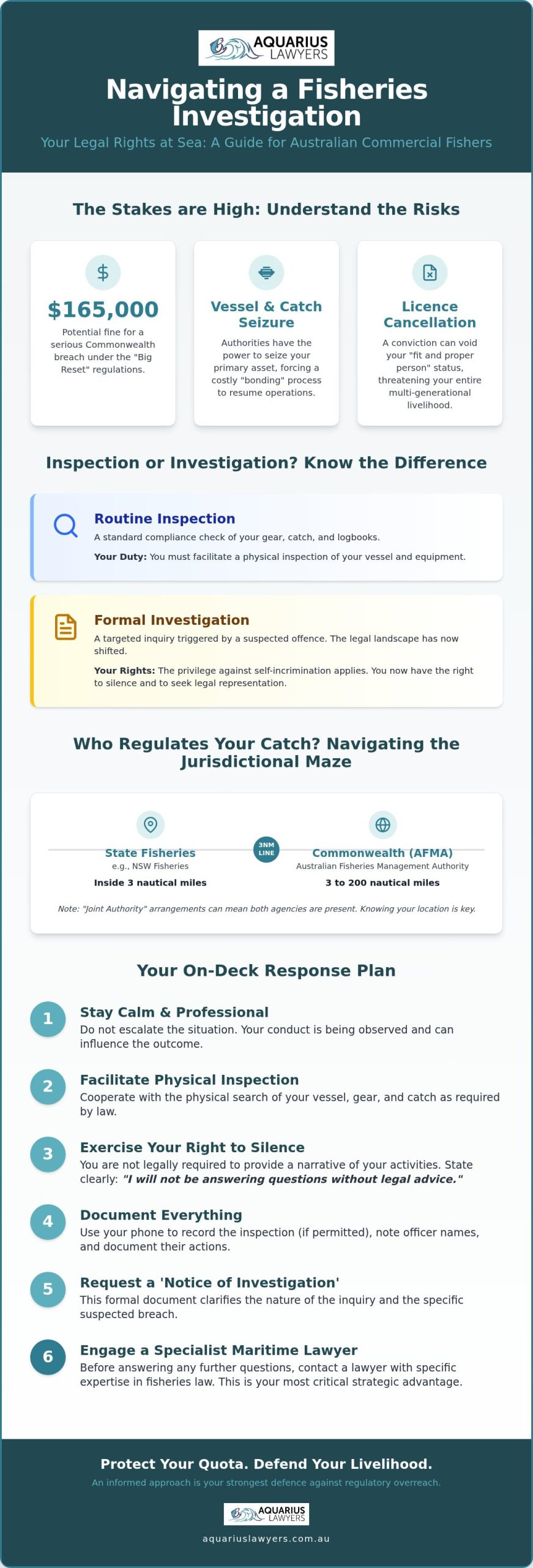
The Australian Fisheries Management Authority (AFMA) manages Commonwealth fisheries, which generally extend from three nautical miles offshore to the edge of the Australian Fishing Zone. Inside that three-mile limit, state bodies like NSW Fisheries take the lead. However, the lines aren’t always clear. Under “Joint Authority” arrangements, you might find yourself boarded by officers from both agencies. Each body has different enforcement powers and procedural requirements. Knowing which jurisdiction you’re operating in is the first step to ensuring you aren’t being subjected to regulatory bullying or jurisdictional overreach.
The High Stakes: Fines, Forfeiture, and Licence Cancellation
The penalties for a misstep are severe. As of August 2026, the Commonwealth penalty unit value sits at $330, meaning serious breaches can attract fines reaching $165,000. In NSW, new legislation has increased penalties to $44,000 for specific aquaculture offences. Beyond the immediate fines, authorities have the power to seize your vessel and catch. This often leads to a “bonding” process where you must provide financial security just to get your boat back in the water. Most importantly, a conviction can tarnish your “fit and proper person” status. This status is the foundation of your commercial licence; lose it, and your multi-generational livelihood could vanish overnight.
Your Essential Legal Rights During a Fisheries Inspection
When an officer steps onto your deck, the power dynamic shifts instantly. Most commercial fishers believe they must answer every question to avoid looking guilty, but this is a dangerous misconception. Understanding your fisheries investigation legal rights australia is about knowing where your “duty to assist” ends and your right to silence begins. While you must facilitate a physical inspection of your vessel and gear under AFMA’s Domestic Compliance Policy, you aren’t legally required to provide a narrative of your activities that could be used against you in court.
The privilege against self-incrimination is a cornerstone of the Australian legal system. It applies just as much on the water as it does in a police station. You have the right to observe the search and record the conduct of officers, provided you don’t obstruct their work. Using a smartphone to document the inspection is a practical way to ensure procedural fairness. If the situation moves beyond a routine check into a formal interview, you have the absolute right to seek legal representation before participating. Don’t let the pressure of the moment force you into making statements that could jeopardise your licence.
The Power to Board and Search: What Officers Can and Cannot Do
Fisheries officers possess broad powers to board and search vessels without a warrant. However, this power isn’t absolute; it’s anchored by the “reasonable suspicion” threshold. They can inspect your catch, gear, and logbooks to ensure compliance with management plans. This doesn’t give them a free pass to rifle through personal cabins or private electronic devices without specific legislative authority or a warrant. Fisheries officers are legally permitted to use only such force as is reasonable and necessary in the circumstances to exercise their boarding and search powers. If you feel an officer is overstepping these boundaries, document the interaction and contact a specialist for strategic legal support immediately.
The Right to Silence vs. The Duty to Assist
You have a non-negotiable requirement to identify yourself and produce your commercial fishing licence. Failing to do so is an offence in itself. You must also provide “reasonable assistance” during the inspection, such as opening hatches or clearing gear. However, there’s a sharp distinction between showing an officer your catch and admitting to a breach of quota. You can answer factual questions about catch location while politely declining to participate in a deeper interview until you’ve spoken with a fisheries lawyer Australia. A simple statement like, “I’m happy to assist with the inspection, but I won’t be answering further questions without my solicitor present,” is a professional way to protect your interests.
Commonwealth vs State Jurisdiction: Navigating the Legal Maze
Jurisdiction isn’t just a technicality; it’s the foundation of your entire legal defence. In Australia, the line between State and Commonwealth authority is usually drawn at the three-nautical-mile mark, but the reality is rarely that simple. Section 10 of the Fisheries Management Act 1991 allows for complex arrangements where State laws can apply in Commonwealth waters and vice-versa. If an officer from one agency boards you while you’re technically under the jurisdiction of another, any procedural errors they make can become the pivot point for a successful defence. Understanding your fisheries investigation legal rights australia means knowing exactly which rulebook the authorities must follow at any given GPS coordinate.
Errors often occur during “hot pursuit” scenarios or when vessels drift across jurisdictional boundaries during a boarding. If a NSW Fisheries officer exercises Commonwealth powers without the correct authorisation, the evidence they gather might be inadmissible. Different jurisdictions also mean different court systems and vastly different penalty scales. A Commonwealth prosecution in the Federal Court involves different rules of evidence than a State matter in the Local Court. Identifying these jurisdictional overlaps early allows you to challenge the validity of the investigation before it reaches a hearing.
NSW Fisheries Regulation: Local Nuances for Sydney Fishers
For those operating out of the Sydney basin or regional ports like Wollongong and Newcastle, NSW Fisheries Compliance officers often employ highly localised enforcement tactics. These include land-based surveillance of unloading points and digital audits of wholesale records. When facing a prosecution in the NSW Local Court, the stakes are high for your “fit and proper person” status. Experienced maritime law firms Sydney know that if a Local Court result is unfavourable, the NSW Land and Environment Court provides a specialised venue for appeals. This court understands the commercial realities of the industry better than a generalist magistrate, offering a more nuanced review of your case.
Double Jeopardy and Overlapping Charges
A common fear among commercial fishers is “double jeopardy,” or being punished twice for the same catch. While you generally won’t face identical criminal charges from both State and Commonwealth bodies, you can be hit by a “pincer movement” of different penalties. This often looks like a criminal prosecution in court alongside administrative sanctions, such as the immediate suspension of your licence or the deduction of quota points. These administrative hits bypass the court system entirely, making them harder to fight. A strategic defence involves managing both fronts simultaneously to ensure an administrative penalty doesn’t cripple your business while you’re still fighting the primary charge in court.
Practical Response Plan: During an Active Investigation
When the blue lights flash, your adrenaline spikes. It’s a natural reaction, but your composure is your first line of defence. Fisheries officers are trained to record your demeanour in their logs. An aggressive reaction can be framed as “obstruction,” while a calm, professional approach establishes that you are a compliant operator who knows their fisheries investigation legal rights australia. Think of the boarding as a business transaction where you are protecting your most valuable assets: your licence and your reputation.
A professional approach also signals to the officers that you’re well-informed. You aren’t just a target; you’re a business owner who understands the regulatory framework. By following a set response plan, you reduce the risk of accidental self-incrimination and ensure that you have the necessary documentation to challenge any future charges.
Immediate Steps: On the Water and at the Wharf
- Step 1: Ask for identification. Request the officer’s name, rank, and the specific reason for the boarding. You should also ask if they are issuing a formal ‘Notice of Investigation’. Knowing whether they suspect a specific breach or are conducting a routine check changes how you should handle the interaction.
- Step 2: Cooperate with safety directions. If an officer directs you to move to a certain part of the deck for safety reasons, do so immediately. However, you should remain silent regarding any alleged breaches or fishing activities. You don’t need to explain your GPS tracks or catch composition on the spot.
- Step 3: Note everything. As soon as the officers leave, create a contemporaneous record. Document the weather, the exact time of boarding, the vessel’s location, and the specific words used by the officers. These notes are vital evidence if the matter proceeds to a hearing.
Evidence Management: Protecting Your Commercial Interests
Authorities often employ a “grab-and-go” strategy during an investigation, seizing logbooks, GPS units, and even mobile phones. If they take hardware, you must ensure you receive a detailed receipt for every item. This isn’t just for your records; it’s a legal requirement that keeps the chain of custody transparent. Without a receipt, it becomes much harder to track your equipment or ensure it hasn’t been tampered with while in state custody.
You may also be served with a ‘Section 269’ notice, which is a formal demand for the production of documents. This isn’t a request; it’s a legal directive. However, the scope of what they can demand has limits. Before handing over years of private business data, it’s wise to have a fisheries law expert review the notice to ensure it doesn’t exceed regulatory authority. Maintaining your own digital backups of VMS data and electronic logbooks is also essential. If the authorities seize your primary devices, having your own data ensures your business can continue to operate and your defence team has the facts they need to challenge the regulator’s version of events.
Strategic Defence: How ‘The Fish Lawyer’ Protects Your Livelihood
Hiring a generalist criminal lawyer for a fisheries matter is like asking a car mechanic to fix a marine diesel engine; they understand the basic principles, but they’ll miss the critical nuances that keep you afloat. Fisheries law is a dense thicket of management plans, seasonal closures, and complex biological data. A generalist might miss the fact that a species identification was flawed or that a GPS coordinate was recorded using an outdated datum. Understanding your fisheries investigation legal rights australia requires a lawyer who speaks the language of the industry and understands the commercial pressures of the 2026 “Big Reset” regulations.
The Aquarius Lawyers approach is built on a “no-nonsense” defence that challenges the regulator’s assumptions at every turn. We don’t just look at the law; we look at the technology. If AFMA or NSW Fisheries bases a prosecution on VMS track logs, we scrutinise the data for satellite lag or signal interference. If a catch is seized, we question the sampling methodology used by the officers. By attacking the technical foundations of the prosecution, we can often negotiate with the DPP or AFMA to reduce charges to minor administrative penalties, effectively saving your commercial licence from cancellation.
The Advantage of Industry-Specific Legal Strategy
Katherine Hawes, known nationally as “The Fish Lawyer,” leverages her “innovative veteran” status to outmanoeuvre regulators who often rely on rigid, one-size-fits-all enforcement. She doesn’t just read the Fisheries Management Plan; she analyses the technical loopholes that allow for legitimate operational variations. The firm’s technical edge allows them to integrate raw VMS data into a courtroom defence, often proving that a vessel was drifting with the current rather than actively fishing in a restricted zone. This blend of traditional maritime knowledge and modern data analysis creates a pathway to resolution that generalist firms simply cannot replicate.
Securing Your Future: Beyond the Immediate Investigation
A successful defence isn’t just about winning in court; it’s about ensuring you can keep fishing next season. This involves licence restoration and appealing administrative decisions that might otherwise sit on your record like a ticking time bomb. We also provide proactive compliance audits to identify potential red flags before they attract AFMA interest. This proactive strategy turns legal advice into an investment in your quota’s longevity. Don’t risk your quota—contact Aquarius Lawyers for a confidential consultation to secure your business against regulatory overreach.
Secure Your Commercial Future on the Water
Facing a fisheries investigation is one of the most stressful experiences a commercial operator can endure, but you don’t have to face the regulator alone. We’ve explored how the distinction between a routine inspection and a targeted inquiry can change your legal obligations instantly. Mastering the balance between your duty to assist and your right to silence is critical. Understanding your fisheries investigation legal rights australia is the most effective way to turn a high-pressure boarding into a manageable business event rather than a career-ending crisis.
With specialist expertise in the Fisheries Management Act 1991, Aquarius Lawyers provides the “no-nonsense” defence needed to protect your quota. Principal Katherine Hawes, known nationally as “The Fish Lawyer,” offers a unique blend of traditional maritime experience and modern technical strategy. Whether you’re operating out of Sydney or a regional port, our offices in Sydney and Shellharbour ensure we are accessible when you need us most. Don’t leave your multi-generational legacy to chance. Protect your licence and livelihood—talk to Katherine Hawes, The Fish Lawyer, today. Your business deserves a steady hand and a strategic pathway to resolution.
Frequently Asked Questions
Can a fisheries officer board my boat without a warrant in Australia?
Yes, fisheries officers have broad powers to board and search your vessel without a warrant if they have a reasonable suspicion that a breach has occurred. This authority is granted under the Fisheries Management Act 1991 for Commonwealth waters and similar state legislation for coastal areas. You must allow them to board and provide reasonable assistance. Failing to do so can lead to separate charges for obstruction, regardless of whether a fishing offence took place.
What happens if I refuse to answer questions during a fisheries inspection?
You must provide your name, address, and commercial fishing licence when requested. However, you have a right to silence regarding alleged offences. While you have a duty to assist with the physical inspection, you aren’t required to provide a self-incriminating narrative. If you refuse to answer questions about your catch or location, the officer will note this in their log, but it is a valid exercise of your fisheries investigation legal rights australia.
Can the AFMA seize my fishing vessel for a minor breach?
AFMA generally reserves vessel seizure for serious breaches, such as fishing in closed zones or significant quota fraud. For minor or technical breaches, they usually issue a fine or a formal warning. However, the legislation provides the power to seize any equipment used in a suspected offence. If your vessel is seized, you’ll need to apply for “bonding” to have it released by providing financial security to the Commonwealth while the matter is resolved.
Do I have to give my phone or GPS password to a fisheries officer?
You aren’t typically required to provide passwords for personal devices or GPS units on the spot without a specific warrant or legislative directive. While officers can seize the hardware as evidence, accessing the data within often requires further legal authority. It’s best to politely decline these requests until you’ve spoken with a legal specialist. Handing over passwords prematurely can give investigators access to private data that is irrelevant to the investigation.
What is the difference between an AFMA investigation and a State fisheries audit?
An AFMA investigation focuses on Commonwealth-managed species and waters beyond the three-nautical-mile limit. A State fisheries audit, such as one by NSW DPI, focuses on coastal and inland waters. AFMA investigations are often intelligence-led and involve Federal Court proceedings; meanwhile, State audits are frequently routine compliance checks that may lead to Local Court prosecutions. Each jurisdiction has different management plans and penalty units that dictate how a legal defence is structured.
How much does a fisheries lawyer cost for a prosecution defence in NSW?
The cost of a fisheries lawyer for a prosecution defence depends on the complexity of the matter and whether it involves a contested hearing or a negotiated plea. Aquarius Lawyers offers fixed-fee options for certain maritime matters to provide clients with pricing certainty. Investing in specialist representation is often more cost-effective than the long-term financial impact of losing a commercial quota or facing the maximum fines allowed for serious breaches.
Can I lose my commercial fishing licence forever after one offence?
It is possible to lose your licence permanently, though it’s rare for a single first-time offence unless it’s exceptionally serious. Most penalties involve fines or temporary suspensions. However, a conviction can impact your “fit and proper person” status, which is a requirement for holding a commercial licence. If the regulator determines you no longer meet this criteria, they can cancel your licence, which effectively ends your career in the industry.
What should I do if I receive a ‘Notice of Intent to Suspend’ my licence?
You must act immediately by seeking legal advice to draft a formal written submission. This notice is a “show cause” process where you have a limited window to explain why your licence shouldn’t be suspended while an investigation continues. A well-drafted response can prevent an immediate shutdown of your business. Proactively addressing the regulator’s concerns at this stage is the most effective way to protect your livelihood before the matter reaches court.
Disclaimer
Please note that legal rules change and this is not a substitute nor construed as legal advice. It is general information only.