A single administrative oversight regarding your commercial quota or a misunderstanding of the mandatory electronic monitoring rules starting in July 2026 can ground your fleet indefinitely. With the Australian seafood market projected to reach $8.66 billion by 2035, your maritime assets represent a significant investment that requires more than just general legal oversight. Securing a specialised fisheries lawyer australia is the most effective way to ensure your commercial licences and quotas remain protected against shifting regulatory tides.
You already know that staying compliant with AFMA or the NSW DPI is a complex, high-stakes balancing act that leaves very little room for error. This guide provides a comprehensive framework for selecting a legal expert who can safeguard your interests and provide a robust defence against fisheries prosecutions. We’ll explore the essential criteria for vetting a specialist, from their mastery of maritime property law to their ability to facilitate smooth entitlement transfers in an increasingly digital industry. By the end of this article, you’ll have the clarity needed to choose a partner who values results over ceremony and understands the practical realities of life on the water.
Key Takeaways
- Understand the jurisdictional divide between AFMA and state authorities to ensure your marine business remains compliant across all Australian waters.
- Discover how a specialised fisheries lawyer australia manages the complexities of ITQs and TACCs to secure your commercial quota and licence transfers.
- Learn to implement proactive compliance strategies that use VMS data and logbooks as a shield against potential regulatory prosecutions.
- Identify the specific criteria for vetting a legal partner, focusing on their proven track record with fisheries tribunal appeals and maritime law.
- Gain insights into the “innovative veteran” approach to marine law, where traditional experience meets modern strategy to protect your long-term commercial interests.
Navigating the Complexity of Australian Fisheries Law
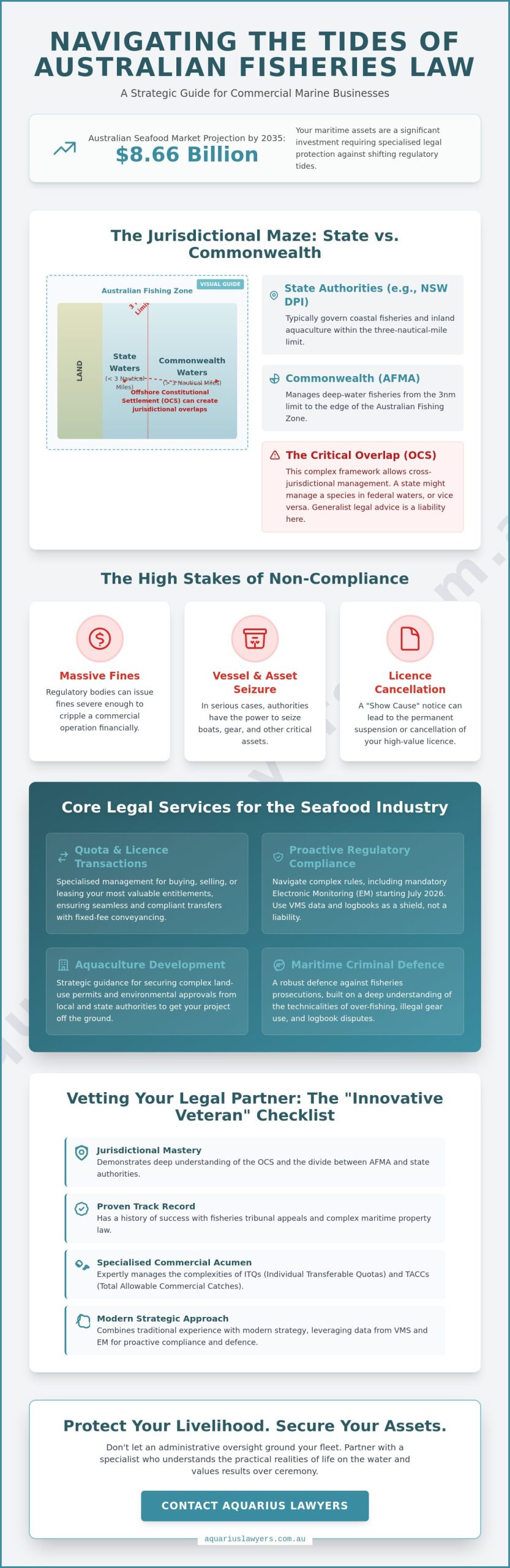
Fisheries law is the rigorous regulation of harvesting aquatic resources across both State and Commonwealth waters. It represents a precise intersection of environmental protection and commercial enterprise. For commercial fishers, aquaculture farmers, and charter operators, the law isn’t just background noise; it’s the foundation of their business. Most legal generalists struggle with the Offshore Constitutional Settlement (OCS). This complex framework determines which government has the power to regulate specific areas or species. Without a specialised fisheries lawyer australia, you risk falling through the cracks of these overlapping jurisdictions. Expert counsel ensures that your operations remain on the right side of the law, regardless of where your gear is in the water.
State vs. Commonwealth Jurisdictions
The three-nautical-mile limit is the traditional boundary in Australian maritime law. Inside this zone, state-based bodies like the NSW DPI or WA Fisheries generally hold sway. They govern coastal fisheries and the rapidly growing inland aquaculture sector. However, the Australian Fisheries Management Authority (AFMA) manages the deep-water fisheries that extend to the edge of the Australian Fishing Zone. The OCS often complicates this by allowing cross-jurisdictional management. A state might manage a specific species deep into federal waters, or the Commonwealth might take over a fishery that hugs the coast. Knowing exactly which set of rules applies to your vessel at any given moment is a legal requirement that demands expert oversight. Generalist advice is a liability when you’re crossing these invisible but legally significant borders.
The High Stakes of Non-Compliance
Non-compliance is an expensive mistake that few marine businesses can afford. Regulatory bodies have the power to issue massive fines that can cripple a commercial operation. In extreme cases, authorities can seize vessels or initiate the permanent cancellation of high-value commercial licences. A “show cause” notice is a particularly dangerous tool. It effectively forces you to prove why your licence shouldn’t be suspended or cancelled, often halting your ability to trade while the matter is resolved. At the heart of most quota disputes is the Total Allowable Catch (TAC). The Total Allowable Catch is the legally binding limit on the total weight of a specific species that can be taken during a fishing season. Mismanaging your quota or failing to account for TAC changes can lead to immediate prosecution and long-term loss of income.
Core Legal Services for the Australian Seafood Industry
Success in the seafood sector relies on a precise legal strategy. A fisheries lawyer australia provides the specialised knowledge needed to manage quotas, licences, and complex maritime assets. Whether you’re a third-generation fisher or an aquaculture startup, your legal needs are distinct from standard commercial operations. A dedicated fisheries lawyer australia understands that these assets are often your most significant investment and require proactive protection.
The legal landscape covers several critical areas that directly impact your bottom line:
- Quota and Licence Transactions: These entitlements are the lifeblood of your operation. Buying, selling, or leasing them involves complex administrative hurdles and strict deadlines that can stop your business in its tracks if mismanaged.
- Regulatory Compliance: With electronic monitoring (EM) becoming mandatory in several fisheries between July 2026 and April 2027, your internal reporting systems must be flawless. Operators seeking expert legal advice for fishers navigating the 2026 regulatory changes should act well before the phase-in deadlines to avoid costly penalties.
- Aquaculture Development: Securing land-use permits and environmental approvals is a multi-layered process involving both local and state authorities.
- Maritime Criminal Defence: If you face charges for over-fishing or illegal gear use, you need a defence that understands the technicalities of the industry.
Commercial Transactions and Asset Protection
Due diligence is non-negotiable in this industry. When purchasing a vessel, you aren’t just buying steel; you’re often buying a history of compliance and specific fishing rights. Smart business structuring combined with secure quota management equals long-term commercial viability. Many operators now utilise maritime property law for fixed-fee conveyancing to ensure these transfers are handled efficiently without hidden costs. If you’re looking to expand your fleet, it’s wise to consult with a specialised maritime legal team early in the process.
Aquaculture and Marine Property Law
Marine-based aquaculture is expanding, but it requires securing long-term leases over public waters. This creates a unique intersection between environmental law and commercial production. You must also account for native title claims, which can impact access to traditional fishing grounds. Navigating these hurdles requires a strategic approach to property law that respects both commercial goals and environmental obligations. Whether you’re dealing with the expansion of gillnetting regulations or new bag limits, having a clear legal pathway is essential for operational stability.
How to Choose a Specialist Fisheries Lawyer in Australia
Choosing a legal representative for your marine business carries significant weight. The wrong advice doesn’t just result in a lost case; it can result in the loss of your family’s legacy. A qualified fisheries lawyer australia must demonstrate an immediate, intuitive grasp of the industry’s unique terminology. If they can’t instantly explain the functional difference between an Individual Transferable Quota (ITQ) and a Total Allowable Commercial Catch (TACC), they aren’t the right fit. You need a partner who understands the sea as well as the law. Securing a fisheries lawyer australia who understands these nuances ensures your business remains resilient against shifting regulations.
Industry knowledge equals operational security. When vetting a specialist, look for these three pillars:
- Proven Track Record: Inquire about their history with AFMA or state fisheries tribunal appeals. A lawyer who hasn’t stepped into a tribunal for a quota dispute lacks the battle-tested experience you need.
- Geographic Reach: Your lawyer should be as mobile as your fleet. Whether you operate out of Sydney, regional NSW, or international waters, your legal support must be able to represent you across multiple jurisdictions.
- Transparent Pricing: Professionalism and pragmatism go hand in hand. Look for firms that offer fixed-fee arrangements for standard transactions like licence transfers or quota leasing.
Specialist vs. Generalist Maritime Lawyers
A general shipping lawyer focuses on hulls, cargo, and collisions. These are important, but they rarely cover the biological cycles and management plans that dictate fisheries regulations. Finding a practitioner with deep industry immersion, often known as “The Fish Lawyer,” provides a distinct advantage. They understand how a change in water temperature or a biosecurity outbreak impacts the legal weight of your permits. This synergy between traditional credentials and modern industry insight is what separates a facilitator from a mere advisor.
Questions to Ask During Your Initial Consultation
Grill your potential representative. Your consultation is a job interview where the stakes are your commercial future. Ask specifically about their experience with your sector, whether it’s abalone, lobster, or trawl fisheries. Inquire about their philosophy on conflict resolution. Do they prefer mediation to settle disputes quickly, or are they prepared for the long haul of litigation? Finally, request a clear breakdown of their fee structure for regulatory compliance audits. Knowing the cost of proactive protection is better than being blindsided by the price of a reactive defence.
Managing Compliance and Defending Fisheries Prosecutions
The moment an inspector steps onto your deck or serves a prosecution notice, the clock starts ticking. Your response in the first 24 hours often dictates the eventual outcome of your case. Taking immediate steps to protect your interests is vital. You should avoid making detailed statements until you’ve consulted a fisheries lawyer australia who understands the nuances of maritime evidence. Silence isn’t an admission of guilt; it’s a strategic pause that allows for a proper legal assessment of the situation.
Evidence gathering is the cornerstone of a successful defence. In the digital age, this involves more than just witness statements. Vessel Monitoring System (VMS) data, electronic logbooks, and AI-driven sensor records are now central to most investigations. While authorities use this data to build a case, a skilled fisheries lawyer australia can use the same data to identify technical glitches or GPS inaccuracies that may undermine the prosecution’s claims. If the data is flawed, the case is flawed. This technical scrutiny can lead to the withdrawal of charges before they ever reach a magistrate.
The Prosecution Process in Australia
The timeline from an initial inspection to the first mention in a Local or District Court can be surprisingly short. Many fisheries offences operate under “strict liability,” meaning the prosecution doesn’t necessarily need to prove you intended to break the law. They only need to prove the act occurred. However, legal expertise can uncover technical flaws in how evidence was collected or handled. Challenging the validity of a search or the calibration of weighing equipment can often provide a pathway to a dismissal. In some instances, we can negotiate “enforceable undertakings,” where a business agrees to specific compliance improvements to avoid the stigma and cost of a criminal conviction.
Proactive Compliance and Risk Management
Prevention is always more cost-effective than a courtroom battle. Implementing robust staff training programmes is a practical way to mitigate vicarious liability, where a vessel owner is held responsible for the actions of their crew. Using modern technology and regular legal audits ensures your operation stays ahead of the latest regulatory shifts. For those operating in state waters, reviewing a Fisheries Compliance in NSW: A Practical Manual can provide a solid foundation for your internal protocols. Combining these proactive steps with expert legal oversight creates a “compliance equation” that results in long-term operational security. If you are currently facing an investigation or want to audit your current systems, contact our maritime defence team today to secure your livelihood.
Protecting Your Livelihood with Aquarius Lawyers
Your commercial fishing operation is more than a business; it’s a livelihood built on years of hard work and significant capital. Protecting that investment requires a fisheries lawyer australia who doesn’t just read the law but understands the sea. Katherine Hawes, known across the industry as ‘The Fish Lawyer,’ brings a unique dual expertise in law and marine science to every matter. This combination ensures your legal strategy is grounded in both biological reality and regulatory precision. We provide a ‘no-nonsense’ approach that cuts through bureaucratic red tape to deliver tangible results.
Why We Are Known as The Fish Lawyer
Aquarius Lawyers has maintained a dedicated focus on the seafood industry since 2005. This long-term commitment has shaped our persona as an ‘innovative veteran’ in the field. We respect traditional industry values while using modern legal tools to secure your commercial assets. Our ‘down-to-earth’ pragmatism helps clients feel reassured, even during the most stressful prosecutions or quota disputes. We move easily between local NSW cases and complex international maritime matters. With offices in both Sydney and Shellharbour, we provide accessible, high-level support for metropolitan and regional clients alike.
Take the Next Step in Securing Your Future
Waiting for an infringement notice is a reactive strategy that puts your commercial entitlements at risk. In an industry where the gross value of Australian fisheries production is forecast to hit $4 billion by 2026–27, you can’t afford to be complacent. A proactive legal review of your licences and commercial contracts is a smart investment in your business’s longevity. We focus on cost-effective solutions that keep your vessels in the water and your operations running smoothly. Our goal is to provide the clarity and confidence you need to grow your marine business with certainty. A specialised fisheries lawyer australia is the bridge between regulatory compliance and commercial success.
Take control of your legal standing before the next season begins. Our team offers the intellectual versatility to handle everything from debt recovery to complex litigation. Contact Aquarius Lawyers to protect your fisheries interests today and secure the future of your maritime assets.
Secure Your Commercial Future on the Water
Navigating the divide between State and Commonwealth waters isn’t just about geography; it’s about protecting your commercial survival. You’ve seen how the right fisheries lawyer australia can turn a complex regulatory burden into a manageable operational framework. By prioritising proactive compliance and understanding the technicalities of quota management, you ensure your fleet remains productive and protected. It’s about combining traditional maritime wisdom with modern legal strategy to stay ahead of the curve and avoid the high costs of litigation.
Led by Katherine Hawes, widely recognised as “The Fish Lawyer”, our team brings over 20 years of specialised experience to your maritime challenges. We operate from strategic offices in Sydney and Shellharbour, providing a “no-nonsense” pathway to success for clients across all of NSW. We understand that your business doesn’t stop at the shoreline, and neither does our support. We’re here to provide the clarity you need to make informed decisions for your crew and your family legacy.
Secure your commercial fishing future with The Fish Lawyer; Book a consultation today
Your livelihood on the water is worth defending. With the right legal partner by your side, you can face the next season with total confidence and clarity.
Frequently Asked Questions
What is the difference between a maritime lawyer and a fisheries lawyer?
A maritime lawyer typically handles broad shipping issues like cargo disputes, vessel collisions, and salvage rights. In contrast, a fisheries lawyer australia focuses on the niche regulation of harvesting aquatic resources, including Individual Transferable Quotas (ITQs) and AFMA compliance. This specialised focus is the difference between general shipping advice and the technical protection of your commercial fishing entitlements.
Can a fisheries lawyer help me appeal a licence suspension in NSW?
Yes, we can represent you in appealing a licence suspension through the NSW Civil and Administrative Tribunal (NCAT) or by negotiating directly with the NSW DPI. We review the evidence used to justify the suspension to identify procedural errors or technical flaws. Acting quickly is essential to minimise the time your vessel is forced to stay in port and lose income.
How much does it cost to hire a fisheries lawyer for a quota transfer?
The cost of managing a quota transfer varies based on the complexity of the entitlements and whether the transaction involves multiple state or federal jurisdictions. While we don’t provide a one-size-fits-all price, we prioritise transparent fee structures to help you manage your business overheads. Factors like the requirement for security interests or complex leasing terms will influence the total investment required.
What should I do if my fishing vessel is arrested by authorities?
You should seek immediate legal advice and avoid making any formal statements to authorities until your lawyer is present. You have the right to review the seizure warrant and understand the specific grounds for the arrest of the vessel. We work to negotiate the release of your asset or secure a bond so you can return to operation while the legal matter is resolved.
Does Aquarius Lawyers handle aquaculture development approvals?
Aquarius Lawyers provides comprehensive legal support for aquaculture development, including navigating environmental approvals and land-use permits. We understand the intersection of commercial production and environmental law. Our team helps you secure the necessary leases and permits to ensure your fish farm remains compliant with both state and federal regulations from the outset.
Can you represent commercial fishers in interstate or international waters?
We represent commercial fishers across all Australian states, Commonwealth waters, and in international maritime jurisdictions. Our expertise covers the Australian Fishing Zone managed by AFMA as well as high-seas operations. This broad reach is essential for fleets that follow migratory stocks or operate across different legal boundaries throughout the fishing season.
Is it possible to avoid a criminal record for a minor fisheries offence?
Avoiding a criminal record for a minor offence is often possible through “enforceable undertakings” or by demonstrating a robust history of compliance. A fisheries lawyer australia can negotiate with prosecutors to reach a resolution that focuses on education and improved internal systems rather than a conviction. This proactive approach keeps your record clean and protects your future licence applications.
Do you offer fixed-fee services for commercial fishing contract reviews?
Yes, we offer fixed-fee arrangements for standard commercial fishing contract reviews and licence transfers to provide our clients with cost certainty. This approach reflects our pragmatic, “no-nonsense” attitude toward legal fees. You’ll know the costs upfront, allowing you to make practical business decisions without the fear of hidden administrative charges or unexpected hourly billing.
Disclaimer
Please note that legal rules change and this is not a substitute nor construed as legal advice. It is general information only.