
What if the commercial fishing asset you’ve spent decades building was one administrative oversight away from total forfeiture? For many Australian fishers, the sheer volume of red tape and the constant fear of licence cancellation feel like an anchor dragging on their livelihood. You understand that staying compliant is no longer just about good practice; it’s about survival in an era where mandatory electronic monitoring is rapidly expanding across the Commonwealth Trawl and Northern Prawn sectors.
Seeking specialised fisheries management act advice is the most effective way to turn complex regulations into a shield for your business. This article provides the expert legal clarity you need to protect your fishing quotas, defend against fisheries prosecution, and ensure your licence renewals are handled with precision. We will explore the latest 2026 AFMA ministerial directions, clarify the blurred lines between state and Commonwealth jurisdictions, and outline a clear pathway for secure asset transfers. By combining traditional industry experience with modern legal strategy, you can move past the stress of compliance and focus on what you do best: working the water.
Key Takeaways
- Secure specialised fisheries management act advice to navigate “strict liability” offences where your intentions won’t protect you from significant penalties or licence loss.
- Master the 3-nautical-mile rule to correctly identify whether you are operating under Commonwealth or NSW state jurisdiction to avoid costly administrative errors.
- Treat your Statutory Fishing Rights (SFRs) as high-value proprietary assets by implementing strategic legal frameworks for every lease, sale, or transfer.
- Prepare for the reality of boardings and inspections by understanding your rights and obligations the moment a fisheries officer steps onto your vessel.
- Bridge the gap between traditional fishing experience and modern legal requirements with a pragmatic, results-oriented approach to maritime and commercial law.
Understanding the Fisheries Management Act: Why Expert Advice Matters
The Fisheries Management Act 1991 (Cth) and its state counterparts, such as the Fisheries Management Act 1994 (NSW), form the backbone of Australia’s maritime regulatory system. These laws aren’t just guidelines; they’re rigid frameworks designed to control every aspect of commercial fishing from the gear you use to the exact coordinates where you drop your nets. Securing professional fisheries management act advice is about more than just paperwork. It’s about building a defensive perimeter around your business assets.
One of the most confronting aspects of this legislation is the concept of “strict liability.” While in most areas of criminal law, a criminal defence lawyer Melbourne would focus on the prosecution’s burden to prove you intended to commit a crime, in fisheries law, intent is often irrelevant. If your vessel is found in a restricted zone or your catch exceeds your quota, the offence is committed regardless of whether it was a genuine mistake or a technical glitch. The stakes are incredibly high. A single conviction can lead to a permanent criminal record, hundreds of thousands of dollars in fines, and the mandatory forfeiture of your vessel and gear. Generic legal advice often fails here because generalist lawyers don’t understand the technical nuances of marine charts, quota leasing, or the specific evidentiary requirements of maritime tribunals.
The Role of the Australian Fisheries Management Authority (AFMA)
The Australian Fisheries Management Authority (AFMA) is the federal body responsible for the efficient management and sustainable use of Commonwealth fish resources. Under the Fisheries Administration Act 1991, AFMA develops and implements management plans that dictate the daily operations of fishers across the Australian Fishing Zone. They aren’t just administrators; they’re an enforcement powerhouse. AFMA acts as the primary guardian of the Australian Fishing Zone, wielding the statutory power to monitor, inspect, and prosecute to ensure the long-term sustainability of our marine resources. Their reach includes mandatory electronic monitoring and at-sea inspections that can happen without notice.
The Importance of Timely Legal Consultation
Proactive legal strategy is always more cost-effective than a reactive court defence. Waiting until you receive a summons is a gamble you can’t afford to take. A specialised fisheries lawyer helps you interpret evolving 2026 ministerial directions and ensures your operational procedures align with the latest compliance standards. At Aquarius Lawyers, we bridge the gap between gritty industry reality and complex legal requirements. Led by Katherine Hawes, known as “The Fish Lawyer,” we provide a steady, common-sense guide through the regulatory fog. We specialise in turning fisheries management act advice into a practical roadmap for asset protection, ensuring that your licences and quotas remain secure for the next generation.
Commonwealth vs State Jurisdictions: Navigating the Legal Maze
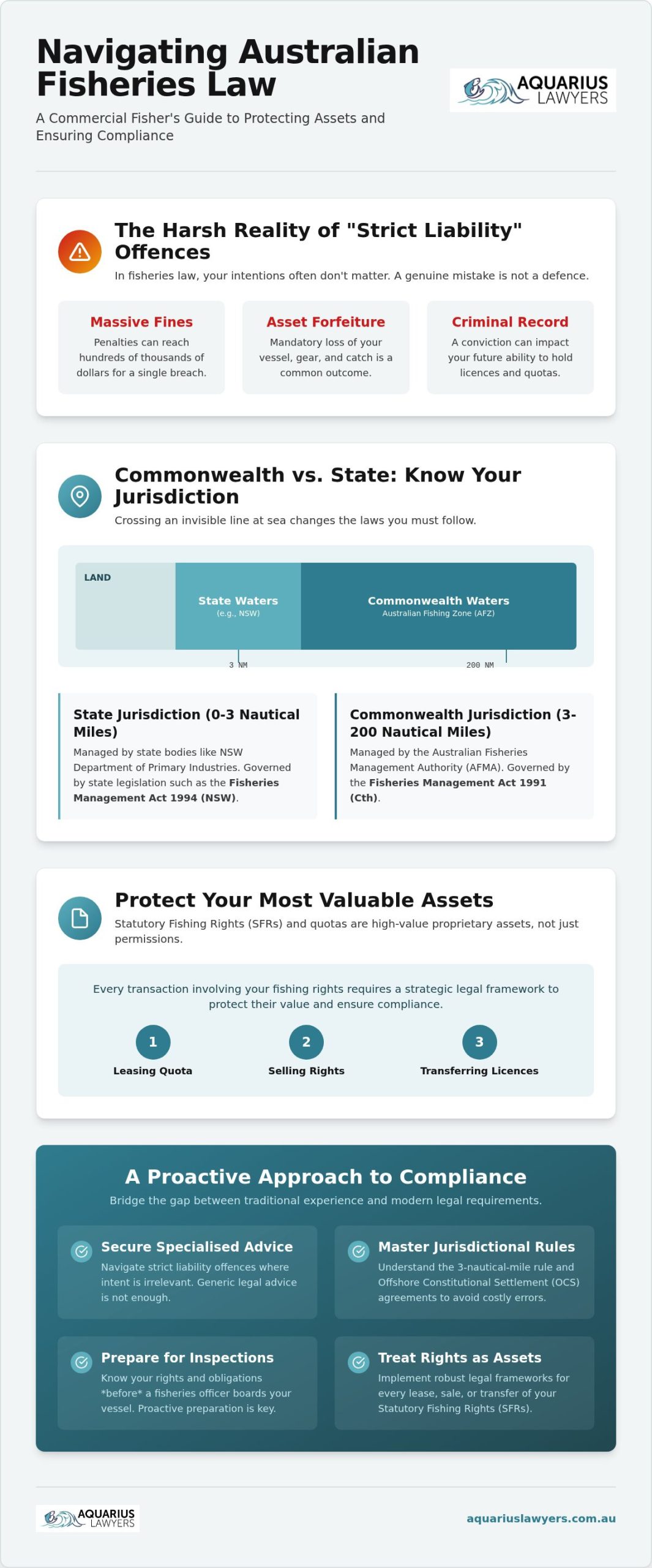
Crossing an invisible line in the ocean can be the difference between a routine haul and a massive fine. In Australia, the legal landscape is split between state and federal oversight. Most state-managed waters extend from the low-water mark out to the three-nautical-mile limit. Beyond that, you enter the Australian Fishing Zone (AFZ), which reaches out to 200 nautical miles and falls under the Fisheries Management Act 1991. This distinction is vital because the rules, reporting requirements, and enforcement agencies change the moment you cross that boundary.
To manage species that don’t respect these legal boundaries, the government uses the Offshore Constitutional Settlement (OCS). This agreement allows a single jurisdiction to manage a specific fishery across both state and federal waters. It sounds simple, but it creates a complex legal maze where a NSW-licensed fisher might suddenly find themselves bound by Commonwealth management plans. Professional fisheries management act advice is essential here to ensure your vessel stays compliant regardless of which side of the line you’re on.
Fisheries Management in New South Wales
NSW fisheries are governed by the Fisheries Management Act 1994 (NSW) and overseen by the Department of Primary Industries and Regional Development. For operators in Sydney or regional ports like Shellharbour, compliance often involves strict gear restrictions and local catch reporting. Common pitfalls include fishing in protected marine parks or failing to update digital logbooks correctly. If you are unsure about your state obligations, reaching out for specialised marine law support can prevent an accidental breach that puts your livelihood at risk.
Commonwealth Managed Fisheries
Commonwealth fisheries target high-value species like tuna, billfish, and deep-water prawns. These are managed by AFMA and often require high-tech compliance tools. As of 2026, the expansion of mandatory Electronic Monitoring (EM) means the federal government is watching your deck in real-time. Legal challenges often arise when operators hold both state and federal permits but fail to reconcile the conflicting reporting standards. This jurisdictional overlap is where many fishers get caught out, leading to heavy penalties under the federal Act. Getting the right fisheries management act advice ensures you have a strategy that covers both jurisdictions, protecting your assets from the high seas back to the wharf.
Statutory Fishing Rights and Quota Management: Protecting Your Assets
Statutory Fishing Rights (SFRs) are the most valuable assets in a commercial fisher’s portfolio. Unlike a temporary permit, an SFR is a form of proprietary interest. It grants the holder a long-term right to a specific portion of the Total Allowable Catch (TAC) or a specific amount of fishing effort. Because these rights can be bought, sold, or leased, they must be treated with the same legal rigour as real estate or intellectual property.
When seeking fisheries management act advice, it’s crucial to understand that the Register of Statutory Fishing Rights serves as the definitive record of ownership and encumbrances. Conducting thorough due diligence on this register before any transaction is the only way to ensure the asset you’re buying is free of undisclosed debts or legal disputes. Structuring commercial fishing contracts requires a precise blend of industry knowledge and legal strategy. A well-drafted agreement should clearly define the duration of the lease, the responsibility for levy payments, and the consequences of a compliance breach by the operator. Without these protections, a quota owner risks losing their asset due to the actions of a third party.
Licensing and Permit Compliance
While an SFR is a permanent right, a fishing permit is typically short-term and subject to more frequent regulatory changes. Pitfalls often arise during the renewal window; missing a deadline by even 24 hours can lead to an immediate licence suspension. A “show cause” notice is a formal legal warning that requires a detailed and persuasive response to prevent the permanent cancellation of your fishing concessions. We ensure your documentation is airtight so that administrative oversights don’t turn into business-ending events.
Disputes Over Quota and Commercial Agreements
Conflicts frequently flare up between quota owners and vessel operators over catch reporting and levy distributions. Structural changes, such as government buy-backs or the 2025-2026 AFMA levy adjustments, can further complicate these relationships. For example, the Coral Sea Fishery permit cost of $15,271.40 or the Southern Bluefin Tuna levy of $0.35087 per SFR can become points of contention if not clearly accounted for in contracts. Aquarius Lawyers specialises in commercial litigation for the fishing industry, offering a steady hand when disputes threaten your operations. We focus on pragmatic resolutions that protect your proprietary interests and ensure your business remains viable in a shifting regulatory environment.
Prosecution Defence and Compliance: When the Fisheries Officer Knocks
When a fisheries officer steps onto your deck or meets you at the wharf, the situation is instantly high-stakes. In 2025, AFMA conducted 223 domestic boat inspections and 107 port visits, proving that compliance checks are a routine but rigorous part of the commercial fishing industry. You have a legal obligation to cooperate, but you also have rights that protect your business from overreach. The moment an inspection begins, every word you say and every logbook entry you provide becomes potential evidence. Maintaining precise records with FishingStat can assist in demonstrating compliance during these boarding procedures.
If you are served with a summons or a notice of prosecution, the clock starts ticking immediately. Professional fisheries management act advice is essential to navigate the gap between a minor infringement and a business-ending conviction. While many offences are “strict liability,” meaning your intent doesn’t matter, a skilled legal team can often argue a defence of “honest and reasonable mistake of fact.” This requires proving that you held a genuine belief in a set of facts that, if true, would have made your actions lawful. Success in these some cases often hinges on expert evidence, such as technical data from your Vessel Monitoring System (VMS) or testimony from maritime surveyors.
Compliance is a daily discipline, not a yearly event. With the expansion of mandatory Electronic Monitoring (EM) into the Commonwealth Trawl sector as of July 1, 2026, your operations are under more scrutiny than ever. Logbook errors or delays in reporting can trigger red flags in AFMA’s system, leading to heavy penalties. For instance, failing to adhere to the Redfish “move-on” rule implemented on May 1, 2026, can result in immediate shot-based exclusions. A proactive audit of your records and VMS requirements can identify these technical traps before they lead to a prosecution. If you’re concerned about your current compliance standing, it’s time to get a professional legal review of your operational procedures.
Defending Your Livelihood in Court
Fisheries cases in NSW typically move through the Local Court or the Land and Environment Court, depending on the severity of the charge. The goal is always the same: mitigate penalties and avoid the catastrophic forfeiture of your vessel. Strategies for defence involve challenging the accuracy of the prosecution’s data or demonstrating a robust history of compliance. Katherine Hawes, “The Fish Lawyer,” specialises in representing fishers in these specialised tribunals, bringing a “no-nonsense” approach to the bar table. We understand that a court case isn’t just about a fine; it’s about protecting the licence that supports your family. By securing expert fisheries management act advice early, you gain a steady guide who can turn a complex legal threat into a manageable resolution.
Strategic Solutions with Aquarius Lawyers: Securing Your Fishing Future
Protecting your livelihood in a sector as volatile as commercial fishing requires more than just a general understanding of the law. It demands a partner who understands the difference between a trawl and a gillnet. Katherine Hawes, widely known as “The Fish Lawyer,” has spent years bridging the gap between deck-level reality and courtroom rigour. At Aquarius Lawyers, we don’t just provide fisheries management act advice; we provide a defensive strategy built on deep industry passion and legal excellence. Our firm operates with a “no-nonsense” pragmatism that values tangible results over legal ceremony.
We specialise in cost-effective, technology-integrated solutions. By using modern tools to manage maritime compliance, we help you stay ahead of AFMA’s mandatory electronic monitoring requirements and evolving ministerial directions. Whether you are operating out of Sydney or a regional port like Shellharbour, our team is accessible and ready to act. We believe that professional expertise plus pragmatic strategy equals business security. This formula ensures that your fishing assets remain protected while you focus on the water.
The Aquarius Lawyers Advantage
Our niche expertise in aquaculture and marine law is a significant advantage for commercial operators. We understand the specific pressures of maritime tribunals and the complexities of the Land and Environment Court. This specialised knowledge often allows us to resolve disputes out of court, saving you the stress and expense of protracted litigation. While we are based in NSW, we handle international maritime matters with a local perspective, ensuring that Australian fishers are represented fairly on the global stage. Our track record is built on the synergy between traditional experience and forward-thinking methodology.
Get Proactive: Your Pathway to Compliance
The best time to seek fisheries management act advice is before a fisheries officer steps onto your vessel. We offer comprehensive compliance health checks to identify potential risks in your reporting systems or quota management. This proactive approach is a small investment compared to the heavy fines or vessel forfeiture that follow a prosecution. Our commitment to the Australian fishing industry is unwavering; we act as a facilitator of outcomes for those who feed the nation. If you want to secure your fishing future and move forward with confidence, Contact Aquarius Lawyers today for expert Fisheries Management Act advice. Let us help you navigate the red tape so you can get back to what matters.
Protect Your Business Against the Regulatory Tide
Navigating the complex waters of Australian maritime law requires more than just a sturdy vessel and a seasoned crew. It demands a proactive legal strategy that accounts for strict liability offences and the shifting boundaries between state and Commonwealth jurisdictions. By treating your Statutory Fishing Rights as protected proprietary assets and maintaining rigorous compliance records, you turn potential liabilities into a foundation for long-term growth.
Principal Katherine Hawes is a recognised expert in Marine and Fisheries Law with a deep understanding of both the Sydney and regional NSW fishing sectors. Whether you need a compliance health check or assistance with a complex quota transfer, our firm provides the specialised fisheries management act advice required to keep your operations on course. We offer fixed-fee options for specific commercial transactions to ensure our expert counsel remains accessible and transparent.
Don’t wait for a notice of prosecution to safeguard your future. Secure your livelihood—book a consultation with The Fish Lawyer today. With the right legal partner, you can face the next inspection with total confidence and keep your focus where it belongs: on the water.
Frequently Asked Questions
What is the difference between Commonwealth and NSW fisheries law?
Commonwealth law governs the Australian Fishing Zone from three to 200 nautical miles offshore, primarily via the Fisheries Management Act 1991. Conversely, the Fisheries Management Act 1994 (NSW) controls coastal waters within that three-mile limit. While they share sustainability goals, their management plans and reporting systems differ significantly. Getting the right fisheries management act advice ensures you don’t inadvertently breach federal rules while holding a state-based licence, especially where Offshore Constitutional Settlements apply.
Can I lose my boat if I am found guilty of a fisheries offence?
Yes, vessel forfeiture is a significant risk for serious or repeat breaches of Australian fisheries law. Under both Commonwealth and NSW legislation, courts have the power to order the permanent seizure of your boat, gear, and catch upon conviction. This often occurs in cases involving fishing in closed zones or exceeding quotas by a substantial margin. Asset protection is why seeking specialised legal counsel early is so vital for every commercial operator.
What should I do if a fisheries officer wants to interview me?
You should remain polite and provide any legally required documentation, such as your fishing licence or logbooks, immediately. However, you aren’t required to participate in a formal interview or answer questions that might incriminate you without legal representation. It’s best to calmly state that you wish to seek fisheries management act advice before making a statement. Contacting a lawyer before the interview ensures your rights are protected and prevents accidental admissions.
How do I legally transfer a commercial fishing quota in NSW?
Transferring commercial fishing quota in NSW requires a formal application through the Department of Primary Industries and Regional Development. You must ensure the quota is clearly registered and free of any undisclosed encumbrances. Because quota is a high-value proprietary asset, we recommend using a solicitor to draft a formal transfer agreement. This contract protects your financial interests and ensures the legal title passes correctly without triggering administrative delays or compliance red flags.
Is a mistake of fact a valid defence under the Fisheries Management Act?
A “mistake of fact” can be a valid defence, but it’s difficult to prove in court. Because most fisheries offences are “strict liability,” the prosecution doesn’t need to prove you intended to break the law. To succeed with this defence, you must demonstrate you held an honest and reasonable belief in a set of facts that would have made your actions legal. This often requires technical evidence from GPS systems or maritime charts.
What are the reporting requirements for VMS under the 1991 Act?
Under the 1991 Act, the Vessel Monitoring System (VMS) requires your boat to transmit automated location data 24 hours a day. You must ensure the unit is operational before leaving port and stays on for the duration of your trip. If the unit fails, you’re required to notify AFMA immediately and follow their manual reporting instructions. Tampering with or failing to maintain your VMS can lead to immediate prosecution and licence suspension.
How can a fisheries lawyer help with a licence suspension?
A fisheries lawyer helps by reviewing the specific grounds for your suspension and identifying any administrative errors made by the regulator. We specialise in drafting formal responses to “show cause” notices, which are your primary opportunity to prevent a permanent licence cancellation. By providing a steady, common-sense guide through the appeal process, we can often negotiate a return to work or a reduced penalty that keeps your business viable.
Do I need a lawyer for a Fisheries Appeal Tribunal hearing?
While you’re allowed to represent yourself, having a lawyer is a major advantage in a Fisheries Appeal Tribunal. These hearings are highly technical and focus on complex administrative law rather than just the facts of your catch. A lawyer with niche expertise in maritime law understands how to present evidence and cross-examine witnesses effectively. This professional rigour often makes the difference between a successful appeal and losing your commercial fishing rights permanently.
Disclaimer
Please note that legal rules change and this is not a substitute nor construed as legal advice. It is general information only.