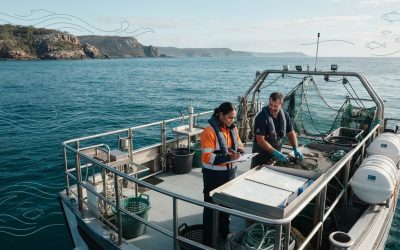
Imagine the sinking feeling when a Fisheries Officer informs you that your gear, your catch, or even your vessel is being seized. For a commercial fisher, a single allegation of a regulatory breach isn’t just a fine; it’s a direct threat to your family’s future and your hard-earned reputation. Navigating the complex web of DPI regulations requires more than just a basic solicitor. While international services like Barristers Direct highlight a shift towards direct access to specialist counsel, here in Australia, you need a dedicated fisheries prosecution defence that understands the technical realities of the industry. It’s a high-stakes environment where traditional legal skills must meet modern maritime expertise to keep you on the water.
We understand that facing court is incredibly stressful, especially when your commercial quota and assets are on the line. You’ve worked too hard to let a procedural error or a misunderstanding of the 2026 enforcement changes end your career. This article explains how Katherine Hawes, known as “The Fish Lawyer,” provides the steady, common-sense guidance needed to challenge charges and protect your livelihood. We’ll break down the strategic pathways to achieving withdrawn charges, reduced penalties, and the security of your fishing licences in both Local and District Courts.
Key Takeaways
- Recognise that fisheries charges are specialised criminal proceedings that put your commercial licence, vessel, and livelihood at immediate risk.
- Understand how “strict liability” under the Fisheries Management Act 1994 (NSW) impacts your case and why early legal intervention is vital.
- Discover how a robust fisheries prosecution defence can challenge the technical accuracy of weighing equipment and the validity of search and seizure procedures.
- Learn the critical steps to take after receiving a “Notice to Produce” to ensure you are properly prepared for Local or District Court appearances.
- Leverage the unique “innovative veteran” expertise of Katherine Hawes, “The Fish Lawyer,” to protect your commercial quotas and professional reputation.
Fisheries Prosecution Defence in Australia: Understanding the Stakes
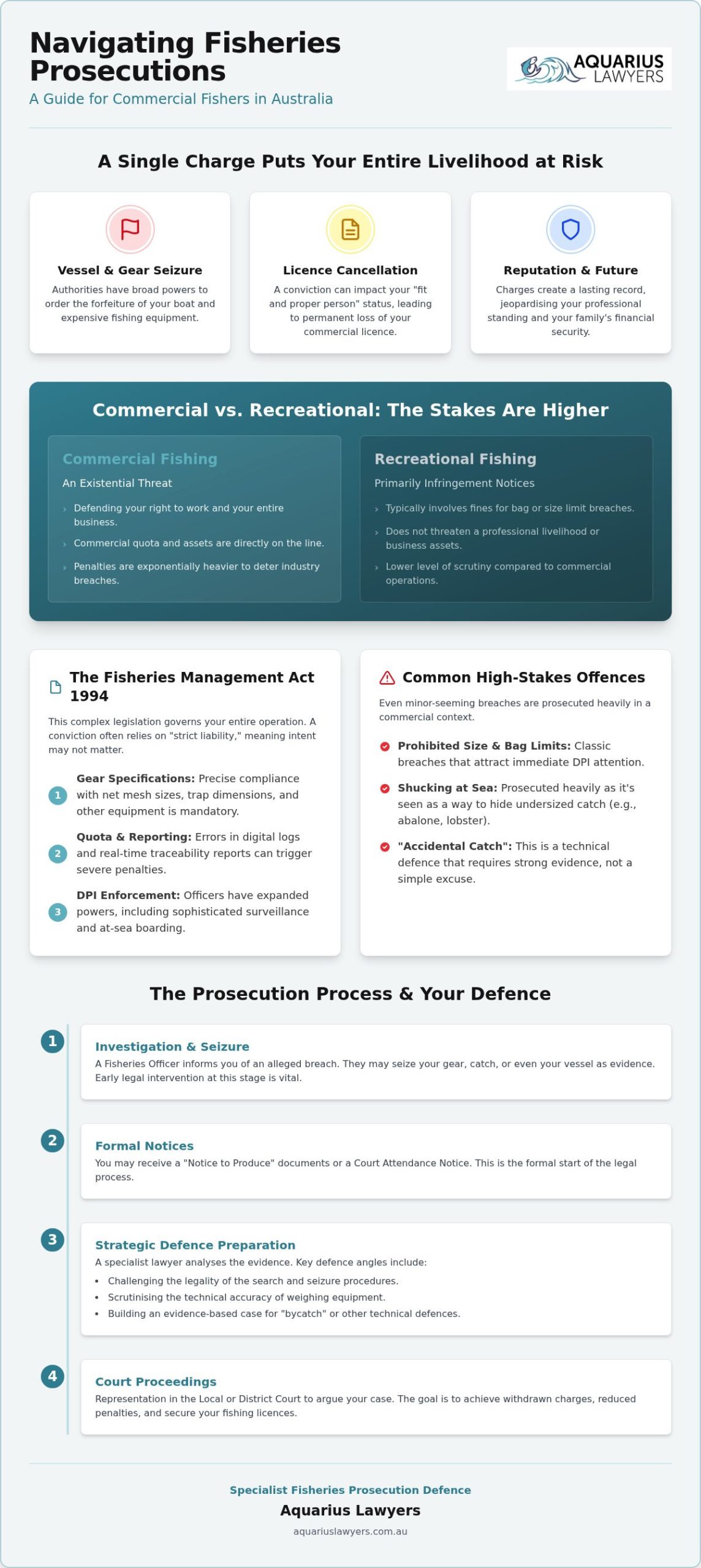
A fisheries prosecution isn’t a simple administrative hurdle; it’s a specialised criminal proceeding. When you’re charged with a regulatory breach, you’re entering a legal arena where the technicality of the gear and the burden of proof can make or break your case. A conviction in these matters carries weight far beyond a standard fine. We’ve seen cases where even minor infractions lead to the permanent cancellation of commercial licences. This is why a proactive fisheries prosecution defence is essential from the moment you’re contacted by authorities.
Under Australian law, the penalties are designed to be a significant deterrent. This means the court has the power to order the forfeiture of your boat, your catch, and your expensive fishing gear. It’s a devastating blow to any business. Fisheries officers carry broad powers of search and seizure that often exceed those of standard police officers. These powers must be legally scrutinised. Our approach ensures that every piece of evidence, from how your vessel was boarded to how your catch was measured, is held to the highest legal standard. If the procedure was flawed, the prosecution’s case may be as well.
Commercial vs. Recreational Prosecution
Recreational fishers often face infringement notices for bag limit breaches, but for commercial operators, the stakes are existential. A commercial charge directly threatens your quota and your “fit and proper person” status. Under the 2026 enforcement changes, if the DPI deems you no longer fit to hold a licence, your career ends. Commercial fishers face higher scrutiny because they operate within a regulated economic framework. This higher standard means the penalties are exponentially heavier, and the prosecution’s focus is much sharper. You aren’t just defending a fine; you’re defending your right to work.
The Role of NSW Fisheries and the DPI
The Department of Primary Industries (DPI) acts as the primary enforcement body in NSW, often coordinating with the Australian Fisheries Management Authority (AFMA) on Commonwealth jurisdictional matters. Following the 2026 Enforcement Bill, fisheries officers now possess expanded powers to tackle black market sales and improve traceability. They use sophisticated surveillance, including aerial drones and at-sea boarding, to gather evidence. They don’t just look at what’s on your deck; they examine your digital logs and GPS data. Having a legal expert present during the initial investigation phase is critical. It ensures your rights are protected while officers exercise these broad authorities.
Navigating the Fisheries Management Act and Compliance
The Fisheries Management Act 1994 is the primary framework governing every cast and haul in NSW waters. Its core objectives are to conserve fish stocks and protect marine habitats while providing a sustainable future for the industry. For a commercial fisher, this legislation isn’t just a set of rules; it’s a technical manual that dictates every aspect of your operation. Compliance isn’t just about the fish in the bin. It’s about the exact mesh size of your nets and the specific dimensions of your traps. A variance of just a few millimetres in gear specifications can be enough to trigger a formal investigation.
Quota management and reporting have become increasingly tech-reliant. Under the latest 2026 regulations, digital logging and real-time traceability are no longer optional. Errors in these reports, or a failure to account for “shucked” seafood, can lead to severe penalties. The law assumes you’re an expert in these regulations. When a discrepancy is found, the burden often shifts to you to explain why you shouldn’t face prosecution. This is where a strategic fisheries prosecution defence becomes your most valuable asset on the water.
Common Offences and Regulatory Breaches
Offences regarding prohibited size classes and bag limits are the most frequent triggers for DPI action. Authorities take an especially dim view of “shucked” abalone or lobster found on a vessel. Shucking at sea is often prosecuted heavily because it’s seen as a method to hide undersized catch or bypass traceability. While you might argue an “accidental catch” or “bycatch” scenario, this isn’t a simple excuse. It’s a technical defence that requires proof of gear selectivity and environmental factors. If you’re worried about how your current gear or reporting methods might look under a microscope, seeking advice on fisheries law can help you identify and fix vulnerabilities before they reach a courtroom.
Strict Liability and Its Defences
Most fisheries offences are “strict liability” matters. This means the prosecution doesn’t have to prove you intended to break the law; they only need to prove the event happened. It’s a tough standard, but it isn’t unbeatable. The “Honest and Reasonable Mistake of Fact” defence is a common pathway in a fisheries prosecution defence. To succeed, you must demonstrate that you held a genuine belief in a set of facts that, if true, would have made your actions lawful. We use technical evidence, such as GPS data, gear certification, and maintenance logs, to show that you took all reasonable steps to remain compliant. We don’t just argue the law; we argue the technical reality of your day-to-day work.
Strategic Defence: How to Challenge a Fisheries Charge
Defending a fisheries charge is a technical battle of centimetres and seconds. When the DPI brings a case, they rely heavily on the assumption that their equipment is infallible and their procedures are beyond reproach. A successful fisheries prosecution defence starts by dismantling that narrative. We look at the investigation from the ground up, starting with the validity of the search and seizure. While officers have broad powers, they must still act within the scope of their authority. If a vessel was boarded or a vehicle searched without the proper legal triggers, the resulting evidence may be vulnerable to challenge in court.
Negotiation is also a vital tool in our kit. In many instances, the most efficient outcome isn’t a protracted trial but a strategic settlement. We frequently engage with prosecutors to have charges withdrawn or reduced to an infringement notice, which avoids a criminal conviction. Looking at illegal fishing prosecution outcomes shows that the authorities are prepared to pursue heavy fines and even imprisonment for repeat or serious offences. This makes it crucial to have an advocate who can speak the technical language of the industry while navigating the nuances of the criminal justice system.
Challenging Technical Evidence
The DPI’s case often hangs on a single measurement or a specific weight. We scrutinise the calibration of scales, measuring tapes, and calipers used in the field. If a scale wasn’t certified or a measuring tape was worn, the “certainty” of the prosecution’s evidence disappears. We also look for procedural errors in the investigation report, such as failures in the chain of custody. If biological evidence like abalone or finfish wasn’t stored and tagged correctly, its reliability as evidence is compromised. In these moments, we often bring in independent expert witnesses in marine biology or gear technology to provide a counter-perspective that the court can’t ignore.
The “Fit and Proper Person” Argument
For commercial operators, the real danger isn’t just a fine; it’s the “fit and proper person” test. Under the 2026 enforcement bill, a conviction can trigger an automatic review of your licence suitability. We focus on protecting this status by highlighting your compliance history and professional reputation. We use character references and evidence of your investment in sustainable practices to demonstrate that the alleged breach was an isolated incident rather than a pattern of behaviour. This proactive approach aims to prevent the permanent loss of your fishing business and ensures you can keep working while the legal process unfolds.
The Prosecution Process: From Infringement to Local Court
The journey from a day on the water to a day in court often begins with a “Notice to Produce.” This is a formal request from the DPI for your logs, GPS data, or sales records. It’s a critical information-gathering phase, and how you respond can dictate the entire direction of your case. If the authorities decide to move forward, you’ll receive a court summons rather than a simple fine. This marks the transition from an investigation to a formal prosecution. Unlike an infringement notice, which you can often settle by paying a penalty, a prosecution is a criminal matter that requires a strategic fisheries prosecution defence to protect your record.
Your first appearance is known as the “mention.” This is a procedural step where the court checks if you’ve sought legal advice and how you intend to plead. It’s a common mistake to show up and try to “explain your side” to the Magistrate immediately. Doing so without seeing the “Brief of Evidence” is a massive risk. The brief contains every statement, photo, and technical report the prosecution intends to use against you. We meticulously review this document to find the gaps in their narrative. If you’ve received a summons, you need an expert to review your brief of evidence before your first court date to ensure no procedural errors go unchallenged.
To Plead or Not to Plead?
Deciding your plea is a tactical choice. An early guilty plea can result in a 25% sentencing discount, but it shouldn’t be your default setting. In many cases, we can draft “Written Representations” to the DPI. These are formal legal arguments that highlight flaws in their case or mitigating circumstances, often leading to charges being withdrawn before they ever reach a hearing. If the matter must proceed and the breach is minor, we often aim for a “Section 10” dismissal. This is a result where the court finds you guilty but chooses not to record a conviction, which is the best way to safeguard your “fit and proper person” status.
Appealing a Fisheries Decision
If a Local Court result doesn’t go your way, you have the right to appeal to the District Court. This is a fresh look at the evidence or the severity of the sentence. For matters involving licence suspensions or quota cancellations, the battle often moves to administrative tribunals like NCAT. These bodies focus on the fairness of the DPI’s administrative decisions rather than just the criminal charge. Time is your enemy here. Most appeals must be lodged within 28 days of the decision. Acting briskly ensures you don’t lose your right to challenge a ruling that could end your commercial fishing career.
Why Specialist Representation Matters: The Aquarius Lawyers Advantage
When your livelihood is on the line, a generalist criminal lawyer simply won’t cut it. Fisheries law is a highly technical field where a missed detail in a gear specification or a misunderstanding of a quota report can lead to disaster. This is where Katherine Hawes, known across the industry as “The Fish Lawyer,” provides a decisive edge. Her expertise isn’t just academic. It’s built on years of operating at the precise intersection of maritime, commercial, and criminal law. We understand that a successful fisheries prosecution defence requires more than just a knowledge of the courtroom; it requires a deep, practical understanding of how things work on the wharf and at sea.
General law firms often approach these cases as standard criminal matters. They might focus on the law but miss the technical nuances of the DPI’s measurement procedures or the specific exemptions for bycatch. Aquarius Lawyers takes a different path. We provide a “no-nonsense” approach that prioritises results over ceremony. We speak the language of the industry, from the intricacies of the Fisheries Management Act to the latest digital logging requirements. This intellectual versatility allows us to move easily between challenging a search warrant and negotiating a complex commercial quota dispute.
A Pathway to Resolution
Our “innovative veteran” methodology is designed to save you time and money by getting to the heart of the matter quickly. We don’t just wait for a court date; we are proactive. This often involves providing compliance advice that helps you avoid the DPI’s radar altogether. If you’re already facing charges, we work to find a resolution that keeps you on the water. With offices in Sydney and Shellharbour, we provide accessible, expert representation for fishers across regional NSW. Whether you’re a small-scale operator or a large commercial fleet, we offer the grounded, steady guidance you need during a high-pressure investigation.
Protecting Your Future on the Water
The formula for a successful outcome is simple: Specialist Knowledge + Strategic Defence = Protected Livelihood. By combining traditional legal credentials with modern maritime tech knowledge, we ensure that your business isn’t dismantled by a procedural error or an overzealous prosecution. Don’t risk your commercial quota or your reputation by hiring a lawyer who doesn’t know a trap from a net. You’ve worked too hard for your assets to lose them to a generalist who doesn’t understand the stakes of your industry. It’s time to secure the specialised protection your business deserves.
Speak with The Fish Lawyer today and take the first step towards resolving your fisheries matter with confidence.
Secure Your Future on the Water with Specialist Legal Protection
A fisheries charge doesn’t have to mean the end of your commercial career. Success in these matters depends on a clear strategy: Technical Scrutiny + Procedural Precision = Protected Assets. By understanding the nuances of the Fisheries Management Act 1994 and challenging every piece of evidence, you can mount a robust challenge against DPI allegations. Specialist representation ensures that your “fit and proper person” status remains intact, preventing the permanent loss of your commercial quotas and hard-earned reputation.
Katherine Hawes, Australia’s leading “Fish Lawyer,” brings a unique blend of maritime and criminal law expertise to every case. With a proven track record in both NSW Local and District Courts, Aquarius Lawyers provides the steady, down-to-earth guidance needed to navigate complex investigations. A strategic fisheries prosecution defence is your most effective tool for achieving withdrawn charges or minimised penalties. Don’t leave your livelihood to a generalist solicitor who doesn’t understand the technical reality of your industry.
Protect your livelihood—contact The Fish Lawyer at Aquarius Lawyers
You’ve built your business through years of hard work and resilience. We’re here to provide the clarity and confidence you need to stay on the water and keep moving forward.
Frequently Asked Questions
Can NSW Fisheries seize my boat and gear before I am convicted?
Yes, fisheries officers have broad powers to seize your vessel, vehicle, and gear immediately if they suspect these items were used in an offence. This is a standard procedure designed to preserve evidence for court. You don’t need to be found guilty for this seizure to occur. It’s often a devastating blow to a commercial operation, but a proactive fisheries prosecution defence can help you apply for the return of seized property while the legal process continues.
What should I do if a fisheries officer asks to interview me?
You should politely decline to answer any questions until you’ve spoken with a legal expert. While you’re required to provide your name and address, you don’t have to participate in a formal record of interview on the spot. Anything you say can be used as evidence against you later. It’s best to stay calm, remain silent, and contact Katherine Hawes, “The Fish Lawyer,” to ensure your rights are protected before you provide a statement.
Is it possible to have a fisheries charge withdrawn before it goes to court?
It’s certainly possible through the use of formal “Written Representations” to the prosecution. We meticulously review the Brief of Evidence to find technical flaws or procedural errors that undermine the DPI’s case. If we can demonstrate that a conviction is unlikely or that the prosecution isn’t in the public interest, we can often negotiate to have the charges dropped. This saves you the stress and significant expense of a Local Court hearing.
What is the “Honest and Reasonable Mistake of Fact” defence in fisheries law?
This defence allows you to argue that you held a genuine belief in a set of facts that, if true, would have made your actions lawful. For example, if you reasonably believed you were in a specific zone based on faulty GPS data, this might apply. It’s a complex area because the mistake must be both “honest” and “reasonable.” We use technical evidence to prove that any breach wasn’t a result of your negligence.
How will a fisheries conviction affect my commercial fishing licence?
A conviction can be catastrophic for your licence. The DPI uses a “fit and proper person” test to determine if you should keep your commercial authority. A serious breach can lead to the suspension or permanent cancellation of your licence and quotas. Because your livelihood depends on this status, our focus is always on preventing a conviction from being recorded, often by aiming for a Section 10 dismissal in the Local Court.
Can I represent myself in a fisheries prosecution?
You can represent yourself, but it’s highly risky given the technical nature of the Fisheries Management Act. Magistrates expect a level of legal and technical detail that is difficult for a layperson to provide. Self-represented fishers often miss procedural defences or fail to challenge the calibration of measuring equipment correctly. Hiring a specialist ensures you don’t accidentally say something that jeopardises your vessel, gear, or commercial future.
What are the costs involved in defending a fisheries charge in NSW?
The costs vary depending on the complexity of the matter and whether it proceeds to a full hearing. While there’s an investment in legal fees, this is often a fraction of the potential fines and the value of seized assets. Protecting a commercial licence worth hundreds of thousands of dollars is a logical business decision. We provide clear, pragmatic advice to ensure your fisheries prosecution defence is both effective and financially sensible.
Does a fisheries prosecution appear on my standard criminal record?
Yes, if the court records a conviction, it will appear on your standard criminal record. This can have far-reaching consequences beyond the fishing industry, including issues with travel, insurance, and future employment. This is another reason why we strive for outcomes like a Section 10 dismissal. It allows the court to find the offence proven without recording a conviction, keeping your record clean and your reputation intact.
Disclaimer
Please note that legal rules change and this is not a substitute nor construed as legal advice. It is general information only.