A single oversight on the water shouldn’t sink a multi-generational business, yet the “strict liability” nature of Australian maritime law means your intent often matters less than the data on a fisheries officer’s tablet. When you’re forced into a fisheries prosecution defence, the stakes are higher than just a fine; they involve your fundamental right to work. With AFMA expanding mandatory electronic monitoring through 2026 and penalty units rising across jurisdictions like Queensland and Tasmania, the margin for error has vanished. It’s natural to feel a sense of distrust when faced with aggressive surveillance or the confusion of shifting state regulations.
You deserve a strategy that balances modern technical expertise with a grounded, common-sense approach to the law. This article provides a clear roadmap to safeguard your commercial fishing future by identifying flaws in the prosecution’s case and leveraging procedural technicalities. We’ll show you how the formula of technical data plus procedural scrutiny equals a secured livelihood. You will learn the strategic legal pathways available to challenge evidence, mitigate penalties, and keep your boat in the water.
Key Takeaways
- Understand the commercial reality of fisheries charges where licence points and potential suspension often pose a greater threat to your future than the immediate fine.
- Discover how a robust fisheries prosecution defence identifies procedural errors and technical glitches in VMS data to effectively challenge the prosecution’s evidence.
- Navigate the convoluted regulations of the Fisheries Management Act with a legal pathway that bridges the gap between maritime industry experience and complex strict liability laws.
- Learn the importance of the disclosure phase to force the prosecution to reveal their full evidence, allowing for the rigorous scrutiny of GPS logs and surveillance methods.
- Gain clarity on how specialised counsel can mitigate penalties and protect your livelihood through a pragmatic, results-oriented approach to litigation.
Understanding Fisheries Prosecution in Australia: The High Stakes
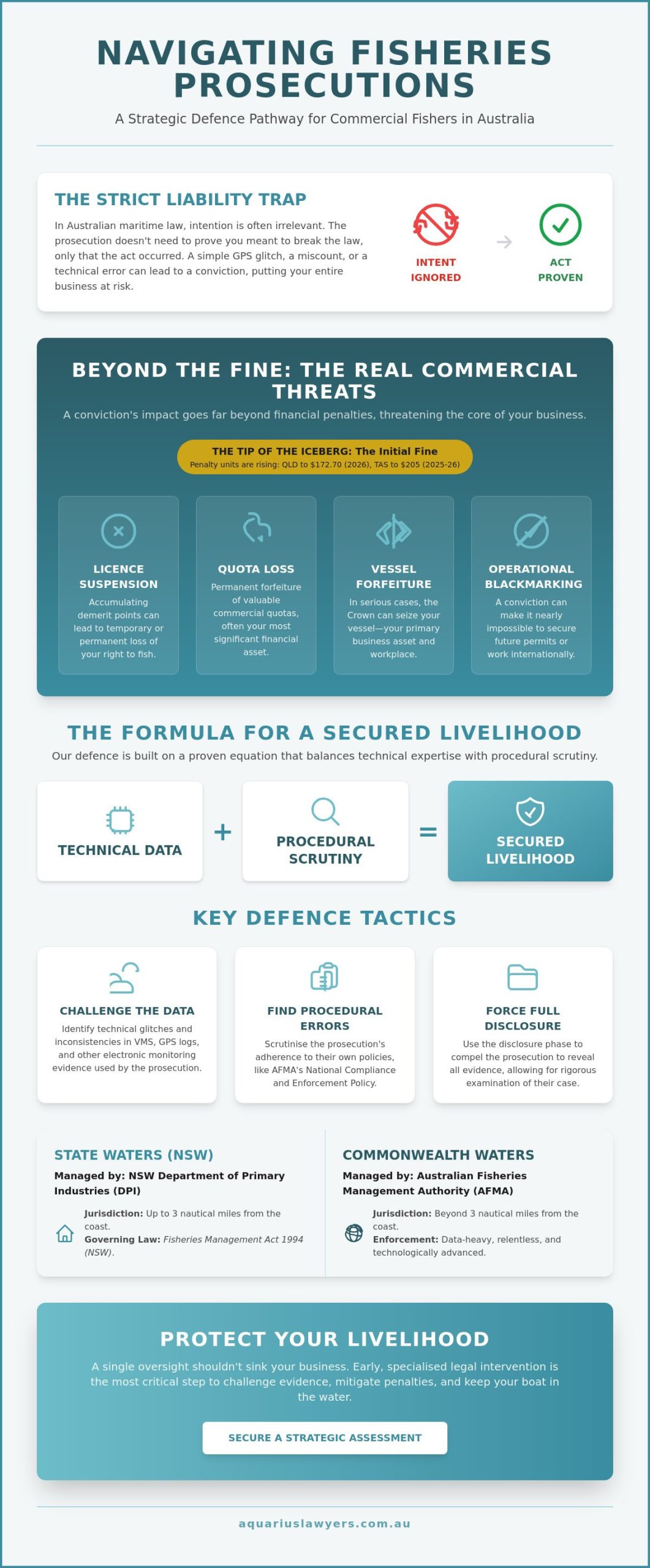
A fisheries prosecution isn’t just a legal hurdle; it’s a direct assault on your business’s viability. In Australia, these cases are built on a foundation of strict liability. This means the prosecution doesn’t usually need to prove you intended to break the law. They only need to prove the act happened. Whether it was a GPS glitch or a simple miscount, the law treats the outcome as the offence. This “strict liability” trap is why a specialised fisheries prosecution defence is essential from the moment you’re contacted by authorities. Strategic legal counsel + procedural scrutiny = protected assets. This is the formula we use to shift the momentum back in your favour.
The commercial reality is that a fine is often the least of your worries. While penalty units are indexed annually, reaching $205 in Tasmania for the 2025-2026 period and $172.70 in Queensland from July 2026, these figures are just the tip of the iceberg. The real danger lies in the demerit point system. Accumulating points leads to licence suspension or permanent cancellation. If you lose your licence, you lose your ability to service debt and maintain your vessel. There’s also a significant psychological toll. Knowing you’ve been the target of long-term surveillance operations, where every move has been logged by VMS for months, can feel like an insurmountable weight.
NSW vs. Commonwealth Jurisdictions
The jurisdiction depends on where the alleged offence occurred. The NSW Department of Primary Industries (DPI) manages activities within three nautical miles of the coast under the Fisheries Management Act 1994. Beyond that limit, the Australian Fisheries Management Authority (AFMA) takes the lead. AFMA is the primary body for Commonwealth fisheries, and their enforcement methods are often data-heavy and relentless. Identifying which set of regulations applies is the first step in building your fisheries prosecution defence pathway.
The Consequences of a Conviction
Convictions carry weight far beyond the courtroom. You face the following risks:
- Licence Suspension: Temporary or permanent loss of the right to fish.
- Quota Loss: The permanent forfeiture of valuable commercial quotas, which are often your most significant financial asset.
- Vessel Forfeiture: In serious cases, the Crown can seize your primary business asset.
- Operational Blackmarking: A conviction makes it nearly impossible to secure future permits or participate in international maritime operations.
We believe in a no-nonsense approach to these threats. By layering industry expertise with a modern understanding of surveillance technology, we provide the clarity you need to move from a position of fear to one of resolution.
The Legal Framework: Why Fisheries Defence Requires Specialised Counsel
Generalist criminal lawyers spend their days dealing with thefts and assaults. They rarely understand the difference between a mesh size variation and a seasonal closure technicality. This knowledge gap is dangerous for a commercial operator. A successful fisheries prosecution defence requires a “Fish Lawyer” who can bridge the divide between the deck of a trawler and the bench of the Local Court. Navigating the Fisheries Management Act 1994 (NSW) and its convoluted regulations demands more than just legal literacy; it requires a deep understanding of maritime industry standards. High-level strategy + industry experience = a defensible position.
Acting early is the most critical step you can take. Waiting until your first mention in the Local Court limits your options. Early intervention allows for direct negotiations with the DPI or AFMA before the prosecution’s narrative becomes fixed. By scrutinising AFMA’s National Compliance and Enforcement Policy, we can identify where the Crown’s approach may have deviated from their own procedural requirements. If you’ve received a notice to produce or a court attendance notice, consulting with Aquarius Lawyers immediately can prevent a manageable issue from escalating into a licence-ending disaster.
Strict Liability and Statutory Defences
Fisheries law is built on strict liability. This means the prosecution doesn’t have to prove you intended to break the law. However, the “Honest and Reasonable Mistake of Fact” defence is a vital shield. To succeed, you must demonstrate that you held a mistaken belief which, if true, would have made your actions legal. You also need to prove this belief was reasonable. Documenting that you took all reasonable precautions, such as staff training and frequent gear checks, is essential to this pathway.
The Intersection of Science and Law
Many cases hinge on biological data or species identification. Officers are human and can make errors when measuring a catch or identifying a protected species. We challenge these findings by using independent expert witnesses to counter DPI scientific claims. We also scrutinise the calibration of weighing equipment and the specific methods used by officers during an inspection. If the equipment wasn’t calibrated or the measurement protocol was flawed, the evidence becomes unreliable.
Case Study: Deconstructing a Successful Fisheries Defence Strategy
Imagine a commercial operator who receives a summons alleging they exceeded their quota by three tonnes. The prosecution’s entire case rests on Vessel Monitoring System (VMS) data. To the authorities, the data is gospel. To the operator, it’s a death sentence for their business. This is where a strategic fisheries prosecution defence moves from theory into practice. Instead of accepting the data at face value, a specialised legal team begins a forensic audit of the digital evidence. Technical scrutiny + procedural accountability = a path to resolution.
In many instances, the “evidence” provided by automated systems is far from infallible. We look for the “ghost in the machine” or the human error in the data entry. By cross-referencing your own onboard logs with the prosecution’s surveillance, we can often find the discrepancies that create reasonable doubt. If the agency’s data doesn’t match the reality on the water, their case begins to crumble before it even reaches a hearing.
The Investigation Phase
The first step involves auditing six months of surveillance logs to identify patterns of equipment failure. In a recent successful defence, the team discovered that the VMS unit had a documented history of “signal drift” during heavy weather. This drift incorrectly placed the vessel inside a restricted zone while the gear was deployed. By cross-referencing these logs with AFMA’s Compliance and Enforcement Framework, the defence identified that the agency failed to follow its own protocols regarding equipment verification and secondary checks.
We also look closely at the chain of custody for any seized catch. If the fish weren’t weighed on a certified, level scale immediately upon landing, the “scientific” weight is often little more than an estimate. Subpoenaing internal agency communications can also be a game-changer. These documents sometimes reveal evidence of bias or a “rush to judgment” that contradicts the agency’s duty of fairness.
Court Strategy and Outcome
When the matter reaches court, we don’t rely on generic pleas for mercy. We present a no-nonsense technical argument to the Magistrate. We demonstrate exactly why the data is unreliable. We combine this technical evidence with character references from respected industry figures to prove the operator’s long-standing record of compliance. This multi-layered approach shows the court that the alleged offence was an anomaly or a technical error rather than a deliberate act of non-compliance.
In the scenario mentioned, the prosecution realised their evidence wouldn’t hold up under cross-examination. They agreed to withdraw the most serious charges in exchange for a plea to a minor record-keeping oversight. The operator secured a “Section 10” dismissal, which meant no conviction was recorded, no licence points were lost, and the business remained fully operational. The lesson is simple: documentation is your best friend. Keep your own logs, take photos of your scales, and never assume the government’s data is perfect. A proactive fisheries prosecution defence is the only way to safeguard your future.
Challenging the Evidence: Surveillance, VMS, and GPS Logs
Data is only as reliable as the system that records it. With the Australian Fisheries Management Authority expanding mandatory electronic monitoring across Commonwealth fisheries between 1 July 2026 and 1 April 2027, the volume of digital evidence is exploding. However, a high-tech surveillance log is not an automatic conviction. A sophisticated fisheries prosecution defence begins by questioning the technical integrity of the tools used against you. Electronic surveillance minus human error equals unreliable evidence. This is the logic we apply when we deconstruct the prosecution’s brief.
We also challenge the legality of how evidence was obtained. While fisheries officers possess broad powers to board vessels, they must still adhere to strict standard operating procedures. If a search was conducted without a justification or if an officer overstepped their authority during an inspection, the resulting evidence may be inadmissible. Cross-examining officers on their adherence to these protocols is a cornerstone of our litigation strategy. If you believe your rights were ignored during a boarding, you need to contact a fisheries law specialist immediately to review the legality of the search.
Technical Flaws in Electronic Monitoring
GPS drift is a documented reality on the water. Signal interference from atmospheric conditions or vessel infrastructure can place your boat in a closed zone incorrectly. We also look for the “Human Factor” where office-based analysts misinterpret VMS logs. These analysts often have never set foot on a commercial trawler and lack the practical context of your operations. Proving a malfunction often requires a deep dive into your maintenance and service records to show a pattern of equipment instability that the prosecution ignored.
Procedural Fairness and Disclosure
You have a fundamental right to procedural fairness. This includes the “Disclosure” battle; forcing the Crown to show their full hand. They are legally obligated to provide all evidence, including exculpatory material that might help your case. A failure to disclose critical documents can lead to a stay of proceedings. We ensure your pathway to trial is built on a complete understanding of the evidence, leaving no room for courtroom surprises. Meticulous preparation is the only way to safeguard your commercial future.
Choosing Your Pathway: Why Aquarius Lawyers is the Strategic Choice
Facing the court alone is a gamble you can’t afford. When your commercial fishing future is on the line, you need a partner who doesn’t just know the law, but knows the water. At Aquarius Lawyers, you get direct access to Katherine Hawes, an innovative veteran who has spent decades bridging the gap between maritime industry needs and complex legal frameworks. We provide a fisheries prosecution defence that is grounded in down-to-earth pragmatism. We respect the hard work you put in and the risks you take every day to keep the Australian seafood industry moving. High-level strategy + industry experience = a secured livelihood.
Our firm functions as a trusted advisor, valuing practical outcomes over detached formality. We understand the jurisdictional complexity of the Australian legal system, from the Commonwealth waters managed by AFMA to the coastal reaches under state control. This intellectual versatility means we can pivot our strategy based on the specific regulations of your fishery. Whether we are challenging a “strict liability” charge or negotiating a reduction in licence points, our focus remains on your commercial survival. We operate from strategic locations across Sydney and regional NSW, ensuring that whether you’re docked in a major port or a coastal town, expert advice is accessible.
We’ve built a proven track record by moving easily between high-stakes commercial negotiation and aggressive courtroom litigation. Our approach isn’t about legal ceremony; it’s about results. We follow a methodical flow that builds trust by layering our foundational expertise with a unique, technology-driven methodology. This ensures that every piece of evidence is used to its full potential to protect your assets.
The Aquarius Advantage
We possess deep industry knowledge that generalist firms simply can’t match. We know the difference between a trap and a trawl, and we understand how a single gear technicality can be misinterpreted by an overzealous officer. This niche authority allows us to build cost-effective solutions that focus on one primary goal: keeping your business operational. By integrating modern technology into our management of complex legal briefs, we ensure that every piece of VMS data or surveillance footage is scrutinised with surgical precision. Practicality + strategy = efficiency.
Next Steps: Securing Your Defence
The first step in resolving your matter is a confidential consultation. This is where we cut through the noise and assess the actual merits of the prosecution’s case. Before we meet, organise your records. Gather your vessel logs, maintenance receipts, and any correspondence from the DPI or AFMA. Having a clear paper trail allows us to identify the strategic pathway forward immediately. Don’t wait for the situation to get worse. Don’t risk your livelihood. Contact the Fish Lawyer for a strategic defence today and take the first proactive step toward protecting your future.
Secure Your Commercial Future on the Water
A successful outcome in maritime law isn’t a matter of luck; it’s the result of precise strategy and technical scrutiny. You now understand that challenging VMS data and enforcing procedural disclosure are the pillars of a robust fisheries prosecution defence. By acting early and choosing a solicitor who understands the deck as well as the courtroom, you shift the odds back in your favour. Specialized knowledge + proactive litigation = a protected livelihood.
Principal Katherine Hawes, known nationally as “The Fish Lawyer,” brings over 20 years of maritime and fisheries law experience to your side. With a specialised focus on the NSW Fisheries Management Act 1994, our team provides the no-nonsense advocacy required to mitigate penalties and protect your commercial quota. We bridge the gap between complex legislation and the practical reality of life on a vessel, ensuring your voice is heard in the Local Court and beyond.
Secure your commercial future—book a consultation with The Fish Lawyer. Your business is worth fighting for, and the right legal pathway is just a conversation away. Stay confident and stay compliant.
Frequently Asked Questions
Can I still fish while my fisheries prosecution is pending?
You can generally continue to operate your business unless the relevant authority has issued an interim suspension of your licence. Suspensions are typically reserved for the most serious allegations or cases involving repeated non-compliance. It’s vital to review any notices served by the DPI or AFMA immediately to ensure you don’t inadvertently breach a temporary condition while your matter is before the court.
What is the “Honest and Reasonable Mistake of Fact” defence in NSW?
This is a legal pathway where you prove you held a mistaken belief about a specific fact that, if true, would have made your actions lawful. For example, you might have relied on data that you reasonably believed was accurate at the time. To succeed in your fisheries prosecution defence, you must demonstrate that this mistake was both honest and reasonable under the circumstances of your operation.
Do I have to let fisheries officers board my vessel without a warrant?
Yes, fisheries officers possess broad legislative powers under state and Commonwealth law to board and search commercial vessels without a warrant. Refusing entry or obstructing an officer can lead to separate, serious charges that carry their own penalties. While they have the right to board, they must still adhere to strict procedural standards and respect your basic legal rights during the inspection.
What happens if I am found guilty of a fisheries offence in NSW?
The consequences range from heavy financial penalties and demerit points to the permanent cancellation of your licence. Fines are tied to penalty units, which are indexed annually to reflect current economic values. Beyond the immediate fine, a conviction can result in a criminal record, which may jeopardise your ability to secure future permits or participate in international maritime ventures.
How much does a fisheries prosecution defence typically cost?
The total investment for a legal defence depends on the complexity of the charges, the volume of surveillance data to be audited, and whether the matter proceeds to a contested hearing. Every case has unique requirements that influence the scope of work. You should check with your solicitor during your initial consultation to get a clear understanding of the fee structure tailored to your specific situation.
Can a fisheries conviction lead to the permanent loss of my commercial quota?
Yes, authorities have the power to forfeit or cancel commercial quotas as part of a sentencing order or administrative decision. Quotas are often a fisher’s most valuable asset, and their loss can result in total business failure. A strategic defence focuses on mitigating these high-level risks to ensure your primary assets remain protected even if a minor breach is proven.
What is the difference between a state and a Commonwealth fisheries charge?
State charges involve offences committed within three nautical miles of the coast and are managed by state agencies like the NSW DPI. Commonwealth charges apply to the Australian Fishing Zone, which extends from three to 200 nautical miles, and are governed by AFMA. Each jurisdiction operates under different legislation and has its own specific schedule of fees and penalty unit values.
How long does a fisheries court case usually take in the Local Court?
Most matters take between three and twelve months to reach a final resolution in the Local Court. The duration is influenced by the time required for the prosecution to provide full disclosure of evidence and the availability of expert witnesses. Early intervention by a specialised legal team can often streamline this timeline by identifying flaws in the prosecution’s case before the trial begins.
Disclaimer
Please note that legal rules change and this is not a substitute nor construed as legal advice. It is general information only.