Could a single $500 on-the-spot fine actually be the first step toward losing your entire commercial fishing licence? For many in the industry, the pressure of constant surveillance from NSW Fisheries and the police feels like a storm that never clears. You’ve worked hard to secure your quota and build a reputation, yet the confusion between State regulations and Federal Native Title rights often leaves you vulnerable. A robust fisheries prosecution defence isn’t just about showing up in court; it’s about deploying a strategic shield around your livelihood.
We understand the stress of facing potential disqualification or the high costs of legal battles. This article provides a clear pathway to navigate these complexities, offering the reassurance that comes from professional expertise grounded in real-world maritime experience. Our approach is built on a simple formula: technical maritime knowledge plus aggressive legal advocacy equals a protected commercial asset. We’ll examine how to challenge surveillance evidence, the implications of the 2025/2026 fee schedules, and the specific methods used to seek a withdrawal of charges. By combining deep legal knowledge with a no-nonsense approach to maritime law, we show you how to protect your assets and secure your professional future on the water.
Key Takeaways
- Learn the critical difference between administrative licence suspensions and criminal charges to better manage the dual-threat nature of NSW fisheries allegations.
- Discover how a strategic fisheries prosecution defence can leverage Federal Native Title rights to challenge state-level restrictions and protect cultural fishing practices.
- Understand your rights during vessel inspections and why seeking legal advice before a formal interview is essential for protecting your commercial quota.
- Identify key ways to challenge the prosecution’s evidence by questioning surveillance methods and the chain of custody for seized catch.
- See how combining deep maritime expertise with technical data analysis provides a proactive shield for your professional future in the industry.
Understanding Fisheries Prosecutions in Australia
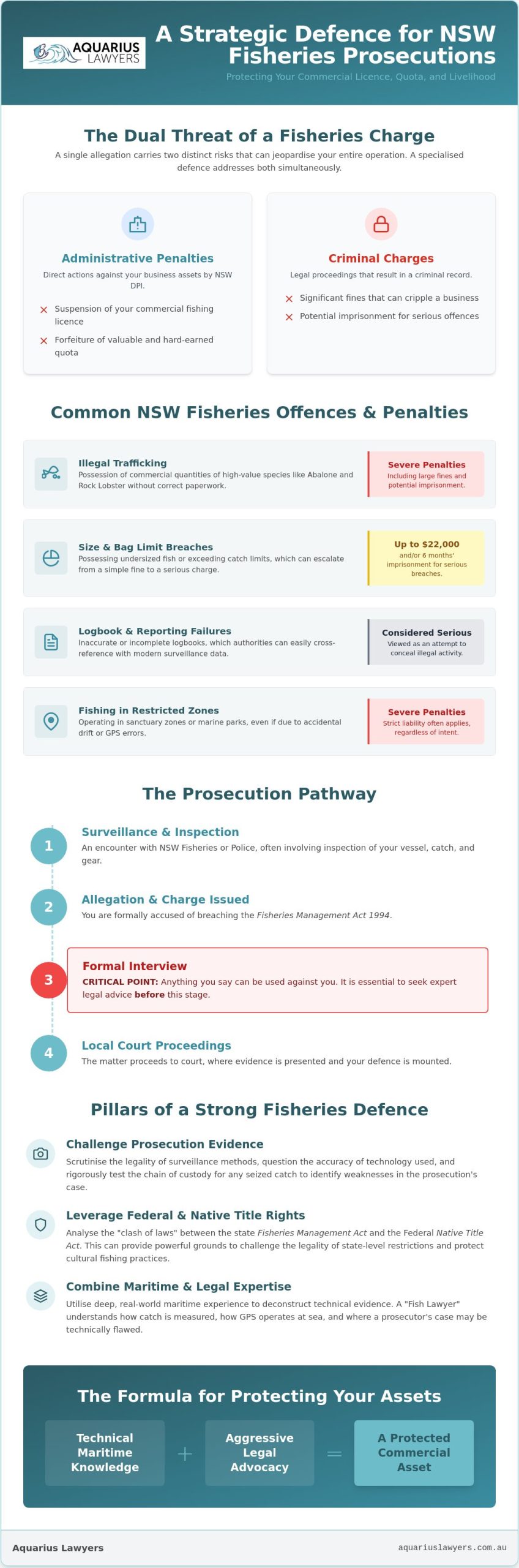
A fisheries prosecution is more than just a bureaucratic headache; it’s a direct challenge to your right to work on the water. These legal actions begin when the NSW Department of Primary Industries (DPI) or the Police allege a breach of the Fisheries Management Act 1994. Unlike a standard criminal matter, these charges often carry a double sting. You face administrative penalties, such as the suspension of your commercial fishing licence or the forfeiture of expensive quota, alongside criminal charges that can lead to significant fines or even imprisonment. This dual-threat environment is exactly why a specialised fisheries prosecution defence is essential for anyone whose livelihood depends on the sea.
Fisheries law is uniquely complex because it sits at the intersection of state regulations and federal rights. While much of the local enforcement falls under the NSW DPI, the Australian Fisheries Management Authority (AFMA) manages Commonwealth fisheries, creating a web of overlapping jurisdictions that can confuse even seasoned operators. Generalist criminal lawyers often miss the critical maritime nuances that determine the outcome of a case. They might understand the rules of a courtroom, but they don’t understand the rules of the reef. Effective representation requires a “Fish Lawyer” perspective, someone who understands how catch is measured, how surveillance technology operates, and where the prosecution’s technical evidence might be flawed.
Commercial vs. Cultural Fishing Charges
Commercial operators typically face heat over quota overruns, gear violations, or reporting failures. These aren’t just paperwork errors; the authorities view them as serious threats to sustainability. Cultural fishing, however, operates on a different legal plane. Friction frequently arises when state regulations clash with the exercise of rights under the Native Title Act 1993 (Cth). Understanding whether your charge stems from a commercial licence or a traditional right dictates every move in your defence strategy. We see the synergy between traditional rights and modern law as a vital pathway to protecting your future.
The Role of the Fisheries Management Act 1994 (NSW)
Prosecutors rely heavily on specific sections of the Act to pursue trafficking or illegal possession charges, particularly for high-value species like abalone and rock lobster. The Fisheries Management Act 1994 (NSW) serves as the primary instrument for regulating fisheries activities across New South Wales. However, its power isn’t absolute. When state law meets the Native Title Act 1993 (Cth), a “clash of laws” occurs that requires a sophisticated legal response. Our methodology involves deconstructing these charges to see if the law was applied correctly or if your rights have been overlooked.
Common Fisheries Offences and Penalties in NSW
Facing a fisheries inspector is rarely a casual encounter. In New South Wales, the Department of Primary Industries (DPI) maintains a sharp focus on compliance, often targeting high-value species and restricted zones. While state authorities manage local waters, the oversight of Commonwealth fish resources remains the domain of federal agencies, creating a complex regulatory environment for commercial operators. Understanding the specific charges you might face is the first step in building a robust fisheries prosecution defence.
Common offences in NSW waters include:
- Illegal trafficking: This involves high-value species like Abalone and Rock Lobster. The law doesn’t just target those selling catch; it targets anyone in possession of commercial quantities without the correct paperwork.
- Size and bag limit breaches: Fisheries officers can issue $500 on-the-spot fines for undersize fish or exceeding limits. However, serious breaches can escalate to maximum penalties of $22,000 and six months’ imprisonment.
- Logbook and reporting failures: Failing to maintain accurate electronic or paper logbooks is a common trap. Modern surveillance makes it easy for authorities to spot discrepancies between your reported catch and your actual landings.
- Restricted zones: Fishing in sanctuary zones or restricted marine parks often occurs due to GPS errors or accidental drift, yet the penalties remain severe.
- Unauthorised gear: Using gear that doesn’t match your licence class, such as illegal cast nets, can result in immediate fines and gear seizure.
Severe Penalties and Asset Forfeiture
The consequences go far beyond a simple fine. For serious offences like Abalone trafficking, you could face up to 10 years in prison. Perhaps more devastating for a commercial business is the risk of asset forfeiture. The DPI has the power to seize your vessel, your gear, and your catch. Losing your boat isn’t just a financial hit; it’s the end of your ability to trade. These penalties threaten family legacies that have been built over generations of hard work.
Technical Breaches vs. Intentional Illegal Activity
Not every breach is a case of intentional poaching. We often see hard-working fishers targeted for technical errors, such as a typo in a digital report or a misidentified species in a large haul. In these cases, the legal principle of an “honest and reasonable mistake of fact” becomes a critical shield. You need a legal team that understands the practicalities of a deck in rough seas, not just the text of a statute. If you’re worried about how an inspection might impact your future, it’s wise to consult a specialist who speaks the language of the DPI.
Strategic Defence Pathways: Native Title and Commercial Rights
Receiving a court attendance notice isn’t the end of the road. A successful fisheries prosecution defence begins by deconstructing the prosecution’s brief of evidence to find where the DPI or police have overreached. Often, the authorities rely on technical data or surveillance footage that isn’t as airtight as it looks. By identifying these weaknesses early, we can negotiate for a withdrawal of charges before a matter even reaches a full hearing. This proactive approach saves you the stress of a trial and protects your reputation in the local fishing community.
Strategy often involves a two-pronged attack: challenging the criminal charges in the Local Court while simultaneously fighting administrative sanctions. If the DPI decides to suspend your licence or cancel your quota, we can take the fight to the NSW Civil and Administrative Tribunal (NCAT). This administrative appeal process is a vital safety net for commercial operators. It ensures that any penalty remains proportionate to the alleged breach rather than being a business-ending blow. We don’t just look at the law; we look at the logistics of how your catch was handled and the chain of custody for any seized goods.
The Native Title Defence in Practice
For First Nations fishers, Section 211 of the Native Title Act 1993 (Cth) provides a powerful legal shield. This federal law can override state fishing restrictions when you’re exercising a traditional right for personal, domestic, or non-commercial communal needs. However, the defence isn’t automatic. It requires proving a continuous connection to the specific waters where the activity occurred. Recent case law in NSW has highlighted the friction between state regulations and Indigenous rights, making it essential to have a representative who understands the cultural rigour required to mount this defence successfully.
Defending Commercial Quota and Licence Disputes
Commercial fishing is now a high-tech industry, but technology fails. Prosecutors frequently rely on GPS or Vessel Monitoring Systems (VMS) to allege that a boat entered a sanctuary zone. These systems can glitch, or environmental factors like sea state and drift can distort the data. We scrutinise this technical evidence, often questioning catch weight estimates and species identification that fisheries officers might have rushed during an inspection. Protecting your commercial assets means ensuring that a technical error doesn’t lead to a permanent loss of your livelihood. We combine traditional maritime experience with modern data analysis to ensure your side of the story is heard with clarity and authority.
The Prosecution Process: From Inspection to Local Court
A fisheries prosecution isn’t a single event; it’s a series of procedural hurdles where any misstep can jeopardise your licence. Understanding the timeline of a case allows you to maintain control when the pressure is highest. From the moment an officer steps onto your deck to the final judgment in the Local Court, your actions dictate the strength of your fisheries prosecution defence. We view the legal process as a sequence of opportunities to challenge the prosecution’s narrative and protect your commercial assets.
- Step 1: The Inspection – Fisheries officers have broad powers to board and search, but you have the right to remain polite without volunteering information that could be used against you.
- Step 2: The Interview – This is often where cases are won or lost. Statements made on the water or at the station form the backbone of the Crown’s case.
- Step 3: The Brief of Evidence – Once charged, you are entitled to “disclosure.” We scrutinise this brief for missing surveillance logs, flawed species identification, or gaps in the chain of custody for seized catch.
- Step 4: The Mention – Your first court appearance is procedural. It’s where we enter a plea and set the timetable for the case.
- Step 5: The Hearing – If the matter isn’t withdrawn, we present your defence before a Magistrate, questioning the technical accuracy of the DPI’s evidence.
What to Do When You Are Under Investigation
If you find yourself the subject of a DPI investigation, adopt a “no-nonsense” approach. Be cooperative with physical directions, but recognise that “saying nothing” about the specifics of your catch or location is often your most powerful legal tool. Silence isn’t an admission of guilt; it’s a safeguard against self-incrimination while you seek professional advice. Engaging a specialised solicitor before your first formal interview ensures that you don’t inadvertently provide the prosecution with the very evidence they need to sink your case.
Navigating Regional NSW Courts
Fisheries matters are often heard in regional circuits like Nowra, Shellharbour, or the South Coast. Magistrates in these coastal towns possess a deep understanding of the local industry, but they also have little patience for procedural delays or poorly prepared defences. Having a solicitor who is a familiar face in these regional courts provides a distinct advantage. Local knowledge of how specific Magistrates view technical breaches can be the difference between a heavy fine and a spent conviction. If you’ve been served with a court attendance notice, contact our team immediately to discuss your next steps.
Why Aquarius Lawyers is Your Best Defence
Choosing the right legal team is a strategic business decision that directly impacts your professional future. Most criminal firms handle a broad range of cases, from traffic fines to common assault, but they rarely understand the technicalities of a commercial quota or the specific limitations of a Garmin GPS unit. We focus exclusively on the intersection of marine and criminal law. This niche expertise allows us to build a fisheries prosecution defence that addresses the technical and administrative threats to your livelihood. We don’t just read the law; we understand the industry from the deck up.
Our methodology is built on a simple equation: traditional legal experience plus modern data analysis equals a superior defence. While the prosecution relies on Vessel Monitoring Systems (VMS) and electronic logs to build their case, we use those same tools to find errors in their narrative. We look for signal drift, software glitches, and environmental factors that the DPI often overlooks. This tech-savvy perspective ensures that your side of the story is backed by hard data. We focus on resolving matters quickly and cost-effectively, ensuring you spend less time in court and more time on the water.
Meet Katherine Hawes: The Fish Lawyer
Katherine Hawes is known nationally as “The Fish Lawyer” for a reason. She brings a down-to-earth pragmatism to every case, offering a blend of high-level strategic thinking and relatable, everyday wisdom. Her deep understanding of both the Fisheries Management Act 1994 (NSW) and the Native Title Act 1993 (Cth) gives our clients a distinct advantage in both commercial and cultural matters. We are committed to protecting the future of the Australian fishing industry by ensuring that honest operators aren’t sidelined by disproportionate penalties or technical errors. Katherine’s niche focus provides an advantage that generalist firms simply cannot match.
Next Steps: Secure Your Defence Today
Don’t wait for your court date to arrive before taking action. Early intervention is often the difference between a matter being withdrawn and a costly, drawn-out hearing. Whether you are facing a complex abalone trafficking charge or a dispute over a minor gear violation, our Sydney and Shellharbour offices are ready to provide local court access and expert advice. We take a no-nonsense approach to every brief, identifying weaknesses in the prosecution’s case from the very first mention. Protect your assets and your family legacy by securing specialised representation now.
Organise a consultation with Aquarius Lawyers today
Securing Your Future on Australian Waters
Protecting your commercial licence or cultural fishing rights requires more than just a basic understanding of the law; it demands a tactical approach that accounts for the technicalities of the marine industry. We have seen how a robust fisheries prosecution defence relies on the synergy between traditional legal credentials and modern data analysis. Whether you are disputing GPS surveillance or exercising Native Title rights, the key to a successful outcome is early intervention and specialised representation that speaks the language of the DPI. Navigating the dual threat of administrative sanctions and criminal charges is simpler when you have a steady, common-sense guide by your side.
Led by Katherine Hawes, Australia’s renowned “Fish Lawyer”, our team provides the expert advocacy needed to navigate complex quota litigation and administrative appeals. With strategic offices in Sydney and regional NSW, we ensure you have local representation that understands the specific nuances of your home port and regional courts. Don’t let a technical error or a stressful inspection define your professional future. Our no-nonsense approach is designed to resolve matters efficiently so you can get back to what you do best. You have worked hard for your livelihood, and we are here to help you protect it.
Protect your livelihood—Contact The Fish Lawyer at Aquarius Lawyers now
Frequently Asked Questions
What should I do if a Fisheries Officer wants to interview me?
You should politely inform the officer that you wish to seek legal advice before making any formal statement. While you are required to provide your name and address, you don’t have to answer substantive questions about your catch, gear, or location on the spot. Exercising your right to silence at the scene is a protected legal step that prevents you from providing evidence that could be used against you later.
Can the DPI seize my boat if I am charged with a fisheries offence?
Yes, the NSW Department of Primary Industries (DPI) has broad powers to seize vessels, vehicles, and fishing gear used during an alleged offence. This seizure often happens at the time of the inspection to preserve evidence or prevent further breaches. In serious cases involving trafficking or repeat offences, the court may order the permanent forfeiture of these assets, making a robust fisheries prosecution defence essential to protecting your property.
How does Native Title affect my right to fish in NSW?
Native Title provides a legal framework for Indigenous people to fish for personal, domestic, or non-commercial communal needs, even without a state licence. Under Section 211 of the Native Title Act 1993 (Cth), these federal rights can override certain state restrictions. However, using this as a defence requires proving a continuous traditional connection to the specific waters, which often involves complex historical and cultural evidence.
What are the possible penalties for a commercial fishing breach?
Penalties range from on-the-spot fines of $500 for minor bag limit errors to court-imposed fines of $22,000 and six months’ imprisonment for standard offences. For high-value trafficking involving species like abalone or rock lobster, you could face up to 10 years in prison. Administrative penalties, such as the permanent loss of your commercial fishing licence or quota, often carry the most significant long-term financial impact.
Can I appeal a decision to suspend my commercial fishing licence?
You can appeal a licence suspension or cancellation through the NSW Civil and Administrative Tribunal (NCAT). This administrative appeal is separate from any criminal court proceedings and allows you to challenge the DPI’s decision-making process. It’s a vital pathway for ensuring that any penalty is proportionate to the alleged breach and doesn’t unfairly end your ability to earn a living.
Is it possible to have fisheries charges withdrawn before a trial?
It is certainly possible to have charges withdrawn if your legal team identifies critical flaws in the prosecution’s brief of evidence during the early stages. We often find discrepancies in surveillance logs, GPS data errors, or failures in the chain of custody for seized goods. Identifying these weaknesses allows for negotiations with the DPI prosecutors to have the matter dropped or reduced to a less serious infringement.
How much does it cost to defend a fisheries prosecution?
The cost of a fisheries prosecution defence varies based on the complexity of the allegations and whether the matter is resolved through negotiation or a full hearing. While specialised representation is an investment, it’s often more cost-effective than the alternative of losing a commercial licence or paying maximum fines. We focus on a pragmatic, results-oriented approach that aims to resolve your case quickly to get you back on the water.
Do I need a specialist fisheries lawyer, or will a regular criminal lawyer do?
A specialist fisheries lawyer is better equipped to handle these cases because they understand the technical maritime nuances that generalist criminal lawyers often miss. Knowing how to challenge Vessel Monitoring System (VMS) data or interpret complex quota reporting regulations is just as important as courtroom experience. Specialist expertise ensures that every technical angle of the prosecution’s case is thoroughly scrutinised for errors.
Disclaimer
Please note that legal rules change and this is not a substitute nor construed as legal advice. It is general information only.