
Your fishing quota isn’t just a permit to work; it’s a high-value property asset that deserves the same legal rigour as a commercial real estate portfolio. Finding reliable fishing quota legal advice shouldn’t feel like navigating a gale without a compass, yet many operators struggle with the opaque shifts from AFMA or the NSW DPI. It’s stressful when the line between a profitable season and a licence suspension depends on a complex web of ITQ management and compliance.
We understand that certainty of ownership is the bedrock of your livelihood. This guide provides the expert legal strategies you need to secure your commercial future, whether you’re grappling with the complexity of leasing versus owning or facing a potential dispute. We’ll explore how the new National Fisheries Guidelines released in July 2026 impact your operations and provide a clear pathway to minimise your compliance risk and protect your assets for the long haul.
Key Takeaways
- Treat your Individual Transferable Quotas (ITQs) as high-value property assets to ensure long-term commercial security and robust asset protection.
- Identify the critical jurisdictional boundaries between NSW DPI and AFMA to navigate the 3-nautical-mile limit and the Offshore Constitutional Settlement effectively.
- Access specialised fishing quota legal advice to draft ironclad leasing agreements and use your harvesting rights as legitimate collateral for business loans.
- Establish a clear protocol for responding to compliance triggers, such as VMS errors or show-cause notices, to minimise the risk of prosecution or licence suspension.
- Combine traditional maritime grit with modern legal technology to achieve efficient, no-nonsense resolutions to complex commercial fisheries disputes.
What is Fishing Quota Legal Advice and Why is it Vital?
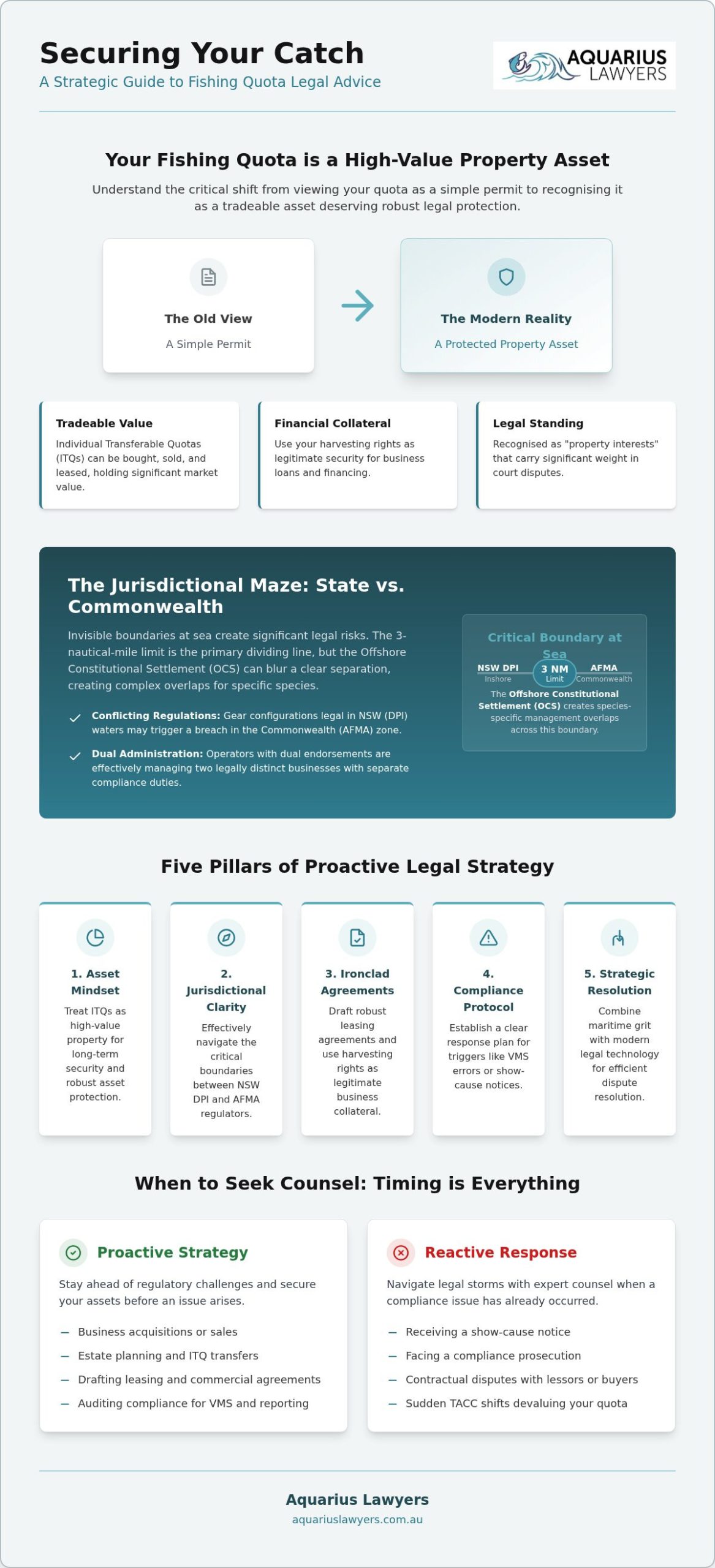
In the high-stakes world of commercial harvesting, fishing quota legal advice is the strategic counsel that ensures your rights aren’t just floating in the breeze. It’s the specialised practice of managing the acquisition, protection, and transfer of your harvesting rights. Your quota isn’t a mere permission slip from the government; it’s the engine room of your business. Without rigorous legal oversight, that engine can be stalled by opaque regulatory shifts or poorly drafted commercial agreements.
Many regulators describe quota as a privilege, but for a commercial operator, Individual Transferable Quotas (ITQs) are tradeable property assets with significant market value. They can be bought, sold, leased, or even used as collateral for business loans. This property-like nature means they require the same level of protection as a commercial warehouse or a fleet of trucks. Katherine Hawes, known across the industry as “The Fish Lawyer”, bridges the gap between the salt-sprayed reality of the deck and the technical precision of the courtroom. She provides a no-nonsense approach that respects the grit of the industry while applying sophisticated legal methodology.
Fishing quota legal advice serves as a comprehensive safeguard for your sea-based equity, ensuring your commercial assets remain protected against regulatory shifts and contractual disputes.
The Shift from Licences to Property Rights
By 2026, the Australian legal system has solidified the view that commercial fishing rights are more than just administrative licences. They are “recognisable interests” that carry significant weight in court. Generic commercial lawyers often miss the nuances of maritime statutory law because they don’t understand how the Fisheries Management Act interacts with property law. If your lawyer doesn’t know the difference between a statutory fishing right and a fishing permit, your assets are at risk. In a dispute, proving a recognisable interest is the difference between keeping your quota and losing your livelihood to a regulatory whim.
When to Seek Counsel: Proactive vs Reactive
The best time to seek advice is before the regulator knocks on your door. Proactive legal audits can identify compliance gaps in your reporting or VMS data before they trigger a prosecution. You need expert eyes on your paperwork during business acquisitions or when organising estate planning to ensure your ITQs transfer smoothly to the next generation. With the release of the “National Guidelines to Develop Fishery Harvest Strategies – 2nd Edition” on 22 July 2026, the landscape for Total Allowable Commercial Catch (TACC) has become more complex. Sudden shifts in these strategies can devalue your assets overnight; having a legal strategy in place allows you to respond with speed and authority.
Navigating the Jurisdictional Maze: State vs Commonwealth Law
Jurisdictional boundaries at sea are often invisible until you’ve crossed a legal line you didn’t know existed. For commercial fishers, the most critical boundary is the 3-nautical-mile limit. This marks the point where NSW Department of Primary Industries (DPI) authority typically ends and the Australian Fisheries Management Authority (AFMA) begins. However, the Offshore Constitutional Settlement (OCS) often blurs these lines, allowing state and federal governments to agree on who manages specific species across different zones. If you’re operating across these boundaries, obtaining specialised fishing quota legal advice is essential to ensure your gear, catch reporting, and vessel movements remain compliant with two sets of often-conflicting regulations.
Moving vessels between jurisdictions is a common pitfall. A gear configuration that’s legal in NSW state waters might trigger a compliance breach the moment you enter the Commonwealth zone. For operators holding dual-authority endorsements, the administrative burden is doubled. You aren’t just managing one business; you’re managing two distinct legal identities. If you find the regulatory overlap confusing, seeking a professional legal review of your permits can prevent a costly administrative error before you leave the wharf. This proactive step ensures your operations are grounded in legal reality rather than guesswork.
NSW Fisheries Management Act 1994
In NSW, the Fisheries Management Act 1994 remains the primary pillar for quota management. Recent 2026 updates to state regulations have tightened reporting windows, making real-time data accuracy more critical than ever. Local court precedents in Sydney and regional hubs like Coffs Harbour or Eden often hinge on the interpretation of “lawful activity” under this Act. If a dispute arises, these local rulings can significantly impact your harvesting rights. Understanding how NSW courts view the property-like nature of your state quota is vital for any long-term asset protection strategy.
Commonwealth Fisheries Management
Beyond the 3-mile limit, AFMA manages high-seas and migratory species through a framework of Statutory Fishing Rights. To understand the federal perspective, it’s helpful to look at the official definition of What is Fishing Quota, which emphasises the transferability and legal weight of these rights. Navigating the AFMA framework requires a different tactical approach, especially following the release of the National Guidelines to Develop Fishery Harvest Strategies on 22 July 2026. This update introduces a more integrated approach to ecological and social objectives, which may require you to restructure how you manage your Commonwealth ITQs. Expert fishing quota legal advice ensures you have the intellectual versatility to move between these complex legal environments without risking your licence or your livelihood.
Individual Transferable Quotas (ITQs): Leasing, Selling, and Security
Managing Individual Transferable Quotas (ITQs) requires more than just filling out a government transfer form. While the AFMA portal makes the administrative side look simple, it doesn’t protect you from the underlying contract law risks. Whether you’re leasing out excess capacity or purchasing a new package, your transaction needs the backbone of expert fishing quota legal advice. Without ironclad agreements, you’re leaving your primary commercial asset exposed to “fair go” claims or unexpected regulatory clawbacks. Don’t treat a high-value quota transfer like a handshake deal at the wharf.
Due diligence is the most critical step when purchasing a commercial fishing business. You aren’t just buying a boat and some nets; you’re buying a legal history. You must verify that the quota is free of encumbrances, liens, or pending compliance actions that could devalue the asset the moment the ink is dry. Understanding What is a Fishing Quota? from a legal perspective means recognising it as a bundle of rights that can be unbundled if your contracts aren’t tight. We ensure that every acquisition includes a forensic review of the Statutory Fishing Rights to confirm you’re getting exactly what you paid for.
Contractual Safeguards for Quota Leases
A well-drafted quota lease protects both the owner and the lessee from the volatility of the season. Essential clauses must address who bears the risk of sudden TACC reductions and how “use it or lose it” provisions are managed. If a lessee fails to fish the quota, the owner could face penalties or a reduction in future allocations under certain management plans. We prioritise dispute resolution mechanisms like mediation to keep you out of court. A clear, specialised contract acts as a circuit breaker for conflict, ensuring both parties know their obligations before the first line is dropped.
Financing and the Register of Statutory Fishing Rights
Since the Australian Government rejected proposals for a government-backed loan facility in April 2024, private financing remains the only pathway for most operators to expand. This makes the ability to securitise your quota essential. By registering a financial interest on the Register of Statutory Fishing Rights, you turn your harvesting rights into a tool for growth. This registration establishes the legal priority of interests, which is vital if a business partner faces an insolvency event. An unregistered interest is a high-risk gamble that offers zero protection in a liquidation scenario. Professional fishing quota legal advice ensures your lender’s interest is perfected, making your business a more attractive prospect for commercial investment.
Compliance, Prosecutions, and the Appeals Process
Compliance isn’t just about following rules; it’s about protecting your commercial assets from heavy-handed regulation. In 2026, the most common compliance triggers remain over-catch, misreporting, and technical errors with the Vessel Monitoring System (VMS). While government agencies like AFMA state that compliance is mandatory, they rarely explain your rights when things go wrong. If you’ve been served with a show-cause notice or a summons, you need immediate fishing quota legal advice to frame a robust defence. A single administrative error shouldn’t sink your entire operation.
Defending a fisheries prosecution requires a no-nonsense maritime expert who understands the synergy between technology and the law. We don’t just look at the statute; we look at the data. If a VMS unit fails or a digital logbook glitches, the burden of proof often shifts in ways that can feel unfair. We provide the intellectual versatility to challenge these assumptions in court. Our approach values results over ceremony, ensuring that your side of the story is heard with the same weight as the regulator’s evidence.
Responding to Regulatory Audits
Boarding and inspections are a reality of life on the water, but you still have rights. You are required to cooperate, but you aren’t required to provide evidence against yourself without counsel. Organising your digital logbooks for legal scrutiny is your best line of defence. We use a simple but effective logical formula: Systems + Documentation = Protection. If your systems are robust and your documentation is forensic, you create a shield against adverse regulatory findings. This proactive preparation is far more cost-effective than a reactive defence in court.
The Appeals Pathway: From DPI to the Supreme Court
If an adverse decision is made, you have a limited window to act. The pathway for appealing administrative decisions often leads to the Administrative Appeals Tribunal (AAT) or a judicial review in the Supreme Court. Choosing between an internal review and a judicial review is a high-stakes strategic decision. Time limits are strict; in maritime law, speed is of the essence. We recently assisted a NSW operator who faced a licence suspension due to a misinterpretation of TACC limits. By launching a strategic legal intervention early, we were able to stay the suspension and successfully appeal the decision. If you are facing a similar threat, you should contact a fisheries law specialist immediately to protect your livelihood.
Strategic Counsel: Why Aquarius Lawyers is the Right Choice
When your commercial future is on the line, generalist legal advice isn’t enough. You need a partner who understands that a fishing quota is a high-stakes property asset, not just a regulatory permit. Aquarius Lawyers, led by Katherine Hawes, provides the specialised fishing quota legal advice required to navigate the complexities of both NSW state and Commonwealth jurisdictions. Known across the industry as “The Fish Lawyer”, Katherine combines academic distinction with the practical maritime grit that only comes from years of dedicated focus on the fisheries sector. We don’t just sit in a Sydney office; we understand the unique pressures facing regional NSW fishing hubs from Eden to Tweed Heads.
Our approach is built on a simple but powerful equation: Traditional Expertise + Modern Technology = Proactive Asset Protection. By integrating the latest legal tech into our case management, we ensure that your matter is handled with maximum efficiency and minimal delay. This methodology allows us to provide a no-nonsense service that values your results over empty ceremony. Whether you are dealing with a complex ITQ transfer or defending a compliance action, we offer a grounded, common-sense guide through the legal storm. We prioritse cost-effective, results-oriented pathways that keep you on the water rather than stuck in a courtroom.
The Fish Lawyer Difference
Generalist commercial firms often struggle with the nuances of maritime statutory law and the specific reporting requirements of AFMA or the NSW DPI. We bridge this gap. Our “innovative veteran” persona means we respect traditional industry values while actively employing contemporary tools to secure your rights. When you work with us, you have direct access to senior counsel who knows the difference between a trawl and a longline. This niche expertise ensures that your fishing quota legal advice is tailored to the technical realities of your specific fishery, providing a level of protection that generalist firms simply cannot match.
Secure Your Livelihood Today
Protecting your commercial assets starts with a clear understanding of your current legal standing. We offer fixed-fee options for standard quota transfers and contract drafting, providing you with price certainty from the outset. If you are concerned about a recent regulatory change or need a forensic review of your leasing agreements, booking an initial consultation is the first step toward certainty. Don’t wait for a show-cause notice to arrive before seeking professional counsel. Contact Aquarius Lawyers today to protect your commercial future. Our team is ready to provide the strategic counsel you need to ensure your assets remain secure in 2026 and beyond.
Secure Your Commercial Horizon
Your fishing quota is the lifeblood of your operation. In 2026, the regulatory tide is shifting faster than ever, and staying ahead requires more than just hard work on the deck. We’ve explored how treating ITQs as high-value property assets is the only way to ensure long-term security, from drafting ironclad leasing agreements to navigating the jurisdictional maze between state and Commonwealth waters. Obtaining specialised fishing quota legal advice isn’t just a business expense; it’s a strategic investment in your future.
Principal Katherine Hawes has been a leading authority in Australian Fisheries Law since 2005. She provides the practical grit and academic distinction needed to defend your rights with a no-nonsense approach. Whether you need fixed-fee arrangements for commercial contracts or a robust defence against a regulatory summons, we have the specialised maritime experience to deliver results. Don’t leave your livelihood to chance when the stakes are this high.
Protect your commercial fishing assets with The Fish Lawyer
We are ready to help you navigate the complexities of the modern maritime landscape with confidence and clarity.
Common Questions About Fishing Quota Law
Can the government take away my fishing quota without compensation?
Under current Australian law, fishing quotas are treated as property-like assets, meaning the government generally cannot extinguish them without a formal process. While the Commonwealth reaffirmed its position against publicly owned quota in April 2024 to avoid market inflation, state-level reforms show that compulsory buybacks are the standard legal pathway for closures. For example, the Western Australian government allocated $20 million for a compulsory buyback in January 2026, establishing a clear precedent for compensation during significant structural reforms.
What is the difference between a fishing licence and a fishing quota?
A fishing licence is a personal permission to operate within a fishery, whereas a fishing quota is a tradeable property right to a specific portion of the Total Allowable Commercial Catch (TACC). Think of the licence as your permit to work and the quota as the equity you own in the resource. Seeking fishing quota legal advice helps you manage this equity as a commercial asset that holds value independently of your vessel or gear.
How do I legally transfer quota to a family member in NSW?
You must lodge a formal transfer application through the NSW DPI FishOnline portal, ensuring all parties meet the “fit and proper person” criteria required by the regulator. Beyond the administrative filing, it is vital to have a private deed of gift or sale drafted to manage potential capital gains tax and estate planning implications. This documentation ensures the transfer is legally robust for both the fisheries regulator and the Australian Taxation Office.
What should I do if I am accused of exceeding my TACC limit?
Cease harvesting immediately and conduct a forensic audit of your catch records and VMS data to identify exactly where the reporting discrepancy occurred. You should seek legal counsel before providing a formal statement to AFMA or NSW DPI officers. Providing a well-documented, technical explanation during the initial investigation can often prevent a show-cause notice from escalating into a criminal prosecution or a permanent licence suspension.
Can I use my fishing quota as security for a bank loan?
Yes, you can use your Individual Transferable Quota (ITQ) as collateral for commercial finance by registering a financial interest on the relevant Statutory Fishing Rights register. This registration provides the lender with legal priority and security over the asset. Since the federal government rejected a dedicated loan facility in early 2024, private securitisation remains the primary pathway for operators looking to fund fleet expansions or additional quota acquisitions.
How long does it take to appeal a fisheries management decision?
The timeframe for an appeal depends on the jurisdiction, but matters before the Administrative Appeals Tribunal (AAT) typically take between six and twelve months to reach a final hearing. You must act with speed; most administrative decisions have a strict 28-day window for lodging an appeal. Professional fishing quota legal advice ensures your application is filed correctly and on time, preventing your case from being dismissed on a technicality before it’s even heard.
Do I need a lawyer for a simple quota lease agreement?
While you can use basic administrative forms for a transfer, a lawyer is essential for drafting clauses that manage “use it or lose it” risks and unexpected TACC reductions. A generic agreement rarely protects the owner if the lessee commits a compliance breach or fails to report catch accurately. A specialised contract acts as a circuit breaker, clearly defining who bears the financial risk of regulatory changes during the lease term.
What are the current reporting requirements for VMS in Commonwealth waters?
Commonwealth operators must ensure their AFMA-approved VMS unit is operational and reporting position data 24 hours a day, regardless of whether the vessel is at sea. Following the release of the updated National Fisheries Guidelines on 22 July 2026, reporting intervals have become more frequent to support adaptive management strategies. If your unit fails, you must notify AFMA immediately and switch to manual reporting to avoid a mandatory grounding order.
Disclaimer
Please note that legal rules change and this is not a substitute nor construed as legal advice. It is general information only.