
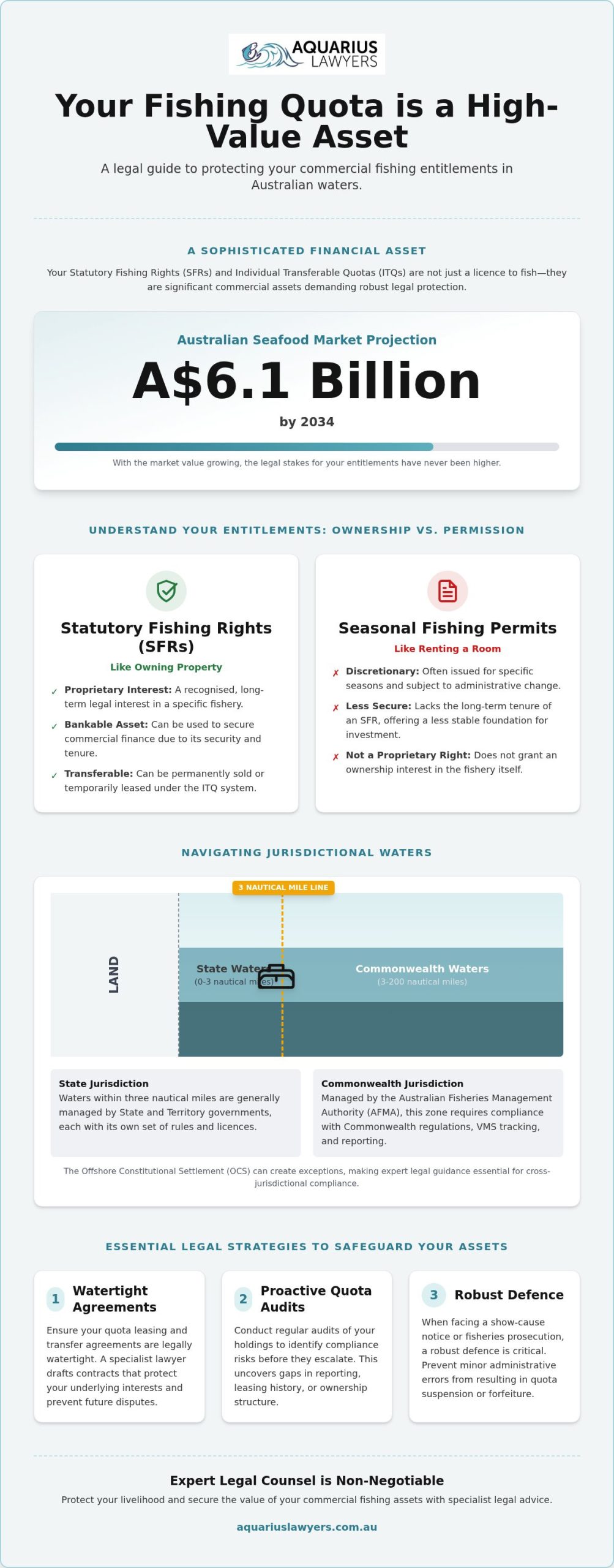
Your commercial fishing quota isn’t just a permit to work; it’s a sophisticated financial asset that demands the same level of legal protection as any high-value property or corporate holding. With the Australian seafood market projected to hit A$6.1 billion by 2034, the stakes for your entitlements have never been higher. Engaging a specialist fishing quota transfer lawyer is no longer just a precaution, it’s a fundamental business strategy to safeguard your commercial future against increasingly rigid regulations and administrative oversight.
We know that the weight of mandatory electronic monitoring and the shift toward real-time digital reporting feels like a constant pressure on your daily operations. The risk of quota suspension or forfeiture due to a minor breach is a reality that can jeopardise years of hard work. This guide will show you how to protect your holdings through expert legal strategy and pragmatic advice. We will cover the latest 2026 AFMA requirements, the intricacies of cross-jurisdictional leasing, and how to mount a robust defence against fisheries prosecutions to keep your business on the water and your assets secure.
Key Takeaways
- Treat your Statutory Fishing Rights (SFRs) and ITQs as high-value commercial assets to ensure long-term financial stability and asset protection.
- Understand the jurisdictional complexities between State and Commonwealth waters to maintain seamless compliance when operating across the three nautical mile line.
- Partnering with a dedicated fishing quota transfer lawyer ensures your leasing and transfer agreements are legally watertight and drafted to protect your underlying interests.
- Learn the critical steps to take when facing a show-cause notice to prevent minor administrative errors from resulting in quota suspension or forfeiture.
- Discover how integrating modern technology with expert legal strategy can streamline your reporting requirements and reduce the risk of regulatory breaches.
Understanding Fishing Quota as a Commercial Asset
In the Australian maritime industry, treating your quota as a mere “licence to fish” is a risky oversight. With the value of Australian fisheries and aquaculture production forecast to reach A$3.9 billion in 2025-2026, these entitlements are among your most significant commercial assets. They should be managed with the same legal rigour and strategic planning as a commercial real estate portfolio or a high-value shareholding. When the market is this competitive, your “licence to operate” depends entirely on the strength of your legal title and your history of compliance.
Market values for quota are rarely static. Regulatory shifts, such as the 2026 review of the Commonwealth Fisheries Harvest Strategy Policy, can cause immediate fluctuations in the capital value of your holdings. A specialist fishing quota transfer lawyer helps you stay ahead of these changes, ensuring that your asset’s value is protected through robust ownership structures and proactive management. Whether you’re operating out of Sydney or Shellharbour, your legal strategy must account for both the biological health of the fishery and the administrative environment that governs it.
Statutory Fishing Rights vs. Fishing Permits
The difference between a Statutory Fishing Right (SFR) and a seasonal fishing permit is the difference between owning a home and renting a room. Statutory Fishing Rights (SFRs) are a proprietary interest in a specific fishery. This distinction is critical for your balance sheet. Because SFRs offer long-term tenure and security, they are often seen as “bankable” assets that can be used to secure commercial finance.
Most modern management plans rely on the Individual Transferable Quota (ITQ) system, which allows for the permanent transfer or temporary leasing of these rights. While permits are often discretionary and subject to sudden change, SFRs provide a more stable foundation for long-term business investment. Understanding the legal nuances of these instruments is essential before you enter into any sale or purchase agreement.
The Importance of Regular Quota Audits
Compliance is the currency of the fishing industry. A single administrative error or a misunderstood reporting requirement can lead to the suspension or forfeiture of your quota. Working with a fishing quota transfer lawyer to conduct regular audits of your holdings is a pragmatic way to identify risks before they escalate into formal prosecution matters. These audits look for gaps in your reporting, inconsistencies in your leasing history, and potential vulnerabilities in your ownership structure.
Audits are particularly vital during periods of business change. If you’re involved in a partnership restructuring, a company merger, or even a divorce, your quota assets are often the first things to be scrutinised. Protecting these assets requires clear, documented evidence of ownership and a clean compliance record. We provide the expert oversight needed to ensure that your commercial entitlements remain secure, regardless of the challenges your business faces on land.
Navigating Commonwealth and State Fisheries Regulations
Understanding where State law ends and Commonwealth jurisdiction begins is the first step in protecting your commercial interests. In Australia, the jurisdictional divide is generally defined by the three nautical mile line. Waters within three nautical miles of the coast are managed by State governments, while the area from that line out to the 200 nautical mile limit falls under Commonwealth control. However, the Offshore Constitutional Settlement (OCS) often complicates this by allowing specific fisheries to be managed by a single jurisdiction across these boundaries. For operators crossing these invisible lines, a fishing quota transfer lawyer provides the clarity needed to ensure your licences remain valid in every zone you enter.
The Australian Fisheries Management Authority (AFMA) is the primary regulator for Commonwealth waters. Their management plans are based on the Australian Government’s definition of fishing quota, which views these entitlements as a way to balance commercial viability with biological sustainability. Managing compliance across these jurisdictions requires more than just good seamanship; it requires a deep understanding of how different sets of regulations overlap and, at times, conflict.
Commonwealth Managed Fisheries
Operating in high-value Commonwealth fisheries, such as Southern Bluefin Tuna or the Northern Prawn Fishery, involves intense administrative scrutiny. AFMA relies heavily on Vessel Monitoring System (VMS) data to track movements and ensure boundary compliance. As of July 1, 2026, mandatory electronic monitoring (EM) has been phased into several Commonwealth fisheries, with full implementation expected by April 1, 2027. This shift toward real-time digital surveillance raises significant legal privacy concerns and changes how you must handle at-sea boardings and inspections. If your data is misinterpreted, you could face immediate suspension or heavy fines. Consulting with an experienced fisheries law specialist can help you map out these boundaries and protect your data rights.
State-Based Entitlements in NSW
Closer to shore, the NSW Department of Primary Industries (DPI) manages entitlements under the Fisheries Management Act 1994 (NSW). State-based licences often have different renewal cycles and transfer protocols than their Commonwealth counterparts. The administrative process for transferring or renewing these licences is strictly governed, and even a small error in your paperwork can stall a high-value transaction.
Legal challenges to state management plans frequently arise when quota allocations are changed or new marine parks are established. These shifts can devalue your investment overnight. We help NSW fishers navigate these state-specific hurdles, ensuring that your local entitlements are as secure and bankable as any Commonwealth right. Whether you’re dealing with share linkage or total allowable catch (TAC) adjustments, having a strategy in place is the only way to maintain your competitive edge.
How to Organise Quota Transfers and Leasing
Organising the transfer of fishing entitlements is a high-stakes commercial transaction. It’s not just a matter of filling out a form; it’s about protecting your underlying capital. The Australian Fisheries Management Authority explains fishing quotas as legal instruments that can be bought, sold, or leased, but the administrative ease of the transfer doesn’t reflect the legal complexity behind it. Whether you’re executing a permanent transfer or a temporary lease, a fishing quota transfer lawyer ensures that the financial and regulatory risks are managed before the ink is dry.
A critical part of any transfer is managing security interests. If you’re financing a quota purchase, the lender will likely register their interest on the Personal Property Securities Register (PPSR). Similarly, if you’re leasing your quota to another operator, you must ensure your interest is registered to protect the asset from the lessee’s potential insolvency. Beyond security, you must consider the taxation implications. Quota transactions often trigger significant Capital Gains Tax (CGT) liabilities. We work alongside your financial advisors to ensure the transaction structure is as tax-efficient as possible while remaining fully compliant with Australian law.
Due Diligence for Quota Purchases
Buying quota without thorough due diligence is a recipe for disaster. You must verify the catch history and ensure there are no latent effort issues that could affect future allocations. Our process involves several key checks:
- Verifying the validity of entitlements and any pending legal actions against the holder.
- Checking the PPSR for undisclosed encumbrances or security interests.
- Ensuring vessel and gear specifications match the specific requirements of the quota.
A mismatch in gear requirements or a history of undisclosed breaches could render your expensive new asset unusable or subject to immediate scrutiny by AFMA or state regulators.
Drafting Enforceable Leasing Contracts
Leasing out your quota allows for a steady income stream, but it exposes you to the lessee’s operational risks. A robust contract must include clear clauses for catch sharing and strict penalties for over-catch. We include seasonal reconciliation milestones to ensure you aren’t left with a compliance headache at the end of the fishing year. Indemnity clauses are non-negotiable; they protect you from the lessee’s regulatory breaches, such as VMS errors or boundary violations. Finally, we tailor dispute resolution mechanisms for the commercial fishing industry, prioritising mediation to resolve issues quickly and keep everyone on the water.
Defending Fisheries Prosecutions and Appeals
The transition from a routine fishing trip to a legal battle often begins with a single administrative oversight. Common triggers for fisheries prosecutions include discrepancies in logbook entries, accidental boundary breaches, or failures in the Vessel Monitoring System (VMS). While these may seem like minor technicalities, regulators like AFMA and the NSW DPI view them as serious threats to the integrity of the management system. When your livelihood is on the line, the role of a fishing quota transfer lawyer expands from managing assets to mounting a sophisticated legal defence. Protecting your quota from suspension or permanent forfeiture requires an immediate, tactical response to any regulatory inquiry.
Investigations can be exhausting and expensive, but they don’t have to be the end of your business. If a regulator makes an administrative decision that unfairly impacts your operations, you have the right to seek a review. Appealing these decisions through the Administrative Appeals Tribunal (AAT) allows for an independent assessment of the facts. This process is your primary safeguard against overzealous enforcement or flawed data interpretation. We focus on maintaining your “licence to operate” while the legal process unfolds, ensuring that an ongoing investigation doesn’t ground your fleet or devalue your commercial holdings.
Responding to Show-Cause Notices
Receiving a show-cause notice is a critical juncture that defines the future of your case. This is your opportunity to explain why the regulator should not take further disciplinary action, making your initial response the most vital document in your defence. We assist by gathering hard evidence to dispute errors in Catch Disposal Records (CDR) or misinterpreted VMS data. Accuracy in this stage is paramount. In Commonwealth fisheries, operators generally have a 28-day window for quota reconciliation following the end of a fishing season to ensure their catch aligns with their holdings. Missing this window or providing an inadequate explanation in your show-cause response can lead directly to prosecution.
Court Representation and Sentencing
Fisheries law frequently involves strict liability offences, where the prosecution only needs to prove the act occurred, regardless of your intent. Defending these matters requires an “innovative veteran” approach that combines deep maritime knowledge with modern data analysis. We focus on mitigating penalties by highlighting your compliance history and any technical malfunctions that may have contributed to the breach. Arguing against the forfeiture of high-value quota is our priority, as losing these assets can be a fatal blow to your commercial viability. If you are facing regulatory action, contact our fisheries prosecution defence team to secure an expert legal shield for your business.
Why Expert Legal Counsel is Non-Negotiable
Hiring a generalist solicitor for a quota dispute is a gamble your business can’t afford. In the highly specialised maritime industry, generic legal advice often results in overlooked regulatory nuances that lead to expensive delays or asset loss. A fishing quota transfer lawyer provides more than just paperwork; they offer a deep understanding of the industry’s unique pathway to success. We integrate modern data analysis with traditional maritime law to ensure your operations remain compliant as the industry moves toward total digital transparency by 2027. This modern methodology ensures that your traditional experience is protected by forward-thinking legal strategy.
Proactive risk management is essential as we navigate the regulatory complexities of 2026. AFMA has established strict quota reconciliation timeframes for the 2026 season, and missing these windows can trigger automatic administrative penalties. By working with a Fish Lawyer who speaks your language and understands the culture of the wharf, you gain a trusted advisor who anticipates these hurdles before they impact your bottom line. It’s about combining high-level strategic thinking with the relatable, everyday wisdom of someone who knows the industry from the deck up. We value results over ceremony, ensuring you stay on the water instead of being stuck in a courtroom.
Strategic Advice for Long-Term Viability
Our approach moves beyond reactive legal help. We focus on a proactive commercial strategy designed to build a resilient seafood enterprise that can be passed down to future generations. This involves structuring your holdings to withstand market volatility and shifting environmental policies. We help you navigate the synergy between commercial property law and niche fisheries entitlements, ensuring your business remains a bankable asset. To discuss your specific needs, contact Aquarius Lawyers for a confidential fisheries consultation where we can map out a secure legal trajectory for your fleet.
The Aquarius Lawyers Difference
Katherine Hawes is nationally recognised as The Fish Lawyer, a title earned through years of dedicated service to the Australian maritime community. With offices in both Sydney and Shellharbour, we provide convenient local representation backed by a national reputation for excellence. We offer a no-nonsense perspective that prioritises your commercial viability above all else. Our firm moves easily between different areas of focus, from aquaculture to international maritime law, providing the intellectual versatility your business demands. Secure your commercial future with expert fisheries legal advice from Aquarius Lawyers.
Secure Your Commercial Future on the Water
Treating your quota as a high-value asset and maintaining ironclad compliance are the two pillars of a sustainable fishing business. As we move toward 2027, the synergy between traditional experience and modern digital reporting will separate successful enterprises from those at risk of regulatory suspension. Whether you are navigating the jurisdictional divide between state and Commonwealth waters or drafting a watertight lease agreement, the right legal strategy protects your capital from erosion. Partnering with a specialist fishing quota transfer lawyer ensures that your entitlements remain bankable and your operations stay resilient against shifting management plans.
Principal Katherine Hawes, the renowned “Fish Lawyer”, provides the specialised expertise in Australian fisheries compliance and PPSR registrations required to safeguard your livelihood. With accessible offices in Sydney and Shellharbour, Aquarius Lawyers offers a pragmatic pathway through the complexities of maritime law. We value results over ceremony, focusing on solutions that keep your fleet moving. Consult “The Fish Lawyer” for expert fisheries advice today to fortify your commercial holdings. Your legacy deserves a legal defence as robust as the work you put in every day.
Frequently Asked Questions
What is the difference between a fishing permit and a statutory fishing right?
A Statutory Fishing Right (SFR) is a proprietary interest in a fishery, offering long-term tenure and security, whereas a fishing permit is a short-term administrative grant that is often seasonal and discretionary. Because SFRs are recognised as a form of property, they are “bankable” and can be used as collateral for finance. Permits don’t offer the same level of asset security or transferability, making SFRs the preferred instrument for long-term commercial investment.
Can I lease out my fishing quota if I am not using it this season?
You can certainly lease out your fishing quota if you don’t intend to fish it yourself. This is a common strategy to generate a steady income stream from your asset while maintaining ownership of the underlying entitlement. However, you must ensure the lease agreement includes strict indemnity clauses to protect you from any regulatory breaches committed by the lessee. A fishing quota transfer lawyer can draft these protections to ensure your asset remains secure.
What should I do if AFMA issues me a notice of suspected non-compliance?
You should seek legal advice immediately and avoid making a formal statement until you understand the specific allegations. AFMA notices are often the precursor to a formal show-cause process or prosecution. Gather all relevant VMS data, logbook entries, and catch disposal records to identify any technical errors or discrepancies. Responding accurately within the initial timeframe is the most effective way to prevent a minor administrative issue from escalating into a serious legal battle.
How is the value of a commercial fishing quota determined in Australia?
The value of commercial fishing quota is determined by market demand, the Total Allowable Catch (TAC) for the season, and the historical profitability of the specific fishery. Factors such as proximity to markets and export demand for species like Southern Bluefin Tuna or Gummy Shark play a significant role. Additionally, the legal security of the entitlement, such as whether it is a permanent SFR or a temporary permit, directly influences its capital value on the open market.
Do I need a lawyer for a simple transfer of a fishing licence?
While the administrative forms for a transfer may seem straightforward, engaging a fishing quota transfer lawyer is essential to manage the underlying commercial risks. A lawyer performs critical due diligence, checking for undisclosed encumbrances on the Personal Property Securities Register (PPSR) and ensuring the transaction is tax-efficient. Skipping this step can leave you liable for the previous owner’s breaches or facing unexpected Capital Gains Tax issues that far outweigh the cost of legal counsel.
Can fishing quota be used as security for a business loan?
Yes, Statutory Fishing Rights are frequently used as security for business loans because they are a recognised proprietary interest. Lenders will typically register their security interest on the PPSR to protect their position. This “bankability” allows operators to leverage their quota assets to fund vessel upgrades or expand their fleet. However, you must ensure your loan documentation correctly identifies the specific entitlements and complies with AFMA or state-based registration requirements to remain valid.
What are the penalties for exceeding my allocated quota in NSW?
Penalties for exceeding your allocated quota in NSW can be severe, ranging from significant monetary fines to the mandatory reduction of future quota allocations. Under the Fisheries Management Act 1994 (NSW), serious or repeat breaches can even lead to the suspension or permanent cancellation of your commercial fishing licence. Regulators may also pursue the forfeiture of catch and gear, making it vital to have a robust compliance strategy and accurate real-time reporting in place.
How long does a fisheries law appeal process typically take?
The duration of an appeal process varies depending on the complexity of the matter and the tribunal’s schedule. A review through the Administrative Appeals Tribunal (AAT) typically takes several months from the initial filing to a final hearing. During this time, we focus on securing stay orders where possible to keep your business operational. Quick resolution often depends on how well the initial evidence was gathered and the clarity of the legal arguments presented early on.
Disclaimer
Please note that legal rules change and this is not a substitute nor construed as legal advice. It is general information only.