
A commercial fishing vessel is a business acquisition of a regulated asset, not just a boat purchase. You’ve likely realised that while the physical survey matters, the invisible legal framework surrounding the hull is what truly determines your success. It’s common to feel overwhelmed by the friction between state and federal regulations or the daunting bureaucracy of the Australian General Shipping Register. Partnering with a dedicated fishing vessel purchase lawyer is the most effective way to ensure your capital is protected and your new venture is seaworthy from a legal perspective.
We’re here to help you secure a clear title and avoid the nightmare of undisclosed maritime liens. This guide explains how to manage the transfer of fishing licences and quotas while ensuring your maritime contracts are watertight. We will look at the practical steps required to satisfy regulatory compliance in 2026, moving you from the negotiation table to the open water with minimal fuss. By blending deep industry experience with modern legal strategy, we provide the pathway to a risk-free acquisition and a profitable future on the waves.
Key Takeaways
- Treat your vessel as a revenue-generating maritime asset to ensure your contract reflects the commercial reality of the industry.
- Conduct thorough PPSR searches to verify a clear title, as a sound hull doesn’t protect you from hidden maritime liens or encumbrances.
- Engaging a dedicated fishing vessel purchase lawyer ensures the secure and simultaneous transfer of Statutory Fishing Rights (SFRs) and state-based licences.
- Move beyond generic “pro-forma” boat contracts by drafting a bespoke Sale and Purchase Agreement that includes robust warranties for regulatory compliance.
- Streamline the administrative burden of Australian General Shipping Register transfers by following a methodical, expert-led approach.
Why Buying a Commercial Fishing Vessel Requires Specialist Legal Oversight
Buying a commercial fishing boat isn’t like picking up a weekend cruiser for the harbour. You are acquiring a revenue-generating maritime asset. This means the transaction is governed by the intricate principles of maritime law, which extend far beyond a basic bill of sale. Standard boat sale contracts usually fail in this arena because they treat the vessel as a recreational object rather than a complex business tool. While a marine surveyor tells you if the hull is sound, a fishing vessel purchase lawyer tells you if the business is legally viable. In 2026, the Australian maritime landscape is defined by increased scrutiny on sustainability and digital documentation. You need a legal strategy that accounts for both the steel and the statutory rights.
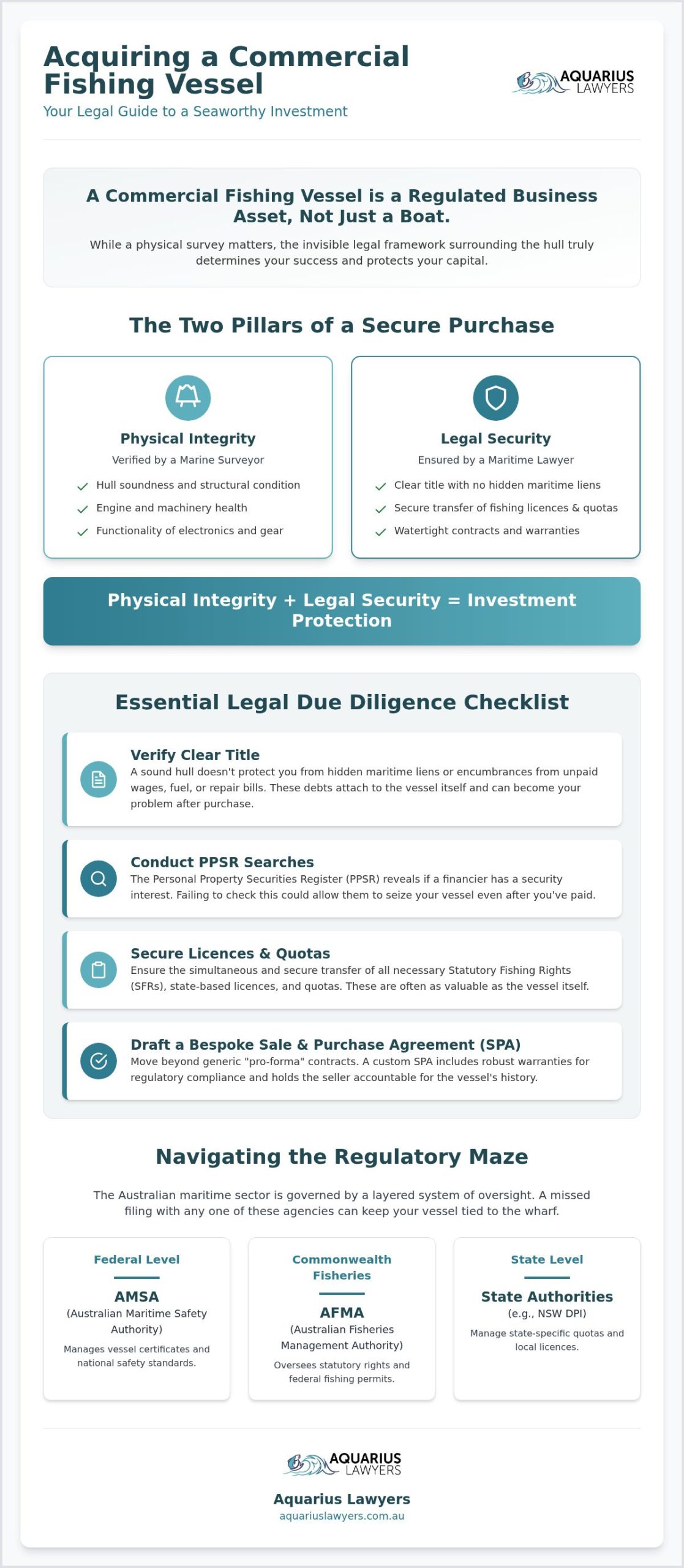
Think of it as a simple equation: Physical Integrity + Legal Security = Investment Protection. A surveyor ensures the engines are running and the electronics are functional. However, they cannot verify if the vessel has hidden maritime liens or if the attached quotas are actually transferable. This is where specialist legal oversight becomes your most valuable tool on the water.
The Legal Complexity of Commercial vs. Recreational Purchases
“As is, where is” clauses are common in recreational sales but can be a death sentence for a commercial operator. If you buy a vessel with undisclosed encumbrances or a history of regulatory breaches, you’re inheriting those problems. The duty of care and disclosure requirements are significantly higher in commercial transactions. You aren’t just checking for past accidents; you’re checking for a history of compliance with safety and environmental standards. A fishing vessel purchase lawyer helps you draft warranties that protect you from these hidden risks, ensuring the seller remains accountable for the vessel’s history.
Regulatory Bodies You Need to Know
The Australian maritime sector operates under a layered system of oversight. The Australian Maritime Safety Authority (AMSA) manages vessel certificates and national safety standards. For Commonwealth fisheries, the Australian Fisheries Management Authority (AFMA) oversees statutory rights and federal permits. Locally, state authorities like the NSW Department of Primary Industries (DPI) manage specific quotas and licences. Each body has its own set of rules for transfers and renewals. Missing a single filing with these agencies can keep your boat tied to the wharf while your competitors are out at sea.
Essential Due Diligence: Beyond the Marine Surveyor’s Report
A clean hull is a positive start, but it isn’t a guarantee of a clean title. While your marine surveyor focuses on the structural integrity of the bulkheads and the health of the main engines, they cannot see the financial weight dragging down the asset. A fishing vessel purchase lawyer looks for the “invisible” encumbrances that don’t appear on a physical inspection. These include maritime liens for unpaid crew wages, outstanding fuel bunker bills, or shipyard repair costs from previous seasons. In the maritime world, these debts often attach to the vessel itself. If they aren’t identified and cleared before settlement, you could find your new investment arrested in port to satisfy the previous owner’s debts.
Verifying the status on the Australian General Shipping Register (AGSR) is equally critical. This confirms the seller actually has the legal right to transfer the title and that the vessel’s registration is current. We also check for any historical claims that might cloud the title. This layer of legal scrutiny ensures that when you take delivery, you are the undisputed owner of a debt-free asset.
Navigating the PPSR and Maritime Liens
Checking the Personal Property Securities Register (PPSR) is a non-negotiable step in modern maritime acquisitions. This register reveals security interests that could allow a financier to seize your boat even after you’ve paid the purchase price. We use a methodical approach to identify these charges and ensure they are discharged at settlement. Protecting your deposit is another priority. We recommend using trust account arrangements to ensure your capital remains safe until every encumbrance is legally removed. For operators looking at international standards or vessels with a global history, referencing NOAA Fisheries permits and regulations can provide a useful benchmark for the documentation required in highly regulated fisheries. It is a simple equation: Verified PPSR + Discharged Liens = Financial Security.
Verifying Compliance and Survey History
Due diligence must extend to the vessel’s operational history through the Australian Maritime Safety Authority (AMSA) records. You need to review the Safety Management System (SMS) and check for any outstanding improvement notices or prohibitions. In 2026, environmental and safety standards have evolved. Ensuring the vessel meets current emissions and waste management requirements prevents costly post-purchase refits. Working with experienced maritime solicitors allows you to uncover these operational risks before you sign on the dotted line. This proactive approach identifies whether a vessel is a turnkey opportunity or a looming liability.
The Regulatory Catch: Licences, Quotas, and Statutory Fishing Rights
A common mistake in maritime acquisitions is treating the vessel and the right to fish as a single entity. They are legally distinct. You can own the hull, registered on the Australian General Shipping Register, yet have zero legal authority to cast a net. The real value of your investment often lies in the attached licences and quotas rather than the steel itself. This is where a fishing vessel purchase lawyer becomes essential. We ensure that the “licence splitting” trap doesn’t catch you out, where a seller might attempt to retain lucrative quotas while selling the vessel they were traditionally attached to. Securing the hull without the corresponding rights is like buying a truck without a commercial transport licence; it’s an expensive ornament that can’t generate revenue.
In 2026, the industry has shifted heavily toward science-based quota management. This means the legal framework governing these rights is more rigid than ever. Every transfer must be meticulously documented to satisfy both commercial law and environmental mandates. We move beyond the physical survey to audit the vessel’s “paper trail,” ensuring the quotas you’re paying for are valid, current, and fully transferable.
Statutory Fishing Rights (SFRs) vs. State Licences
Navigating the friction between Commonwealth and State jurisdictions requires a steady hand. Statutory Fishing Rights (SFRs) are issued by the Australian Fisheries Management Authority (AFMA) for federal waters. These are sophisticated financial assets that can be leased, sold, or used as security. The transfer process involves specific AFMA forms and often requires the discharge of existing interests. Conversely, state-based licences operate under different legislative frameworks. For example, Queensland Coral Trout quotas were valued at approximately $4.24/kg in early 2026, illustrating the high stakes involved in these transfers. If you are heading north to inspect a potential purchase, you can visit Zoom FNQ for luxury private transfers in the Cairns region. Missing a deadline or filing incorrect paperwork can result in the suspension of fishing operations, costing you thousands in lost sea time.
If you are operating in New South Wales, you must navigate the share-based fishery system managed by the NSW Department of Primary Industries (DPI). This system ties your right to fish to the number of shares you hold in a specific fishery. It’s a complex “equation” where Share Holdings + Vessel Capacity = Operational Limit. We verify that you meet the “fit and proper person” requirements, a mandatory hurdle for any prospective licence holder. Additionally, we assess the impact of regional zoning and marine park closures on the vessel’s future earning potential. Understanding these local restrictions is the difference between a profitable venture and a stranded asset. Our role is to provide the clarity and confidence needed to finalise these transfers without regulatory friction.
Drafting a Robust Vessel Sale and Purchase Agreement (SPA)
Using a generic “pro-forma” boat contract for a commercial acquisition is a recipe for disaster. These standard templates are designed for recreational runabouts, not revenue-generating maritime assets with complex regulatory ties. A fishing vessel purchase lawyer drafts a bespoke Sale and Purchase Agreement (SPA) that reflects the commercial reality of your investment. This document must move beyond the basic hull price to include specific warranties regarding the vessel’s title, freedom from encumbrances, and full regulatory compliance. Without these protections, you are essentially flying blind into a potential financial storm.
Condition precedent clauses are the most vital part of a commercial SPA. These ensure the sale is legally contingent on the successful transfer of fishing licences and quotas. If the NSW DPI or AFMA refuses the transfer, the contract allows you to walk away with your deposit intact. We also meticulously define the “inventory” to avoid post-settlement disputes. This includes everything from specialized sonar systems and winch gear to spare nets and engine components. If it isn’t in the written inventory, you can’t assume it stays on the boat. Clear Warranties + Condition Precedents = Transactional Safety.
Key Clauses for Commercial Fishing Contracts
The “Delivery and Acceptance” protocol is a critical milestone that occurs at the slipway. This clause defines exactly when the risk passes from the seller to you. It usually involves a final inspection or sea trial to ensure the vessel’s condition hasn’t deteriorated since the survey. We also include robust indemnity clauses to protect you from prior environmental or safety breaches. If the previous owner incurred fines for illegal discharging or safety violations, those liabilities must remain with them. Choosing an Australian jurisdiction for dispute resolution is another non-negotiable. It ensures that any legal disagreements are handled by courts that understand our unique maritime and fisheries legislation.
Settlement and Post-Purchase Obligations
Settlement is more than just handing over a cheque. It involves the formal execution of the Bill of Sale and the transfer of registration on the Australian General Shipping Register (AGSR). Following settlement, there is a flurry of mandatory notifications. You must inform AFMA, AMSA, and the NSW DPI to update their records and ensure your operations remain legal. Organising specialist marine insurance is the final step. This isn’t standard boat insurance; it must specifically cover commercial fishing risks, including P&I (Protection and Indemnity) and hull and machinery cover. To ensure your contract is watertight before you commit, contact our maritime commercial law team for a comprehensive agreement review.
How Aquarius Lawyers Streamlines Your Maritime Acquisition
Securing a commercial maritime asset requires more than just a legal generalist. Katherine Hawes, widely known as “The Fish Lawyer”, leads our team with a sharp focus on the intersection of commercial law and maritime regulation. Our no-nonsense approach means we value results over ceremony, providing you with the clarity needed to make informed investment decisions. As a dedicated fishing vessel purchase lawyer, Katherine understands that time spent at the wharf is money lost. We cut through the red tape of AFMA and state-based authorities to ensure your acquisition moves forward without unnecessary delays.
We provide fixed-fee options for vessel conveyancing and contract reviews, giving you price certainty from the outset. This transparency is vital for both local NSW fishers and international investors looking to enter the Australian market. By combining high-level professional expertise with a down-to-earth pragmatism, we facilitate outcomes that protect your capital and your reputation.
The “Innovative Veteran” Advantage
We operate as an innovative veteran in the maritime sector. This means we blend traditional credentials with forward-thinking methodology to solve modern regulatory challenges. We assess every transaction through a clear logical equation: Legal Integrity + Operational Compliance = Commercial Success. This formula ensures that every potential risk is identified and mitigated before you commit your funds. Our strategy is tech-driven and efficient, focusing on a clear pathway to resolution rather than endless billable hours. We don’t just identify problems; we provide the strategic solutions required to get your vessel fishing as soon as possible.
Get in Touch with the Maritime Specialists
Our firm is positioned to support the industry across the coast, with offices located in Sydney’s King Street and regional Shellharbour. This dual presence allows us to stay connected to the heart of the commercial fleet while maintaining a strong presence in the legal centre of the state. Booking your initial consultation for a vessel purchase review is the first step toward a secure acquisition. We will review your maritime contracts, audit the vessel’s regulatory history, and ensure your licences are ready for transfer. Protect your investment—contact Aquarius Lawyers today to ensure your next commercial venture is built on a solid legal foundation.
Chart a Secure Course for Your Next Maritime Venture
Navigating the acquisition of a commercial fishing vessel in 2026 requires more than just a keen eye for a sound hull. It demands a strategic understanding of how maritime assets and statutory rights intersect. By prioritising thorough due diligence on the PPSR and ensuring your Sale and Purchase Agreement is contingent on licence transfers, you eliminate the risks that often sink new investments. Every successful operation is built on the foundation of a clear title and verified compliance with AFMA and NSW DPI regulations.
Partnering with a specialised fishing vessel purchase lawyer provides the clarity you need to move from negotiation to the open water with confidence. Principal Katherine Hawes, the industry-recognised “Fish Lawyer”, offers the niche expertise required to handle complex transfers while providing fixed-fee structures for total price certainty. Don’t leave your commercial future to chance or generic contracts. Secure your maritime future—consult with The Fish Lawyer at Aquarius Lawyers today. We’re ready to help you turn your next purchase into a profitable, long-term success on the waves.
Frequently Asked Questions
Do I need a separate lawyer for the boat and the fishing licence?
No, you should engage a single fishing vessel purchase lawyer who specialises in both maritime and fisheries law. Managing these as separate transactions is a common error that leads to complications. A specialist ensures that the transfer of the physical hull and the statutory fishing rights are legally synchronised. This integrated approach prevents “licence splitting” where the vessel is sold but the vital quotas are inadvertently retained by the seller.
What is a maritime lien and can it affect my new vessel?
A maritime lien is a legal claim against a vessel for debts like unpaid crew wages, fuel bills, or shipyard repairs. Unlike standard commercial debts, these liens “stick” to the hull regardless of ownership changes. If you purchase a boat with an active lien, you inherit that liability. We conduct deep due diligence to identify these “invisible” encumbrances, ensuring they are discharged before you take legal possession of the asset.
How long does the legal process of buying a commercial fishing boat take?
The timeline typically ranges from four to eight weeks, depending on the complexity of the licences involved. While a physical survey might take a few days, the administrative friction of transferring Australian General Shipping Register details and AFMA or NSW DPI quotas adds significant time. We focus on a methodical flow to minimise delays, but regulatory processing times remain the primary variable in most 2026 maritime transactions across Australia.
Is a PPSR search enough to guarantee a clean title on a vessel?
A PPSR search is essential but not exhaustive for maritime assets. While it reveals registered security interests from financiers, it doesn’t always capture traditional maritime liens or historical claims. We combine PPSR searches with a thorough audit of the Australian General Shipping Register and operational records from AMSA. This multi-layered strategy is the only way to ensure your fishing vessel purchase lawyer can guarantee a truly clean title before settlement.
Can I buy an overseas fishing vessel and bring it into Australian waters?
Yes, but you must navigate a complex gauntlet of import permits, biosecurity clearances, and AMSA safety certifications. The vessel must be modified to meet strict Australian 2026 environmental and safety standards before it can be registered on the AGSR. Additionally, you must secure the appropriate Australian fishing licences separately. It’s a high-stakes process that requires specialist legal oversight to avoid the vessel being impounded at the border upon arrival.
What happens if the fishing quota doesn’t transfer after I’ve paid for the boat?
This is a nightmare scenario that we prevent by using “condition precedent” clauses in your Sale and Purchase Agreement. These clauses state that the sale isn’t legally finalised until the regulatory bodies confirm the quota transfer. If you’ve already paid without these protections, you face a costly legal dispute. We recommend using trust accounts to hold funds until all statutory rights are successfully registered in your name by the relevant authorities.
Are there specific legal requirements for fishing vessels in NSW regional waters?
NSW regional waters are governed by a unique share-based fishery system managed by the DPI. You must hold a specific number of shares to legally operate in certain zones. There are also “fit and proper person” requirements for all licence holders. We verify that the vessel and the operator meet these local standards, particularly regarding regional zoning closures and marine park restrictions that could impact your future return on investment.
How does Aquarius Lawyers charge for vessel purchase assistance?
We offer fixed-fee options for vessel conveyancing and contract reviews to provide you with total price certainty from the start. This approach removes the stress of unpredictable billable hours during complex negotiations. Our fees reflect the specialist nature of fisheries and maritime law, covering everything from PPSR due diligence to the final transfer of statutory rights. We’ll provide a clear, written quote after our initial consultation regarding your specific maritime acquisition project.
Disclaimer
Please note that legal rules change and this is not a substitute nor construed as legal advice. It is general information only.