
A notice of suspension from a fisheries department isn’t a final verdict; it’s a formal proposal that you have the legal right to challenge. When your primary income and family business are on the line, the weight of administrative bureaucracy can feel overwhelming. You’ve worked hard to build your reputation on the water, and the fear of a permanent licence cancellation is a heavy burden to carry alone. We agree that the system often feels geared against the operator, but the right strategy can level the playing field.
This article provides a comprehensive legal roadmap for a commercial fishing licence suspension appeal, designed to help you secure an urgent stay of proceedings and protect your livelihood. It’s a guide to turning a stressful setback into a proactive defense of your rights. We will preview the critical 2026 deadlines for tribunals like NCAT and QCAT, explain the mandatory internal review requirements in Queensland, and outline the strategic pathway to get your vessel back out to sea. Clear legal insight plus prompt action equals a protected future. Let’s look at exactly how to challenge these decisions and restore your commercial fishing operations.
Key Takeaways
- Distinguish between an immediate suspension and a proposed cancellation to understand the specific legal threat to your commercial operations.
- Identify the most effective grounds for a commercial fishing licence suspension appeal, focusing on procedural fairness and challenging factual errors in fisheries reports.
- Evaluate the strategic benefits of an independent tribunal review versus an internal department review to ensure an unbiased look at your case.
- Follow a structured legal roadmap to gather essential evidence, including GPS records and character references, to build a robust maritime defence.
- Leverage the synergy of specialised fisheries law expertise and modern technology to streamline your pathway back to the water.
Understanding Your Commercial Fishing Licence Suspension in Australia
Receiving a formal notice from the Department of Primary Industries (DPI) or a state fisheries regulator feels like a door slamming shut on your career. It isn’t just administrative paperwork; it’s your livelihood placed on ice. Understanding the mechanics of a commercial fishing licence suspension appeal starts with knowing exactly what the regulator is doing and why they’ve targeted your operations. In New South Wales, the Fisheries Management Act 1994 provides the primary framework for these enforcement actions. While the Australian Fisheries Management Authority (AFMA) manages Commonwealth fisheries further offshore, state-based legislation governs the majority of inshore commercial activities. Knowing which rules apply to your specific zone is the first step toward a resolution.
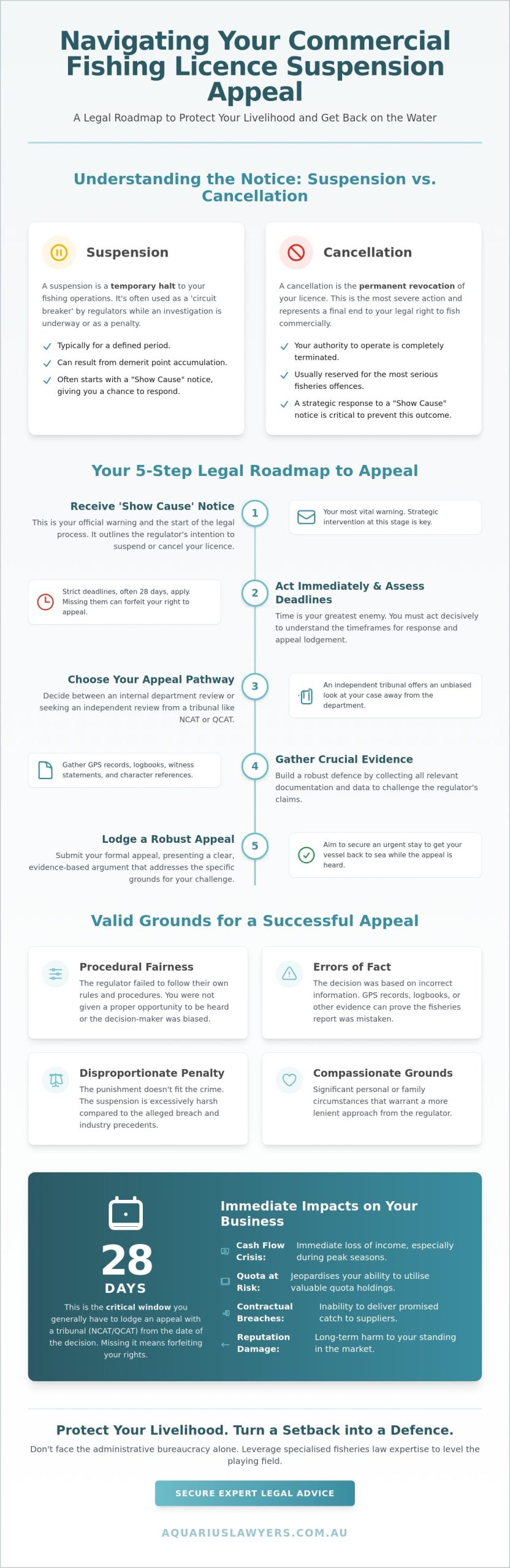
There is a critical legal distinction between an immediate suspension and a proposed cancellation. A suspension is a temporary halt, often used as a “circuit breaker” while an investigation continues or as a penalty for accumulated demerit points. A cancellation is the permanent revocation of your right to fish. Both usually begin with a “Show Cause” notice. This document is your most vital warning. It’s the department’s way of saying they intend to take action, but they’re legally required to give you a chance to argue why they shouldn’t. Strategic intervention at this stage can often prevent a suspension from ever taking effect.
Common triggers for these notices include serious fisheries offences, such as exceeding quota or obstructing inspectors, but they can also stem from simple administrative failures. A missed fee or a late logbook entry can be just as damaging as a technical breach on the water. Regardless of the trigger, the goal is the same: keeping your vessel operational. Early intervention plus expert evidence equals a protected business.
The Immediate Impact on Your Fishing Business
Being grounded during a peak season, like a prawn run or a high-demand holiday period, creates a cash flow crisis that many businesses can’t survive. Beyond the daily loss of income, a suspension can jeopardise your standing in share management schemes and your ability to utilise expensive quota holdings. You also face the risk of breaching contractual obligations to wholesalers and suppliers. If you can’t deliver the catch you’ve promised, your reputation in the market may suffer long-term damage that outlasts the suspension itself.
Legal Timeframes You Cannot Afford to Miss
In the world of fisheries law, time is your greatest enemy. You generally have a strict 28-day window from the date of the decision to lodge an appeal with a tribunal like NCAT in NSW or QCAT in Queensland. Missing this deadline often means forfeiting your right to a review. We also see cases of “deemed refusal,” where a department’s failure to make a decision within a statutory timeframe counts as a rejection. You must act decisively to challenge these outcomes. A proactive approach ensures a temporary setback doesn’t evolve into a permanent exit from the industry.
Valid Grounds for Appealing a Fisheries Compliance Decision
A successful commercial fishing licence suspension appeal relies on identifying where the regulator overstepped or erred. It isn’t enough to simply disagree with the outcome. You must demonstrate that the decision was legally flawed or based on a fundamental misunderstanding of the facts. Reviewing Queensland’s policy on licence suspension reveals that departments must adhere to specific criteria before halting your work. If they’ve skipped a step or misinterpreted their own guidelines, you have a solid foundation for a challenge. We focus on four primary pillars: procedural fairness, errors of fact, disproportionate penalties, and compassionate grounds.
The severity of the penalty must match the gravity of the offence. In 2021, Queensland saw cases where fishers received five-year suspensions for obstruction, while others were fined $13,000 for multiple black market offences. If your suspension feels excessively harsh compared to the alleged breach, we argue that the punishment doesn’t fit the crime. Engaging a specialist in Fisheries Law can help you dissect these procedural gaps and build a case for a reduced or stayed penalty.
Challenging the Evidence of Fisheries Officers
Fisheries officers are human; they make mistakes. We often find inconsistencies between department surveillance data and a fisher’s own digital logbooks or GPS records. If the prosecution’s “statement of facts” relies on faulty measurements, we look at the calibration records of their weighing equipment. Evidence isn’t always absolute. If the data used to ground your vessel is technically flawed, the entire basis for the suspension may collapse under scrutiny.
Procedural Fairness and Natural Justice
Natural justice is a cornerstone of Australian administrative law. It means you have a right to be heard before a decision ruins your business. If the Department failed to give you a genuine opportunity to respond to allegations, or if there’s evidence of a perceived bias in the decision-making process, the suspension may be legally invalid. You aren’t just a licence number; you’re an operator with a right to a fair, transparent process. We ensure the Department follows its own rulebook.
Exceptional circumstances also play a vital role. If a breach occurred due to a medical emergency, equipment failure, or other factors beyond your control, these compassionate grounds can be powerful tools in a tribunal. Your history as a compliant operator matters. We use your track record to demonstrate that a temporary error shouldn’t lead to a permanent loss of livelihood.
Internal Review vs. NCAT: Choosing Your Appeal Pathway
Choosing the right venue for your commercial fishing licence suspension appeal is a decision that dictates your financial survival over the coming months. You typically face a choice between an internal review conducted by the Department and an external review by an independent body like the NSW Civil and Administrative Tribunal (NCAT). While the Department’s internal process is often faster and involves fewer filing fees, it’s essentially asking the regulator to grade its own homework. This can lead to a “rubber-stamping” of the original decision unless you present undeniable new evidence or highlight a blatant procedural error. It’s a tactical fork in the road that requires a cool head and a clear strategy.
For those operating in Commonwealth-managed fisheries, the pathway leads to the Administrative Appeals Tribunal (AAT). Regardless of the venue, the goal remains the same: an independent assessment of the facts. In many states, like Queensland, an internal review isn’t just an option; it’s a mandatory legal hurdle you must clear before you’re even allowed to approach a tribunal. We often use this stage to “flush out” the Department’s full range of evidence. This allows us to build a more robust case for the eventual tribunal hearing by seeing exactly what the prosecution thinks they have on you.
The Pros and Cons of Internal Reviews
The primary benefit of an internal review is efficiency. It’s a cost-effective way to resolve simple administrative errors without the complexity of a full legal hearing. However, the risk of institutional bias is high. If your case relies on a complex interpretation of the law, the Department’s officers may be less likely to overturn their colleagues’ work. It’s a strategic calculation. Use the internal review to fix minor issues, but prepare for NCAT if the dispute involves fundamental disagreements over your right to fish. Speed is good, but a fair result is better.
Applying for a “Stay” of Proceedings
This is the most critical tool in your legal arsenal, yet it’s often overlooked in standard compliance guides. A “stay” is a temporary order that stops the suspension from taking effect until the final appeal is decided. To win a stay, you must demonstrate “triable issues” and show that the “balance of convenience” favours you staying on the water. If you can prove that losing your income now would cause irreparable damage to your business, a tribunal can allow you to keep fishing while the legal process unfolds. This preserves your cash flow and ensures that a long-winded commercial fishing licence suspension appeal doesn’t bankrupt you before you even get your day in court.
How to Lodge Your Appeal: A Step-by-Step Legal Guide
Lodging a commercial fishing licence suspension appeal requires more than just filling out a form; it’s about building a technical case that can withstand the scrutiny of a tribunal member. Government policy documents often make this process look like a simple administrative task, but the reality on the ground is far more complex. You need a methodical approach to dismantle the department’s reasoning. Precision in your paperwork often determines whether you’re back on the water next month or stuck at the jetty for the season. Follow this five-step roadmap to protect your business.
- Step 1: Scrutinise the Notice of Decision. Look for errors in the department’s logic. Check if they’ve cited the correct sections of the Fisheries Management Act 1994 or if they’ve made factual blunders regarding your vessel’s location.
- Step 2: Gather your evidence. This is the foundation of your defence. You need GPS logs, character references, and technical reports that tell your side of the story.
- Step 3: Draft the Grounds of Appeal. Use precise legal citations. Don’t just say the decision is “unfair”; explain why it is legally “unreasonable” or “procedurally flawed” based on administrative law principles.
- Step 4: File the application. Submit your documents to the relevant body, such as NCAT or the AAT, within the strict 28-day window. Missing this deadline by even a day can end your appeal before it starts.
- Step 5: Attend the directions hearing. This is your first interaction with the tribunal. It’s where the timetable for evidence is set and where mediation is often suggested.
If you’re facing a complex compliance dispute, don’t navigate the tribunal alone. Engaging a specialist in Fisheries Law ensures your grounds of appeal are drafted with the technical precision required to win.
Gathering Your Defence Evidence
Evidence is the currency of the tribunal. Your Vessel Monitoring System (VMS) data is your most powerful witness; it provides an objective record of your location that can often override a fisheries officer’s manual log. Don’t overlook the human element either. Statements from crew members or other master fishers can provide context that data cannot. If the suspension involves gear violations, an expert report on equipment failure or environmental factors (like extreme weather) can prove that a breach wasn’t intentional. Strong evidence + strategic presentation = a restored livelihood.
What to Expect at the Tribunal Hearing
The tribunal hearing is a “merits review,” which is different from a court case. The Tribunal Member acts as an independent umpire and essentially “steps into the shoes” of the original decision-maker to decide what the “correct and preferable” decision should be. This is your chance to have the facts heard fresh. Unlike a judicial review, which only looks at whether the law was followed, a merits review looks at the actual facts of your case. Having professional representation at this stage significantly increases the likelihood of a settlement during the mediation phase, often getting you back to work without a full hearing.
Securing Your Livelihood with “The Fish Lawyer”
Katherine Hawes has earned her reputation as “The Fish Lawyer” through decades of focused practice in Australian Fisheries Law. When you’re facing a commercial fishing licence suspension appeal, you don’t need a generalist. You need an advisor who understands the salt and the statutes in equal measure. Aquarius Lawyers combines deep traditional credentials with a forward-thinking methodology. We use modern technology to streamline complex maritime cases, ensuring that your data, from VMS records to catch logs, is used as a shield against regulatory overreach. Our firm operates on a simple formula: specialised expertise plus strategic technology equals a protected livelihood.
Dealing with DPI regulators requires a “no-nonsense” attitude. We value results over ceremony. Our approach is grounded in pragmatism; we identify the quickest pathway back to the water while building a long-term compliance strategy that protects your future. A successful appeal is just the start. We help you organise your operations so you stay on the right side of the law for years to come. This proactive stance prevents future friction with departments and ensures your business remains a viable, multi-generational asset.
Why Niche Expertise Matters in Fisheries Law
Generalist practitioners often overlook the nuances of share management schemes and quota holdings. These aren’t just administrative details; they’re the core assets that define your business’s value. Our “innovative veteran” status means we blend decades of courtroom experience in regional NSW and Sydney maritime courts with a tech-savvy perspective on modern fisheries management. This synergy allows us to spot legal opportunities that others miss, particularly regarding the technicalities of the Fisheries Management Act 1994. We understand how a suspension in one zone can ripple across your entire operation, and we fight to contain that damage.
Take the First Step Toward Restoration
The moment you receive a notice of suspension, the clock starts ticking on your 28-day window. We organise your defence immediately to minimise business disruption and get you back to work. Every case begins with a confidential initial consultation where we assess the merits of your commercial fishing licence suspension appeal and map out a clear solution. We don’t just offer legal advice; we provide a steady, common-sense guide through the most stressful periods of your career. Don’t let administrative bureaucracy sink your livelihood. Protect your licence—contact Aquarius Lawyers today.
Secure Your Future on the Water
A suspension notice is a challenge to your livelihood, but it doesn’t have to be the final word. By identifying procedural errors and utilising technical evidence like VMS data, you can build a robust case to protect your family business. The 28-day window for a commercial fishing licence suspension appeal is strict; early intervention is the key to preventing a temporary halt from becoming a permanent exit. Whether you are navigating the nuances of the NSW Fisheries Management Act or appearing before the NCAT or AAT maritime tribunals, having a specialist who knows the landscape is your greatest advantage.
Principal Katherine Hawes is known nationally as “The Fish Lawyer” for her deep expertise in these complex legal environments. She provides the steady, no-nonsense guidance you need to navigate administrative bureaucracy and get your vessel back to work. Don’t let a department decision sink your business when a strategic solution is within reach. Speak with The Fish Lawyer about your appeal today and take the first step toward restoration. You’ve built your reputation on the water; let’s work together to keep it there.
Frequently Asked Questions
Can I keep fishing while my licence suspension appeal is being heard?
You can only continue fishing if you successfully apply for a ‘stay’ of proceedings from the tribunal. This legal order effectively pauses the suspension while your case is being reviewed, allowing you to maintain your operations and cash flow. Without a stay, you must stop all commercial activity immediately from the date specified in the notice, even if you are in the middle of a challenge.
What is the difference between a licence suspension and a cancellation?
A suspension is a temporary halt on your fishing rights, whereas a cancellation is the permanent revocation of your licence. While a suspension is often used as a penalty for demerit points or minor breaches, a cancellation is a far more severe action that usually results from serious offences. Reversing a cancellation is significantly more complex and often involves a permanent loss of business value.
How much does it cost to appeal a fisheries decision in NSW?
Appealing a fisheries decision involves tribunal filing fees which the government updates annually. You should check the current schedule for NCAT or the relevant state body to confirm the exact filing amount for a commercial fishing licence suspension appeal. Beyond these administrative costs, your total investment depends on the complexity of the evidence required and the level of professional legal support you choose to engage.
How long do I have to lodge an appeal after receiving a suspension notice?
In New South Wales and Queensland, you generally have a strict 28-day window from the date of the decision to lodge your appeal. Western Australian fishers face a tighter timeframe, with only 21 days to notify the State Administrative Tribunal. These deadlines are set in stone; missing them by even a single day can result in the loss of your right to a review.
Do I need a lawyer for an NCAT fisheries hearing?
You aren’t legally required to have a lawyer, but the technical nature of fisheries law makes self-representation risky. Most cases involve complex “merits reviews” where you must cross-examine department evidence and argue specific points of administrative law. A specialist ensures your case is presented logically and that technical data, like GPS records, is used effectively to challenge the department’s claims.
Can a fisheries licence suspension be overturned on compassionate grounds?
Yes, tribunals can consider exceptional circumstances or compassionate grounds when reviewing a penalty. This might include situations where a breach occurred due to a genuine medical emergency or a sudden equipment failure that was beyond the operator’s control. If you can prove the breach wasn’t intentional and that a suspension would cause undue hardship, the tribunal has the power to reduce or overturn the penalty.
What happens if I miss the deadline to appeal my licence suspension?
If you miss the statutory deadline, the department’s decision usually becomes final and your right to a standard appeal is forfeited. While it’s possible to apply for an extension of time, tribunals only grant these in very rare cases where a “reasonable excuse” is provided. It’s much harder to get back on the water once the legal clock has run out, so prompt action is vital.
What are the most common reasons for a successful appeal?
The most common reasons for success include proving that the department made a factual error or failed to provide procedural fairness during their investigation. If the evidence provided by fisheries officers is found to be inconsistent or technically flawed, the suspension can be overturned. Tribunals also frequently reduce penalties that they deem disproportionate to the actual offence committed by the fisher.
Disclaimer
Please note that legal rules change and this is not a substitute nor construed as legal advice. It is general information only.